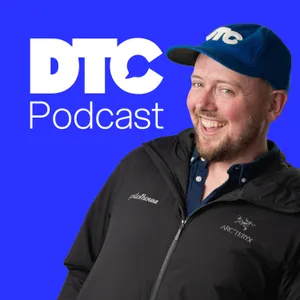
Free Daily Podcast Summary
The DTC Podcast: Daily Summaries Delivered
by Eric Dyck
What does it take to build and scale a successful direct-to-consumer brand? DTC Podcast, hosted by Eric Dyck, delivers practical e-commerce growth strategies from founders, operators, and marketing experts. Explore DTC marketing, customer acquisition, performance marketing, paid media, conversion rate optimization, customer retention, creative strategy, AI, and brand growth. Hear what works, what fails, and how leading consumer brands adapt and grow.
Latest Episodes
The most recent episodes — sign up to get AI-powered summaries of each one.
- 4 days ago41 min
The New Fundamentals of Brand Strategy (While Shipping Hundreds of Ads a Week), With Eugene Healey
Brand strategist Eugene Healey on DTC marketing at high creative volume: why creative is the new targeting, why brand books fail with creators, and how teams approve hundreds of ads a week.How do you keep a DTC brand coherent when you're shipping that much creative? Eugene says the fundamentals of brand still hold. The job around them has moved from controlling every campaign to orchestrating hundreds of pieces of creative the brand no longer controls.Eugene lectured in marketing and brand management at the University of Melbourne, runs a brand strategy studio, and is an equity partner in the brand tracking platform Tracksuit. On his second DTC Podcast appearance he tells Eric Dyck where brand strategy goes when media becomes the key variable, and how a team builds the judgment to approve work at volume.Eugene's live cohort course, The New Fundamentals of Brand, starts October 12. It runs seven weeks, with live sessions, studio groups of five or six people in your time zone, and interviews with brand leaders from Hinge and Nothing. Final-release seats are limited: https://thenewfundamentals.coGet the DTC Newsletter: https://directtoconsumer.coWHAT YOU WILL SOLVEYour team ships more creative than any approval chain can review. Eugene's model has senior people approve the overall pattern while juniors and mid-levels own the day-to-day sign-off.Your brand book can't govern creators, partners and communities. Why you hand third parties a suite of assets that can travel into their context, instead of 80 pages of logo rules.Your team still works strategy, then creative, then media. Creative has to be conceived inside its distribution, which is why on Meta the creative has become the targeting.All of your brand knowledge lives in one long-tenured person. How to spread that judgment across the team by debating why a piece does or doesn't feel right.AI is producing work nobody on the team has read. Tobi Lütke's "slop grenades," and why saving money on copy makes little sense when media costs more than it ever has.Your brand keeps trying to make memes. What Gap and the studio Invisible Dynamics did instead, bringing back music video culture with dance covers people remix on their own.Your positioning sits in the aspirational middle. What Everlane's sale to Shein says about brands whose promise is that tomorrow can be a little better than today.ABOUT EUGENEEugene Healey is a brand strategist and co-founder of The New Fundamentals of Brand, a seven-week live course for marketers and brand leaders. He previously lectured in marketing and brand management at the University of Melbourne and is an equity partner in Tracksuit. https://thenewfundamentals.coInstagram: https://www.instagram.com/eugbrandstrat00:00 Cold open: the funnel is now a tornado00:22 Two years of making content, and what changed01:51 Why he turned it into a course03:50 The central thesis: from control to orchestration04:50 Salience in the Andromeda era05:39 Creative is the new targeting06:56 Walter Cronkite and the creator model of trust08:51 Everlane, Shein and the death of the middle12:16 What happened to the analog revival15:23 Private social and the entertainment platforms17:26 Creative velocity and who approves the work19:39 Slop grenades and human discernment22:56 Can AI hold the brand's judgment?25:06 Hiring top screenwriters for UGC scripts25:45 Stop making memes and become the meme: Gap29:08 Tracksuit, queryable brand tracking and Hall30:17 Sydney Sweeney and why we let ourselves get rage baited34:54 Inside The New Fundamentals of Brand38:02 Seats, and where to sign up38:30 Wrap
- 1 weeks ago42 min
Black Friday Discount Strategy for DTC Brands Hooked on 30% Off | AKNF
How do you run Black Friday when your DTC brand is already hooked on discounts? Split your customers into new and repeat, keep the coupon-trained cohorts on their deal, and use the Black Friday offer to bring in new customers who have never seen your 30% off.On the second DTC Rundown, Eric Dyck is joined by Jordan Gordon, who leads email and retention at Pilothouse, and Rafael Gi, who works on partnerships and client strategy there. Each topic runs on a timer. They start with a brand that has run 30% off sitewide five times this year, move to why Meta keeps spending in the markets you have already saturated, and finish with the worst things Pilothouse finds when it audits a brand's email program.Get an audit from Pilothouse: https://pilothouse.coWHAT YOU WILL SOLVEYour customers only buy when there is a coupon. Jordan separates the coupon-addicted cohorts, keeps showing them their price through email, and controls the offers new customers see so they settle on a new normal.Your Black Friday offer is the same one you ran all year. Push it to 35%, or lead with an "up to" offer on a door buster that is not your most important product.You treat your discount as a flat rate. Rafael budgets discounts like media spend, with a goal for each offer, such as a one-day drop on your best seller to capture new customer emails.You give away margin in Q4 and get nothing back in January. Set an AOV threshold that earns a gift card customers can only redeem in Q5.Your early access list waits weeks for the deal. Give them the Black Friday offer the day they sign up, then use the flow to sell them on buying from you all year.Meta keeps spending where you are already strongest. In one Pilothouse audit of a nine-figure brand, two regions near where the company was founded held 8% of its addressable market, produced 40% of its revenue, and were being over-delivered by 20 to 30%.Every region carries the same ROAS target. Set targets by market maturity instead: higher efficiency in saturated markets, break even or a small loss in new ones, and something in between for markets that are emerging.Your email program is turned up to maximum. Jordan found one brand with 700 live flow messages sending up to four campaigns a day, and another using 30-day open attribution that credited email for sales driven by ads.You do not know what email earns on its own. A control group that only receives the first welcome email shows you the incremental revenue.Your SMS budget looks expensive. At one brand, email click-through sat at 0.09% while SMS reached 2.5%, and an SMS click cost 25 cents against roughly $1.30 for Meta and Google retargeting.The algorithm narrowed your brand to one message. How a testosterone supplement ended up with a site built around libido, and why the fix meant rebuilding creative, site and email together.Your pricing sits behind a quiz. At one subscription brand, only 3% of people who went through the quiz checked out.ABOUT THE GUESTSJordan Gordon leads email and retention at Pilothouse and hosts The World's Best Email and Retention Podcast. https://podcasts.apple.com/us/podcast/the-worlds-best-email-and-retention-podcast/id1772940578Rafael Gi works on partnerships and client strategy at Pilothouse, a performance marketing agency. https://pilothouse.coSTAY CONNECTEDDTC Newsletter, daily ecommerce marketing and ecommerce growth tactics: https://directtoconsumer.coYouTube: https://youtube.com/@dtcnewsletterLinkedIn: https://linkedin.com/company/directtoconsumerWant to be on the Rundown? Email eric@directtoconsumer.co00:26 Raf's hamstring and Jordan's white belts04:49 Budget your discounts like media spend07:15 Do bundles and gifts with purchase fix it16:06 How a market matures27:16 The supplement the algorithm turned into a libido brand33:08 The subject line typo the investors saw34:20 Budweiser Red Light and the Bud Light UFC promo37:36 The $10,000 retreat ticket paid in Bitcoin
- 1 weeks ago39 min
How to Test Connected TV for a DTC Brand: $20K a Month for 60 Days | Harness the Halo 4/6
Carve Designs gave connected TV 60 days at a $20K monthly minimum before deciding it worked, which is about as clean a test as a DTC brand runs on a new channel. The lift showed up first in direct traffic and search, and conversion rates rose across channels for customers who had seen the ads.Hannah Fleming runs performance marketing at Carve Designs, the coastal apparel brand that grew out of swim. She joins Eric Dyck and Jesse Math of Keen Decision Systems to walk through the bets that take months to pay back: direct mail, connected TV, TikTok and whitelisted ads, plus the Pinterest test that never worked. You walk away knowing how to size a first test, where to look for the halo, and how long to wait before you cut a channel.Get the DTC Newsletter: https://directtoconsumer.coWHAT YOU WILL SOLVEYour direct mail gets credit for every buyer on the mailing list. Jesse's question is how many of them would have bought anyway. Carve answers it with holdout panels, including tests that also suppress email and paid social for the held-out group.You can't tell whether to mail more. Carve tracks contribution per piece, tests catalog count, page count and size, and reweights audiences between 0 to 12 month and 13 to 24 month buyers.Your average ROI says spend more. Jesse's example: a $2 return on $1 million tells you nothing about the next dollar, because the first dollars into a channel return more than the last ones.Your other channels swing around the catalog drop. Carve plans spend in every other channel around catalog in-home dates.You don't know what a first connected TV test costs. Carve ran 60 days at a $20K monthly minimum, with a fixed window, set objectives and targets, and landed on target or slightly ahead of it.You can't find where connected TV sales land. At Carve they land mostly on the site as direct traffic, with a small portion on Amazon, and GA4 shows higher conversion rates for customers who saw a CTV ad and then clicked an email or a paid social ad.Your CTV attribution looks too good. Jesse sees brands arrive with platform numbers their CFO doesn't believe. The question to ask is whether you are buying new customers or buying inventory your existing customers already watch.You judge upper funnel on a 14 or 30 day window. For brands buying CTV for awareness, Jesse says Keen sees roughly 30% of the measured impact in the short term and roughly 70% over time.You're about to kill a channel at month three. TikTok took Carve about six months to gain momentum, and whitelisted ads took close to 18 months before they became a top performer.You treat every test as a pass or a fail. Jesse's alternative is to find the 30% that worked, pare back the rest, and keep going.ABOUT THE GUESTSHannah Fleming is Performance Marketing Director at Carve Designs. Shop the collection or request a catalog at https://carvedesigns.comJesse Math is VP of Strategic Partnerships at Keen Decision Systems, the marketing mix modeling, planning and forecasting platform. https://keends.comHARNESS THE HALOHarness the Halo is a six-part series from DTC and Keen about the spend that doesn't pay you back the same day, and the measurement that gives you room to make it. This is episode 4 of 6, and a new episode drops every other week.STAY CONNECTEDDTC Newsletter, daily ecommerce marketing and ecommerce growth tactics: https://directtoconsumer.coYouTube: https://youtube.com/@dtcnewsletterLinkedIn: https://linkedin.com/company/directtoconsumerSPONSORHarness the Halo is presented by Keen Decision Systems. Keen measures the incremental impact of every channel on sales, revenue and profit, and forecasts how a channel will perform before you spend in it. https://keends.com
- 1 weeks ago48 min
How Terra Kaffe Pre-Sold 10,000 Espresso Machines With No Reviews
How do you grow a DTC brand without a big brand awareness budget? Terra Kaffe founder Sahand Dilmaghani pre-sold 10,000 espresso machines from a single page with no reviews, and word of mouth has been the top reason customers buy every month for five years.On the DTC Podcast, Sahand tells Eric Dyck how he left investment banking to bootstrap a super automatic espresso machine, what he cut to get it shipped with $2.5 million already spent, and why Terra Kaffe now puts its money into community and performance marketing instead of brand awareness. Terra Kaffe has 70,000 machines in homes today.Get the DTC Newsletter: https://directtoconsumer.coWHAT YOU WILL SOLVEYou sell a high-ticket product and cannot seed it to a thousand creators a month. Sahand built word of mouth by calling customers himself, and it now drives well over a third of Terra Kaffe's orders.Your brand awareness budget is too small to register. Why $15K to $20K a month will never make you a household name, and when to hold that money for one campaign big enough to count.Your best video flopped on Meta. A $30K shoot that never converted on Instagram or Facebook became one of Terra Kaffe's strongest performers on CTV.Your investors want proof of demand before the product is finished. One pre-order page, a teaser campaign, an email to the subscriber list and a booth at a New York coffee festival produced 10,000 orders.Your product is over budget and behind schedule. The features Terra Kaffe cut in a do-or-die meeting to ship in six months, and which ones came back later as a fast follow.Your outside partner has spent double to go half the distance. How Sahand replaced his engineering firm mid-build while it still held most of the product knowledge.You cannot afford tooling or a production deposit. The trade he made with his manufacturer on the first machine's design rights, and what it cost him later.ABOUT SAHANDSahand Dilmaghani is the founder and CEO of Terra Kaffe, the Brooklyn-based maker of super automatic espresso machines, including the TK-02 and the Demi. Before Terra Kaffe he worked in investment banking and at an electric vehicle startup. https://www.terrakaffe.comInstagram: https://www.instagram.com/terrakaffeSTAY CONNECTEDDTC Newsletter, daily ecommerce marketing and ecommerce growth tactics: https://directtoconsumer.coYouTube: https://youtube.com/@dtcnewsletterLinkedIn: https://linkedin.com/company/directtoconsumer00:49 From Wall Street banker to "barista"02:25 Carrying a 30 pound espresso machine on the subway04:40 The only espresso brand anyone could name05:22 The Larry David campaign idea06:13 Building complex hardware during COVID08:52 $2.5 million in, with no guarantee it ships09:09 Funding one milestone at a time10:42 The meeting where the features got cut13:36 Replacing the engineering firm mid-build16:33 Giving the manufacturer the V1 design rights20:44 Answering the dropship accusations21:32 The investor test: does anyone want this23:22 10,000 pre-orders from one page25:11 The Terra Kaffe manifesto26:16 What a super automatic machine does29:39 Why people bought before they could try it32:33 70,000 machines in homes33:25 Word of mouth, every month for five years36:28 Brand spend versus performance marketing38:23 The three problems every operator hits40:39 Why a small brand awareness budget is a trap41:15 Coming for Nespresso42:37 CTV and the $30K shoot that flopped on Meta46:34 Survival by a thousand band-aids47:34 Raising $2.6 million in 13 days48:03 You are going to get punched in the face
- 2 weeks ago31 min
Meta Partnership Ads Now Make Up 30 to 50% of the Ads on Our Biggest Accounts
What are Meta partnership ads, and how should a DTC brand test them before Q4? They run through a creator's handle with your brand tagged, so Meta combines both accounts' engagement signals, and Pilothouse typically sees lower CPMs on them than on ads from the brand handle alone.Jacob Geary runs Meta accounts at Pilothouse and joins Eric Dyck on All Killer No Filler to lay out how partnership ads work in practice. On the larger accounts his team runs, 30 to 50% of the ads now go out as partnership ads, and most of the creators behind them are micro-creators. You walk away with a test plan for a brand spending $50K to $100K a month on Meta: the budget, the number of creators, the formats to brief, and the metrics that decide what scales.Get the DTC Newsletter: https://directtoconsumer.coWHAT YOU WILL SOLVEYour customers have seen your brand ads so often they scroll past them. The same message from a creator's handle, with your brand tagged, gives them a fresh face and tends to deliver at a lower CPM.You don't know where to find creators. The Partnership Ads Hub inside Meta suggests creators in your vertical, surfaces people already posting about you, and hands you the ad code once both sides approve.You don't know what to brief. Jacob's starting formats are "why I switched" problem and solution videos, holiday gift guides, and raw unboxings shot on a phone.You don't know what to pay. Jacob's range is $100 to $300 per creator for a few videos and 60 days of usage, and some creators will take the exposure from your ad spend without a fee.You assume you need big names. Micro-creators make up 80 to 90% of what Pilothouse runs, with performance Jacob describes as very similar and a faster testing cadence.Your Q4 creator ads die the day the sale ends. Brief creators three to four weeks ahead and have them mention the sale in general terms instead of reading out a discount and a date.You don't know how big the first test should be. At $100K a month on Meta, Jacob puts 10% toward three to five creators with one or two videos each, then builds toward 20% by month three.You're not sure how to judge the results. Use the same purchase conversion rate and ROAS benchmarks as any new creative test, with a little more patience in month one.ABOUT JACOBJacob Geary is a Meta media buyer at Pilothouse, the performance marketing team behind DTC, where he runs paid social for ecommerce brands. To talk partnership ads with his team, go to https://pilothouse.co and ask for Jacob.STAY CONNECTEDDTC Newsletter, daily ecommerce marketing and ecommerce growth tactics: https://directtoconsumer.coYouTube: https://youtube.com/@dtcnewsletterLinkedIn: https://linkedin.com/company/directtoconsumer00:49 Intro: Jacob from Pilothouse on Meta partnership ads01:28 What partnership ads are, versus whitelisting and dark posts02:53 The Partnership Ads Hub as a creator discovery network03:53 Why they matter: combined signals and ad blindness05:17 Are partnership ads incremental?06:30 Why partnership ads get cheaper CPMs07:34 Fresh looks, Andromeda and ad sequencing08:59 Formats that work: why I switched, gift guides, unboxings10:30 Gifting angles for each creator's audience11:24 Usage rights and how creators get paid12:10 Deal structures: affiliate, paid per video, or free13:32 Planning creator volume for Q415:40 Briefing sale language that won't expire16:12 What share of Meta ads run as partnership ads17:37 Test budgets for brands just starting out19:38 Micro-creators versus mega-influencers21:17 Post-click: when a dedicated landing page earns the build22:06 Creator communities and leaderboards23:06 Setup steps, and why to get permissions before November25:11 A test plan for a $5M brand spending $50K to $100K a month27:58 The metrics that decide a winner29:43 Close and how to reach Jacob
- 2 weeks ago43 min
Raising Prices in DTC: How Last Crumb Sells a $140 Cookie Box
How do you raise prices on a DTC brand without killing demand?Derek Jaeger founded Last Crumb in 2020, priced a box of cookies at $110, then moved it to $140. He says that is when the company took off. Eric Dyck gets the full DTC marketing story on the DTC Podcast: pricing as positioning, ecommerce growth without a repeat purchase, and why he killed the weekly drop model that made the brand famous.Get the DTC Newsletter: directtoconsumer.coGet your brand on TV today: https://www.universalads.com/dtcpromocode?utm_medium=email&utm_source=dtc-newsletter&utm_campaign=issue-takeoverWHAT THIS EPISODE SOLVESYour premium product is not moving and you are about to discount it. Derek tested upward instead. At $110 Last Crumb was fine, at $140 it had a differentiator, and the drops started selling out in one second.You cannot hold a high price on packaging alone. He built the box as shipper and gift box in one, tested the angle each cookie sits at, and landed on 35 degrees with 90% of the lettering visible on open.Scarcity launched you and has become your ceiling. Why a drop model cannot stay a value pillar forever, and how moving to evergreen was the test of whether he had a real company or a hype company.Your customer acquisition cost will not clear on a single order. No subscription, no natural repeat, and a product that mostly gets gifted. What carried ecommerce growth when paid could not.You are paying creators for content that does not perform. Last Crumb briefs nobody. They watch for organic posts that already work, whitelist those, and run the same asset on Instagram and YouTube. One repurposed video pulled 300,000 views.You lose control of the product the moment it ships. The last seventy two hours in a UPS truck, and why owned retail at $8.50 a cookie fixed what ecommerce marketing could not.ABOUT THE GUESTDerek Jaeger is the founder of Last Crumb, the luxury cookie brand he started in Los Angeles in 2020 and has since moved to New York, with production in Brooklyn and its first store in Williamsburg. He still writes every recipe himself. lastcrumb.comSTAY CONNECTEDNewsletter: directtoconsumer.coRECORDING TIME | CHAPTER00:00 Two ex-affiliates sitting down01:18 The affiliate years, penny clicks and dollar CPMs02:44 Walking away from performance marketing03:33 A year of brand building before a single box shipped04:38 The brief: the opposite of every mom and pop bakery05:47 Pricing as position one06:53 The box, the pull tab, and the 35 degree cookie angle08:45 Liquid Death on the vision board10:01 The Monday noon drop model11:28 Why he banned paid ads at launch12:35 Fifty boxes in LA, and the move from $110 to $14014:01 Chrissy Teigen posts and it goes ballistic15:15 People posting receipts before the box arrives16:43 Sifting flour in the original kitchen17:26 Investors show up, and 1,500 orders left in carts19:16 Building the cap table20:22 Where the first money went21:18 Killing the drop model22:26 Why paid media does not scale on a gifting brand23:34 The company today, 16,000 square feet in Brooklyn24:20 Why he has never been CEO25:58 Managing the operator you hire27:20 Building a smaller pack for TikTok Shop28:53 The last 72 hours you cannot control30:38 A unique dough for every flavor31:59 What he kept from affiliate marketing33:09 Moving the company to New York35:17 Retail pricing and the Levain comparison36:52 Retail as top of funnel38:33 Whitelisting organic creator content39:59 Product as the reason any of it worked41:56 Where the brand goes next43:01 The Crumbl lesson45:40 Why GLP-1s might help a premium cookie brandhttps://directtoconsumer.typeform.com/DTC-Brand?utm_source=podcast-648&utm_medium=podcast
- 3 weeks ago25 min
Google Ads Brand Keywords: Cut 80% of Brand Spend, Buy New Customers Instead
How much of your Google Ads budget goes to your own brand name? Most DTC marketing teams cannot answer that, and the brands defending an ambiguous brand term are paying for customer acquisition they already had. Wildflower Cases is spending the large majority of roughly $3,500 a month on the single term "wildflower," according to SEMrush.Pilothouse Senior Google Media Buyer Zav audits that account with Eric Dyck on the DTC Podcast. Brand clicks at twelve to fifteen cents, a 21,000 subscriber YouTube library with no connection to the ad account, and a word that belongs to Tom Petty, Billie Eilish, a 2022 film and every florist in the country. You walk away knowing your own brand versus generic split and what to move the money into.Get the DTC Newsletter: https://directtoconsumer.coWHAT YOU WILL SOLVEYour brand keyword is cheap and converts well, so you cannot tell if it is working. Zav explains the account math that makes a brand campaign look like your best performer.You do not know your brand versus generic split. There is a ten minute check in the search terms report, and a percentage to keep it under.Your budget is fixed and nobody will raise it. Zav reallocates $3,500 a month on air with no increase.Your ROAS will fall when you cut brand spend and somebody will ask why. He gives you that answer before you need it.Your collab partners drive search demand you are not bidding on. Charli XCX and Slushy Noobz fans are already looking.Your generic ads all land on the homepage. Specific query, specific collection page.You have a YouTube library doing nothing for paid. Performance Max and Demand Gen take those videos as they are.ABOUT ZAVZav is a Senior Google Media Buyer at Pilothouse, the performance marketing team behind DTC, where he runs paid search and shopping for ecommerce brands. He wrote the Wildflower Cases search breakdown for the DTC Newsletter. If you want his team to look at your account, go to https://pilothouse.co and ask for Zav.STAY CONNECTEDDTC Newsletter, daily ecommerce marketing and ecommerce growth tactics: https://directtoconsumer.coYouTube: https://youtube.com/@dtcnewsletterLinkedIn: https://linkedin.com/company/directtoconsumer00:00 Who Zav is and what he does at Pilothouse00:47 Why Wildflower Cases became the case study01:17 A brand name that means five other things02:21 Tom Petty, Billie Eilish, and a 2022 movie03:54 Searching "cool iPhone 17 case" live on air04:49 Why their sponsored result sits at the bottom of the page05:22 What decides where your ad places06:46 The case for reallocating a $3,500 monthly budget07:20 Where the money goes instead: shopping plus generic search08:40 Landing pages, and why every ad points at the homepage08:56 Turning collab partners into keyword coverage10:34 The "are they worth it" searches Reddit owns12:23 A 21,000 subscriber YouTube channel with no link to the ad account12:39 Feeding existing video into Performance Max and Demand Gen13:59 24 hours, no extra budget, what changes first14:29 Cutting 80% of the brand spend15:42 Why ROAS falls and revenue rises16:53 The one situation where brand defense earns its budget17:57 The metric agencies over report to clients18:56 Whether $3,500 a month is enough for a brand this size20:19 The brand versus generic diagnostic to run this week20:35 The 20% rule of thumb22:31 What to monitor after you make the cut23:26 How to get Pilothouse to look at your accounthttps://directtoconsumer.typeform.com/DTC-Brand?utm_source=podcast-647&utm_medium=podcast
- 3 weeks ago26 min
Under $50M: Half the Trade Budget Goes to Retail Media | Harness the Halo 3/6
To Subscribe to DTC Newsletter - https://dtcnews.link/signupA brand doing under $50 million a year is putting roughly half of its combined retail media, trade, and shopper marketing budget into retail media. At larger companies that share drops toward 30, 20, then 15 percent. Mike Chiasson works on Keen's models, which cover $45 billion in marketing investment, and his read on where that money comes from is the part worth sitting with. It is mostly net new, sourced out of trade rather than pulled from Meta and Google, which is why so much of it sits with sales teams and never gets measured the way media does.If you run growth at a brand moving into retail: this is the episode about what the retail media line in your budget is actually buying, and which part of it is buying customers you already had.If you own the media budget: Chiasson makes the case that the untapped return in retail media is upper funnel, inside retailers where almost everyone is still only buying search.What he gets into:Where the money comes from, and why trade budgets rather than media budgets explain retail media's growthThe benchmark: about half the retail media, trade, and shopper marketing bucket at brands under $50M, versus 15 to 30 percent at large onesWhy small brands with a narrow distribution footprint default to bottom-funnel search, and what that costs themThe Amazon question: whether retail media spend compounds on a retailer's algorithm the way it does on a listing, and why brick and mortar has no real equivalentRetail media ads that carry no visible association with the retailer at all, and why targeting is the actual productWalmart, Vizio, and streaming video as the moment upper-funnel retail media became buyableRetail media social, which he calls very small and rapidly growing, with returns he thinks reflect how early the curve isThe two flaws in ROAS, and why the return on your next dollar is the only version of the number that helps you planBayesian priors, and how Keen gives a brand a response curve for a retailer it has never advertised withPatience as a budgeting problem rather than a virtue, and why cash-strapped brands structurally cannot buy upper funnelWho this is for: operators whose product is landing on shelves in more places every quarter, and whose retail media invoices are growing faster than their ability to explain them.What to steal: find out which budget your retail media is actually coming from. If it is trade, the people approving it are measuring a retailer relationship and the people spending it are measuring sales. Those are different jobs and almost nobody has reconciled them.Harness the Halo is a six-part series from DTC and Keen about the spend that doesn't pay you back the same day, and the measurement that gives you room to make it. Episode 1 was the market read. Episode 2 was the first brand. This one maps the fastest-growing line in the budget.Timestamps:00:00 Why retail media is becoming a major growth channel04:00 Where retail media investment is growing08:00 Why retail media ROI is outperforming other tactics13:00 The upper-funnel opportunity in retail media17:00 Why marginal ROI matters more than ROASSubscribe to DTC Newsletter - https://dtcnews.link/signupAdvertise on DTC - https://dtcnews.link/advertiseWork with Pilothouse - https://dtcnews.link/pilothouseFollow us on Instagram & Twitter - @dtcnewsletterWatch this interview on YouTube - https://dtcnews.link/video
Get The DTC Podcast summaries in your inbox
Free AI-powered daily recaps. Key takeaways, quotes, and mentions — in a 5-minute read.
Get Free Summaries →Free forever for up to 3 podcasts. No credit card required.
You Might Also Like
Listeners also like.
eCommerce Fastlane: Shopify Growth Strategies—Where AI Efficiency Meets Human Connection
A Shopify-focused podcast offering growth strategies from a founder and former Merchant Success Manager.
Perpetual Traffic
A weekly podcast covering paid advertising strategies, campaign optimization, and performance marketing for business owners and marketers.

Growth Triggers: Content Marketing & AI
A marketing podcast teaching business owners how to use podcasting to generate leads, sales, and authority across competitive niches.
MarTech Podcast // Marketing + Technology = Business Growth
Marketers share how they use technology to solve challenges and drive business growth in real-world roles.

Everyone Hates Marketers | No-BS Marketing & Brand Strategy Podcast
A marketing podcast offering practical insights on branding, strategy, and customer research from industry professionals.
Marketing Made Simple
Strategies for crafting clear marketing messages that connect with customers and grow businesses.
Proof to Product
A weekly podcast offering practical strategies for makers and physical product sellers to grow their business and scale sustainably.

The Vault Unlocked
Founders share hard-earned lessons on what actually worked, what failed, and the pivotal decisions behind growing successful companies.
Right About Now - Legendary Business Advice
Raw business insights from founders and industry leaders, revealing real wins, failures, and actionable strategies without the fluff.

The Best SEO Podcast
A practical guide to SEO in the age of AI, focusing on real-world strategies that work and insights from experienced marketers.
Omni Talk Retail
A retail industry podcast offering news, analysis, and commentary on e-commerce, technology, marketing, and consumer behavior.
The Entrepreneur DNA
Entrepreneurs share lessons on building businesses and personal growth through real experiences and mistakes.
About The DTC Podcast
What does it take to build and scale a successful direct-to-consumer brand? DTC Podcast, hosted by Eric Dyck, delivers practical e-commerce growth strategies from founders, operators, and marketing experts. Explore DTC marketing, customer acquisition, performance marketing, paid media, conversion rate optimization, customer retention, creative strategy, AI, and brand growth. Hear what works, what fails, and how leading consumer brands adapt and grow.
Customized Recaps
AI-powered recaps with compact key takeaways, quotes, and insights.
Straight to Your Inbox
Get key takeaways from The DTC Podcast in a 5-minute read.
Save Hours Every Week
Stay current on your favorite podcasts without falling behind.
Frequently Asked Questions
What is Podzilla's The DTC Podcast daily summary?
It's a free AI-powered email that summarizes new episodes of The DTC Podcast as soon as they're published. You get the key takeaways, notable quotes, and links & mentions — all in a quick read.
How does the The DTC Podcast podcast summary work?
When a new episode drops, our AI transcribes and analyzes it, then generates a personalized summary tailored to your interests and profession. It's delivered to your inbox every morning.
Is this an official The DTC Podcast product?
No. Podzilla is an independent service that summarizes publicly available podcast content. We're not affiliated with or endorsed by Eric Dyck.
Can I get summaries of other podcasts too?
Absolutely! The free plan covers up to 3 podcasts. Upgrade to Pro for 15, or Premium for 50. Browse our full catalog at /podcasts.
How often does The DTC Podcast release new episodes?
The DTC Podcast publishes every few days. Our AI generates a summary within hours of each new episode.
What topics does The DTC Podcast cover?
The DTC Podcast covers topics including Business, Marketing. Our AI identifies the specific themes in each episode and highlights what matters most to you.
Start getting The DTC Podcast summaries tomorrow morning.
Free forever for up to 3 podcasts. No credit card required.
Free forever for up to 3 podcasts. No credit card required.