Free Daily Podcast Summary
The Field Guide to Particle Physics: Daily Summaries Delivered
by Sean Downes
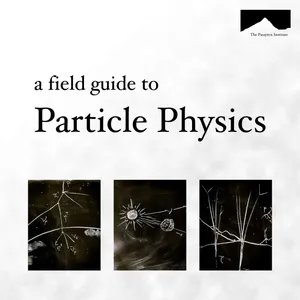
This is your informal guide to the subatomic ecosystem we’re all immersed in. In this series, we explore the taxa of particle species and how they interact with one another. Our aim is give us all a better foundation for understanding our place in the universe. The guide starts with a host of different particle species. We’ll talk about their masses, charges and interactions with other particles. We’ll talk about how they are created, how they decay, and what other particles they might be made of.
Latest Episodes
The most recent episodes — sign up to get AI-powered summaries of each one.
- Dec 7, 202213 min
The Reason for Antiparticles
The Reason for Antiparticles.The Field Guide to Particle Physics : Season 3. Episode 8.https://pasayten.org/the-field-guide-to-particle-physics©2022 The Pasayten Institute cc by-sa-4.0The eBookThe Field Guide to Particle Physics eBook is now available! If you're looking to support the show, we've got some fun options for you here, or you could buy us a coffee!ReferencesThe definitive resource for all data in particle physics is the Particle Data Group: https://pdg.lbl.gov. This episode also pays tribute to Richard Feynman’s 1986 Memorial Dirac Lecture.Terrell-Penrose rotation can be viewed from a human perspective in at "A Slower Speed of Light" by MIT's GameLab. That demo also includes the relativistic doppler effect. Some other great videos by Ute Kraus and Corvin Zahn at spacetimetravel.org. See in particular their dice demo.The Reason for Antiparticles.Antimatter is uncommon, but it’s not exactly rare. Antiparticles - especially those generated by cosmic radiation - are all around us, all the time. But just what is it doing here?Antimatter is just like MatterIn a lot of ways, antimatter behaves just like matter does. Quarks make up protons? Antiquarks make up antiprotons… and antineutrons, too!Antiprotons and antielectrons - that is, positrons - combine to form antihydrogen atoms.The Antihydrogen Laser PHysics Apparatus - the ALPHA Experiment at CERN - studies the spectroscopic properties of antihydrogen. That is, it uses photons to give a little extra energy boost to those positrons. As those positrons relax to their ground state, they emit distinct wavelengths of light.Just like regular hydrogen atoms.Photons, you see, are their own antiparticles. They interact with matter and antimatter in precisely the same way.If there were any difference between hydrogen and antihydrogen - any difference in mass, spin or the magnitude of their electric charge - those wavelengths of emitted light would also be different. And the ALPHA experiment would be able to detect those differences.But no such differences have been observed.So again, what exactly is antimatter doing here in our physical reality?Antimatter annihilates MatterThe one thing antimatter does *not* do is hang around.Antimatter annihilates with ordinary matter. Electrons and positrons annihilate to form a pair of gamma rays, a pair of photons.If the universe were balanced between matter and antimatter, we wouldn’t be here. Or… perhaps worse… we’d rapidly disintegrate into a bursts of gamma radiation as our particles and those antiparticle partners annihilated.So if antimatter is so uncommon - why is it even here? What is the point, the reason for antimatter? Why does the universe need antimatter?To understand that, we need to talk about time travel.The Light ConeOur reality has four dimensions. Three space and one time. Famously, Einstein’s special theory of relativity tell us that these four dimensions are related.That relationship is nature’s conspiracy to make sure that nothing travels faster than the speed of light.One way to think about how this works is time travel. Literally traveling through time. When we are still, we are traveling forward, through time. When we spring up to go for a run, we’re still traveling through time, but we *rotate* our perceived motion through time into space. This is a four-dimensional sort of rotation. Sometimes this is called a Terrell rotation. There are some stunning visualizations of Terrell rotation linked in the show notes.The amount of Terrell rotation varies without speed. In a sense, we exchange some of our speed in the time direction to travel through space. The faster we go through space, the slower we go through time. There is a limit to this kind of rotation. We cannot rotate our motion so deep into space that we travel backwards in time. The most we can do is cause time to stand almost still, which happens when we travel just shy of the speed of light.<p
- Nov 4, 202215 min
Bonus : The Perils of Science Communication
Update! Best place to find associated references are linked in our substack essay:This is an essay that we originally posted on our substack page:https://pasayteninstitute.substack.com/p/the-perils-of-science-communicationA Bonus Episode for The Field Guide to Particle Physics : Season 3https://pasayten.org/the-field-guide-to-particle-physics©2022 The Pasayten Institute cc by-sa-4.0The definitive resource for all data in particle physics is the Particle Data Group: https://pdg.lbl.gov.The Pasayten Institute is on a mission to build and share physics knowledge, without barriers! Get in touch.A History LessonIn the film “Einstein’s Big Idea”, French Scientist Antoine Lavoisier is portrayed just as he discovers how to split water into oxygen and hydrogen gas, thereby realizing the conservation of mass in chemical reactions.Lavoisier is generally credited with disproving the phlogiston theory of combustion and reframing Chemistry as a quantitive science.This shift from the qualitative is emphasized in a specific scene where Lavoisier meets with an excited young man who is pitching his apparatus for observing heat. Lavoisier assertively dresses down the man for failing to meet the modern, quantitative standards of scientific experiment.This man is later revealed to be a revolutionary, and Lavoisier’s final act of the film ends with an escort to the guillotine.While dramatized, the message was clear:Science needs popular support, and clear communication is not enough. We need to do more than educate. We need to build community with inspiration, excitement and respect for Science. We also need to share with folks how Science works1.Respect for Science is a value we share as Scientists. But it’s not universal. Whether or not Science is morally entitled to respect is irrelevant. Without constantly striving to earn and refresh that respect from Society, it can be lost.The Siren Call of the OutsiderScience Communication is a rapidly professionalizing field that encompasses a spectrum from dynamic professional speakers to university department media managers to science-minded journalists. From journalists like Natalie Wolchover, to Professors like Tatiana Eurikhamova, there’s a lot of great work being done by people I admire.The line between #SciComm and marketing is extremely thin, and unfortunately, the internet’s content treadmill incentives their confluence.Journals and university departments alike publish heroic press-releases about recently accepted scientific publications by department staff as if they were breakthrough results. But more often than not, these results are merely slow, incremental progress.How is anyone but a specialist supposed to understand the difference?The SciComm ecosystem, in other words, is full of noise. Especially for the general audience.Cutting through that noise is tough. But content editors have had a tool for this as long as humans have printed newspapers: headlines.Here’s a recent one:“No one in physics dares say so, but the race to invent new particles is pointless.In private, many physicists admit they do not believe the particles they are paid to search for exist – they do it because their colleagues are doing it”Sabine Hossenfelder - the Guardian Opinion (26 Sept 2022)As a lead generator, this headline and its subtitle are incredible. Given the current intellectual climate around distrusting experts, it hits all the high points: All these experts
- Sep 27, 20229 min
Bonus : The Physics of Muon Colliders
The rest of season three is still under development! We wanted to improve the clarity before publishing. Parity violation just isn't that easy to talk about! In the mean time, here is the second episode in a short bonus series about the state and future contemporary particle physics. I hope you enjoy it!This is an essay that we originally posted on our substack page:https://pasayteninstitute.substack.com/p/the-physics-of-muon-collidersThis is a follow up to our 4 Reasons to Build a New Particle ColliderYou can also get the bumper sticker version here!A Bonus Episode for The Field Guide to Particle Physics : Season 3https://pasayten.org/the-field-guide-to-particle-physics©2022 The Pasayten Institute cc by-sa-4.0The definitive resource for all data in particle physics is the Particle Data Group: https://pdg.lbl.gov.The Pasayten Institute is on a mission to build and share physics knowledge, without barriers! Get in touch.
- Sep 22, 20229 min
Bonus: We should build a muon collider.
The rest of season three is still under development! We wanted to improve the clarity before publishing. Parity violation just isn't that easy to talk about! In the mean time, here is the second episode in a short bonus series about the state and future contemporary particle physics. I hope you enjoy it!This is an essay that we originally posted on our substack page:https://pasayteninstitute.substack.com/p/we-should-build-a-muon-colliderFour Reasons we should build a new particle collider:1. We still have more science to do!2. Technology transfer to Medicine and Industry3. Institutional memory is valuable4. Even more science comes with it!Share these reasons with someone, especially if they doubt the need for more Scientific funding!You can also get the bumper sticker version here!A Bonus Episode for The Field Guide to Particle Physics : Season 3https://pasayten.org/the-field-guide-to-particle-physics©2022 The Pasayten Institute cc by-sa-4.0The definitive resource for all data in particle physics is the Particle Data Group: https://pdg.lbl.gov.The Pasayten Institute is on a mission to build and share physics knowledge, without barriers! Get in touch.
- Sep 20, 202218 min
Bonus : Do we really need new particle physics?
The rest of season three is still under development! We wanted to improve the clarity before publishing. Sphalerons just aren't easy to talk about! In the mean time, here is the first in a short bonus series about the state and future contemporary particle physics. I hope you enjoy it!This is an essay that we originally posted on our substack page:https://pasayteninstitute.substack.com/p/do-we-really-need-new-particle-physicsA Bonus Episode for The Field Guide to Particle Physics : Season 3https://pasayten.org/the-field-guide-to-particle-physics©2022 The Pasayten Institute cc by-sa-4.0The definitive resource for all data in particle physics is the Particle Data Group: https://pdg.lbl.gov.The Pasayten Institute is on a mission to build and share physics knowledge, without barriers! Get in touch.
- Sep 5, 202213 min
The Positron Excess
The Field Guide to Particle Physics : Season 3https://pasayten.org/the-field-guide-to-particle-physics©2022 The Pasayten Institute cc by-sa-4.0The definitive resource for all data in particle physics is the Particle Data Group: https://pdg.lbl.gov.The Pasayten Institute is on a mission to build and share physics knowledge, without barriers! Get in touch.The Positron ExcessSpace is not a safe place. Matter and energy take on a totally different form than is familiar from our planetary lifestyle. Radiation is everywhere, and with it we find high energy particles flying all over the place. One of the biggest challenges in a voyage to Mars is shielding the travelers from all that radiation. Our magnetosphere and atmosphere do an outstanding job of filtering out the most of the high energy particles flying at us from all directions.Many energetic particles come from the sun. Fast moving protons and electrons that boil off our friendly plasma ball get trapped in the van Allen belts of our earth’s magnetic field. Way above the atmosphere, we can see them sometimes as the Aurora.Other energetic particles come to us from inside the Milky Way galaxy. Exploding stars, neutron stars and other monsterous astrophysical objects can shed or accelerate their own high energy particles. Often these particles have more energy than those put off by the sun, but it’s the same story: A lot of protons, a few electrons, and also some heavier nuclei: like alpha particles. Much less often, we see cosmic rays made up of even bigger things, like the nuclei of Carbon, Silicon or even Iron!Some particles come from outside our galaxy. These can sometimes have outrageously high velocities, and are observed as miles-wide particle showers by large, ground based detector arrays. They aren't common. One of the biggest of these was observed by the Fly’s Eye camera back in 1991. It had over 50 J of energy packed into a single particle - probably a proton. That’s about the same kinetic energy as baseball being thrown around… in a single particle.Fast moving high energy particles - the ones flying in from outside our solar system - are typically called Cosmic Rays. A tiny fraction of these Cosmic Rays are actually antimatter. Antiprotons and positrons, specifically. Understanding where all these cosmic rays come from is an important scientific question in its own right, but understanding where the antimatter comes from - and how much of it there is - has been a truly fascinating question. Especially of late.Where does the cosmic antimatter come from?The ratio of matter to antimatter in Cosmic Rays is small, and varies with particle speed. Typical numbers are 1 or 2 antiprotons for every ten thousand protons. The ratio of positrons to electrons is higher, closer to a few parts in a hundred. One thing we haven't seen? Bigger antiparticles. No antideutrons or antialpha particles have been observed - at all - let alone bigger antinuclei. But of course, we see big nuclei in Cosmic Rays all the time.Because Cosmic Rays come from other parts of the galaxy - or even outside of it - these ratios are basically consistent with our typical assumption that all observed antimatter is secondary. It is created - in other words - through collisions or decay of so-called “normal” matter.Really fast Cosmic Rays occasionally interact with other particles in our galaxy: the tiny, sparse bits of gas and dust in the large voids between stars, sometimes called the interstellar medium. Those collisions often generate more particles, and just like in our own atmosphere, antiparticles are part of that collision debris.Just like the proton and the electron, to the best of our knowledge, the antiproton and the positron are stable particles. So unless they annihilate, these particles of antimatter just hang around. The collective effect of all these Cosmic Rays bounding around our galaxy is a very small - but measurable - population of antiprotons and positrons flying at us as secondary cosmic rays.If we were to assume th
- Aug 16, 202211 min
The Antineutrino
The Field Guide to Particle Physics : Season 3https://pasayten.org/the-field-guide-to-particle-physics©2022 The Pasayten Institute cc by-sa-4.0The definitive resource for all data in particle physics is the Particle Data Group: https://pdg.lbl.gov.Also check out the links embedded this description. Or also check out those same links at:https://pasayten.org/the-field-guide-to-particle-physics/antineutrinoThe Pasayten Institute is on a mission to build and share physics knowledge, without barriers! Get in touch.The AntineutrinoThe neutrino is a curious particle. As fundamental as the electron or the muon, but rarely interact with other particles. This makes the study of these neutrini quite challenging. But also quite interesting.Are there antineutrini? Yes, surely. But, a better question is what are antineutrini?Antiparticles with an electric charge are easier to identify. Positrons and electrons have opposite charges and behave oppositely in most respects. Photons and neutral pions do not have any electric charge. They are their own antiparticle partners! But this isn’t always the case with neutral particles. As we have antineutrons and two distinct kinds of neutral kaons: the K0 and K0bar which are antiparticles of each other.Neutrini - those smallest of massive matter particles in the Standard Model - are electrically neutral. So it is natural to ask: are they their own antiparticle? Or are there distinct antineutrini? And importantly, how can we tell the difference?The short answer is, we don’t know yet. End of story. But the short answer is boring.Neutrini are famously shy and interact only via the weak nuclear force - and gravity - so detecting them so detecting them is no small task.So without further ado, let’s go ahead with the long answer.Beta DecayNeutrons decay to protons by emitting an electron. This is usually called beta decay, and is mediated by the W- boson. Other nuclei experience it as well. Detailed studies of beta decay suggest that the neutron should decay into two particles rather than one. That second particle was need to make sure that energy, momentum and spin angular momentum was conserved. As it should be.The neutrino - the small neutral one - was discovered nearly 26 years after their proposal.Now, electric charge is conserved in beta decay. The uncharged neutron decays to a positively charged proton and a negatively charged electron and a neutrino. The neutrino also has no electric charge, but carries away some of the energy and some of the momentum.So far as we can tell, energy, momentum and spin like electric charge, is always conserved. Such conservation laws are useful organizing principles for understanding the laws of particle physics. Some might argue they are foundational.Another thing that seems to be conserved in nature - usually anyway - is the number of leptons in the universe. There are actually quantum effects that can change the number of leptons, but in ordinary decays - like beta decay - they seem to conserve the number of leptons.Neutrini - like electrons, <a h
- Jul 29, 20224 min
The Antineutron
The Field Guide to Particle Physics : Season 3https://pasayten.org/the-field-guide-to-particle-physics©2022 The Pasayten Institute cc by-sa-4.0The definitive resource for all data in particle physics is the Particle Data Group: https://pdg.lbl.gov.The Pasayten Institute is on a mission to build and share physics knowledge, without barriers! Get in touch.The AntineutronLike the antiproton, the antineutron is a composite particle made up of antiquarks. It looks a lot like the neutron, and that’s pretty interesting because both of those particles have no electric charge!The antineutron is made from two antidown quarks and an antiup quark. The antineutron’s mass is a bit over 939 MeV, and the mass difference ratio between the neutron and the antineutron is essentially consistent with zero.Because it’s electrically neutral, it is really hard to measure properties of the antineutron. You can’t really use electric or magnetic fields to confine, shape or cool collections of antineutrons in any meaningful way.We don’t have a working measurement of the antineutron’s magnetic dipole moment. We haven’t really studied their decay. Left to its own devices, the neutron decays in about 15 minutes to a proton, and electron and a neutrino. We’d expect the antineutron to decay similarly, but with a positron. But again. It’s a serious experimental challenge. We barely have a handle on the antineutron’s mass! But there have been experimental antineutron beams and there is still plenty of interesting physics that can be done with them.Antineutron beamsAntiproton and antineutron technologies are linked. The antiproton was discovered in 1955 , and the antineutron was found in 1956. In the 1980s, The Low Energy Antiproton Ring at CERN fired a slow beam of antiprotons at liquid hydrogen to create a secondary beam of anti neutrons.Low energy proton-antiproton collisions proceed by the exchange of a single pion. Because the hydrogen was kept super cold, and the antiprotons had such low energy, the two particles exchanged a single, virtual neutral pion, which afforded a conversion of the proton antiproton pair to a neutron antineutron pair.This secondary beam of neutron/antineutron pairs was aimed at an iron slab for a target. The neutron and antineutron interact with iron differently, but expecting to find both particles simultaneously made the measurement pretty tractable.Again. Antineutrons are hard to work with, so any trick you can find to help is welcome!AntinucleiOf course, there’s more.Antineutrons have been created in atomic nuclei. Or antinuclei, if you like. Deuterium - a hydrogen atom with a bonus neutron in the nucleus has a theoretical antimatter cousin, antideuterium. The nucleus of anti deuterium was created in experiments way back in the 60s, although cooling those nuclei down enough to accept an orbiting positron has not yet occurred. But hey, ,antihydrogen was only really successfully studied in 2016!The relativistic heavy ion collider has observed the anti helium-4 nucleus. In other words, there’s also an anti alpha particle!All these discoveries point to to the fact that there is very little difference between matter and antimatter, which makes the overall dearth of antimatter in our observed universe even more confusing.
Get The Field Guide to Particle Physics summaries in your inbox
Free AI-powered daily recaps. Key takeaways, quotes, and mentions — in a 5-minute read.
Get Free Summaries →Free forever for up to 3 podcasts. No credit card required.
You Might Also Like
Listeners also like.
Physics to God
Explores the intersection of modern physics and theology, examining fine tuning, the multiverse, and the concept of God.
The Science of Everything Podcast
Explores diverse topics in natural and social sciences through the lens of the scientific method.
Physics for Future
Experts discuss quantum mechanics, atomic clocks, and AI to make physics accessible for students and the public.

The Quanta Podcast
A weekly discussion on groundbreaking science and math stories with Quanta's editorial team.

The Skeptics' Guide to the Universe
A weekly science podcast covering recent science news, critical thinking, and analysis of bad science, conspiracies, and controversies.

Elementary
A student-run podcast exploring a different chemical element each episode through fun facts, science games, and interviews with researchers.

The World, the Universe and Us
Explores big scientific questions about life, consciousness, climate, and the cosmos with expert scientists and New Scientist journalists.

Into the Impossible With Brian Keating
Brian Keating explores profound scientific and philosophical questions with leading thinkers in physics, technology, and beyond.

Theories of Everything with Curt Jaimungal
A deep, rigorous exploration of theories uniting physics, consciousness, AI, and metaphysics through analytical and unconventional thinking.
Math & Physics Podcast
Two University of Toronto students discuss topics in math and physics.

Sean Carroll's Mindscape: Science, Society, Philosophy, Culture, Arts, and Ideas
Conversations with leading thinkers exploring fundamental ideas in science, philosophy, culture, and the arts.

The Joy of x
A mathematician explores the lives and ideas of leading scientists through in-depth conversations.
About The Field Guide to Particle Physics
This is your informal guide to the subatomic ecosystem we’re all immersed in. In this series, we explore the taxa of particle species and how they interact with one another. Our aim is give us all a better foundation for understanding our place in the universe. The guide starts with a host of different particle species. We’ll talk about their masses, charges and interactions with other particles. We’ll talk about how they are created, how they decay, and what other particles they might be made of.
Customized Recaps
AI-powered recaps with compact key takeaways, quotes, and insights.
Straight to Your Inbox
Get key takeaways from The Field Guide to Particle Physics in a 5-minute read.
Save Hours Every Week
Stay current on your favorite podcasts without falling behind.
Frequently Asked Questions
What is Podzilla's The Field Guide to Particle Physics daily summary?
It's a free AI-powered email that summarizes new episodes of The Field Guide to Particle Physics as soon as they're published. You get the key takeaways, notable quotes, and links & mentions — all in a quick read.
How does the The Field Guide to Particle Physics podcast summary work?
When a new episode drops, our AI transcribes and analyzes it, then generates a personalized summary tailored to your interests and profession. It's delivered to your inbox every morning.
Is this an official The Field Guide to Particle Physics product?
No. Podzilla is an independent service that summarizes publicly available podcast content. We're not affiliated with or endorsed by Sean Downes.
Can I get summaries of other podcasts too?
Absolutely! The free plan covers up to 3 podcasts. Upgrade to Pro for 15, or Premium for 50. Browse our full catalog at /podcasts.
How often does The Field Guide to Particle Physics release new episodes?
The Field Guide to Particle Physics publishes weekly. Our AI generates a summary within hours of each new episode.
What topics does The Field Guide to Particle Physics cover?
The Field Guide to Particle Physics covers topics including Science, Nature, Physics. Our AI identifies the specific themes in each episode and highlights what matters most to you.
Start getting The Field Guide to Particle Physics summaries tomorrow morning.
Free forever for up to 3 podcasts. No credit card required.
Free forever for up to 3 podcasts. No credit card required.