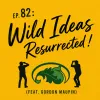
This episode, we’re stepping back to the golden age of natural history podcasting by resurrecting the format of the classic show Wild Ideas: The Podcast. Joining us on the trail is one of the OG hosts: the man himself, Gordon Maupin. It’s a 3-way team-up where each of us brings a heavy-hitting seasonal mystery to the table.First, Steve unravels the rule-breaking world of the Ambystoma polyploid salamander complex, where unisexual lineages are mixing up DNA from different species and blurring the lines of what makes a species a species. Then, Gordon shrinks things down to look at the world of duckweed ecology, a group that includes the smallest flowering plants in the world. Finally, Bill turns our eyes to the skies over the marsh to pull back the curtain on dragonfly migration, looking into the recent science that shows some dragonfly species are multi-generational continental travelers (as well as badass predators).Come listen in as Gordon and the guys answer the question, “What’s going on outside?” (Wild Ideas fans, that’s for you)This episode was reecorded at the Iroquois National Wildlife Refuge in Alabama, NY on May 13, 2026.Episode LinksCheck out the Iroquois National Wildlife Refige and their Bald Eagle Cam.Here’s the New York Times article about 7 Podcasts About the Joys of Bird Watching that includes a mention of our show.Episode NotesGetting The Great Egret’s Latin Name RightDuring a quick aside this episode, Gordon spotted a Great Egret and Steve tried to recall its scientific name, tentatively going with Erodea alba. He wasn't entirely wrong! The correct name is Ardea alba.While alba means "white," Ardea is Latin for "heron." It also ties back to the ancient myth by everyone’s favorite Roman poet Ovid, who wrote about a bird rising directly from the ashes of the burned city of Ardea. What’s the Deal With Axolotls?We wondered if the axolotl is in the same genus as the Jefferson and blue spotted salamander (Ambystoma) and yes they are!Species: A. mexicanum (Axolotl) Unlike most members of Ambystomatidae—which typically metamorphose into terrestrial adults—the axolotl exhibits a trait called neoteny (or paedomorphosis). This is where an organism retains juvenile or larval traits into adulthood. Axolotls retains its aquatic, larval features (like its signature feathery external gills) into adulthood and spends its entire life in the water Bill’s Hard Claim on ID’ing Jefferson Salamanders Bill said there is no way we could tell if it was a Jefferson salamander: is that true? Bill was basically right if we’re talking about visually confirming a female-looking salamander in a blue-spotted/Jefferson overlap zone. Many unisexual individuals cannot be confidently identified by sight, and genetic testing is the clean answer. But during the breeding season, a male with a swollen cloaca is not part of the all-female unisexual lineage, so that can help narrow things down. So, a male in breeding condition can sometimes be identified much more confidently than a female/unisexual-looking animal, but you need to have serio
Podzilla Summary coming soon
Sign up to get notified when the full AI-powered summary is ready.
Free forever for up to 3 podcasts. No credit card required.
Listen to This Episode
More from The Field Guides

Ep. 81 - Keepin' Wetlands Wet: The Western NY Land Conservancy's Mission to Save Bear Lake

Ep. 80 - The Deer Are NOT Alright: Chronic Wasting Disease
Ep. 79 - The Brown Tree Snake on Guam: Using Genetics to Unlock the Secrets of an Invasive Species
Ep. 78 - 3 Guys and A Gator (featuring Chip Campbell)
Get summaries like this every morning.
Free AI-powered recaps of The Field Guides and your other favorite podcasts, delivered to your inbox.
Free forever for up to 3 podcasts. No credit card required.