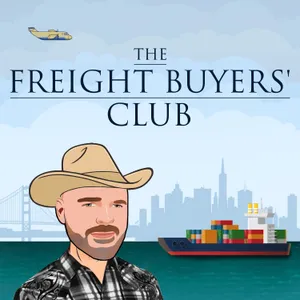
Free Daily Podcast Summary
The Freight Buyers' Club: Daily Summaries Delivered
by Mike King
The Freight Buyers’ Club podcast is a new home for anyone with a professional interest in international trade, container shipping, procurement, logistics and air cargo. Each episode your host, award-winning journalist Mike King, will be speaking to leading decision-makers, analysts, journalists, operators and shippers to get their take on current freight and logistics markets and the challenges and opportunities ahead.
Latest Episodes
The most recent episodes — sign up to get AI-powered summaries of each one.
- 3 days ago44 min
Air Cargo Unpacked: IAG Cargo’s David Shepherd, Peak Season Rates, AI Demand and Asia’s Airport Backlogs
In an exclusive interview, IAG Cargo Chief Executive David Shepherd joins Air Cargo Unpacked as air freight rates hit their highest levels of 2026 and AI demand stretches Asia’s busiest air cargo gateways to the limit. This episode of Air Cargo Unpacked is supported by FreightSuite, the modern alternative to your legacy TMS: https://www.freightsuite.com/fbc David Shepherd, Chief Executive Officer of IAG Cargo, talks to Freight Buyers’ Club host Mike King and co-host Neel Jones Shah about a year of airspace closures and high fuel costs, and how IAG Cargo has kept its network moving. He explains how the Global Cargo Joint Business with Qatar Airways Cargo and MASkargo works and what it means for shippers and forwarders. He also covers the impact of the EU’s new customs fee, the transatlantic market, this winter’s schedule changes, where the bottlenecks are, and IAG Cargo’s priorities for 2027. Before that, Mike and Neel run through the news: what the US midterm results could mean for tariffs, the EU’s new €2 customs handling fee, Scan Global Logistics’ deal to buy OIA Global, and plans to revive the Lufthansa Cargo and ANA joint venture between Japan and Europe. They look at the cargo backlogs in Bangkok and Taipei, with insight from Mike’s recent interview with Jeffrey Shih, CEO of Dimerco Express Group, whose intra-Asia trucking network is moving cargo out of Thailand by road to avoid Bangkok. Data from Aevean shows how AI and data centre demand is reshaping air trade from Asia to the US, with Thailand’s high-tech exports up 122% and Taiwan’s up 72%. Neil Wilson, editor of TAC Index, the calculating agent for the Baltic Air Freight Indices, takes Mike through the latest rates. He covers a peak well above the last two, jet fuel prices, the surge out of Seoul, India’s sharp rise this year and the seasonal climb on the transatlantic. Listen to Mike’s full interview with Jeffrey Shih of Dimerco Express Group: https://youtu.be/37fxGFh0BcQ Thanks as always to Neil Wilson, TAC Index and the Baltic Exchange for the rates data. For more from The Freight Buyers’ Club, subscribe wherever you get your podcasts, follow us on LinkedIn and YouTube, and visit https://www.thefreightbuyersclub.com 00:00 Coming up and welcome 02:30 The midterms and US tariffs 06:20 The EU fee, SGL buys OIA Global and the Lufthansa-ANA joint venture 09:50 Bangkok’s backlog and Taiwan’s congestion 13:50 AI demand: the Aevean data and fears of an AI bubble 18:10 TAC Index: peak season rates and jet fuel 20:25 Rates out of Bangkok, Seoul and India, and the transatlantic 24:00 IAG Cargo’s David Shepherd on a year of disruption 26:55 How the Global Cargo Joint Business with Qatar Airways Cargo and MASkargo works 31:00 De minimis, and AI cargo in the belly hold 32:30 The transatlantic market and CBP’s new data rules 36:45 Winter schedules, bottlenecks and UK screening rules 42:00 IAG Cargo’s 2027 wish list #AirCargo #AirFreight #PeakSeason #FreightRates #SupplyChain #Logistics #AirCargoUnpacked #FreightBuyersClub
- 5 days ago11 min
Port of LA’s Gene Seroka on record volumes, tariffs and what 2027 holds
Freight Buyers’ Club host Mike King talks to Gene Seroka, Executive Director of the Port of Los Angeles, at the IAPH World Ports Conference in London. The Port of Los Angeles has just had the best four-month run in its history, handling nearly 4 million TEU, with October also tracking at a record pace and more than 65 ships on the way. Gene explains what’s behind it. Importers now have a clear view of their costs because tariffs have stabilised. Security concerns around Suez and drought restrictions in Panama are pushing more bookings direct to Southern California. And an early Lunar New Year is adding to the pressure. He also explains how each twist in US trade policy has shown up in cargo flows, from the Supreme Court ruling on the IEEPA tariffs through the temporary Section 122 tariffs to Section 301. He gives an update on congestion, with truck, rail and vessel dwell times measured against his targets and against the peak of COVID. He discusses how the port is managing the Vincent Thomas Bridge closure, shares his first thoughts on the US midterm results, and gives his forecast for 2027 volumes. Please note this interview was recorded on 4 November 2026, when a strike by ILWU Local 26 was expected later that week. The deadline has since been extended to 20 November while talks with the Pacific Maritime Association continue. This episode is brought to you by FreightSuite, the modern alternative to legacy TMS systems, designed by forwarders and reimagined with AI. Find out more at https://freightsuite.com/fbc Follow The Freight Buyers’ Club wherever you get your podcasts for more conversations with the people shaping global supply chains.
- 1 weeks ago42 min
Inside Taiwan’s Export Boom: Dimerco Express Group CEO Jeffrey Shih on AI Cargo, Tariffs and Asia Trade
Taiwan is exporting more than at any time in its history, and Jeffrey Shih, CEO of Dimerco Express Group, says it may be a once-in-a-lifetime boom. Jeffrey explains how AI server cargo is moving out of Taiwan by air and ocean. He says Taiwan's monthly air export tonnage has roughly doubled in two years, with charter flights to the US rising every month this autumn, and that each crate of the next generation of AI servers could be worth $7 million to $8 million. He describes how that cargo is protected and why space out of Taipei is so tight heading into peak season. They also discuss why Jeffrey has seen some high-skill manufacturing slow down in Southeast Asia or even move back to China, how Taiwanese manufacturers are using Johor Bahru and Singapore as a route to the US, terminal delays in Bangkok, the surge in intra-Asia container rates, factory moves into India, cross-border trucking across Southeast Asia, IEEPA tariff refunds and what he says is a new C-TPAT requirement for overseas importers, and why he expects heavy transpacific volumes to run right up to an early Chinese New Year. In this episode: - What shippers got right after the 2025 tariff truce - Is manufacturing still leaving China? - How AI server cargo moves, and how it is protected - Tight air capacity out of Taiwan into peak season - Taiwan, Southeast Asia and the Johor Bahru route - The transpacific and an early Chinese New Year - Why intra-Asia rates have surged - Factory relocations, India and cross-border trucking - IEEPA refunds, C-TPAT and planning for 2027 Mike refers in the episode to the latest Freight Buyers' Club News Brief, with the Baltic Air Freight Index, powered by TAC Index data, showing air freight rates above last year's peak season, plus the latest NYSHEX Freight Indices container rates: https://www.thefreightbuyersclub.com/air-rates-pass-last-years-peak-as-the-transpacific-becomes-shippings-golden-trade/ The Freight Buyers' Club is produced with the support of Dimerco Express Group: https://dimerco.com/
- 1 weeks ago10 min
Port of Long Beach CEO: Why the West Coast Is Winning
Recorded at the IAPH World Ports Conference at Olympia in London, this episode was produced with the support of FreightSuite, the modern multimodal TMS built by forwarders and transformed by AI. Find out more at https://www.freightsuite.com/fbc Freight Buyers’ Club host Mike King talks to Dr Noel Hacegaba, CEO of the Port of Long Beach, on the day the US midterm results came in. They discuss what a new Congress could mean for trade policy and infrastructure funding, and why Noel believes a port’s job is to be ready for whatever comes out of Washington. The port has had a record year, with September its busiest month in 115 years, and is on course to approach 10 million TEU in 2026. Noel explains why the West Coast is winning. Shippers have been frontloading against tariff uncertainty. Carriers are consolidating services and deploying 24,000 TEU ships as the closure of the Strait of Hormuz pushes up fuel costs. And extreme weather, from the Panama Canal drought to delayed sailings out of Asia, has sent more cargo his way. Mike also asks about rising rail dwell times and the dispute involving the ILWU Local 26 watchmen, and what shippers and forwarders can expect ahead of the wider ILWU contract talks in 2028. Noel then explains why Long Beach is studying small modular reactors as part of its plan to reach 20 million TEU by 2050. He also covers how $3.3 billion of committed investment will triple on-dock rail capacity over the next decade, so the port can grow without needing more land. Subscribe for more conversations with the people shaping global freight: https://www.thefreightbuyersclub.com
- 1 weeks ago18 min
Risks and Opportunities for 2027: FIATA’s Stéphane Graber on Disruption, Protectionism and the New Cargo Document Convention
What does 2027 hold for freight forwarders and their customers? Mike King caught up with Stéphane Graber, Director General of FIATA, to talk through the biggest risks and opportunities ahead. This episode is produced with the support of FreightSuite, the modern alternative to legacy TMS platforms, built by forwarders and transformed with AI. Find out more at https://www.freightsuite.com/fbc Stéphane expects the disruption to keep coming, and he talks about why forwarders need to stay adaptable and the challenge of adopting new technology. He also explains why the new Negotiable Cargo Document Convention, signed in Accra, could be one of the biggest opportunities the industry has seen in years. Mike and Stéphane also cover protectionism, port data, electronic bills of lading and where AI really fits.
- 2 weeks ago9 min
Europe’s New Customs Clock Is Already Running: Stephen Tracey, WiseTech Global
Stephen Tracey of WiseTech Global lays out what European importers and exporters need to be planning for over the next decade: a mandatory new data requirement that came into force on 1 November, and a complete rebuild of EU customs systems by the mid-2030s. He explains why Europe’s new parcel duty can apply more than once to a single parcel depending on what’s inside it, how AI is already being used in customs to catch errors rather than just speed things up, and why most businesses can see their supplier’s risk but not their supplier’s supplier’s. This was recorded before the 1 November deadline Steve refers to, which has now passed. The direction he describes, and the longer-term EU Customs Data Hub timeline, still holds. This is an extended clip from a longer conversation also featuring Cindy Allen, CEO of Trade Force Multiplier, and Roel Gevaers, supply chain expert at the University of Antwerp. Full episode: https://youtu.be/4s1XNmd5p6A
- 3 weeks ago11 min
Cindy Allen (CEO, Trade Force Multiplier) on Why Customs Now Wants to Know Your Supplier’s Supplier
In this clip from The Freight Buyers’ Club, host Mike King speaks with Cindy Allen, CEO of Trade Force Multiplier and a former Executive Director at US Customs and Border Protection, about the shift in US trade policy from national security to what she says CBP and the administration are now calling economic security. Allen explains why CBP wants importers of record to trace goods back through every supplier and every border they have crossed, not just the last point of origin, and why she describes trade policy right now as “a team sport,” with the US on one side and most of its trading partners on the other. She also walks through the four legal authorities she says the administration is using to assess tariffs after the Supreme Court struck down its use of IEEPA, including forced labour tariffs she says now apply to more than 60 countries, and the use of a rarely invoked authority against Canada. Watch the full episode: https://youtu.be/4s1XNmd5p6A #FreightBuyersClub #Customs #Tariffs #USTradePolicy #SupplyChain #ImporterOfRecord #TradeCompliance #CBP #GlobalTrade #Logistics
- 3 weeks ago50 min
Shipping to the US? Why inland freight costs are soaring, with Dean Croke, Principal Analyst at DAT iQ, and Bill Cassidy, Senior Editor, Trucking at the Journal of Commerce
What happens to your freight once the container is off the ship in America, and why is it costing so much more to move? In this episode of The Freight Buyers’ Club, host Mike King is joined by Dean Croke, Principal Analyst at DAT iQ, and Bill Cassidy, Senior Editor, Trucking at the Journal of Commerce, to explain what’s going on in the US inland market and what it means for importers and exporters around the world. US truck rates are up by around a third on last year, but as Dean explains, it isn’t because there’s more freight. He says the market has been repriced by a mass exodus of trucking capacity, driven by tougher enforcement on driver licensing, immigration status and English proficiency, and he describes his own encounter with ICE officers checking drivers at a truck stop fuel island. Dean also explains why national averages hide what’s happening on the busiest import lanes out of Los Angeles, and why diesel prices that vary by state are changing where carriers are willing to run. Bill sets out what shippers are actually paying, and why he sees a “K-shaped” economy shaping US freight demand. The pair also look at how the AI data centre boom has been holding up parts of the trucking market, and why Dean thinks that could be a bubble, as well as C.H. Robinson’s $5.8 billion acquisition of RXO, the $604 million verdict against C.H. Robinson and what it means for carrier vetting, the US midterms, the shift from road to rail, the proposed Union Pacific and Norfolk Southern merger, and what to expect in 2027. The video version on YouTube and Spotify includes on-screen charts from DAT iQ, the Journal of Commerce and the Drayrates-JOC port drayage index, which are worth a look alongside the audio. Thanks to Dimerco Express Group (https://dimerco.com/), our sponsor and your best partner on the transpacific. In this episode 00:00 Coming up 01:00 Introductions 03:00 Why Americans call it “the freight market” 05:00 Truck rates up a third, but no more freight 07:00 ICE at the fuel island 10:00 West Coast imports and the lanes out of Los Angeles 13:00 Diesel and where carriers choose to run 15:00 What shippers pay, and the K-shaped economy 21:00 Drayage rates surge at the Gulf Coast ports 22:00 Data centres, flatbed and farm machinery 28:00 C.H. Robinson buys RXO 31:00 The $604 million verdict and carrier vetting 39:00 The midterms, diesel and the trucker vote 43:00 From road to rail 45:00 The Union Pacific and Norfolk Southern merger 46:00 What to expect in 2027 49:00 Thanks and goodbye Related episodes Air Cargo Unpacked: Peak Season, Wartime Costs: What’s Next for Air Cargo in 2027? https://youtu.be/TJwYZQp7K0g Cargo Theft, Double-Brokering and Chameleon Carriers: Nancy O’Liddy on the Fraud Hitting US Freight, with Nancy O’Liddy, Executive Director of the National Industrial Transportation League https://youtu.be/4b4Pz1uN67I
Get The Freight Buyers' Club summaries in your inbox
Free AI-powered daily recaps. Key takeaways, quotes, and mentions — in a 5-minute read.
Get Free Summaries →Free forever for up to 3 podcasts. No credit card required.
You Might Also Like
Listeners also like.

The Trade Guys
Trade experts analyze global trade issues, policies, and their real-world impacts on businesses and consumers.

View From Afar | Travel Industry News
Conversations with travel industry leaders shaping sustainable tourism, destination management, and the future of global travel.

The Investor's Podcast (We Study Billionaires) - The Investor’s Podcast Network
Analyzes the investment strategies of billionaire investors and explores lessons from legendary financiers on wealth, wisdom, and life.
Grain Markets and Other Stuff
Two agricultural experts analyze grain markets, farm economics, and agribusiness news with insights on broader rural topics.

The Business of Cricket by cricexec
cricexec
Hangar Flying with Smokehouse Pilots Club
Smokehouse Pilots

Aviation Week's Check 6 Podcast
Aerospace and defense industry analysis from Aviation Week & Space Technology editors.
King Dems Podcast
Discusses leadership, AI, and business growth with CEOs and entrepreneurs through practical insights on strategy, innovation, and mindset.

TFL Car Chat
Discusses new and classic cars, EVs, off-road vehicles, and automotive trends with hosts Roman and Tommy Mica.

The Intelligence from The Economist
Global news and analysis from The Economist, covering politics, business, and culture with weekday stories and a deep dive on weekends.

Red Eye's Extra Mile with Eric Harley Podcast
Extended discussions on trucking industry issues, regulations, technology, and driver wellness with expert guests and real-world stories.

The Rest Is Politics: US
Insightful analysis of U.S. politics and policy from a former White House official and a veteran BBC correspondent.
About The Freight Buyers' Club
The Freight Buyers’ Club podcast is a new home for anyone with a professional interest in international trade, container shipping, procurement, logistics and air cargo. Each episode your host, award-winning journalist Mike King, will be speaking to leading decision-makers, analysts, journalists, operators and shippers to get their take on current freight and logistics markets and the challenges and opportunities ahead.
Customized Recaps
AI-powered recaps with compact key takeaways, quotes, and insights.
Straight to Your Inbox
Get key takeaways from The Freight Buyers' Club in a 5-minute read.
Save Hours Every Week
Stay current on your favorite podcasts without falling behind.
Frequently Asked Questions
What is Podzilla's The Freight Buyers' Club daily summary?
It's a free AI-powered email that summarizes new episodes of The Freight Buyers' Club as soon as they're published. You get the key takeaways, notable quotes, and links & mentions — all in a quick read.
How does the The Freight Buyers' Club podcast summary work?
When a new episode drops, our AI transcribes and analyzes it, then generates a personalized summary tailored to your interests and profession. It's delivered to your inbox every morning.
Is this an official The Freight Buyers' Club product?
No. Podzilla is an independent service that summarizes publicly available podcast content. We're not affiliated with or endorsed by Mike King.
Can I get summaries of other podcasts too?
Absolutely! The free plan covers up to 3 podcasts, any in the catalog. Basic raises that to 15, Pro to 40 and Max to 100. Browse our full catalog at /podcasts.
How often does The Freight Buyers' Club release new episodes?
The Freight Buyers' Club publishes 2x weekly. Our AI generates a summary within hours of each new episode.
What topics does The Freight Buyers' Club cover?
The Freight Buyers' Club covers topics including News, Business, Management. Our AI identifies the specific themes in each episode and highlights what matters most to you.
Start getting The Freight Buyers' Club summaries tomorrow morning.
Free forever for up to 3 podcasts. No credit card required.
Free forever for up to 3 podcasts. No credit card required.