Free Daily Podcast Summary
The Geometry of Closed Packed Spheres: Daily Summaries Delivered
by Nick Trif
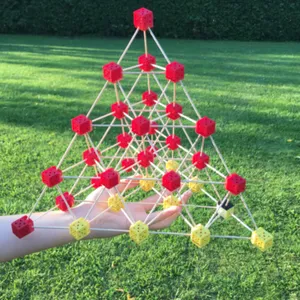
The Geometry of Closed Packed SpheresMission statement: To change minds, to open eyes, to educate and inspire people designing and building better worlds.Beauty makes beautiful things beautiful!A sphere can be completely surrounded by exactly twelve other identical spheres. Close-packing of spheres helps us explore the shape of the physical space. A good design of a 3D structure shall obey the principles, freedom, and constraints imposed by the physical space around us.
Latest Episodes
The most recent episodes — sign up to get AI-powered summaries of each one.
- Oct 18, 202413 min
18. The Square Roots Spiral
The document explores the concept of incommensurability in mathematics, focusing on the relationship between numbers and their square roots. It introduces the square roots spiral as a visual representation of incommensurable magnitudes. The text then contrasts the square roots spiral with two other well-known spirals: the logarithmic spiral and the Archimedean spiral. It details the construction and properties of each spiral, highlighting similarities and differences among them. Finally, the document concludes by suggesting the potential use of these spirals in defining a metric relationship for a specific geometry called CPS Geometry.
- Oct 17, 20248 min
17. Lines Patterns in Space
The text discusses the concept of straight lines in CPS Geometry, a system where points are infinitesimal spheres arranged in a specific pattern. It explores the concept of lines as patterns that extend infinitely in both directions and can be defined by any two points in the space. The text then investigates patterns formed by lines emanating from a central point, analyzing these patterns based on the surrounding layers of points, which are arranged in cuboctahedron structures. The text also considers how these patterns arise from the arrangement of rhombic dodecahedrons, which fill space in CPS Geometry. The text concludes by highlighting the potential for further exploration of these line patterns and their connection to complex analysis concepts such as Möbius transformations.
- Oct 16, 20248 min
16. The Fibonacci Sequence
The source explains the connection between the Fibonacci sequence and the Golden Ratio, also known as the Golden Section. The Fibonacci sequence is a series of numbers where each number is the sum of the two preceding numbers (e.g., 1, 1, 2, 3, 5, 8). The Golden Ratio is an irrational number, approximately 1.618, that appears in various natural and mathematical phenomena. The source shows that the ratio of consecutive terms in the Fibonacci sequence approaches the Golden Ratio as the sequence progresses. It then explores the relationship between the Golden Ratio and the Close Packing of Spheres (CPS) geometry, which is a system for studying the arrangement of spheres in three-dimensional space. The source argues that the CPS geometry provides a geometric interpretation of the Golden Ratio and the Fibonacci sequence, demonstrating that the relationship between these concepts is not just a mathematical curiosity but has a basis in the natural world.
- Oct 11, 20248 min
15. The Golden Section
The text explores the Golden Ratio, also known as the Golden Section, and its significance in classical geometry. It highlights three primary ways the Golden Ratio manifests itself: through Euclid's definition of dividing a line into extreme and mean ratio, in the construction of a regular pentagon, and as a key element in constructing an icosahedron. The text emphasizes the fractal nature of the Golden Ratio, showcasing how its principles can be applied across different scales, from microscopic to macroscopic. It also draws connections between the Golden Ratio, the Theorem of Pythagoras, and complex functions, suggesting potential applications in advanced mathematical fields.
- Oct 10, 20247 min
14. Similarity Theorem in CPS Geometry
The source explores the concept of similarity in geometry, arguing that traditional Euclidean geometry’s reliance on the parallel postulate is not the most fundamental approach. Instead, the source proposes a "CPS Geometry" based on the close-packing of spheres, where similarity arises from the inherent patterns and structures within this arrangement. This framework introduces the idea of "quantization" and suggests that the similarity theorem, rather than being a consequence of parallel lines, is a result of the inherent properties of the CPS arrangement.
- Oct 9, 20248 min
13. Archimedean Solids
The text describes the 13 Archimedean solids in terms of their relationship to the close-packing of spheres (CPS) arrangement. The author explains how these semi-regular polyhedrons, such as the cuboctahedron, truncated tetrahedron, and truncated icosahedron, can be constructed by manipulating Platonic solids within the framework of CPS. The text emphasizes that the CPS arrangement, where points are considered infinitesimal spheres, offers a fundamental understanding of geometrical concepts such as similarity and quantization of space. The text then explores the relationship between the CPS Geometry and other geometric and mathematical systems, including the Cartesian Geometry and Number Theory.
- Oct 7, 202411 min
12. The Rhombic Dodecahedron in CPS
This excerpt from "12-The Rhombic Dodecahedron in CPS.pdf" explores the presence of the rhombic dodecahedron in the Close Packing of Spheres (CPS) model. It argues that the shape of the rhombic dodecahedron, a space-filling form, emerges from a multitude of spheres arranged in a specific pattern. The text then connects this pattern to the concept of minimum surfaces, exemplified by soap films, demonstrating the emergence of soap film-like surfaces within the CPS framework. This connection is further supported by the observation of angles and geometric conditions, which correspond to Joseph Plateau's laws governing soap film behavior. Finally, the source highlights the potential of the rhombic dodecahedron and its associated patterns for understanding the design of complex structures, particularly in the context of Platonic Structures, which are 3D structures built using simple components.
- Oct 4, 20246 min
11. Platonic Solids in CPS Geometry
This source discusses the five Platonic solids, or perfect bodies: the tetrahedron, cube, octahedron, dodecahedron, and icosahedron. The author argues that these solids are not mystical, but rather can be explained using the principle of close-packing of spheres in a specific arrangement called the CPS Space. The source presents detailed patterns and structures of the Platonic solids within the CPS arrangement, showcasing how these solids can be assembled from identical spheres. It emphasizes the importance of building physical models to understand these structures and challenges the traditional view of space as being composed of cubes. The source concludes by exploring the relationship between the icosahedron and dodecahedron as dual structures, illustrating their interconnections and the existence of a related structure called the Great Stelled Dodecahedron.
About The Geometry of Closed Packed Spheres
The Geometry of Closed Packed SpheresMission statement: To change minds, to open eyes, to educate and inspire people designing and building better worlds.Beauty makes beautiful things beautiful!A sphere can be completely surrounded by exactly twelve other identical spheres. Close-packing of spheres helps us explore the shape of the physical space. A good design of a 3D structure shall obey the principles, freedom, and constraints imposed by the physical space around us.
Customized Recaps
AI-powered recaps with compact key takeaways, quotes, and insights.
Straight to Your Inbox
Get key takeaways from The Geometry of Closed Packed Spheres in a 5-minute read.
Save Hours Every Week
Stay current on your favorite podcasts without falling behind.
Frequently Asked Questions
What is Podzilla's The Geometry of Closed Packed Spheres daily summary?
It's a free AI-powered email that summarizes new episodes of The Geometry of Closed Packed Spheres as soon as they're published. You get the key takeaways, notable quotes, and links & mentions — all in a quick read.
How does the The Geometry of Closed Packed Spheres podcast summary work?
When a new episode drops, our AI transcribes and analyzes it, then generates a personalized summary tailored to your interests and profession. It's delivered to your inbox every morning.
Is this an official The Geometry of Closed Packed Spheres product?
No. Podzilla is an independent service that summarizes publicly available podcast content. We're not affiliated with or endorsed by Nick Trif.
Can I get summaries of other podcasts too?
Absolutely! The free plan covers up to 3 podcasts. Upgrade to Pro for 15, or Premium for 50. Browse our full catalog at /podcasts.
How often does The Geometry of Closed Packed Spheres release new episodes?
The Geometry of Closed Packed Spheres publishes daily. Our AI generates a summary within hours of each new episode.
What topics does The Geometry of Closed Packed Spheres cover?
The Geometry of Closed Packed Spheres covers topics including Science, Mathematics. Our AI identifies the specific themes in each episode and highlights what matters most to you.
Start getting The Geometry of Closed Packed Spheres summaries tomorrow morning.
Free forever for up to 3 podcasts. No credit card required.
Free forever for up to 3 podcasts. No credit card required.