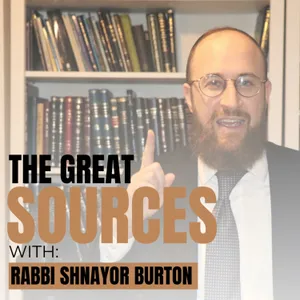
Free Daily Podcast Summary
The Great Sources with Rabbi Shnayor Burton: Daily Summaries Delivered
by Rabbi Shnayor Burton
Lecture series in Jewish Philosophy. What was the purpose of Creation? What is man's place in the world? What are prophecy and prayer about? What is the significance of Shabbos and the Promised Land? Explore these fundamental questions of Judaism from their sources, and become familiar with the systems developed by the great Torah thinkers: R' Saadiah Gaon, R' Yehuda HaLevi, R' Bachya ibn Paquda, Rambam and the school of the Mekubalim.
Latest Episodes
The most recent episodes — sign up to get AI-powered summaries of each one.
- 5 days ago1h 2m
Understanding Truth or Receiving Torah: The Root of the Dispute between Rambam and the Kabbalists
- Aug 13, 202637 min
S7, E20, The Guide of the Perplexed, the Closing Chapters, 04: Know, My Son — The Parable of the Parable's Interpretation Shnayor Burton Shnayor Burton 306 subscribers Analytics Edit video
1:00 The parable of the sultan and its two interpretations4:00 The alternative path to God that does not involve studying philosophy nor human perfection8:00 Rambam gives the interpretation of the parable and then declares that it is not a true interpretation10:30 Parables have interpretations that are not completely true12:30 Shlomo went from parable to parable, and likewise the Rambam14:45 The power of a parable lies in its appeal to the imagination and the body, which stands in tension with the interpretation of the parable18:00 The first interpretation of the parable is actually a parable for the deeper interpretation of the parable21:00 Can the first track lead to prophecy? Would it be called prophecy only equivocally with true prophecy achieved through the second track?24:00 The student requires a parable to motivate him, and he must take the path through the first interpretation, which is itself a parable27:30 Study of Torah is a lived parable, and only after appreciating its study for its own sake can a person appreciate it as a parable for something else30:30 Why Aristotle did not become a prophet31:00 The answer to the greatest contradiction between Mishneh Torah and the Guide, regarding the importance of studying halacha: its study is a living parable34:30 The key to resolving the contradiction within the Rambam himself is understanding parables
- Aug 9, 20261h 11m
S7, E19, The Guide of the Perplexed, the Closing Chapters, 03: Two Roads to the Inner Court of the King
0:00 The parable of the sultan in his palace9:30 The interpretation of the parable: the Torah track to reach knowledge of God12:45 The second meaning of the parable: the scientific track to reach knowledge of God20:25 The second meaning stands in tension with and contradicts the first27:00 Rambam wanted his student to learn things in their proper order31:00 How a person could reach certainty about divine matters without studying the propaedeutic sciences35:45 Some noble souls have God-given illumination attained not through a course of education but as a gift42:30 As a student of Rambam, R' Yosef needed a course of education 48:45 The meaning of the sultan is never interpreted; in III:52, the king is interpreted to mean the intellect54:15 God dwells in Reason, which is His Shechinah58:30 Rambam does not interpret the meaning of the sultan, since there is no parable for God1:01:01 "HaKadosh Baruch Hu" as a parable for the acquired intellect or the active intellect1:04:00 The Treatise of the Pool and the final chapters of the Guide; reason as king and conduit to God
- Jul 28, 20261h 12m
S7, E18, The Guide of the Perplexed, the Closing Chapters, 02: The Birth of a Nation Under Divine Providence
00:45 The turn and the tension in III:51, and its parallel in III:54, about whether the service of God involves turning away from this world or engaging with it4:15 A new reason for all of the mitzvahs that runs counter to the reasons given earlier in the Guide16:15 The contradiction in III:54: Is the true perfection of man intellectual or practical?28:00 Why does Rambam think we cannot be like Avraham, Yitzchak, Yaakov and Moshe?40:30 Only the founders of the nation can be engaged with this world while remaining purely objective and focused on Hashem 54:30 The history of the Jewish Nation as the embodiment of Hashem's traits of Kindness, Justice and Righteousness, which are the hallmarks of Divine Providence57:00 The perfection of man as individual is knowledge; the perfection of man as a member of the Jewish Nation is engagement in lived Kindness, Justice and Righteousness1:01:00 "The unity of God in the world" – Kindness, Justice and Righteousness reflect God's unity in the dimension of the material world 1:05:00 Kindness, Justice and Righteousness for the collective correspond to intelligence for the individual
- Jul 21, 20261h 16m
S7, E17, The Guide of the Perplexed, the Closing Chapters, 01: The Perfect Life and the Perfect Death
- Jun 29, 202651 min
Should Judaism Go Universal?
0:00 Has the time arrived for Judaism to cultivate a stance of ideological expansion?5:00 The divine decree of separation between Israel and the nations8:00 Is the role of Israel to teach other nations or to stand as a model?13:15 Why da'as Hashem includes all the nations17:30 Ideas that are privately held are not fully held19:50 To teach da'as Hashem requires not claiming the status of a teacher of da'as Hashem26:00 AI and globalized da'as31:00 Keeping Torah internal preserves its integrity40:45 If Israel would produce prophets, would the other nations come to study from them?43:00 Should Torah sages be challenged to justify how their study is relevant to the nations?48:45 Torah scholars in Israel should orient themselves toward the other nations; Torah scholars living among the nations should orient themselves toward Israel
- Jun 21, 20261h 8m
How Shlomo Read the Torah: Good, Evil, and the Heart of the Entire Tanach
Guest shiur delivered at Kollel Bein Hamikraos in Yerushalayim
- May 28, 20261h 14m
The Door Moshe Closed: Nobody Can Be Moshe, Everyone Has to Listen to Him
Torah is a transmission from someone who went where no one else could go and came back to tell us not to.Moshe entered the source of all being and returned with a single mitzvah: stay outside. Everything else is commentary.
Get The Great Sources with Rabbi Shnayor Burton summaries in your inbox
Free AI-powered daily recaps. Key takeaways, quotes, and mentions — in a 5-minute read.
Get Free Summaries →Free forever for up to 3 podcasts. No credit card required.
You Might Also Like
Listeners also like.
The Tanakh Podcast
A daily commentary on the Hebrew Bible, offering 10-15 minute insights chapter by chapter at a pace of five chapters per week.

The Jewish History Podcast - With Rabbi Yaakov Wolbe
A podcast featuring Rabbi Yaakov Wolbe's lectures on Jewish history.
The Q & A with Rabbi Breitowitz Podcast
Rabbi Dr. Yitzchak Breitowitz answers questions on Jewish law, philosophy, and modern life in weekly sessions from Jerusalem.

Jewish Stories to Inspire: Motivational & Spiritual Stories Based on the Torah's Ethics, Values and Wisdom
Inspirational Jewish stories drawn from the Torah, sages, and chassidic tradition that convey spiritual and ethical lessons.

Nach Yomi
Discusses the daily Nach Yomi chapter with brief insights.

Rambam Yomi: Mishneh Torah, a Perek a Day
Study one chapter daily of Maimonides' Mishneh Torah according to the three-year Rambam Yomi cycle with Rabbi Dr. Moti Novick.

The Frieda Vizel Podcast
Conversations exploring Hasidism, Judaism, New York City, and cultural topics through interviews and personal insights.

Being Jewish with Jonah Platt
Candid conversations exploring the diverse facets of Jewish identity and culture with prominent Jewish figures and allies.

Tablet Studios
Explores Jewish identity, tradition, and culture through diverse podcasts offering insight for contemporary Jewish life.

Adventures with Dead Jews
Explores bizarre and darkly humorous stories from Jewish history to examine society's obsession with dead Jews.

Call Me Back - with Dan Senor
Discusses challenges and dilemmas facing Israelis and Jews worldwide.

Ask Haviv Anything
A history podcast shaped by listener questions, covering identity, conflict, and culture with moments of humor.
About The Great Sources with Rabbi Shnayor Burton
Lecture series in Jewish Philosophy. What was the purpose of Creation? What is man's place in the world? What are prophecy and prayer about? What is the significance of Shabbos and the Promised Land? Explore these fundamental questions of Judaism from their sources, and become familiar with the systems developed by the great Torah thinkers: R' Saadiah Gaon, R' Yehuda HaLevi, R' Bachya ibn Paquda, Rambam and the school of the Mekubalim.
Customized Recaps
AI-powered recaps with compact key takeaways, quotes, and insights.
Straight to Your Inbox
Get key takeaways from The Great Sources with Rabbi Shnayor Burton in a 5-minute read.
Save Hours Every Week
Stay current on your favorite podcasts without falling behind.
Frequently Asked Questions
What is Podzilla's The Great Sources with Rabbi Shnayor Burton daily summary?
It's a free AI-powered email that summarizes new episodes of The Great Sources with Rabbi Shnayor Burton as soon as they're published. You get the key takeaways, notable quotes, and links & mentions — all in a quick read.
How does the The Great Sources with Rabbi Shnayor Burton podcast summary work?
When a new episode drops, our AI transcribes and analyzes it, then generates a personalized summary tailored to your interests and profession. It's delivered to your inbox every morning.
Is this an official The Great Sources with Rabbi Shnayor Burton product?
No. Podzilla is an independent service that summarizes publicly available podcast content. We're not affiliated with or endorsed by Rabbi Shnayor Burton.
Can I get summaries of other podcasts too?
Absolutely! The free plan covers up to 3 podcasts. Upgrade to Pro for 15, or Premium for 50. Browse our full catalog at /podcasts.
How often does The Great Sources with Rabbi Shnayor Burton release new episodes?
The Great Sources with Rabbi Shnayor Burton publishes weekly. Our AI generates a summary within hours of each new episode.
What topics does The Great Sources with Rabbi Shnayor Burton cover?
The Great Sources with Rabbi Shnayor Burton covers topics including Religion & Spirituality, Spirituality, Judaism. Our AI identifies the specific themes in each episode and highlights what matters most to you.
Start getting The Great Sources with Rabbi Shnayor Burton summaries tomorrow morning.
Free forever for up to 3 podcasts. No credit card required.
Free forever for up to 3 podcasts. No credit card required.