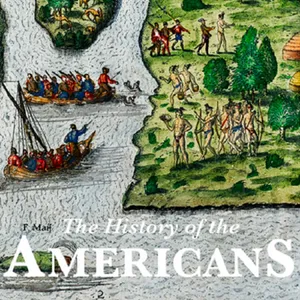
Free Daily Podcast Summary
The History of the Americans: Daily Summaries Delivered
by Jack Henneman
The history of the people who live in the United States, from the beginning.
Latest Episodes
The most recent episodes — sign up to get AI-powered summaries of each one.
- 4 days ago
#210 The Quakers Invade West New Jersey
This is the story of the division of the colony of New Jersey into East New Jersey and West New Jersey, and the bizarre legal and financial machinations that resulted ultimately in the settlement of the region by Quakers in the second half of the 1670s. Fundamentally, those machinations were between two somewhat disreputable Quakers, John Fenwick and Edward Byllynge. Their longstanding quarrel would threaten to spill out into non-Quaker circles, so William Penn intervened to arbitrate between them and save the Friends from embarrassment. It was this intervention that would first involve Penn in North American colonization, and just a few years down the road would result in the founding of Pennsylvania. Subscribe to my Substack! X – @TheHistoryOfTh2 – https://x.com/TheHistoryOfTh2 Facebook – https://www.facebook.com/HistoryOfTheAmericans Useful prerequisite episodes: #167 Ohhhh! Whaddabout New Jersey? #171 New Jersey Is Revolting! Primary references for this episode John E. Pomfret, The Province Of West New Jersey 1609-1702 (Out of print – best found in libraries) The concessions and agreements of the proprietors, freeholders and inhabitants of the province of West New-Jersey, in America Introduction to and summary of the West Jersey Concessions Quintipartite Deed
- 2 weeks ago44 min
#209 What You Need to Know About English Politics in the 1680s 2: The Glorious Revolution
The "glorious revolution" of 1688-89 would change the terms of the English monarchy, and reverberate through American history.
- May 2, 202646 min
#208 What You Need to Know About English Politics in the 1680s 1: The Exclusion Crisis
Heading as we are into the 1680s on the timeline of the History of the Americans, it will be useful for all of us to know a few basic things about English politics in the 1680s, including especially the “exclusion crisis” of 1679-1681 and the Glorious Revolution of 1688. Both had a big impact on our own history. Along the way we learn more about John Locke, how the acquittal of William Penn transformed the law in England and ultimately the United States, the actual conspiracy between the English King Charles II and Louis XIV of France, the origin of the words “Tory” and “Whig” at the moment that the English invented political parties, the role of infant mortality in the politics of a monarchy, and the awful, but hilarious, “Popish Plot” conspiracy theory that shaped English politics in 1679-81. Subscribe to my Substack! X – @TheHistoryOfTh2 – https://x.com/TheHistoryOfTh2 Facebook – https://www.facebook.com/HistoryOfTheAmericans Primary references for this episode (Commission earned for Amazon purchases through the episode notes on our website) Jonathan Healey, The Blazing World: A New History of Revolutionary England 1603-1689 The Popish Plot (Wikipedia entry, which goes much deeper than the podcast) Optional prerequisite episode: #146 Oliver’s Army: What You Need to Know About the English Civil Wars
- Apr 20, 202620 min
#207 How Indians of the American West Acquired Horses
[Notice: Friends of the podcast, I will be in New Orleans from April 28 through May 8, and would be delighted to get together for a beer or something. If there is interest, send me a DM on X or better an email at thehistoryoftheamericans *at* gmail, and I’ll set up a meetup!] Going down a rabbit hole while learning about the Pueblo Revolt of 1680, I started reading about something I have wondered about – how and when did the Indians of the American West acquire horses and learn to use them rather than eat them? The answer is not what you think, or at least not what I thought before I did this work. The story begins with the discovery of silver in Mexico, which I did not see coming. Subscribe to my Substack! X – @TheHistoryOfTh2 – https://x.com/TheHistoryOfTh2 Facebook – https://www.facebook.com/HistoryOfTheAmericans Primary references for this episode William Taylor, et. al., “Early dispersal of domestic horses into the Great Plains and northern Rockies,” Science, 30 March 2023. Jack D. Forbes, “The Appearance of the Mounted Indian in Northern Mexico and the Southwest, to 1680,” Southwestern Journal of Anthropology, Summer, 1959.
- Apr 6, 202640 min
#206 The Pueblo Revolt of 1680 2: The Siege of Santa Fe and the Flight to El Paso
It is August, 1680 in New Mexico. The rebelling Pueblo Indians have sprung their ambush and quickly killed 400 Spaniards. About 2500 survivors have concentrated in two groups, at the government buildings in Santa Fe, and 70 miles to the south at Isleta Pueblo. Each has reason to believe that everybody else has died, and they are alone. The Indians beseige Santa Fe, but Governor Antonio de Otermín leads a successful defense. Still, they are isolated and out of food, and determine to retreat to the recently established mission at El Paso. The southern group, under Lieutenant Garcia at Isleta, make the same decision. This is the history of that harrowing retreat, another amazing story of survival in the European settlement of today’s United States. It is also the only time in American history that rebelling indigenous peoples entirely expelled an established European settlement from their territory. The Spaniards would, of course, eventually reconquer New Mexico, but not until 1692. The settlement of the New Mexican refugees at El Paso would make it – for the moment – the third most populous settlement of Europeans in North America, and the functional beginning of the eventual New Spanish territory, Mexican state, Republic, and American State of Texas. Maps of the Pueblo Revolt Subscribe to my Substack! X – @TheHistoryOfTh2 – https://x.com/TheHistoryOfTh2 Facebook – https://www.facebook.com/HistoryOfTheAmericans Primary references for this episode (Commission earned for Amazon purchases through the episode notes on our website) John L. Kessell, Pueblos, Spaniards, and the Kingdom of New Mexico Charles Wilson Hackett, “The Revolt of the Pueblo Indians of New Mexico in 1680,” The Quarterly of the Texas State Historical Association, October 1911. Charles Wilson Hackett, “The Retreat of the Spaniards from New Mexico in 1680, and the Beginnings of El Paso, I,” The Southwestern Historical Quarterly, October 1912. Charles Wilson Hackett, “The Retreat of the Spaniards from New Mexico in 1680, and the Beginnings of El Paso, II,” The Southwestern Historical Quarterly, January 1913.
- Mar 19, 202637 min
#205 The Pueblo Revolt of 1680 1: The Kindling of War
In August 1680, an alliance of Puebloan peoples, led by a mysterious religious man named Po’pay (also spelled Popé), launched a surprise attack that forced the Spanish entirely out of New Mexico 82 years after they had first settled it. Po’pay’s rebellion would combine elements that will remind longstanding listeners of King Philip’s War in New England and Opechancanough’s surprise attack in Virginia in March 1622. Unlike the Wampanoags and the Pamunkeys, however, Po’pay would achieve his war aims. Along the way we examine the causes of the revolt, the preparations for the ambush, and the terrible first days setting up the siege of Santa Fe, which will be taken up next time. Maps of the Pueblo Revolt Subscribe to my Substack! X – @TheHistoryOfTh2 – https://x.com/TheHistoryOfTh2 Facebook – https://www.facebook.com/HistoryOfTheAmericans #98 A Kingdom of God on the Rio Grande Primary references for this episode (Commission earned for Amazon purchases through the episode notes on our website) John L. Kessell, Pueblos, Spaniards, and the Kingdom of New Mexico Charles Wilson Hackett, “The Revolt of the Pueblo Indians of New Mexico in 1680,” The Quarterly of the Texas State Historical Association, October 1911. Herbert E. Bolton, The Spanish Borderlands: A Chronicle of Old Florida and the Southwest Andrew L. Knaut, The Pueblo Revolt of 1680 David Roberts, The Pueblo Revolt: The Secret Rebellion that Drove the Spaniards
- Mar 2, 2026
#204 Albemarle Arises: Culpeper’s Rebellion
In 1677, the longtime residents of the old and remote county of Albemarle in northern Carolina, a collection of cranks and dissidents who had fled from Maryland and Virginia and were used to living free of interference from the Carolina proprietors and the Crown’s tax collectors, revolted against new attempts to collect duties on tobacco. Quite astonishingly, they succeeded! And not without some history comedy along the way. In the long history of the Americans, it is easy to ignore Culpeper’s Rebellion. Virtually all surveys of American history do. Albemarle was small, a literal backwater, and not even the most important part of Carolina. Historians of North Carolina, however, see it as a truer reflection of the American Revolution, a century later, than the other colonial upheavals of the 1670s. The Albemarle rebels were an early example, in their democratic tax-avoiding free-trading don’t-tread-on-me resistance, of ideas that would later be taken up throughout English North America. Subscribe to my Substack! X – @TheHistoryOfTh2 – https://x.com/TheHistoryOfTh2 Facebook – https://www.facebook.com/HistoryOfTheAmericans #158 The Free County of Albemarle #160 The Official Founding of North Carolina Primary references for this episode (Commission earned for Amazon purchases through the episode notes on our website) Lindley S. Butler, A History of North Carolina in the Proprietary Era 1629-1729 Noeleen McIlvenna, A Very Mutinous People: The Struggle for North Carolina, 1660-1713 Hugh F. Rankin, Upheaval in Albemarle: the Story of Culpeper’s Rebellion, 1675-1689
- Feb 13, 202647 min
#203 Sidebar: Henry Knox and the Noble Train of Artillery Part 2
Twenty-five year-old bookseller Henry Knox, his 19 year-old brother Will, and teamsters led by John Becker, Sr., move a long “noble train” of 59 pieces of salvaged artillery from Fort Ticonderoga to Cambridge. The route crossed frozen rivers and the not-dreamlike Berkshire Mountains under unbelievably arduous conditions. As word spread, crowds of Americans would turn out to cheer them on, and serve them cider and whiskey. The artillery, when hoisted to the commanding heights of Dorchester above Boston, would drive the British from their long occupation of that city, and they would never return. It is a story of initiative, ingenuity, tenacity, survival, and charismatic leadership, and was perhaps the first miracle of many that would bless the American Revolution. Map of the Noble Train’s route (not reflecting all the river crossings discussed in the episode): Subscribe to my Substack! X – @TheHistoryOfTh2 – https://x.com/TheHistoryOfTh2 Facebook – https://www.facebook.com/HistoryOfTheAmericans Primary references for this episode (Commission earned for Amazon purchases through the episode notes on our website) William Hazelgrove, Henry Knox’s Noble Train: The Story of a Boston Bookseller’s Heroic Expedition That Saved the American Revolution Thomas M. Campeau, Major, U.S. Army, “The Noble Train of Artillery: A Study Comparison of Current Doctrinal Concepts of the Mission Command Philosophy in History.” (Master’s thesis, pdf)
About The History of the Americans
The history of the people who live in the United States, from the beginning.
Customized Recaps
AI-powered recaps with compact key takeaways, quotes, and insights.
Straight to Your Inbox
Get key takeaways from The History of the Americans in a 5-minute read.
Save Hours Every Week
Stay current on your favorite podcasts without falling behind.
Frequently Asked Questions
What is Podzilla's The History of the Americans daily summary?
It's a free AI-powered email that summarizes new episodes of The History of the Americans as soon as they're published. You get the key takeaways, notable quotes, and links & mentions — all in a quick read.
How does the The History of the Americans podcast summary work?
When a new episode drops, our AI transcribes and analyzes it, then generates a personalized summary tailored to your interests and profession. It's delivered to your inbox every morning.
Is this an official The History of the Americans product?
No. Podzilla is an independent service that summarizes publicly available podcast content. We're not affiliated with or endorsed by Jack Henneman.
Can I get summaries of other podcasts too?
Absolutely! The free plan covers up to 3 podcasts. Upgrade to Pro for 15, or Premium for 50. Browse our full catalog at /podcasts.
How often does The History of the Americans release new episodes?
The History of the Americans publishes biweekly. Our AI generates a summary within hours of each new episode.
What topics does The History of the Americans cover?
The History of the Americans covers topics including History. Our AI identifies the specific themes in each episode and highlights what matters most to you.
Start getting The History of the Americans summaries tomorrow morning.
Free forever for up to 3 podcasts. No credit card required.
Free forever for up to 3 podcasts. No credit card required.