Free Daily Podcast Summary
The Homeboy Way: Daily Summaries Delivered
by The Homeboy Way
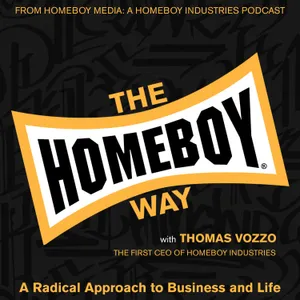
The Homeboy Way Podcast invites listeners into stories of healing, kinship, and transformation. Hosted by Tom Vozzo, former longtime CEO of Homeboy Industries, alongside Fr. Greg Boyle, S.J., and illuminating guests, the show explores what happens when people are seen, cherished, and given space to heal. The Homeboy team will talk about trauma, redemption, social justice, faith, and business efforts that foster healing, but more than anything, we talk about belonging and what happens when you meet people where they're at. The Homeboy Way, a movement of radical kinship.
Latest Episodes
The most recent episodes — sign up to get AI-powered summaries of each one.
- Yesterday32 min
Healing Through Art and Community: Finding Purpose at Homeboy Industries with Gabby Hidalgo, Alejandro Zapata, and Dre Comers
After 17 years in prison, Gabby Hidalgo came home to a family that still saw the person she used to be. Alejandro Zapata returned to Homeboy after a second prison term, determined to leave behind the fast money and experiences he never wanted to repeat. At Homeboy Industries, both found people willing to believe in their future, even when rebuilding their lives felt overwhelming.In this episode of The Homeboy Way, Tom Vozzo and co-host Dre Comers, Director of the Homeboy Art Academy, join Gabby and Alejandro for an honest conversation about life after prison, youth mentorship, and healing through art. Gabby shares how she graduated college at 40, became a navigator supporting young adults, and turned to photography after losing her best friend. Alejandro discusses finishing high school, pursuing a career as an electrician, and finding focus through graffiti and drawing.Together, they explore the challenges of prison reentry, the importance of mental health support, and why creative expression can matter even when becoming an artist is not the goal. From Father Greg’s unconditional welcome to Gabby’s determination to interrupt cycles of gang violence and abuse, their stories reveal how consistent support, compassion, and second chances help people build a different life.Key TakeawaysConsistency creates belonging.Support groups, education, and dependable relationships helped Gabby find a sense of family at Homeboy Industries.Fast money comes with a long-term cost.Alejandro reflects on how incarceration changed his thinking about income, lost time, and the opportunities he wants to pursue.Lived experience can guide youth mentorship.Gabby draws on her own history to speak honestly with young adults and help them recognize paths that could lead to incarceration.Art can support healing without becoming a career.Dre explains the value of creative expression, while Alejandro describes the focus he finds in graffiti and working with pastels.In This Episode[00:00] Introduction[01:04] Meet Gabby, Alejandro, and Homeboy Art Academy director Dre[02:06] Dre’s full-circle return to working with youth[02:53] Gabby finds Homeboy after 17 years in prison[04:13] Reentry anxiety and finding support through women’s empowerment[06:58] Returning to Homeboy and graduating college at 40[08:06] Alejandro’s journey from juvenile camp to a second chance[10:09] Rethinking fast money and the cost of incarceration[11:42] Showing up with intention at the Homeboy Art Academy[12:23] The prison experiences Alejandro never wants to repeat[15:48] Why Gabby wants to interrupt gang violence and abuse[18:01] Honest conversations and support for young adults[21:15] What makes the Homeboy Art Academy different[23:40] Why creative expression matters beyond earning money[24:58] Father Greg’s help and an open door to return[28:38] How Homeboy changed Dre’s approach to compassion[31:25] Finding joy in family, nature, and everyday lifeNotable Quotes“You could meet new people, new opportunities. You just never know what's in store for you.” Alejandro [11:23]“I'm grateful to be here. I'm grateful with the kids. I'm grateful for the opportunity, like being able to share my life story because I don't want none of them to go through that.” - Gabby [17:30]“Not everyone is gonna be an artist and go into a pathway that they're gonna start making money from.” - Dre [23:46]Resources and LinksHomeboy Industrieshttps://homeboyindustries.org/https://www.youtube.com/@HomeboyIndustries_LA/videosDonate: https://homeboyindustries.org/donate/donate-online/Homeboy Media https://homeboyindustries.org/social-enterprises/homeboy-media/Thomas Vozzohttps://www.linkedin.com/in/thomasvozzoThe Homeboy Way: A Radical Approach to Business and Life: <a href="https://www.amazon.com/Homeboy-Way-Rad
- 1 weeks ago43 min
Before There Was Homeboy: Dr. Jorja Leap on Gangs, Research, and Father Greg
In the late 1980s, a young social worker in Watts kept hearing she had to meet a priest in Boyle Heights. She didn't like priests. She didn't like religion. But she finally made the call.What happened in that first meeting, and in the decades that followed, changed how Dr. Jorja Leap saw gangs, research, and her own life.In this episode of The Homeboy Way, Tom Vozzo, former CEO of Homeboy Industries, sits down with Jorja, a UCLA professor, longtime friend of Father Greg Boyle, and a self-described "Homeboy elder." She takes us back to a time when there was no Homeboy, when a city was afraid, and when almost no one believed in the people Greg did. She shares what she discovered by simply showing up, why funders and government kept Homeboy at arm's length, and what she'd tell any nonprofit fighting for support.She also gets personal about how Homeboy became her chosen family, a woman who has stayed in her heart for years, and the one time she and Fr. Greg really fought.Key TakeawaysViolence is multifaceted, so the response has to be too. Jorja compares gang violence to cancer: cutting out the tumor never worked on its own. She says no single approach, and no "typical" gang member, exists. Relationships were the intervention. Her early research at Homeboy found that no specific strategy explained the results. Community, transferable skills, and seeing other former gang members succeed gave people the confidence to believe they could change too. Relapse is part of the process, not a failure. Jorja prefers "relapse" to "recidivism" and describes people as "struggling," not failing. She advises nonprofits to put a comma in place of the period: "We have an 18-month program, and very few people make it through the first time." Bring in a researcher early, but don't let a rigid funder rewrite your mission. She urges nonprofits to partner with a university researcher early and often. She and Tom also criticize control groups that deny services to people in need, and she argues that if a funder insists on one, "you don't want their money." Homeboy never gives up on anyone. Jorja describes a woman she has watched at Homeboy since 2008 who is still struggling and still trying. To her, that is what Homeboy stands for: hope, not just success. In This Episode:[00:00] Introduction[01:32] Meeting Father Greg before Homeboy existed[03:37] The "super predator" myth[06:40] Why violence is multifaceted[11:40] Pitching Fr. Greg on research[14:48] Relapse, not recidivism[18:07] What the research found: relationships[21:05] The study's results[23:06] Why foundations hesitated[26:37] LA County, the "bad boyfriend"[30:28] Advice for nonprofits[31:40] The trouble with control groups[35:19] Explaining an 18-month program[36:28] How Homeboy changed Jorja[41:20] Being Fr. Greg’s friend [43:24] Closing Notable Quotes"The effectiveness was based on relationships." - Jorja Leap [00:18:18]"Homeboy never gives up on anyone." - Jorja Leap [00:39:50] "Greg Boyle has taught me in the purest sense, the meaning of unconditional love." - Jorja [42:32] Resources and LinksHomeboy Industrieshttps://homeboyindustries.org/https://www.youtube.com/@HomeboyIndustries_LA/videosDonate: https://homeboyindustries.org/donate/donate-online/Homeboy Media https://homeboyindustries.org/social-enterprises/homeboy-media/Jorja Leaphttps://luskin.ucla.edu/profile/jorja-leap/https://www.linkedin.com/in/jorja-leap-a30a451a5/Thomas Vozzoht
- 2 weeks ago31 min
Rock Bottom Isn't the End: How a Prayer and a TAP Card Led Paradise Adamson to Homeboy
What do you do when you're tired of the life you're living but have no idea where to start? Paradise Adamson asked that question in a prayer on a dirt hillside beside the freeway, at what she calls her rock bottom. What followed was an arrest over a missing TAP card, time in county jail and in treatment, and a string of people telling her she should check out Homeboy.In this episode, Tom Vozzo sits down with Paradise, now a navigator at Homeboy Industries who went through the 18-month trainee program herself. She shares how she went from rock bottom to walking through Homeboy's doors for the first time. She talks about what it meant to be honest in an interview when every past job had taught her to hold something back, and how she learned to treat anger as a signal instead of a flaw. She also explains why she believes healing works best as a toolbox rather than a single fix, and what it takes to guide new trainees through the same fears she once had.Her story is a reminder that transformation doesn't require a plan. It can begin with showing up, telling the truth, and letting yourself be accepted as you are.Key TakeawaysSometimes the hardest part is finding a starting point. Paradise reflects on reaching rock bottom and struggling to figure out where to begin. Homeboy became the opportunity she had been praying for. Honesty was the game changer. She feared that being open about her past would work against her. At Homeboy it was exactly what was asked of her, and she says being that honest for the first time gave her room to grow. Addiction takes many forms. Paradise learned that anything not used in moderation can become an addiction, including anger, harsh self-talk, and even depression. Grief isn't something to stop; it's something to carry well. She doesn't try to stop missing her loved ones. She focuses on how she represents them. Healing is a toolbox. Rather than expecting one class or one insight to fix everything, Paradise takes what fits from each and leaves the rest. In This Episode:[00:00] Introduction[01:00] A prayer near the train tracks, and an arrest over a TAP card[04:24] Hearing about Homeboy in jail and in treatment[06:27] Showing up for intake and interview[07:10] Being honest about her past for the first time[08:38] Celebrating one year of sobriety at Homeboy[10:09] What was different about this prayer[13:15] Learning through hardship and changing how she prays for her siblings[14:42] Advice for avoiding addiction: everything in moderation[16:04] Why she vents out loud in the morning[17:41] Being tired of the life and having no starting point[19:23] Still working on her emotions as a trainee[20:58] Understanding anger as a secondary emotion[22:01] Embracing grief instead of trying to stop it[23:26] Building a toolbox from Homeboy's classes[24:15] Working in the Homeboy Cafe[26:05] Why trainees should embrace the social enterprises[27:11] What keeps her grounded[27:48] Why navigator may be the hardest job at Homeboy[29:23] Where she sees herself in the next few years[30:31] What Father Greg means to her Notable Quotes"If I'm always pretending, then I can never authentically grow." - Paradise [09:26] "Anything that's not used in moderation could become addiction." - Paradise [15:04] Resources and LinksHomeboy Industrieshttps://homeboyindustries.org/https://www.youtube.com/@HomeboyIndustries_LA/videosDonate: https://homeboyindustries.org/donate/donate-online/Homeboy Media https://homeboyindustries.org/social-enterprises/homeboy-media/Thomas Vozzohttps://www.linkedin.com/in/thomasvozzoThe Homeboy Way: A Radical Approach to Business and Life: <a href="https://www.amazon.com/Homeboy-Way
- 3 weeks ago41 min
Seeing God in Others and Other Lessons of Faith from Homeboy Industries with Mikala Rahn, Fr. Frank Buckley, S.J., and Mary Ellen Burton
After surviving a brain hemorrhage and facing stage-four metastatic cancer, Fr. Frank Buckley, S.J. describes the past year as both the hardest and the best of his life. His experience revealed something he had spent years searching for: God was not somewhere “out there.” God was already present within him, and in the people surrounding him at Homeboy Industries.In this deeply personal conversation, Tom Vozzo is joined by Mikala Rahn, Fr. Frank Buckley, S.J., and Mary Ellen Burton to explore how Homeboy Industries has transformed their understanding of God, faith, and unconditional love. Mikala shares why curiosity protects us from judgment and how loving ourselves is inseparable from accepting God’s love. Mary Ellen reflects on arriving at Homeboy broken, being welcomed into the community, and discovering a God who is “relaxed and smiling.”Together, they examine faith in action, the relationship between suffering and joy, and the difference between helping people and walking alongside them in kinship. They also discuss spiritual doubt, contemplative practice, cherished belonging, and why Homeboy can feel more like church than church itself. This episode is an honest exploration of what becomes possible when faith moves beyond belief and becomes a way of being with others.Key TakeawaysGod can be found in the chaos.Homeboy Industries may not look peaceful from the outside, but its relationships reveal a deeply present, loving, and nonjudgmental God.Accepting God’s love requires self-love.Believing that God loves us unconditionally is only part of the journey. We must also confront the barriers that prevent us from loving ourselves.Kinship is different from rescuing people.The goal is not to fix or save someone. It is to stand beside them and allow both people to be changed through the relationship.Homeboy offers a different model of leadership.Humble leadership is rooted in relationships, openness, and a willingness to be corrected while staying grounded in the mission.In This Episode[00:00] Introduction to The Homeboy Way[01:28] How Homeboy changed Mikala’s understanding of God[03:25] Mary Ellen arrives at Homeboy broken and finds love[04:18] Discovering a God who is relaxed and smiling[08:35] Fr. Frank’s hardest and best year[10:58] Experiencing the kingdom of God in a Homeboy classroom[11:38] A God too busy loving us to judge us[13:05] Finding unexpected joy after a devastating diagnosis[14:01] The dream that changed Fr. Frank’s surgery experience[19:04] The daily practices that keep Mary Ellen grounded[20:19] Finding Jesus in Homeboy’s “secure village”[21:46] Why Homeboy can feel more powerful than Sunday church[24:40] Mikala receives an unexpected “ticket to heaven”[27:13] Why suffering and resurrection belong together[28:13] Cherished belonging and the Homeboy model of healing[36:38] Fr. Richard Rohr, Henri Nouwen, Rumi, and belovedness[38:15] Finding spiritual teachers in everyday lifeNotable Quotes“All you need to do in this life is take in that you are beloved and support anybody who comes across your path in taking that in for themselves.” - Mary Ellen Burton [05:39]“At Homeboy, we learn to meet what Fr. Greg says, ‘A God who is way too busy loving us to judge us.’” - Fr. Frank Buckley, S.J. [11:38]“I’m a kinship person. I wanna be with someone so that I’m transformed as much as they’re transformed.” - Mikala Rahn [26:14]Resources and LinksHomeboy Industrieshttps://homeboyindustries.org/https://www.youtube.com/@HomeboyIndustries_LA/videosDonate: https://homeboyindustries.org/donate/donate-online/Homeboy Media https://homeboyindustries.org/social-enterprises/homeboy-media/Thomas Vozzohttps://www.linkedin.com/in/thomasvozzoThe Homeboy Way: A Radical Approach to Business and Life: <a href="https://www.amazon.com/Homeboy-Way-Radical-Approa
- Sep 9, 202656 min
Breaking Cycles Through Music, Comedy, and the Homeboy Way with Nickloos Tate and Washea Beverly
What does it take to rebuild your life after prison, addiction, grief, and years of being told you will never change? For Nickloos Tate and Washea Beverly, transformation began when they stopped allowing their pasts to dictate their futures and found a community willing to believe in them.Nickloos shares how a life-changing question inside prison, “Do you want life, or do you want to live life?”, helped him change direction after 14 years behind bars. Washea opens up about recovery, rebuilding her relationship with her son, and using stand-up comedy to find light in painful experiences.In this episode of The Homeboy Way, Tom Vozzo and Hector Verdugo explore how Homeboy Industries creates second chances through kinship, accountability, laughter, and unconditional support. Nickloos also performs “Drive to You,” an original song he wrote while incarcerated, and explains why his greatest ambition is helping someone else succeed.Key TakeawaysYour past is part of your story, not your identity.Nickloos refuses to hide his former gang involvement or incarceration, but he no longer allows those experiences to define the man he is becoming.Choosing life requires deciding what to do with it.A fellow incarcerated man challenged Nickloos to think beyond getting released and seriously consider what kind of life he wanted to build.Recovery begins with honest acceptance.Washea explains how accepting the consequences of her past allowed her to stop defending herself and begin moving forward.Homeboy Industries welcomes people from every background.Washea initially wondered whether she belonged because she had never been in a gang or prison. What she discovered was a community built around love, accountability, and personal transformation.Accountability is an expression of love.Homeboy does not abandon people when they struggle. It offers correction, another opportunity, and the invitation to return when they are ready.In This Episode[00:00] Introduction[03:03] Nickloos Tate’s first days after leaving prison[03:35] Meeting Father Greg inside juvenile hall[04:47] The handwritten letter that brought Nickloos home[05:24] Why Nickloos refuses to hide from his past[14:01] Washea Beverly opens up about addiction and her legal cases[15:01] Arriving at Homeboy and questioning whether she belonged[16:06] Working to rebuild her relationship with her son[18:07] Why Nickloos chooses to smile after surviving violence[20:51] Washea’s decision to choose peace and light[23:00] Teaching her son to remain cautious but lead with love[30:17] How Washea became a stand-up comedian[32:37] Laughter, accountability, and everyday life at Homeboy[40:45] Nickloos’ goal of writing music for other artists[42:37] Live performance of “Drive to You”[48:09] How Homeboy helped Nickloos rebuild his life[55:50] Washea explains what brings her joy[56:22] Closing reflectionsNotable Quotes“My past don’t define who I am, but it also is a reflection of where I came from.” - Nickloos Tate [05:24]“I choose to choose peace. I choose the lighter side of life, only because we all go through something.” - Washea Beverly [20:51]“You be cautious in this world, but you lead with love, and love will follow you.” - Washea Beverly [23:32]“A hand up means I’m just pulling you up and showing you there’s another way to do it.” - Nickloos Tate [41:26]Resources and LinksHomeboy Industrieshttps://homeboyindustries.org/https://www.youtube.com/@HomeboyIndustries_LA/videosDonate: https://homeboyindustries.org/donate/donate-online/Homeboy Media https://homeboyindustries.org/social-enterprises/homeboy-media/Thomas Vozzohttps://www.linkedin.com/in/thomasvozzoThe Homeboy Way: A Radical Approach to Business and Life: <a href="https://www.amazon.com/Homeboy-Wa
- Sep 2, 202620 min
Iron Mike Meets Homeboy: A Raw Conversation on Trauma, Hope, and Transformation with Mike Tyson and Miguel Tyson
A life shaped by survival can make change feel almost impossible. Mike Tyson knows that world firsthand. So does Jose Arellano, whose childhood in a multigenerational gang family led him into the streets, juvenile hall, and eventually prison. Miguel Tyson’s story takes a different path, shaped by a mother who taught him through her actions that helping others is a way of living.When Jose returned home after six years in prison, he was carrying trauma and struggling to adjust to life outside. Then he called Homeboy Industries looking for a job. His past could have closed the door, but instead, it opened one. Even after setbacks, the Homeboy community continued to welcome him back. Today, Jose is the organization's Vice President of Operations and an entrepreneur.In this episode of The Homeboy Way, Tom Vozzo and co-host Jose Arellano sits down with legendary boxer Mike Tyson and his son Miguel Tyson to talk about the mentors who shaped them, the communities that helped them survive and grow, and the responsibility to give others the opportunities they were given. From boxing and incarceration to service, entrepreneurship, and the new Homeboy gym, their stories come together around a powerful idea: sometimes transformation begins when someone sees possibility in you before you can see it in yourself.Key TakeawaysHomeboy becomes a place to rebuild.After six years in prison, Jose returned carrying trauma and struggling to adjust, eventually finding his way to Homeboy Industries.Second chances require persistence.Homeboy welcomes people back even after setbacks and relapse, creating a community where people society has written off are given another opportunity.Survival can shape what feels normal.Mike and Jose reflect on growing up surrounded by crime, poverty, violence, and environments where survival became the norm.A mentor can change a life.For Mike, boxing and the mentorship of Bobby Stewart created a path beyond the world he knew.Giving creates purpose.Mike explains that he started the Tyson Foundation because he wanted to use his reach and resources to do meaningful work and help people.Belief can unlock potential.Mike argues that helping people believe in themselves, while understanding the value of work, struggle, and sacrifice, can change how they see what is possible.In This Episode:[00:00] Introduction[00:24] Jose's story: three generations of gang life to incarceration[03:11] The phone call that got Jose hired at Homeboy[04:23] Jose's path from client to VP of Operations[04:47] Mike Tyson on his upbringing and the Tyson Foundation[07:45] Mike’s "awakening" moment through boxing[08:20] Miguel on discovering Homeboy and starting the gym project[11:36] Homeboy's reliance on donor generosity[12:19] Mike on poverty as a "frame of mind"[13:07] Why even a bad mentor beats no mentor[14:55] Miguel on his mother's activism and his global mission work[16:56] Giving as self-love[18:20] Jose's business, Tepito Coffee, and its meaning[19:09] Homeboy's mission: healing, community, and job skills[20:04] Closing thanks and reflections on family Notable Quotes"You only keep what you have by giving it away." — Jose [17:09]"Even a bad mentor is better than having no mentor." — Mike Tyson [13:12]"Poor is a frame of mind... it's all about believing in yourself." — Mike Tyson [12:41] Resources and LinksHomeboy Industrieshttps://homeboyindustries.org/https://www.youtube.com/@HomeboyIndustries_LA/videosDonate: https://homeboyindustries.org/donate/donate-online/Homeboy Media https://homeboyindustries.org/social-enterprises/homeboy-media/Thomas Vozzohttps://www.linkedin.com/in/thomasvozzoThe Homeboy Way: A Radical Appr
- Aug 26, 202643 min
Carla Javits on Scaling Social Enterprise Across America
What if the most effective response to incarceration, homelessness, and economic instability isn’t another temporary program, but a real job? Carla Javits has spent nearly two decades helping employment social enterprises turn overlooked talent into meaningful work, sustainable businesses, and pathways toward a better life.In this episode of The Homeboy Way, host Tom Vozzo sits down with Carla to explore how Redefine Alliance, formerly REDF, helped strengthen a national movement of purpose-driven businesses. Carla shares the scale of that impact: 350 social enterprises supported, $4 billion in revenue generated, and 176,000 people employed.Together, Tom and Carla unpack what it takes to build a viable social enterprise, why employers keep screening out capable people, and how government procurement can create thousands of second-chance jobs. They also discuss Homeboy Industries’ transitional employment model, the value of lived expertise, and why belonging and compassion aren’t just good for people; they’re good for business.Key TakeawaysEmployment creates a pathway forward.Support services matter, but people also need the opportunity to earn income, demonstrate their abilities, and build meaningful lives through work.Social enterprise requires a real business model.A strong mission cannot rescue an idea with no customers, market, or reliable source of revenue.Business and social impact must work together. Successful employment social enterprises balance revenue generation with meaningful support, skill development, and opportunity.Clear employment goals shape the entire enterprise.Organizations must decide whether they are creating transitional jobs, permanent employment, or another specific pathway for workers.Belonging is good business.Valuing lived expertise, nurturing employees, and creating a genuine sense of connection can strengthen both people and organizations.In This Episode[00:00] Introduction[00:25] Welcoming Carla Javits[01:00] Why REDF became Redefine Alliance[04:34] The business leaders behind the movement[08:50] Has society become more open to second-chance hiring?[12:21] 350 enterprises, $4 billion in revenue, and 176,000 jobs[14:22] The five pillars of Redefine Alliance’s model[16:23] Should a nonprofit start a social enterprise?[22:11] Homeboy Industries as a transitional employer[23:20] Defining business goals and employment outcomes[25:36] Bringing government into the social enterprise ecosystem[26:28] The $2.23 societal return for every dollar invested[28:24] Why government must define employment social enterprise[33:26] The Caltrans partnership creating thousands of jobs[34:50] Carla’s first impressions of Homeboy Industries[38:42] Why lived experience should be valued as expertise[39:38] Carla’s next chapter of service and leadership[42:13] Helping people take action instead of accepting doom and gloom“Do you really want to run a business? There’s a balance when you run a business. You have to balance the social mission with the revenue generation.” - Carla Javits [16:46]“People’s life experiences are a big part of what they bring to any job.” - Carla Javits [38:42]“Nurturing people and making them feel that sense of belonging is a good way to run your business.” - Carla Javits [39:19]“We need each other. We need the reflection of each other.” - Carla Javits [41:02]Homeboy Industrieshttps://homeboyindustries.org/https://www.youtube.com/@HomeboyIndustries_LA/videosDonate: https://homeboyindustries.org/donate/donate-online/Homeboy Media https://homeboyindustries.org/social-enterprises/homeboy-media/Thomas Vozzohttps://www.linkedin.com/in/thomasvozzoThe Homeboy Way: A Radical Approach to Business and Life: https://www.amazon.com/Homeboy-Way-Radical-Approach-Business/dp/082945456XCredits
- Aug 19, 202629 min
Removing the Past: The Healing Power of Tattoo Removal at Homeboy Industries with Dr. Troy Clarke, Marvin Kelly, and Ashley Mendoza
For thousands of people, the hardest part of leaving gang life behind isn't deciding to change. It's carrying visible reminders of a past they're trying to escape. Every day at Homeboy Industries, people walk through the tattoo removal clinic hoping for more than a treatment. They're hoping for another chance. Behind that work is a team of 36 volunteer doctors who donate their time to help remove more than 12,000 tattoos every year, making it one of the busiest free tattoo removal clinics in the world.In this episode, Tom Vozzo sits down with Marvin Kelly, who arrived at Homeboy fresh out of prison and entered its 18-month trainee program before working his way up to lead the organization's tattoo removal department, and Dr. Troy Clarke, a volunteer provider who has spent more than two decades helping people rewrite their futures one tattoo at a time. Together, they share why the clinic has become one of Homeboy's signature programs, how a simple tattoo appointment often opens the door to counseling, education, and employment, and why removing ink is only one part of the healing process.Their stories reveal that the real transformation isn't what disappears from someone's skin. It's what begins to grow in its place: confidence, dignity, hope, and the belief that the future no longer has to look like the past.Key TakeawaysHomeboy opened Marvin's first door. Fresh out of prison, one conversation with Father Greg Boyle led to Marvin's first job and eventually to leading Homeboy's tattoo removal clinic.Success comes full circle. Troy says the greatest reward is seeing former clients return as managers, employers, or donors who help the next generation.Removing tattoos helps people move forward.The goal isn't simply fading ink but removing reminders that keep people tied to their past.Healing is a process. Every treatment requires patience, honest conversations, and ongoing support through discomfort and change.Change is bigger than appearance.One mother shares she's removing her face tattoos to create new opportunities for herself and a better example for her children.In This Episode:[00:00] Introduction[00:46] Ashley’s story of removing tattoos for herself and her children[03:10] Why tattoo removal became one of Homeboy's signature programs[04:09] Marvin's journey from prison to leading the clinic[05:38] Inside one of the world's busiest free tattoo removal clinics[06:39] Troy on why he joined Homeboy more than 20 years ago[07:47] Creating a place where everyone feels welcome[08:39] How tattoo removal introduces people to Homeboy's other services[10:33] Why removing one tattoo can change a life[11:45] "It hurts more to keep it on."[13:05] The emotional process of deciding which tattoos to remove[14:55] Success stories that keep the team motivated[16:01] Why every treatment is completely free[17:22] Working with court-ordered youth[19:49] How laser tattoo removal actually works[23:59] Why Homeboy's clinic is different from private providers[26:03] Former clients helping today's participants[26:32] What gives Marvin and Troy hope Notable Quotes"You realize it's more than just taking the tattoo off; it's helping them move forward their life." — Tom [28:47]“It hurts more to keep it on."—Troy [11:46]“We mainly focus on the visible and like gang-related tattoos. Not no girlfriend, boyfriend name.”— Marvin [12:21]Resources and LinksHomeboy Industrieshttps://homeboyindustries.org/https://www.youtube.com/@HomeboyIndustries_LA/videosDonate: https://homeboyindustries.org/donate/donate-online/Homeboy Media https://homeboyindustries.org/social-enterprises/homeboy-media
Get The Homeboy Way summaries in your inbox
Free AI-powered daily recaps. Key takeaways, quotes, and mentions — in a 5-minute read.
Get Free Summaries →Free forever for up to 3 podcasts. No credit card required.
You Might Also Like
Listeners also like.

Founder's Story
Raw conversations with entrepreneurs about the struggles, doubts, and pivotal moments behind their ventures.

Geto Boys Reloaded
Scarface and Willie D discuss music, culture, and social issues in candid, unfiltered conversations.

Say It Anyway with Corey Proffitt-Boyd
A storyteller shares personal experiences on grief, mental wellness, and everyday life with honesty and humor.
Becoming UnDone with Dr. Toby Brooks
Explores how high-achievers rebuild after hitting rock bottom, facing burnout, or losing their identity.

Culture Apothecary with Alex Clark
Experts share holistic remedies to heal cultural wounds through candid conversations on wellness, identity, and systemic change.

Army of Normal Folks
A podcast highlighting everyday people taking action to solve societal problems, hosted by Coach Bill Courtney.

Hollywood Handbook
Two aspiring actors parody self-help advice and celebrity culture while interviewing famous guests about their paths to fame.
The Good Stuff Podcast
Documents the efforts of a Dallas nonprofit aiding veterans, first responders, and families in mental health and emotional wellness.

Let's Try This Again with B. Simone
A comedian shares her personal healing journey, focusing on resilience, growth, and finding joy after pain.
The Determined Society with Shawn French | Adversity & Mindset
Raw interviews with athletes, authors, and public figures exploring mental toughness, resilience, and the real stories behind success.

The Way I Heard It with Mike Rowe
A collection of short, mysterious stories and enlightening conversations exploring history, people, and ideas with curiosity and wit.

The PM Podcast
Personal conversations with changemakers driving social impact, exploring their journeys of struggle, resilience, and purpose.
About The Homeboy Way
The Homeboy Way Podcast invites listeners into stories of healing, kinship, and transformation. Hosted by Tom Vozzo, former longtime CEO of Homeboy Industries, alongside Fr. Greg Boyle, S.J., and illuminating guests, the show explores what happens when people are seen, cherished, and given space to heal. The Homeboy team will talk about trauma, redemption, social justice, faith, and business efforts that foster healing, but more than anything, we talk about belonging and what happens when you meet people where they're at. The Homeboy Way, a movement of radical kinship.
Customized Recaps
AI-powered recaps with compact key takeaways, quotes, and insights.
Straight to Your Inbox
Get key takeaways from The Homeboy Way in a 5-minute read.
Save Hours Every Week
Stay current on your favorite podcasts without falling behind.
Frequently Asked Questions
What is Podzilla's The Homeboy Way daily summary?
It's a free AI-powered email that summarizes new episodes of The Homeboy Way as soon as they're published. You get the key takeaways, notable quotes, and links & mentions — all in a quick read.
How does the The Homeboy Way podcast summary work?
When a new episode drops, our AI transcribes and analyzes it, then generates a personalized summary tailored to your interests and profession. It's delivered to your inbox every morning.
Is this an official The Homeboy Way product?
No. Podzilla is an independent service that summarizes publicly available podcast content. We're not affiliated with or endorsed by The Homeboy Way.
Can I get summaries of other podcasts too?
Absolutely! The free plan covers up to 3 podcasts. Upgrade to Pro for 15, or Premium for 50. Browse our full catalog at /podcasts.
How often does The Homeboy Way release new episodes?
The Homeboy Way publishes weekly. Our AI generates a summary within hours of each new episode.
What topics does The Homeboy Way cover?
The Homeboy Way covers topics including Business, Non-Profit. Our AI identifies the specific themes in each episode and highlights what matters most to you.
Start getting The Homeboy Way summaries tomorrow morning.
Free forever for up to 3 podcasts. No credit card required.
Free forever for up to 3 podcasts. No credit card required.