Free Daily Podcast Summary
The Jodcast: Daily Summaries Delivered
by Jodrell Bank Centre for Astrophysics
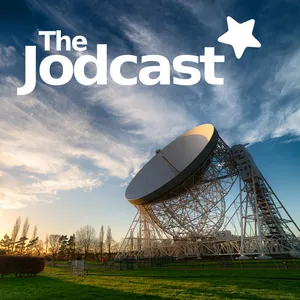
The Jodcast is an astronomy podcast created by students and staff from the Jodrell Bank Centre for Astrophysics. The episodes include the latest astronomy news, interviews with astronomers, stargazing information, and more.
Latest Episodes
The most recent episodes — sign up to get AI-powered summaries of each one.
- Oct 3, 200853 min
October 2008
You don't see the same universe twice. This month Jim Cordes tells us [20:12 - 34:25] about the recently discovered class of pulsars which emit their pulses in a very intermittent way. Jim also tells us about future searches for transient astrophysical objects and his use of the Arecibo radio telescope. As usual we get the latest news from Megan [01:14 - 08:37] and find out what you can see in the northern night sky from Ian [38:10 - 52:55].
- Sep 18, 20081h 19m
September 2008 Extra
In this show Tim returns to answer your questions about astronomy [09:04-37:16] and we talk to Andreas Faltenbacher about dark matter halos in the Millennium Simulation [37:38-76:56].
- Sep 2, 200849 min
September 2008
This month we bring you a final interview that we conducted at the National Astronomy Meeting in Belfast. Dill Faulkes, the man behind the Faulkes Telescope project, tells us why he set it up and what the future holds [20:12 - 34:25]. We also talk to Debbie Mitchell about how her training in astrophysics led her to a career working for the National Air Traffic Control Service [15:02 - 18:55]. As usual we get the latest news from Megan [01:03 - 08:08] and find out what you can see in the northern night sky from Ian [36:10 - 47:24].
- Aug 18, 20081h 11m
August 2008 Extra
In space nobody can hear you scream but that doesn't mean that it is totally quiet. In this show, Tim O'Brien helps our ears to explore the sounds of the cosmos [08:12-46:53] and Elaine Barrett tells us about her very special tour of NASA's Space Centre in Houston [48:03-1:10:13].
- Aug 2, 200847 min
August 2008
On 1st August 2008 parts of the world experienced a total solar eclipse. In the UK we saw a partial solar eclipse and the Jodcast was at Jodrell Bank Observatory with our eclipse special. We talk to Dr Phillipa Browning about eclipses and the state of our knowledge about the solar atmosphere [15:15 - 21:09] and to Professor Mark Edmonds about the evidence that prehistoric people had an interest in the Sun, Moon and stars. As usual we also get the latest news from Megan [02:35 - 10:59] and find out what you can see in the night sky from Ian [31:50 - 43:10].
- Jul 1, 200845 min
July 2008
With 95% of the content of the universe being dark, we ask Jochen Weller about dark energy and models that describe the expansion of the universe [16:28 - 31:17]. As usual we also get the latest news from Megan [02:09 - 10:28] and find out what you can see in the night sky from Ian [33:24 - 43:36].
- Jun 17, 200842 min
June 2008 Extra
In the show this time we find out how astronomers and particle physicists are detecting cosmic rays hitting our atmosphere with the Pierre Auger Observatory in Argentina [13:43 - 40:41]. Nick also gives us an update on some recent extrasolar planet discoveries which have found a planet only 3.3 times the mass of the Earth orbiting a star thought to be a brown dwarf [2:13 - 8:40].
- Jun 3, 200859 min
June 2008
In this show we talk about Mars Phoenix Lander touching down on Mars and sending back its first results. In our interview Ben Maughan tells us how he has been weighing clusters of galaxies. Tim O'Brien tells us about events at Jodrell Bank Observatory over the next month including the Longest Day Garden Party. We also get the latest news from Megan and find out what you can see in the night sky from Ian.
About The Jodcast
The Jodcast is an astronomy podcast created by students and staff from the Jodrell Bank Centre for Astrophysics. The episodes include the latest astronomy news, interviews with astronomers, stargazing information, and more.
Customized Recaps
AI-powered recaps with compact key takeaways, quotes, and insights.
Straight to Your Inbox
Get key takeaways from The Jodcast in a 5-minute read.
Save Hours Every Week
Stay current on your favorite podcasts without falling behind.
Frequently Asked Questions
What is Podzilla's The Jodcast daily summary?
It's a free AI-powered email that summarizes new episodes of The Jodcast as soon as they're published. You get the key takeaways, notable quotes, and links & mentions — all in a quick read.
How does the The Jodcast podcast summary work?
When a new episode drops, our AI transcribes and analyzes it, then generates a personalized summary tailored to your interests and profession. It's delivered to your inbox every morning.
Is this an official The Jodcast product?
No. Podzilla is an independent service that summarizes publicly available podcast content. We're not affiliated with or endorsed by Jodrell Bank Centre for Astrophysics.
Can I get summaries of other podcasts too?
Absolutely! The free plan covers up to 3 podcasts. Upgrade to Pro for 15, or Premium for 50. Browse our full catalog at /podcasts.
How often does The Jodcast release new episodes?
The Jodcast publishes monthly. Our AI generates a summary within hours of each new episode.
What topics does The Jodcast cover?
The Jodcast covers topics including Science. Our AI identifies the specific themes in each episode and highlights what matters most to you.
Start getting The Jodcast summaries tomorrow morning.
Free forever for up to 3 podcasts. No credit card required.
Free forever for up to 3 podcasts. No credit card required.