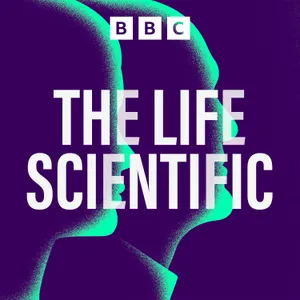
Free Daily Podcast Summary
The Life Scientific: Daily Summaries Delivered
by BBC Radio 4
Professor Jim Al-Khalili talks to leading scientists about their life and work, finding out what inspires and motivates them and asking what their discoveries might do for us in the future
Latest Episodes
The most recent episodes — sign up to get AI-powered summaries of each one.
- May 26, 202628 min
Dean Lomax on discovering ichthyosaurs and defying nay-sayers
Have you ever been told you aren't good enough to do something, then gone ahead and proved the naysayers wrong by doing it anyway - in glorious, headline-grabbing style? That is the satisfying story of Dr Dean Lomax. Dean grew up in Doncaster with a passion for fossils but after failing various school exams, was told by teachers that he'd never make it as a palaeontologist. Undeterred by leaving school with no qualifications, Dean sold his childhood Star Wars collection to fund a fossil-hunting trip to America that changed his life - after which a chance discovery led to him publishing his first ever scientific paper at the age of just 20. Today, he’s an expert on ichthyosaurs - the massive marine reptiles that once inhabited our seas - and has discovered and named several new species, written books for both adults and children, and brought the prehistoric world to life on TV. Talking to Professor Jim Al-Khalili, Dean discusses dinosaurs as a 'gateway science', discovering the Rutland Sea Dragon and the importance of cutting out noise from nay-sayers to follow your dreams...Presented by Jim Al-Khalili Produced by Lucy Taylor A BBC Studios production
- May 19, 202628 min
Helen Hastie on the future of human-robot relations
What if robots of the future weren’t just clever machines, performing tasks in isolation, but trusted teammates you could have a chat with? That could respond naturally to conversational cues and even explain their work? Making this relationship a reality is a focus for Helen Hastie, Professor of Human-Robot Interaction and Head of the School of Informatics at the University of Edinburgh. Helen’s career has taken her from developing early dialogue systems - the ancestors of today’s generative AI - to working on sophisticated bots that can serve coffee with a side of small-talk, teach struggling kids with empathy, or provide calm and confident decisions as triage nurses. She’s also driven some of the UK’s flagship robotics initiatives, including as co-lead of the National Robotarium.Talking to Professor Jim Al-Khalili - who reveals he was once told off for rudeness by an early chatbot - Helen explains her hopes for useful, reliable and ultimately trustworthy robots; machines that aren’t just in our world but a welcome part of it. Presented by Jim Al-Khalili Produced by Lucy Taylor A BBC Studios production
- May 12, 202628 min
Seth Berkley on the importance of vaccinating the world
Dr Seth Berkley is an epidemiologist and global health leader whose career has been shaped by one central problem: vaccines save lives, but only if people can actually get them.His 40-year career has spanned the global, from helping to build Uganda’s first HIV surveillance system and founding the International AIDS Vaccine Initiative; to leading Gavi, the Vaccine Alliance for more than a decade – overseeing the immunisation of hundreds of millions of children worldwide. And when COVID-19 struck, Seth co-founded COVAX, the global initiative designed to stop wealthy nations monopolising vaccines.In conversation with Professor Jim Al-Khalili, Seth discusses the highs and lows of his globe-trotting career - from saving millions of young lives through vaccine distribution, to setting his own shattered leg after a climbing accident in Namibia - and addresses the huge challenge of tackling vaccine scepticism.Presented by Jim Al-Khalili. Produced by Lucy Taylor. A BBC Studios production.
- May 5, 202628 min
Hiranya Peiris on unravelling the story of the universe
Hiranya Peiris is playing a starring role in a movie that promises to tell perhaps the greatest story of all time. However, it’s a movie with a difference – there’s no director and no script. The Legacy Survey of Space and Time is one of the most ambitious projects in the world of astronomy, with a mission to create a decade-long time-lapse movie of the visible universe, to answer fundamental questions about its origin, evolution and, ultimately, its fate.Hiranya is Professor of Astrophysics 1909, the prestigious Chair at the Institute of Astronomy at Cambridge University. Over her career she’s been one of the pioneers of a revolution in astronomy, bridging fundamental physics with the observational data coming back from space, to establish the first evidence-based standard model for the origin, evolution and fate of the universe. The endeavour has transformed the field from the ‘wild west’ of physics to the modern era of precision cosmology. Ironically, it was another movie, of sorts, Carl Sagan’s documentary series ‘Cosmos’, that first sparked Hiranya’s interest in the universe as a young girl. Always keen to inspire women to follow in her footsteps and choose careers in science, if this interview were a live show she’d have reserved the front row for schoolgirls.Presented by Jim Al-Khalili Produced by Beth Eastwood A BBC Studios production
- Apr 28, 202628 min
Washington Yotto Ochieng on the navigation tech that keeps our world moving
As a child growing up on the shores of Lake Victoria in western Kenya, Washington Yotto Ochieng once watched a plane cross the night sky and told his mother he wished he could travel on it. But he remembers her encouraging him to dream bigger...Today, Washington is a Professor of Engineering at Imperial College London, and President of the Royal Institute of Navigation. Over a career bridging industry and academia, he has helped shape the movement of urban transport; how satellites guide us and locate us; and how governments manage the technologies underpinning so much of modern life. Professor Jim Al-Khalili speaks to Washington about his inspirational upbringing, how reliant we've become on technologies such as GPS, and his work encouraging the next generation of engineers in both the UK and Africa. Presented by Jim Al-Khalili Produced by Lucy TaylorA BBC Studios production
- Apr 21, 202628 min
Lucy Carpenter on how our oceans are destroying ozone
Working on a remote tropical island in the Atlantic might sound like some sort of romantic idyll - but trying to conduct scientific research on a windy, isolated volanic outcrop is no picnic, as Lucy Carpenter can attest!Lucy is an atmopsheric chemist and a Professor at the University of York, whose work has helped to transform understanding of how oceans shape the air above them. She was one of the founding scientists behind the Cape Verde Atmospheric Observatory, established on São Vicente in 2006 and now a key global monitoring site. Measurements made there helped overturn a long-standing assumption: ozone loss is not solely a human-made problem. Lucy and her colleagues showed that gases released by natural marine processes can trigger chemical reactions that destroy ozone - demonstrating that the sea is not simply a passive backdrop to climate change but an active participant; affecting aerosols, clouds and ultimately the climate itself.More recently Lucy's expertise has taken her into the policy arena, co-chairing the scientific assessment panel for the Montreal Protocol: the international agreement designed to protect the ozone layer.In conversation with Professor Jim Al-Khalili, Lucy dicusses her journey from sampling ocean air to turning the tide of global environmental policy - and explains why her passion for duathlons could arguably be seen as an easier pastime than scientific research.Presented by Jim Al-Khalili Produced by Lucy Taylor A BBC Studios production
- Apr 14, 202628 min
Jens Juul Holst on the gut hormone discovery behind weight-loss drugs
As recently as a few years ago, the idea of a self-administered injection that would deliver proven weight-loss results might have sounded fantastical. Today, these medications are a reality and a global phenomenon; hailed in many quarters as “miracle drugs" for their success in treating obesity and diabetes. They do this by replicating a gut hormone called GLP‑1, which tells the brain you’ve eaten enough and nudges the pancreas to release insulin; and this hormone was discovered and decoded thanks to years of work by today's guest.Jens Juul Holst is a Professor of Medical Physiology and Biomedical Sciences at the University of Copenhagen. His efforts laid the groundwork for today’s weight loss jabs, earning him a slew of high-profile accolades and awards. Now it seems they might not only have positive impacts on obesity and diabetes, but also other health issues...But alongside the big success comes some big questions: including concerns over side effects, weight regain post-treatment, the black market in such drugs, and their cost and accessibility. In a frank conversation with Professor Jim Al-Khalili, Jens address these issues and shares his hopes for the future of GLP-1-focused research. Presented by Jim Al-Khalili Produced by Lucy Taylor A BBC Studios production
- Apr 7, 202628 min
Jim Ashworth-Beaumont on how a near-fatal accident made him a better clinician
It's a rare thing to encounter a medical specialist who has experience of his field from the expert and the patient perspective - but not unheard of...Jim Ashworth-Beaumont is an orthotist and prosthetist who spent years helping people adapt to life with artificial limbs and musculoskeletal supports, before a near-fatal accident left him relying on both.This twist of fate might have derailed many - but Jim drew on reserves of resilience and determination forged long before his accident; initially in the army, then by returning to education to earn the qualifications he missed out on as a youngster. He put himself through night school before earning a place to study Prosthetics and Orthotics at the University of Strathclyde. Later, while working at London’s Royal National Orthopaedic Hospital, Jim completed a Master’s in Neurorehabilitation, and a PhD in Health Studies – driven by a fascination with how the human body adapts under pressure.But in 2020, while training for a triathlon, Jim was involved in a catastrophic cycling accident that nearly killed him - and cost him an arm. He tells Jim Al-Khalili how the incident gave him a whole new insight into his patients’ experience and made him more determined than ever to achieve his goals.Presented by Jim Al-Khalili Produced by Lucy TaylorA BBC Studios production for Radio 4
Get The Life Scientific summaries in your inbox
Free AI-powered daily recaps. Key takeaways, quotes, and mentions — in a 5-minute read.
Get Free Summaries →Free forever for up to 3 podcasts. No credit card required.
You Might Also Like
Listeners also like.
In Our Time: Science
Discusses scientific principles, theories, and influential figures in the development of science.
BBC Inside Science
Explores the latest scientific discoveries and debates shaping our understanding of the world.
Discovery
Explores various topics in the field of science.
Science In Action
The BBC covers the latest weekly developments and news in science.
The World, the Universe and Us
Explores big scientific questions about life, consciousness, climate, and the cosmos with expert scientists and New Scientist journalists.
The Infinite Monkey Cage
A witty, irreverent exploration of science and the world with Adam Rutherford and Jess Fostekew.

5 Live Science Podcast
Dr Chris and the Naked Scientists present the latest science news and analysis.

Nature Podcast
Covers breakthrough research from Nature journal across all scientific fields, with insights from scientists and science journalists.

Inquiring Minds
Explores the intersection of science and society through critical thinking and in-depth analysis.

CrowdScience
Explores listener-submitted questions about life, Earth, and the universe with scientists at the forefront of research.
Curious Cases
Hannah Fry and Dara Ó Briain use science to solve listeners' questions and mysteries.
The Naked Scientists Podcast
A weekly science podcast featuring news, expert interviews, experiments, and listener Q&A.
About The Life Scientific
Professor Jim Al-Khalili talks to leading scientists about their life and work, finding out what inspires and motivates them and asking what their discoveries might do for us in the future
Customized Recaps
AI-powered recaps with compact key takeaways, quotes, and insights.
Straight to Your Inbox
Get key takeaways from The Life Scientific in a 5-minute read.
Save Hours Every Week
Stay current on your favorite podcasts without falling behind.
Frequently Asked Questions
What is Podzilla's The Life Scientific daily summary?
It's a free AI-powered email that summarizes new episodes of The Life Scientific as soon as they're published. You get the key takeaways, notable quotes, and links & mentions — all in a quick read.
How does the The Life Scientific podcast summary work?
When a new episode drops, our AI transcribes and analyzes it, then generates a personalized summary tailored to your interests and profession. It's delivered to your inbox every morning.
Is this an official The Life Scientific product?
No. Podzilla is an independent service that summarizes publicly available podcast content. We're not affiliated with or endorsed by BBC Radio 4.
Can I get summaries of other podcasts too?
Absolutely! The free plan covers up to 3 podcasts. Upgrade to Pro for 15, or Premium for 50. Browse our full catalog at /podcasts.
How often does The Life Scientific release new episodes?
The Life Scientific publishes weekly. Our AI generates a summary within hours of each new episode.
What topics does The Life Scientific cover?
The Life Scientific covers topics including Science, Culture, Journals, Society & Culture, Personal Journals. Our AI identifies the specific themes in each episode and highlights what matters most to you.
Start getting The Life Scientific summaries tomorrow morning.
Free forever for up to 3 podcasts. No credit card required.
Free forever for up to 3 podcasts. No credit card required.