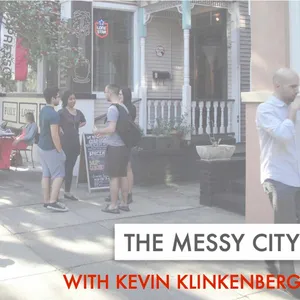
Free Daily Podcast Summary
The Messy City Podcast: Daily Summaries Delivered
by Kevin Klinkenberg
Embracing change, uncertainty and local initiative for our cities and towns
Latest Episodes
The most recent episodes — sign up to get AI-powered summaries of each one.
- Yesterday35 min
Order and Safety Matter More for Cities
For most of my career, people in the urban planning, architecture and development world have almost completely avoided the discussion on crime and order in cities. We seem to like to pretend it’s either not important, or we have nothing to say about it beyond CPTED (Crime Prevention through Environmental Design) techniques. In many cases, I just have people hand-wave the issue away, as if it doesn’t really matter - “crime will happen no matter what, I’m not an expert,” blah blah blah. Let’s talk about zoning standards and street design instead.Today I discuss why this issue needs to be front and center, especially now as most suburbs build out their own downtowns and walkable neighborhoods. I discuss the importance of seeing your own city as others see it, and what the actual marketing proposition is for living in a city.I admit for most of my life, I have not cared enough nor focused enough on this issue. I’ve probably had the same, very typical attitudes you see in the professional, urban world. That’s simply no longer the case, as I’ve gotten much more of an insider’s view, and as my own city has suffered through demand destruction due almost primarily to this problem. And, it’s not unsolvable, either. Many of the solutions just involve making this a clear priority, and getting everyone focused on it as a team. Perhaps I’ll dive more into that in the future. For now, I rant.Find more content on The Messy City on Kevin’s Substack page.Music notes: all songs by low standards, ca. 2010. Videos here. If you’d like a CD for low standards, message me and you can have one for only $5.Intro: “Why Be Friends”Outro: “Fairweather Friend” Get full access to The Messy City at kevinklinkenberg.substack.com/subscribe
- 3 weeks ago1h 5m
Property Taxes - How We Got Here
You might wonder how a podcast on urban planning, design and development could get interested in the arcane subject of property taxes. Except that, it’s all over the news lately, and its another fundamental issue than actual normies care about. People in my city have left it because of outrageous tax re-assessments. Developers and investors won’t invest in my County because of the same. And, frankly, we are a fairly no-drama, modest cost part of the world compared to many places.So I turned to Jaime Izurieta to start this conversation. Over at his Substack, The Vertical Sidewalk, Jaime recently authored a piece called “When the Levy Breaks,” which is a thorough introduction to how we got here with property taxation. I found the history incredibly interesting, and as a good a starting point as any for diving deep into this topic.As Jaime likes to say, “We don’t know that our way of doing this is the best. And we don’t know it isn’t.” But if we don’t start by understanding how we got here, we’ll never understand how to move forward.Find more content on The Messy City on Kevin’s Substack page.Music notes: all songs by low standards, ca. 2010. Videos here. If you’d like a CD for low standards, message me and you can have one for only $5.Intro: “Why Be Friends”Outro: “Fairweather Friend” Get full access to The Messy City at kevinklinkenberg.substack.com/subscribe
- Sep 1, 20261h 4m
Dissecting Euclid
Returning champion Aaron Lubeck joins me to discuss his exceptional piece called, “Revisiting Euclid v. Ambler at 100,” which he posted on his Substack “On Housing.” Aaron also posts and helps curate “Southern Urbanism” - an excellent publication I highly recommend.While a lot of ink has been spilled and words shared about the impact of the Euclid v Ambler case, Aaron’s column adds some new wrinkles and information to it that even surprised me. We talk in some detail about the case itself, the arguments made, and the people you might be surprised that were considered the “out” groups in that era. We also talk some about what a post-Euclid world could look like, and the implications for the planning profession.Because Aaron and I can’t stop at just one topic, we also hit on some of the perverse consequences of building and energy codes, and how “The modern world destroys all that cannot be quantified” as he states. Oh also, Mel Brooks at 100, and the need for more satire in our lives. Enjoy.Find more content on The Messy City on Kevin’s Substack page.Music notes: all songs by low standards, ca. 2010. Videos here. If you’d like a CD for low standards, message me and you can have one for only $5.Intro: “Why Be Friends”Outro: “Fairweather Friend” Get full access to The Messy City at kevinklinkenberg.substack.com/subscribe
- Aug 25, 20261h 0m
Learning from Rocket City, USA
Architect, Author, Photographer and New Urbanist Steve Mouzon joins me to tell his story about the emergence of New Urbanism in a location that many would consider unlikely. Huntsville, Alabama might be known for Space Camp, but it’s not widely known as a place to find great urban design and architecture. And that’s a shame, because there’s more lessons to learn here for most cities than by flying to a big, coastal market.Steve talks about the emergence of the Village of Providence in the early 2000s, its unique characteristics, and how that project also influenced the rebirth of downtown Huntsville. He also shares some of his own travails and triumphs, asking “why not us?” For more on Steve’s work, please do check out his incredible resource at The Original Green.Find more content on The Messy City on Kevin’s Substack page.Music notes: all songs by low standards, ca. 2010. Videos here. If you’d like a CD for low standards, message me and you can have one for only $5.Intro: “Why Be Friends”Outro: “Fairweather Friend” Get full access to The Messy City at kevinklinkenberg.substack.com/subscribe
- Aug 12, 20261h 3m
Overcoming the Fear-Industrial Complex
We bring back my brother Dean on this episode, to talk about how we often let our fears overrun our lives, and how to get beyond them. Dean is not just one of my favorite humans on the planet, he’s also a clinical psychologist, author of a number of books on the Mississippi River, and a world traveler. His newest book, “Better Safe than Sorry: Slow Boats, Chicken Buses, and the Radical Choice to Trust the World” is coming out in late August.For people who care about their communities and often wrestle with the fear of change, understanding what drives us and the psychology behind fear is essential. But even more so, we must understand how we can take steps to help people overcome those fears. Dean’s latest book is a study in how someone can gradually, incrementally overcome deep-seated worries or fears. He writes about how difficult it was for him to take risks as a young adult, and how over time that gave way. More importantly, he shares examples of how leaning into discomfort can frequently result in some of the greatest joys of life.I often ask when it comes to change in cities, “what are we really afraid of?” And I’m not trying to be dismissive - some change really can be for the worse. American cities have seen a lot of that in the 20th century, especially with massive urban renewal efforts. But it’s also true that most of our fears are unfounded, or rooted in something deeper. We like change, but we don’t like change. Or, we want a certain kind of change. And yet, our messy lives change whether we want them to or not. Dean’s book and our conversation tries to help people to not let fear rule your life, so that you might truly enjoy it.Find more content on The Messy City on Kevin’s Substack page.Music notes: all songs by low standards, ca. 2010. Videos here. If you’d like a CD for low standards, message me and you can have one for only $5.Intro: “Why Be Friends”Outro: “Fairweather Friend” Get full access to The Messy City at kevinklinkenberg.substack.com/subscribe
- Aug 5, 20261h 8m
Rethinking Infrastructure Finance
It’s very easy for all of us to get caught up in status quo bias. We live the way we do, it must be fine, right? The way things are surely is the way they’ve been for a very long time, and probably got this way for good reasons. Or so we think, if we think about it at all.I think about this a lot when I think about how we finance, design and build infrastructure. Sitting here in 2026, we have so many assumptions about the way things have always been, and that what we’ve landed on is the best way. But is it, really?For these, questions, I turned to brothers Vince and Geoff Graham. Vince and Geoff are true Renaissance men. They’re developers who have developed some of the most beautiful and inspirational communities of the last few decades. Those include Newpoint, in Beaufort, South Carolina and I’On in Mt. Pleasant, South Carolina. Both were wildly successful examples of New Urbanism, and showcased that we are still capable of building timeless, traditional places.But beyond their development endeavors (which continue, in less talked-about projects), they are both deeply curious and knowledgable about a wide range of topics. They’ve got a depth of understanding of history that is unique, and ask all the right, and hard, questions about the way we do things. We dive into a fair amount of American history in this episode, but I hope you’ll see how it all ties together with our difficult conversations today about infrastructure, community, and much more.Find more content on The Messy City on Kevin’s Substack page.Music notes: all songs by low standards, ca. 2010. Videos here. If you’d like a CD for low standards, message me and you can have one for only $5.Intro: “Why Be Friends”Outro: “Fairweather Friend” Get full access to The Messy City at kevinklinkenberg.substack.com/subscribe
- Jul 28, 202644 min
Is the Housing "Crisis" Real?
I get personal in this episode, in order to ask questions about the nature of what is called the “housing crisis.” Are we all just doom-pilling way too much?As a case study, I talk through the life and history of my parents, and discuss whether or not their life and lifestyle is still available today. I discuss house sizes, mortgage rates, lifestyle choices, lifestyle inflation, and more.Find more content on The Messy City on Kevin’s Substack page.Music notes: all songs by low standards, ca. 2010. Videos here. If you’d like a CD for low standards, message me and you can have one for only $5.Intro: “Why Be Friends”Outro: “Fairweather Friend”AI TranscriptIntroductionWelcome back to The Messy City Podcast. This is Kevin Klinkenberg. I’m going to do something a little different today and just talk without a guest about the topic of housing in particular and how it ties into a few other kind of hobby courses of mine. Why Challenge the Housing NarrativeReally what I want to spend some time doing is taking a contrarian view of how we talk about the so-called housing crisis. And in one sense, this is kind of fun for me to do. One of the things I really loved about my father is when we would have our discussions or debates in the family about various things that were going on, he would often take an opposite view of Almost just for the sport of it. And the truth is, there are a lot of times he was so good at it, you didn’t really know if he felt that way or not. Because he could do really well to argue multiple sides of an argument. And that was really a lot of fun. It was an education for me. It’s something I wish more people would just do generally and try to see an issue from multiple perspectives and try to steel man different perspectives or perspectives that are different from your own. And so I’ve kind of taken to obviously do that if you know me at all.You know I’ve done that a fair amount in my own life. Not nearly as good as my father was at it, but it has been fun to do occasionally. And I really wanted to apply this to the topic of housing. And there’s a couple of reasons for this. And this also ties into a story. I’m going to tell you a little bit of a story about my parents and how they grew up and their trajectory through life, because I think it’s actually very relevant to this topic. And whether or not we have a housing crisis at all in America, or if we do, what is the actual nature of of that crisis. And I want to talk about this because I just see so much online and in person conversation that I just feel like there are too many people, especially too many young people that have been kind of doom pilled on life today and life in America generally.And the thing that I want to start out that I really want to propose to everybody and talk about is the life that my parents had And their trajectory through life is still available today. It is absolutely and unequivocally still available to anyone who wants to choose the life that they lived. And in my opinion, obviously, I knew them really well. In my opinion, they had a tremendous life. They had a great life. They’ve both passed on in recent years. And so I have to talk in the past tense. But by any measure that matters, they had a great life. They lived well into their 80s. They had four kids. We actually all like each other. So it’s not just like a, you know, there are some families where you can say, well, I love my family. But as my brother used to say, or after my dad passed, he would say, you know, that... We didn’t just love our parents, we really liked our parents.And I think if you’re fortunate to be in a family like that, you know a little bit of what I’m talking about. And the four of us as children all... We get along. We’re still all friends with each other and get along. We enjoy being together. We’re all very different people with different interests and different worldviews. In some senses, we had pretty different childhoods, interestingly enough, because there’s a big age spread in our family. So my parents had four kids that they raised. They had a long, stable marriage. They were able to get consecutively better houses as they aged. And then by the time they hit retirement age, they had saved enough money to be able to do other things that they wanted to do. Along the way, they traveled when they wanted to. They really wanted to get out and see the country, see the world.When we were young, that traveling mostly involved just driving around the United States and going to national parks and big cities and seeing the sights. As they got older and had a little bit more disposable income, they would join tour groups and go or sometimes with family to foreign
- Jun 23, 202650 min
How to Scale Change with Housing
Eric Kronberg is back again, to dive deeper into the topics of housing choice, scale and essentially - what works and what doesn’t. Eric’s firm, Kronberg Urbanists & Architects, produces some of the routinely best graphic content to explain these complex issues. In this episode, in particular we discuss his updated Housing Choice Catalog, which is a tour de force of a document for anyone remotely interested in these issues.We discuss how to implement change, what some of the more important changes, are, and how to do this in real American towns and places. We also hit on one of my favorite topics, which is a discussion of what scales more quickly: small-scale infill or large multifamily/mixed-use projects.If you stick with us, you’ll also learn about the model to have a successful neighborhood center built around Homer Simpson’s favorite things.Find more content on The Messy City on Kevin’s Substack page.Music notes: all songs by low standards, ca. 2010. Videos here. If you’d like a CD for low standards, message me and you can have one for only $5.Intro: “Why Be Friends”Outro: “Fairweather Friend” Get full access to The Messy City at kevinklinkenberg.substack.com/subscribe
Get The Messy City Podcast summaries in your inbox
Free AI-powered daily recaps. Key takeaways, quotes, and mentions — in a 5-minute read.
Get Free Summaries →Free forever for up to 3 podcasts. No credit card required.
You Might Also Like
Listeners also like.

The Urbanist Agenda
An exploration of urban planning and mobility issues by popular online urbanists.
Talking Headways: A Streetsblog Podcast
A weekly podcast exploring sustainable transportation, urban planning, and economic development through expert interviews and analysis.
Community Catalysts
Leaders from local government and nonprofits share hard-won lessons and practical strategies for building stronger communities.
The Strong Towns Podcast
A weekly conversation exploring how urban design, economics, and community systems can strengthen cities and towns financially and socially.
Living for the City
Detroit’s music evolution from Motown to techno through stories of artists and creators who shaped its sound.
Kevin Kietzman Uncanceled
Discusses Kansas City local topics and national issues with an open, non-cancelling approach.

RacketCast
Local news, culture, and debates from a reader-funded, worker-owned Twin Cities media outlet.

Bozeman Beat
Conversations with community members about local issues and civic life in Bozeman.

The Kevin Rose Show
Conversations with experts in tech, science, and performance to uncover unconventional wisdom for personal and professional growth.

Optimist Economy
Economists analyze U.S. economic challenges like housing, healthcare, and retirement, pairing data and history with practical solutions.

State of Love & Trust Podcast
Jason Kerepesi & Paul Ghiglieri

It Could Happen Here
A daily chronicle of societal collapse and the search for a better future amid the ruins of the old world.
About The Messy City Podcast
Embracing change, uncertainty and local initiative for our cities and towns
Customized Recaps
AI-powered recaps with compact key takeaways, quotes, and insights.
Straight to Your Inbox
Get key takeaways from The Messy City Podcast in a 5-minute read.
Save Hours Every Week
Stay current on your favorite podcasts without falling behind.
Frequently Asked Questions
What is Podzilla's The Messy City Podcast daily summary?
It's a free AI-powered email that summarizes new episodes of The Messy City Podcast as soon as they're published. You get the key takeaways, notable quotes, and links & mentions — all in a quick read.
How does the The Messy City Podcast podcast summary work?
When a new episode drops, our AI transcribes and analyzes it, then generates a personalized summary tailored to your interests and profession. It's delivered to your inbox every morning.
Is this an official The Messy City Podcast product?
No. Podzilla is an independent service that summarizes publicly available podcast content. We're not affiliated with or endorsed by Kevin Klinkenberg.
Can I get summaries of other podcasts too?
Absolutely! The free plan covers up to 3 podcasts. Upgrade to Pro for 15, or Premium for 50. Browse our full catalog at /podcasts.
How often does The Messy City Podcast release new episodes?
The Messy City Podcast publishes weekly. Our AI generates a summary within hours of each new episode.
What topics does The Messy City Podcast cover?
The Messy City Podcast covers topics including Arts, Design, Culture, Society & Culture. Our AI identifies the specific themes in each episode and highlights what matters most to you.
Start getting The Messy City Podcast summaries tomorrow morning.
Free forever for up to 3 podcasts. No credit card required.
Free forever for up to 3 podcasts. No credit card required.