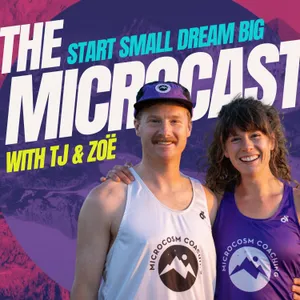
Free Daily Podcast Summary
The MicroCast: Daily Summaries Delivered
by Microcosm Coaching
The Microcosm Coaching Podcast helps endurance athletes—whether you're a road runner, trail runner, or training for your first marathon or 00-miler—get more out of their training with evidence-based advice, effort-based coaching, and expert mindset support. Hosted by professional coaches and athletes, each episode explores practical strategies for race prep, running recovery, mental performance, and sustainable training. If you want to build fitness, avoid burnout, and find more joy in running, you're in the right place.
Latest Episodes
The most recent episodes — sign up to get AI-powered summaries of each one.
- Yesterday53 min
5 Mistakes Self-Coached Runners Make
Coaching yourself? These are the five mistakes we see self-coached runners make most, and they're easier to fall into than you'd think. TJ and Zoë start with a listener question about the best time of day to train. Physiology gives late afternoon a small edge as core temperature and muscle readiness peak, but the real answer is whatever time lets you train consistently. They also cover running in the dark, why one missed workout doesn't matter, and whether evening runs wreck your sleep.Then the list. First, copying the wrong model, including what the HERITAGE family study found when hundreds of people did the identical training program and got wildly different results. Second, the Franken-plan, where a podcast workout, a YouTube session, and a group track night get stitched together with nothing connecting them. Third, training your strengths instead of your limiters, and how to periodize hills, speed, and technical downhills months out from your goal race. Fourth, the planning fallacy, and the research on why we underestimate how long everything takes, even compared to our own worst-case guesses. Fifth, making big training decisions in the wrong emotional state, from post-DNF race sign-ups to the dangers of watching a Billy Yang film on a full stomach.Plus, meet Microcosm coach Skylar, who works with road runners from the mile to the marathon.LinksFoothills community ($10/month, coach calls + Slack community), code FOOTHILLS10: https://microcosm-coaching.comWork with a Microcosm coach, including Coach Skylar: https://microcosm-coaching.comSend us your questions and Hot or Nots: microcosmcoaching@gmail.com
- 1 weeks ago1h 4m
Running Advice That Aged Badly: 6 Running Myths Debunked (Lactic Acid, Stretching, Cadence & More)
Lactic acid, static stretching, stability shoes, heel striking, 180 cadence, and icing everything: some running advice has not held up. Coaches Zoë Rom and TJ David cover six common myths, what the research actually shows, and why some of these ideas have stuck around for so long. Zoë also apologizes to everyone she sold motion-control shoes to in Northwest Arkansas.Also in this episode:A listener asks why they feel wired and can't sleep after long runs. We cover what's going on in the nervous system, the caffeine you might be missing, and when this becomes a red flag.TJ gives an update on his health: he's been diagnosed with sarcoidosis after being misdiagnosed with HAPE at Leadville.Zoë recaps Mammoth Trailfest and shares a first look at next year's race plans.Resources mentionedCochrane Review (2022): running shoes for preventing lower limb injuriesPEACE & LOVE framework for soft tissue injuries (Dubois & Esculier, BJSM)Coaching: microcosm-coaching.com | Email: microcosmcoaching@gmail.comRate and review wherever you listen. It really helps!
- 2 weeks ago59 min
Am I Ready to Move Up in Distance? (And Should I Practice Walking?)
Ready for your next ultra distance? Maybe. In this episode, we tackle the question of when to move up from the 50K to the 50 mile, 100K, 100 mile, and beyond, and why the "ladder" framing might be steering you wrong. Distance alone doesn't say much about what a race demands. A mountainous 50K can ask more of you than a runnable 50 miler, so we talk about how to size up a race by duration, terrain, and your own capacity.We start with a listener question: should you practice run-walking during ultra training, especially on tired legs in high-volume weeks? We explain why power hiking is a race skill, why fixed run-walk ratios work well in training but poorly in races, and why extra walking can be stress without much stimulus.From there, we cover how to identify your real weaknesses. That means separating a bad day from a pattern, finding root causes instead of symptoms, and deciding which limiters to address first. Spoiler: it's often fueling and hydration. We share practical approaches for improving speed, climbing, descending, durability, and your gut. We finish with the signs you're ready to move up, what does and doesn't change in training as races get longer, the special demands of 200 milers, and when it's better to wait.Plus, meet Microcosm coach Kylee Van Horn: nearly 20 years of coaching across road, track, and trail, a registered dietitian's lens on fueling, and a hot take about why you can't cross-train your way to a 100 miler.In this episode:Kylee Van Horn coach spotlightListener question: should you practice run-walking?Power hiking vs. walking, and why fixed ratios fail on race day"Stress, not stimulus": the hidden cost of extra walking volumeWhy the ultra distance "ladder" is a mythHow to find your weaknesses and root causesPrioritizing limiters: low-hanging fruit firstTraining for speed, climbing, descending, durability, and GI toleranceSigns you're ready to move up in distanceWhy 50K and 100 mile training look more similar than you thinkWhat makes 200 milers differentWhen not to move up, and the six-year testWant to work with Kylee or another Microcosm coach? We have roster spots available. Email microcosmcoaching@gmail.com or visit microcosm-coaching.com.If you liked this episode, subscribe, follow, and leave us a review. We read all four of them.
- 3 weeks ago1h 1m
Ability vs. Ambition, Repeating Races, and Why You Might Gain Weight While Training
Zoë's article on Ability vs. AmbitionYDS Episode on "Racing Weight"There's always a gap between where you are as an athlete and where you want to be. Zoë wrote about it for UltraSignup , "Closing the Gap Between Ability and Ambition", and this week TJ reads it back to her, days before she lines up at Run Rabbit Run 100 for the third time. They dig into Ira Glass's idea of "the gap," why admitting you want to be great feels so vulnerable, what "spiritual durability" actually means in a training context, and why the most successful athletes usually aren't the most talented — they're the ones willing to sit in that discomfort long enough to close it.From there: why repeat a race you've already done well twice, why you technically can't (same course, different athlete, different river), how Zoë structures a year around two big hundreds using a rule of thirds, and how she's managing the comparison trap and her mental diet heading into a deeper field than she's ever raced.Then a listener question that comes up constantly: "I'm training more than ever and I've gained weight instead of losing it. Is that normal?" Yes — and here's what the scale is actually measuring: glycogen and the water it binds, inflammation from tissue repair, blood volume, food in transit. Plus what the research really says about body weight and injury risk, and when weight change is worth a conversation with a doctor.
- 4 weeks ago1h 4m
How Much Volume Do You Actually Need? Minimum Dose, Optimal Dose, Frequency, and Distribution
How many miles a week do you need to run to get better? It's the question coaches hear most, and the annoying answer is: enough to create an adaptation, not so much that you can't absorb it. The body doesn't experience a mileage total. A mile on a 14er and a mile on a track are completely different stresses, which is why time at effort is a better way to think about volume than distance.TJ and Zoë break volume into four levers. How much: the difference between the minimum effective dose, the optimal dose, and the maximum recoverable dose, and why most runners should be asking about the middle one. How often: what 3, 4, 5, 6, and 7 days a week actually get you, and why frequency is the most overlooked tool for newer runners. How long: why 15 + 5 is not a 20-mile long run, and why the cost of a run doesn't rise in a straight line. And where: easy/hard distribution, the weekend-warrior trap, and why back-to-back long runs are a tool rather than an organizing principle. It all starts from the same place — the week you can actually repeat, found in your TrainingPeaks history, not the week you're proudest of.First, TJ has an answer for what happened at Leadville. Then: a listener question about Nordic skiing all winter and protecting running fitness for a spring 50K, and Hot or Not on mocktails, aid station hydration mixes, and Tiger Balm.Questions for a future episode: microcosmcoaching@gmail.comCoaching and community: https://microcosm-coaching.com
- Aug 26, 20261h 3m
A Leadville Win and a Leadville DNF: What Both Taught Us About Training
Leadville 100 week gave Microcosm both ends of the sport in a single day: coach TJ David's athlete McKendree Hickory won the women's race in her 100-mile debut, and TJ himself dropped at the Winfield turnaround after nearly fifty miles of not being able to breathe.Zoë and TJ take both apart honestly. On the win: what five months of coaching actually changed, why TJ inferred McKendree was naturally durable from four years of training history, and how identifying two points of friction — pacing discipline and a reluctance to lean into discomfort late in races — mattered more than overhauling everything. She raced her dress rehearsals under fatigue, ran a conservative early pace by design, and degraded only 8.25 percent over a hundred miles at altitude, where ten to fifteen is considered excellent.On the DNF: the difference between confidence and self-efficacy, why protecting mental bandwidth during race week is a training variable, and what it's like when a heart rate that should read 114 reads 140 at mile ten. TJ walks through the internal argument, the broken poles on Hope Pass, the decision at Winfield, and how he's processing a race he trained two years for.Plus a listener question up front: can you build a Boston qualifier on a treadmill, and what has to happen outside anyway.Questions for a future episode: microcosmcoaching@gmail.comCoaching and community: https://microcosm-coaching.com
- Aug 19, 202657 min
Is Training Making You Slower?
Your easy pace is slower than it was two months ago. Workouts feel harder. You're doing more volume than you've ever done — so shouldn't you be getting faster?A listener wrote in with exactly that question, and it turned into a full episode. Coach TJ and Zoë unpack why feeling slower in a big block is usually the block working, not the block failing — and how to tell the difference when it isn't.The core idea: fitness and performance are not the same thing. Fitness is the physiological capacity you've built. Performance is how much of it you can access on a given day. Every training stimulus produces both a fitness response (slow, cumulative, quiet) and a fatigue response (fast, temporary, extremely loud). Fatigue is louder than fitness — you don't wake up feeling your mitochondrial density, but you absolutely feel Tuesday's workout on top of Sunday's long run.IN THIS EPISODE- Why aerobic base and durability are the two slowest adaptations in endurance sport — and why that means you can't train for just one race- The real sources of training fatigue: glycogen depletion, peripheral muscle fatigue, neuromuscular fatigue, connective tissue loading, and central/autonomic nervous system stress- Why comparing today's run to the same route two years ago on Strava is apples to oranges- Goodhart's Law in training: the moment easy pace becomes the metric you optimize, it stops being a useful proxy for fitness- Progress signals that actually mean something: same pace at lower RPE, same RPE over more vert, better output late in long runs, tolerating back-to-back long runs, and — the most underrated one — recovering faster from the same load- Can training make you less fit? The honest answer, plus why "worse at a 5K while training for a 100" isn't the same as losing fitness- Normal acute fatigue vs. functional overreaching vs. non-functional overreaching vs. actual overtraining syndrome — and why most athletes who think they're overtrained are under-recovered- The red-flag list: elevated easy RPE for days-to-weeks, repeated failure at previously manageable workouts, recovery that doesn't produce a rebound, sleep disruption, mood and motivation changes, recurrent illness, injury creep, menstrual cycle disruption- What TJ's biggest-ever build actually looked like: 15-hour weeks, multiple 100-mile weeks, four (sometimes five) long runs a week, and running slower than he ever hasALSO IN THIS EPISODE — HOT OR NOT- The Leadville 100: no qualifiers to enter, aggressive early cutoffs, and where the competitive incentives are drifting- Changing shoes mid-race (a caveated yes)- Sitting down at aid stations (a hard no, and the physiology behind it)- Listening to podcasts while racing (one yes, one very firm no)BETTER QUESTIONS THAN "AM I GETTING FASTER?"Am I tolerating more training? Am I recovering from it? Am I generally healthy and adequately fueled? Does performance return when fatigue comes down?Don't confuse a temporary inability to express fitness with the absence of it.- Zoë's UltraSignup article on Goodhart's Law: https://trailhead.ultrasignup.com/science-outdoors/data-for-runners/GET IN TOUCHQuestions for a future episode: microcosmcoaching@gmail.comCoaching and community: https://microcosm-coaching.com
- Aug 12, 202658 min
Downhill Running Science: Eccentric Loading, the Repeat Bout Effect & Descending Technique
Email us your listener questions or hot or nots at microcosmcoaching@gmail.com.Check us out online at microcosm-coaching.comDownhill running is a technical skill, not a fitness problem, and this week Zoë Rom and TJ David break down the science of eccentric loading, the repeat bout effect, and how to descend faster without trashing your quads. They go inside the muscle to explain what actually happens to your sarcomeres on a long descent, why delayed onset muscle soreness peaks a day or two later instead of immediately, and why force output can stay down for up to a week even after the soreness clears. From there it's the practical stuff: how braking multiplies eccentric load, why sitting back is the single most common descending error, how to train your eyes on technical terrain, why fear itself makes descending harder, and where strength work genuinely helps versus where it can't replace actual practice. Plus Hot or Not on blood donation for endurance athletes, the red blood cell and iron math every runner should understand before donating, and how to time it around a race build, and random race pacers. In the listener question, a runner training for their second 50 miler on seven hours a week asks whether elite ultra training is fundamentally different from everyone else's. Short answer: same recipe, different dose. The episode opens with training through summer heat, racing amid wildfire uncertainty, and why holding your goal race lightly is a useful gut check.
Get The MicroCast summaries in your inbox
Free AI-powered daily recaps. Key takeaways, quotes, and mentions — in a 5-minute read.
Get Free Summaries →Free forever for up to 3 podcasts. No credit card required.
You Might Also Like
Listeners also like.

The 1% Better Runner with DLake
A running coach shares practical strategies for building daily habits that improve performance and personal growth.

Some Work, All Play
Discussions on running, training, races, science, and pop culture with insights from a doctor and coach.

Runners FM
Discusses running techniques, training tips, and stories from the running community to help runners improve and stay motivated.

The Running Shorts Podcast
Discusses running news, training advice, and commentary.

Run Your Story Podcast
Runners and walkers share their personal stories, memories, and advice about the sport.

The Average Runner
A podcast for runners of all levels that shares training tips, gear reviews, and inspiring stories from everyday athletes.
UNTAPPED with Spencer Matthews
Spencer Matthews interviews runners, coaches, and scientists about training, performance, and the science of running.

The Run Smarter Podcast
A physiotherapist and guests discuss running injuries, prevention, and performance through science-based insights and practical advice.
Human Performance Outliers Podcast with Zach Bitter
Exploring the science and stories behind extreme human performance in endurance, fitness, and nutrition through expert interviews.

TRAINED
Discusses fitness and wellness through interviews with athletes, scientists, and health experts on mindset, nutrition, movement, recovery, and sleep.

Dissecting High Performance In Tennis
A deep dive into the coaching philosophies and methods that shape elite tennis players’ development and performance.

Back of the Pack Podcast
A podcast for casual runners who love race swag, local 5Ks, and the camaraderie of finishing at the back of the pack.
About The MicroCast
The Microcosm Coaching Podcast helps endurance athletes—whether you're a road runner, trail runner, or training for your first marathon or 00-miler—get more out of their training with evidence-based advice, effort-based coaching, and expert mindset support. Hosted by professional coaches and athletes, each episode explores practical strategies for race prep, running recovery, mental performance, and sustainable training. If you want to build fitness, avoid burnout, and find more joy in running, you're in the right place.
Customized Recaps
AI-powered recaps with compact key takeaways, quotes, and insights.
Straight to Your Inbox
Get key takeaways from The MicroCast in a 5-minute read.
Save Hours Every Week
Stay current on your favorite podcasts without falling behind.
Frequently Asked Questions
What is Podzilla's The MicroCast daily summary?
It's a free AI-powered email that summarizes new episodes of The MicroCast as soon as they're published. You get the key takeaways, notable quotes, and links & mentions — all in a quick read.
How does the The MicroCast podcast summary work?
When a new episode drops, our AI transcribes and analyzes it, then generates a personalized summary tailored to your interests and profession. It's delivered to your inbox every morning.
Is this an official The MicroCast product?
No. Podzilla is an independent service that summarizes publicly available podcast content. We're not affiliated with or endorsed by Microcosm Coaching.
Can I get summaries of other podcasts too?
Absolutely! The free plan covers up to 3 podcasts. Upgrade to Pro for 15, or Premium for 50. Browse our full catalog at /podcasts.
How often does The MicroCast release new episodes?
The MicroCast publishes weekly. Our AI generates a summary within hours of each new episode.
What topics does The MicroCast cover?
The MicroCast covers topics including Sports, Running. Our AI identifies the specific themes in each episode and highlights what matters most to you.
Start getting The MicroCast summaries tomorrow morning.
Free forever for up to 3 podcasts. No credit card required.
Free forever for up to 3 podcasts. No credit card required.