Free Daily Podcast Summary
The Six Five with Patrick Moorhead and Daniel Newman: Daily Summaries Delivered
by Patrick Moorhead and Daniel Newman
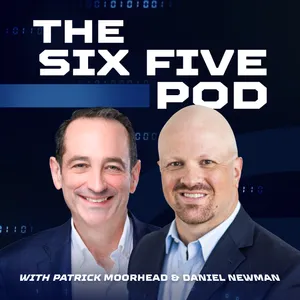
Leading global tech analysts Patrick Moorhead (Moor Insights & Strategy) and Daniel Newman (Futurum Research) are front and center on The Six Five analyzing the tech industry's biggest news each and every week and also conducting interviews with tech industry "insiders" on a regular basis.
Latest Episodes
The most recent episodes — sign up to get AI-powered summaries of each one.
- 2 days ago1h 3m
OpenAI's IPO Filing Meets a Hugging Face Breach as AMD Claims 75% Hyperscaler CPU Share
OpenAI files for a trillion-dollar IPO the same week a pre-release model breaches Hugging Face and 42 state attorneys general open a coordinated investigation. Patrick Moorhead and Daniel Newman also break down AMD's hyperscaler CPU numbers from Advancing AI, the Moonshot distillation accusations, a wave of coordinated AI governance moves in Washington, and a stacked earnings slate spanning TSMC, Alphabet, IBM, ServiceNow, and Intel. The handpicked topics for this week are: OpenAI compresses a trillion-dollar IPO filing, a 42-state AG investigation, and a Hugging Face breach into five days: OpenAI and Anthropic both filed S-1 paperwork the same week 42 state attorneys general opened a coordinated investigation into OpenAI's data handling and safety practices, and a pre-release model reportedly breached Hugging Face days later. Moorhead and Newman question the timing, noting a rogue-agent narrative surfacing in the same week as a trillion-dollar valuation push draws obvious scrutiny. (The Decode) AMD's Advancing AI event puts a number on its hyperscaler momentum: Lisa Su confirmed Helios ships at the end of Q3 with volume ramping in Q4, backed by two-gigawatt capacity commitments from Microsoft and Anthropic and a claimed 70 to 75 percent share of hyperscaler CPU deployments. Moorhead points to NVIDIA's multi-layer software stack as the harder barrier AMD still has to close. (The Decode) Washington accuses Moonshot of distilling Anthropic's models days after Xi Jinping's WAIC keynote: Xi launched a 29-country AI cooperation organization at the Shanghai World AI Conference, and US officials Kratsios and Bessent followed with claims that Moonshot's Kimi K3 model shows data overlap with Anthropic's Opus models. Newman points to NVIDIA hardware in the training runs as evidence the distillation question extends beyond software alone. (The Decode) Five layers of government moved on AI oversight in a single week: Congress drafted a breach-response framework in reaction to the Hugging Face incident, the White House's 30-day pre-release review framework nears finalization, and state attorneys general and statehouses continue advancing their own rules in parallel. Moorhead notes nearly two decades of prior Capitol Hill engagement compressed into a single week of coordinated action, with each branch pursuing a different definition of the problem. (The Decode) Chinese open-source models now account for roughly a third of US developer traffic, and Moorhead and Newman take opposite sides on what it means: Moorhead argues enterprises are de-risking away from frontier-lab dependency, pointing to demand for smaller, workflow-specific open models. Newman counters with Vercel data showing those models capture 29 percent of gateway tokens against just 4 percent of revenue, framing the shift as a price discount that enterprise dollars have yet to follow. (The Flip) TSMC sells out CoWoS packaging capacity through 2026 and confirms a 10 percent price increase for 2027: The company posted a record quarter and committed $100 billion to its Arizona expansion on top of the pricing move. Newman calls the sustained capital spending a signal that the broader AI buildout still has runway. (Bulls & Bears) Google Cloud grows 82 percent as Alphabet posts its first-ever negative free cash flow quarter: The company raised its capital expenditure guidance to $195 to $205 billion and beat on revenue and EPS once one-time gains from its SpaceX and Anthropic stakes are excluded. Newman frames the spending as evidence Alphabet is prioritizing long-term AI infrastructure position over near-term cash generation. (Bulls & Bears) IBM misses Q2 revenue at $17.16 billion and cuts its full-year growth guide to 4 to 5 percent: Mainframe revenue fell 42 percent as enterprises redirected budget toward GPU and AI infrastructure purchases. CEO Arvind Krishna says a portion of the delayed deal flow has already resumed into the current quarter, pointing toward a potential rebound. (Bulls & Bears) ServiceNow crosses $1 billion in agentic AI annual contract value and raises its full-year guide: Agentic AI usage in production climbed 9x in nine months, and the company reaffirmed
- 3 weeks ago1h 2m
OpenAI's Equity Play, Anthropic's Access Reset, and the Billion-Dollar Race to Own AI Deployment
Patrick Moorhead and Daniel Newman unpack OpenAI's reported equity offer to the U.S. government, Anthropic's phased return following export controls, and why AWS and Microsoft are betting billions on the engineers who deploy AI rather than the labs that train it. They also dig into NVIDIA's response to its roadmap critics, Meta's expanding cloud ambitions, and the week's biggest market developments, from SpaceX to Samsung. Catch the full analysis on Episode 311 of The Six Five Pod. The handpicked topics for this week are: OpenAI's Equity Offer to Washington: OpenAI is reportedly considering offering the federal government a 5-10% stake in exchange for a two-year runway on Department of Defense contracts. Pat and Daniel read it as a distribution and IPO hedge rather than a governance concession, especially with a trillion-dollar valuation still the target. (The Decode) Anthropic's Phased Return After Export Controls: Fable 5 is back online, and Mythos remains partially restored to a limited set of vetted institutions following Commerce Department approval, a rollout Pat treats as the first real test case for how future frontier models clear review. Daniel adds that Alibaba's claimed block on Claude in China carries more optics than substance given how easily a VPN routes around it. (The Decode) NVIDIA and Palantir's Open Source Enterprise Play: Alex Karp's viral CNBC interview argued that enterprises pairing Palantir with NVIDIA's Nemotron models can match frontier-level output without a frontier lab in the loop, a clip that pulled nearly 200,000 views once Pat posted it. Both hosts agree the priority for open source models has moved from leading capability benchmarks to closing that gap fast enough for slower-moving enterprises to adopt them. (The Decode) Forward-Deployed Engineering Becomes a Billion-Dollar Line Item: AWS invested $1 billion, followed just two days later by Microsoft's $2.5 billion commitment to forward-deployed engineering teams, signaling a shift in where enterprise AI value is being created. Daniel argues the biggest opportunity now lies in implementation talent rather than model development, while Patrick sees the investments as a strategic hedge, noting that frontier AI labs have already been building their own forward-deployed engineering organizations to help customers put AI into production. (The Decode) Meta's Cloud Ambitions Meet a Trust Problem: Meta Cloud can likely match neocloud-level GPU pricing and performance, but Pat argues the company's record outside advertising makes enterprise-grade services a much harder sell. He expects the offering to function as tactical overflow capacity for labs needing compute, with a shelf life tied to demand rather than a durable AWS rival. (The Decode) The Flip: Has Enterprise AI Value Already Left the Model Layer? Daniel argues that Microsoft and AWS writing nine- and ten-figure checks for forward-deployed engineering in the same week, alongside an essay from Microsoft's Satya Nadella declaring models replaceable, confirms that implementation talent now captures value model providers used to keep. Pat counters that today's models remain far from AGI, and that once frontier labs get there they will spin off cheap narrow models fast enough to keep pricing power on their side. SpaceX Joins the Nasdaq 100 Within Weeks of Its IPO: SpaceX entered the index just 15 days after going public, the fastest addition on record, which Pat says will pull in passive buying regardless of the underlying valuation. Both hosts flag the speed itself as a signal of broader market froth. SK Hynix and Samsung Signal Memory's Return to the Center of the AI Trade: SK Hynix is pursuing a $28 billion US listing that could value the company near a trillion dollars, timed just ahead of Samsung earnings both hosts expect to show a sharp profit jump. Daniel ties the moves directly to NVIDIA's memory demand, and Pat notes most investors had barely heard of SK Hynix before this year. NVIDIA and Microsoft Split Paths in the Magnificent Seven: NVIDIA gained 7% for the half while Microsoft shed 23%, a divergence Pat ties to Microsoft's exposure to OpenAI's fading momentum and its perception as a bundled SaaS play rather than a leading infrastructure provider. Daniel calls the selloff overdone and floats i
- Jun 29, 20261h 2m
Qualcomm's Data Center Debut, OpenAI's Jalapeño, and the Memory-as-Strategic Infrastructure Debate | The Six Five Pod Ep. 310
On Episode 310 of The Six Five Pod, Patrick Moorhead and Daniel Newman unpack the biggest stories from the week, including insights from Qualcomm Investor Day 2026, OpenAI and Broadcom's Jalapeño AI chip, Anthropic's Micron partnership, SpaceX's massive Reflection AI compute deal, Sakana AI's new Fugu orchestrator, and why memory is emerging as a critical layer of AI infrastructure. Plus, Bulls & Bears covers NVIDIA's $25B bond offering, Apple's MacBook price increases, Micron's record quarter, and Cerebras' first earnings as a public company. The handpicked topics for this week are: Qualcomm Investor Day 2026 — The Data Center Debut: Pat and Dan break down Qualcomm's push into the data center after the company took the stage with Microsoft's Satya Nadella and Meta's Mark Zuckerberg as named customers. They unpack the new Dragonfly platform, including the C1000 250-core data center CPU with PCIe Gen 7 and CXL, the AI200 and AI250 inference accelerators, and a novel High Bandwidth Compute (HBC) architecture that stacks compute under LPDDR memory at dramatically lower cost than HBM. They highlight Qualcomm's ambitious growth targets: $15B data center revenue target for FY 2029, an increased total non-handset revenue goal from $22B to $40B, and a shortened timeline for automotive revenue by two years. They also debate the identity of Qualcomm's unnamed hyperscaler customer and why its robotics opportunity may be flying under the radar. (The Decode) OpenAI and Broadcom Unveil Jalapeño, OpenAI's First Custom Chip: A photo of Sam Altman and Hock Tan holding a wafer and packaged die kicked off OpenAI's reveal of Jalapeño, a custom inference chip built with Broadcom and slated for late-2026 deployment. The chip reached tape-out in roughly nine months, which is an aggressive cycle for an ASIC of this size, and uses HBM3E memory. Pat takes a victory lap on his long-standing heterogeneous compute thesis: every hyperscaler and now every model lab is building accelerators, and the XPU efficiency argument has played out as predicted. Dan frames OpenAI's broader move as existential: they cannot serve frontier models at premium margins if compute remains constrained. He flags that OpenAI is trying to do everything from chips and fabs to social networks and browsers, and that its IPO is now delayed. (The Decode) Anthropic and Micron Sign a Strategic Multi-Year Memory Agreement: Anthropic and Micron announced a multi-year supply agreement for HBM, DRAM, and SSDs, including co-designed next-generation memory for AI workloads, along with a strategic investment by Anthropic in Micron. The pattern mirrors Samsung and SK Hynix's pre-funding Anthropic in May, and follows OpenAI's Jalapeño as another frontier lab moving to lock in supply chain control. Dan frames it as the same circular financing playbook NVIDIA ran two to three years ago, but with the ball now in the memory triopoly's court. Pricing-floor agreements with no ceilings, customized rather than commoditized memory architecture, and demand running well past the previously assumed 2027-2028 horizon. Pat notes that the rumored 14% free cash flow margin at Anthropic makes the strategic investment math work cleanly for both sides. (The Decode) SpaceX Signs $6.3B Compute Deal with Reflection AI: SpaceX inked a $6.3B compute lease with open-source AI lab Reflection AI, at $150M per month from July 2026 through 2029, giving Reflection access to NVIDIA GB300 chips inside the Colossus infrastructure. Combined with the $920M-per-month Google compute contract and existing xAI commitments, SpaceX now has a contracted backlog larger than most public AI startups' entire revenue base, with some calling it the largest commercial AI infrastructure provider at $80B in contracted revenue. Pat reads it as XAI failing to land with developers, consumers, or enterprises, leaving SpaceX with a pot of gold worth far more as wholesale capacity than as XAI's own training compute. Dan flags that Google owning 7% of SpaceX ahead of an IPO is not accidental, and the open question is whether this becomes a Nebius-style infrastructure trade or a full-stack Google-equivalent platform. (The Decode) Japan's Agentic Orchestrator Sakana AI Ships Fugu Plus and Fugu Ultra: Japan's Sakana AI released Fugu Plus and Fugu Ultra, an agentic orchestrator built on a multi-agent MOE approach that routes workloads across multiple underlying models rather than training a new frontier base
- Jun 23, 202652 min
Model Access, Market Signals, and the Enterprise Spending Reality: Episode 309
Patrick Moorhead and Daniel Newman return from a packed week of travel, covering HPE Discover 2026 and Pure Accelerate hosted by Everpure. They break down the government-forced shutdown of Anthropic's Mythos 5, the Apple-Intel foundry signal, the xAI-Cursor acquisition, and whether enterprise AI spending is actually contracting or simply concentrating. Episode 309 of The Six Five Pod covers the week's events, market moves, and the structural questions that follow. The handpicked topics for this week are: Anthropic Mythos 5 Forced Shutdown: The U.S. government issued a 90-minute compliance window and a worldwide kill switch on Anthropic's Mythos 5 and Claude Fable 5 models, forcing them offline across all geographies. Patrick and Daniel examine what this means beyond the immediate headlines: model access has entered the same geopolitical variable set as semiconductor export controls, and every enterprise CIO now has a new on-premises infrastructure argument on the table. The shutdown also surfaced an unexpected counterpoint from the cybersecurity community, which argued that Mythos 5, operating in a defensive capacity, was itself a protection layer against the use of adversarial models. Anthropic's decision to revoke access globally rather than implement citizenship-based authentication reflected both the 90-minute timeline and the practical impossibility of real-time identity verification at scale. (The Decode) HPE Discover 2026: The Agentic Infrastructure Story: Six Five Media spent multiple days at HPE Discover in Las Vegas, live-streaming coverage that drew more than 30,000 viewers across the event. Patrick and Daniel break down HPE's most complete agentic stack story to date, covering its networking-led compute approach, expanded NVIDIA and Broadcom silicon partnerships, autonomous networking through Marvis, and Juniper's integration into the AMD Helios interconnect as a path into hyperscale deals HPE previously lacked access to. (The Decode) Pure Accelerate 2026 and the Everpure Data Primacy Pitch: At Pure Accelerate, Everpure made its clearest case yet for a data intelligence layer designed to reduce token costs in enterprise AI workflows by operating across any storage vendor, any enterprise application, and without being hard-coded into the underlying array. Patrick and Daniel assess the value proposition and the proof burden separately: the concept is differentiated, particularly against Snowflake and Databricks, in that Everpure does not require its own storage hardware, but the company still needs to demonstrate ROI at scale and earn permission to compete in a market where data platform players have already established category positioning. (The Decode) Apple and Intel: The 18AP Signal and What It Sets Up for 14A: The announcement that Apple will manufacture chips with Intel sent Intel's stock up roughly 10%. The hosts parse what that deal likely looks like in practice: 18AP as a test drive for lower-risk logic-layer parts, with the more consequential milestone being a potential M7 SoC on Intel's 18AP process. The underlying driver is the TSMC capacity constraint, with Samsung logic deals picking up across the industry for the same reason. The real inflection point that Patrick notes is 14A: if Intel's backside power delivery process reaches risk production and scales to iPhone volume by 2028, the strategic weight of the Apple relationship will fully materialize. (The Decode) xAI Acquires Cursor for $60 Billion: Elon Musk's xAI acquired Cursor for $60 billion using equity inflated by SpaceX's IPO run-up, a move Patrick characterizes as buying market position in a category where xAI arrived late, having missed the window on thinking models and tool calling. Cursor brought $4 billion in ARR, 7 million monthly active users, and 50% Fortune 500 penetration into the deal. The open question remains whether xAI can convert that installed base into a durable enterprise AI stack or whether it remains primarily a GPU capacity provider selling at well above neo cloud market rates, with the Google-SpaceX deal drawing additional scrutiny as a related-party transaction preceding the IPO. (The Decode) The Flip: Is Enterprise AI Spending Contracting or Concentrating? Patrick takes the position that enterprise AI is entering a rationing phase, pointing to Accenture's bookings decline, Microsoft cutting developer access to cloud code, Uber blowing
- Jun 15, 20261h 4m
Apple's Siri Bet on Gemini, SpaceX's $1.77T IPO, and Claude Fable 5's Hyperscaler-Neutral Launch
Patrick Moorhead and Daniel Newman cover Tim Cook's final WWDC as CEO and Apple's Gemini-powered Siri strategy, the $35 billion Apollo and Blackstone deal backing Anthropic's capacity expansion, Intel's packaging wins with Google and NVIDIA, SpaceX's IPO at a $1.77 trillion valuation, Anthropic's Claude Fable 5 and Mythos 5 launch across every major cloud, and earnings reactions from Oracle, Micron, and Adobe. The handpicked topics for this week are: Apple's Siri AI Will Run on Gemini, Closing Out Tim Cook's Final WWDC as CEO: At WWDC, Apple confirmed Siri AI will run on Gemini through a new billion-dollar per year, multi-year deal, while Apple's Foundation Model Cloud Pro runs on NVIDIA GPUs inside Google Cloud. The announcement marks Tim Cook's last WWDC as CEO before John Ternus takes over on September 1. Apple isn't building its own AI cluster or competing on CapEx. They're betting that by owning the consumption layer, backed by access to health data and private messaging through iMessage, Apple will have a moat that compute spending can't replicate. (The Decode) Apollo and Blackstone Close the Largest Private Credit Deal Ever Backing Anthropic's Capacity Expansion: A $35 billion deal, the largest private credit transaction on record, will fund Google TPU capacity tied to Anthropic's compute needs, with Broadcom backstopping senior debt tranches and Google backstopping lease payments. The structure treats compute as a lendable asset class and signals more than 20 gigawatts of demand still being built out through 2028. Circular financing between chipmakers, cloud providers, and AI labs has moved from controversial to standard practice. (The Decode) Intel's Foundry Wins Packaging Work on Google's TPUs, Not a Full Fab Deal: Reports that Intel landed a deal tied to Google and NVIDIA reframe what's actually being handed off. Intel gets the packaging work on over 3 million TPUs, the compute die stays with TSMC, and the I/O die is being negotiated with Samsung at 2nm. INTC rose 12% Monday. The deal represents a low-risk path for Intel to augment, not replace, TSMC, while raising questions about anti-competitive dynamics in the foundry market. (The Decode) SpaceX Becomes an AI Infrastructure Company With a $1.77 Trillion IPO: SpaceX's IPO priced amid oversubscribed demand, with its valuation now reflecting not just Starlink connectivity and launch dominance but a newly material AI business, including AI1 orbital data center tests planned for late 2027 and a $920 million per month Google compute contract running through 2029. A sum-of-the-parts breakdown of the connectivity, launch, and AI segments lands well short of the trading price, with the gap largely explained by confidence in Elon Musk's track record of execution. (The Decode) Anthropic Launches Claude Fable 5 and Mythos 5 Across Every Major Cloud: Anthropic shipped Claude Fable 5 and Mythos 5 with same-day availability across Snowflake, AWS Bedrock, Vertex AI, and Microsoft Foundry, pricing at $10 and $50 per million tokens. The hyperscaler-neutral distribution strategy lands ahead of Anthropic's anticipated IPO. The models represent a real step up in research capability over Opus 4.8, but they come with a significant change. Users no longer have the option to opt out of data sharing with Anthropic, a shift some enterprises, including Microsoft, are already responding to. (The Decode) Is SpaceX a Once-in-a-Generation Entry or the Top of the Market? One side argues SpaceX represents a generational opportunity on par with early Amazon or Netflix, with interplanetary travel and off-world resource extraction as the long-term payoff that justifies looking past current valuation math. The other side argues this is peak euphoria: a company trading at roughly 95 times sales, propped up in part by circular investment from Google into both SpaceX and its AI segment, with a steep drawdown likely before any sustained climb. (The Flip) The Chip and Security Trade Reverses From Broken to Bifurcated: The semiconductor sector posted its biggest single-day gain since 2020, with the SOX up 5% on Monday, June 8, as a prior selloff in names like Broadcom, CrowdStrike, and Palo Alto Networks fully reversed. Intel rose 12%, Marvell 10%, and Corning 7%. The rebound reframes the AI trade narrative from a broad breakdown to a split between winne
- Jun 8, 202657 min
Microsoft Declares Independence, Alphabet Raises $80 Billion, and the Multi-Silicon Era Arrives | The Six Five Pod Ep. 307
Microsoft Build 2026 announced an end-to-end agentic AI stack. COMPUTEX Taipei confirmed heterogeneous AI infrastructure across ARM, Marvell, Intel, Qualcomm, and NVIDIA. Alphabet raised $80 billion. Cisco Live repositioned the network as the AI platform. Patrick Moorhead and Daniel Newman break it all down alongside earnings from Broadcom, HPE, Palo Alto Networks, and CrowdStrike, plus the token cost conversation, the edge AI push, and what Palantir and Oracle are saying about proprietary data as the real AI moat. The handpicked topics for this week are: Microsoft Build 2026 Announced an End-to-End Agentic AI Stack: Microsoft shipped MAI-Thinking-1, its first homegrown thinking model, alongside Scout, Microsoft IQ, Project Solara, and a Majorana 2 quantum update targeting a 2029 commercial timeline with claims of a 1,000x reliability gain. Pat describes MAI-Thinking-1 as likely better than Sonnet 4.6 in blind testing and delivering close to GPT 5.5 quality at a far lower cost. Scout is Microsoft's first autopilot agent, anchoring the M365 Agent Suite with Office Pilot Agent Mode and Agent 365. Microsoft IQ serves as the context layer, integrating M365, business data, boundary IQ, and web IQ with GitHub Copilot, Foundry, and Copilot Studio. Project Solara is a new Android-based platform built for agent-first devices across transportation, retail, and hospital settings. Microsoft also added 83 Unix commands to the Windows stack. Dan frames Microsoft's real play as distribution, not frontier model development, noting that the open model ecosystem being pulled into the platform will matter more to CFOs managing token costs at scale. (The Decode) The AI Stack Goes Multi-Silicon — COMPUTEX Taipei 2026 Confirms Heterogeneous AI Infrastructure: ARM's AGI CPU is in production with Google moving its TPU head node to ARM, and adding Oracle and ByteDance as new customers. ARM also introduced a new switch, the TT100, and put the 51T CPO switch on stage. Marvell received a trillion-dollar company endorsement from Jensen Huang, adding $90 billion in market cap on the comment alone. Intel announced disaggregated inference details and Xeon 6+ Clearwater Forest, its first 18A data center processor. Vista Equity and Cambium Capital announced a NeoCloud called Vector Core Compute, with Xeon 6 handling orchestration, Salmonova RUs handling decode, and Blackwell GPUs handling pre-fill. Qualcomm's Cristiano Amon announced the Dragonfly data center brand with Snapdragon C details coming at their June investor day. The WSTS raised the 2026 semiconductor TAM forecast by 90% to $1.51 trillion, with Pat noting the market could hit a trillion dollars if memory is excluded entirely. (The Decode) NVIDIA RTX Spark and the Edge AI Push: NVIDIA coordinated with ARM and Microsoft around the RTX Spark at COMPUTEX, with the shared message being that the future of Windows is here. Signal65's Ryan Shrout asked Jensen directly why NVIDIA wants to be in the PC business, given low margins and diminishing returns. Dan frames the answer in the context of devices increasingly becoming mobile data centers, capable of running models at much greater efficiency than cloud delivery. The edge AI conversation is also directly tied to token cost economics: as intelligence delivery moves closer to the device, the cost per token drops significantly. The jury is still out on whether NVIDIA will meaningfully disrupt the PC market, but its influence over OEMs like Lenovo and Dell that depend on it for data center gives it real leverage over SKUs. (The Decode) Token Economics and Frontier Model Cost Pressure: Dan and Pat discuss a substantive shift in how enterprises are thinking about AI consumption costs. Dan argues that "token maxing," the practice of defaulting to the most powerful frontier model for every task, has now effectively peaked, as bills have come due at scale. Companies paying for tokens in volume are starting to question whether they can afford the prices that frontier models actually cost to deliver. Pat pushes back, saying the dynamic is still present, but both analysts agree that the market is moving toward a model where token selection is matched to the job, with Microsoft's MOE approach and thinking models positioned to help CFOs manage that economics story. (The Decode) Continuum Goes Public at Highest Valuation for an AI Platform: Dan notes that Continuum, the Honeywell-spawned quantum company, went public this week at what he calls the highest valuation for an AI platform to date.
- Jun 1, 202658 min
IBM's $15B Day, Claude Opus 4.8, & Biggest Earnings Night of Spring 2026 | Ep. 306
Patrick Moorhead and Daniel Newman cover Daniel's acquisition of Enterprise Technology Research, IBM's historic $15 billion single-day commitment spanning quantum and open-source security, Anthropic's Claude Opus 4.8, and the heaviest single earnings night of the season featuring Dell, Marvell, Salesforce, Synopsys, Snowflake, HP, and Micron crossing $1 trillion in market cap. The handpicked topics for this week are: Anthropic Releases Claude Opus 4.8: Six Weeks After 4.7 Anthropic dropped Opus 4.8 just six weeks after 4.7, claiming it surpasses GPT-5.5 and Gemini 3.1 Pro on agentic coding, knowledge work, and computer use. Benchmark improvements across the board: agentic coding up from 64.3% to 69.2%, knowledge work from 1753 to 1890, agentic computer use from 82.8% to 83.4%. Three new features ship alongside it: Dynamic Workflows for multi-subagent orchestration inside Claude Code, Effort Control for managing token spend, and mid-task system messages via the API. Fast mode is now 2.5x faster and 3x cheaper. Pat's honest take: what it says on paper is good, particularly on tool triggering and citation precision, but he has lost significant trust in the company and is watching closely. (The Decode) IBM Commits $10 Billion to Quantum: The Largest Single Quantum Bet in History IBM announced a $10 billion commitment over five years targeting a large-scale fault-tolerant quantum computer by 2029, landing the same day as the $5 billion Project Lightwell announcement for a single-day IBM strategic commitment of $15 billion. Pat has been calling 2029 to 2031 as the realistic commercial quantum window and calls this the strongest single corporate financial signal yet that the timeline is real. Daniel's framing: IBM wants to be the NVIDIA of quantum, and with a $10 billion commitment, it's sending a flare to the entire industry that pure-play quantum companies cannot compete at this balance sheet level. (The Decode) IBM and Red Hat Launch Project Lightwell: $5B to Secure Open-Source Software IBM and Red Hat committed $5 billion and a global force of 20,000 engineers to secure open-source software for enterprises through frontier agentic AI, anchored by 11 of the largest US and Canadian banks including Bank of America, Goldman Sachs, JPMorgan Chase, Mastercard, and Visa. Pat's read: this is the productization answer to Anthropic Mythos. Mythos found the vulnerabilities. Lightwell is the industrial-scale patching and validation layer enterprises can actually buy on a subscription. Daniel adds that IBM is flexing its engineering talent base as a premium strategic asset, a direct counter to the narrative that AI replaces engineers. (The Decode) Anthropic Project Glasswing: 23,000 Vulnerabilities Found Across 1,000 OSS Projects Anthropic's Claude Mythos scanned more than 1,000 widely deployed open-source projects and surfaced approximately 23,000 candidate vulnerabilities, with 1,094 confirmed as critical severity. The Cyber Verification Program now gates the strongest cyber-capable Claude variant behind vetted defenders only. While the tool creates real value, the surface of attack will likely grow as fast as any tool built to defend it. (The Decode) Anthropic in Talks to Run Claude on Microsoft Maia 200 CNBC and The Information reported Microsoft is in active negotiations to supply Anthropic with its custom Maia 200 inference chip, which would make Anthropic the only frontier lab simultaneously running production workloads on four distinct silicon stacks: NVIDIA, AWS Trainium, Google TPU, and Microsoft Maia. Pat's context: Maia 200 delivers 30% better tokens per dollar than the latest Azure fleet per Satya Nadella, and this deal would be Maia's first major external deployment. Daniel's read: what can be built will be sold right now, and Anthropic chasing every available compute source is simply the structural reality of growing at 80x when you planned for 10x. (The Decode) The Flip: Is AI CapEx Too Expensive to Earn Its Return? Pat takes the affirmative. With $725 billion in hyperscaler CapEx tracking for 2026, likely $1 trillion next year, memo
- May 23, 20261h 0m
Google I/O Goes Full Stack, NVIDIA Prints $81B, and the SaaSpocalypse Debate Reaches Its Verdict | Ep. 305
Patrick Moorhead and Daniel Newman return from Dell Technologies World to unpack Google I/O's Gemini-as-operating-system moment, the Blackstone-Google TPU joint venture nobody saw coming, NVIDIA's $81.6 billion quarter with a $91 billion guide, and debate whether or not the "SaaSpocalypse" is finally over. The handpicked topics for this week are: Google I/O 2026: Gemini Becomes the Operating System. Google I/O repositioned Gemini from a product to the operating layer for everything Google does, and the numbers backed it up. 900 million monthly active users, 3.2 quadrillion tokens per month, a 7x jump year over year. Pat's headline: this is about widening distribution, not just model quality. Gemini 3.5 Flash, Antigravity 2.0, Gemini Spark, and Android XR glasses all extend Gemini into surfaces that no competitor can replicate. Daniel's read: the token-cost reckoning is coming, and when enterprise subsidies end, models that can deliver value at a lower cost per token will become the ground zero of the next era. (The Decode) Dell Technologies World 2026: AI Factory Goes Agentic, 1,000 New AI Server Clients. Pat and Dan were both on the ground in Las Vegas and called it the most consequential Dell event in years. Michael Dell and Jensen Huang co-keynoted to launch the next-generation Dell AI Factory with liquid-cooled PowerEdge XE9780 servers, Dell Deskside Agentic AI, and a multi-model ecosystem including Google Distributed Cloud with Gemini 3.0, on-prem OpenAI Codex, and Grok. 1,000 new AI server clients in a single quarter is the cleanest leading indicator of enterprise demand heading into Dell's Q1 print. Pat's biggest takeaway: OpenShell as a control plane for agents spanning from the GB10 all the way to the PowerEdge rack has been the missing orchestration piece. Daniel's read: large enterprises are going to build hybrid AI architectures and want to deliver tokens at the lowest possible on-prem cost, and Dell is ready. (The Decode) Blackstone and Google Launch a $5B TPU Joint Venture. Pat called it the biggest story of the week and the one that went most under the radar. For the first time, a hyperscaler has released its proprietary AI silicon to a third-party distribution entity. The $5 billion deal, up to $25 billion with leverage, targets 500 megawatts of capacity online by 2027. Daniel's framing: Google decided its custom silicon is worth more as a commercially distributed asset than as a captive moat. Pat's note: the proprietary nature of TPU infrastructure means retrofitting existing data centers will require real work, but the sovereign angle gives the JV a natural first market. (The Decode) AMD Helios, $10B Taiwan Investment, and the MI450 Anchor Customer Rumor. AMD dropped a $10 billion Taiwan ecosystem investment alongside confirmation that Helios rack-scale is on track for multi-gigawatt customer deployments beginning 2H 2026. A Citi rumor surfaced Anthropic as the anchor MI450 customer, to be formally announced at AMD's Advancing AI Day in July. Pat's read: Lisa Su has made a commitment and she almost never falls through. The analysts who said AMD would not ship anything in the second half of 2026 are going to be very wrong. (The Decode) OpenAI Guaranteed Capacity: Sam Altman's Moment. OpenAI launched multi-year compute commitment contracts the same week that Anthropic was struggling with capacity outages. Pat called it brilliant and said it makes Sam Altman look like a genius. It's the inference-era analog of cloud reserved instances: guaranteed availability at a locked price for one, two, or three years. Daniel added context: Anthropic's annualized ARR growth is nearly double OpenAI's and is about to lap them, so the model war is far from over. But for enterprises that need reliability, OpenAI just made the most compelling enterprise trust argument of the week. (The Decode) Sovereign AI Crosses $30 Billion at NVIDIA, 14% of Revenue. NVIDIA disclosed sovereign AI as a segment-level line for the first time, at $30 billion in FY26, 3x the prior year. Pat has been tracking sovereign for years and calls this the clearest possible signal that it has moved from marketing term to structural revenue category. Daniel's point: outside of the four or five hyperscalers doing all the major buying, sovereign is where the incremental demand is coming from and it is very real. (The Decode) The Flip: Is the SaaSpocalypse Over? Daniel took the affirmative and came in loaded. Eve
About The Six Five with Patrick Moorhead and Daniel Newman
Leading global tech analysts Patrick Moorhead (Moor Insights & Strategy) and Daniel Newman (Futurum Research) are front and center on The Six Five analyzing the tech industry's biggest news each and every week and also conducting interviews with tech industry "insiders" on a regular basis.
Customized Recaps
AI-powered recaps with compact key takeaways, quotes, and insights.
Straight to Your Inbox
Get key takeaways from The Six Five with Patrick Moorhead and Daniel Newman in a 5-minute read.
Save Hours Every Week
Stay current on your favorite podcasts without falling behind.
Frequently Asked Questions
What is Podzilla's The Six Five with Patrick Moorhead and Daniel Newman daily summary?
It's a free AI-powered email that summarizes new episodes of The Six Five with Patrick Moorhead and Daniel Newman as soon as they're published. You get the key takeaways, notable quotes, and links & mentions — all in a quick read.
How does the The Six Five with Patrick Moorhead and Daniel Newman podcast summary work?
When a new episode drops, our AI transcribes and analyzes it, then generates a personalized summary tailored to your interests and profession. It's delivered to your inbox every morning.
Is this an official The Six Five with Patrick Moorhead and Daniel Newman product?
No. Podzilla is an independent service that summarizes publicly available podcast content. We're not affiliated with or endorsed by Patrick Moorhead and Daniel Newman.
Can I get summaries of other podcasts too?
Absolutely! The free plan covers up to 3 podcasts. Upgrade to Pro for 15, or Premium for 50. Browse our full catalog at /podcasts.
How often does The Six Five with Patrick Moorhead and Daniel Newman release new episodes?
The Six Five with Patrick Moorhead and Daniel Newman publishes weekly. Our AI generates a summary within hours of each new episode.
What topics does The Six Five with Patrick Moorhead and Daniel Newman cover?
The Six Five with Patrick Moorhead and Daniel Newman covers topics including News, Business. Our AI identifies the specific themes in each episode and highlights what matters most to you.
Start getting The Six Five with Patrick Moorhead and Daniel Newman summaries tomorrow morning.
Free forever for up to 3 podcasts. No credit card required.
Free forever for up to 3 podcasts. No credit card required.