Free Daily Podcast Summary
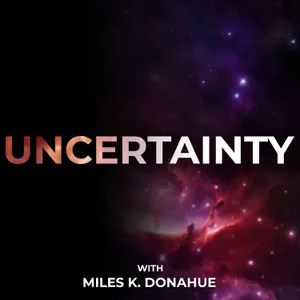
The Uncertainty Podcast: Daily Summaries Delivered
by Miles K. Donahue
A philosophy Ph.D. student working his way, with the world's leading thinkers, through the problems of philosophy, religion, science, and the existential struggle with irritable bowel syndrome (IBS) - similar to Alex O'Connor, but more American. Who wants to come along for the ride? mileskdonahue.substack.com
Latest Episodes
The most recent episodes — sign up to get AI-powered summaries of each one.
- 1 weeks ago55 min
#92 - A.I. Agents Are Here, and the Future Is Not Bright - Kevin Scharp
Philosopher Kevin Scharp discusses his experience working with A.I. agents, and what it portends for the future.Video of this interview is available on YouTube.To support the channel, do please oh please consider donating, either via PayPal or Buy Me a Coffee.Follow me on X because you’re awesome.EPISODE CHAPTERS:00:00:00 Introduction00:01:10 What AI agents are00:03:22 Why AI agents remain under the radar00:06:07 Creating research-level AI agents00:08:44 How AI agents work00:11:06 Are AI agents conscious?00:17:59 Have AI agents already achieved AGI?00:21:40 Embodied agents and what comes next00:24:57 Automation, unemployment, and social unrest00:27:05 AI as an unprecedented capacity for harm00:28:46 Could governance and AI rights slow development?00:32:00 Has ChatGPT become less useful?00:39:34 AI, human extinction, and theism00:43:08 Does AI favor naturalism over theism?00:46:35 How to live under existential uncertainty00:49:31 Atheism, agnosticism, and changing your mind Get full access to Miles K. Donahue at mileskdonahue.substack.com/subscribe
- 2 weeks ago1h 27m
#91 Philosophers Don't Want to Solve Philosophy (and other hot takes) - Lance S. Bush
Lance Bush returns to the channel to discuss the need for empirical research in philosophy, whether philosophers even want to find the answers to their questions, and, of course, phenomenal conservatism (which is true, btw).Video of this interview is available on YouTube.To support the channel, do please oh please consider donating, either via PayPal or Buy Me a Coffee.Follow me on X because you’re awesome.EPISODE CHAPTERS:00:00:00 Introduction00:03:12 Common mistakes in student writing00:06:54 Brevity and writing as a craft00:09:34 Why Lance pursued psychology over philosophy00:13:58 Studying moral language empirically00:20:03 What psychology reveals about philosophical practice00:24:59 A pragmatic theory of meaning00:31:22 Does philosophy differ from science?00:43:37 Why philosophers disagree00:47:40 Could philosophy ever be solved?00:56:31 Bias and the David Enoch debate01:00:31 Competing philosophical starting points01:05:58 Heterodox views and accusations of contrarianism01:08:43 Debate mistakes and the possibility of a rematch01:11:46 Michael Huemer and future conversations01:13:39 Phenomenal conservatism01:16:22 Epistemic blank checks01:20:03 Defeaters and the psychology of seemings01:24:57 Pragmatism and philosophical goals Get full access to Miles K. Donahue at mileskdonahue.substack.com/subscribe
- 3 weeks ago1h 39m
#90 A Heated Debate on Hell, Catholicism, and Fine-Tuning - Ethan Muse
Ethan Muse and I spar over the problem of evil, cosmic fine-tuning, infallible popes, and the doctrine of eternal conscious torment.Video of this interview is available on YouTube.To support the channel, do please oh please consider donating, either via PayPal or Buy Me a Coffee.Follow me on X because you’re awesome.EPISODE CHAPTERS:00:00:00 Introduction00:01:44 Rutgers, philosophy, and Catholic apologetics00:05:08 Ethan’s path into philosophy00:09:52 The goal of doing philosophy00:13:52 Ethan’s conversion to Catholicism00:17:55 Doubts, confidence, and the problem of evil00:23:45 Miracle evidence and outweighing evil00:25:04 Fine-tuning and theism00:28:48 Frequency data, design, and Bayesianism00:33:43 Mini-verses and apparent design00:38:20 What fine-tuning means00:41:04 Apparent design and fragile harmony00:46:38 The infrared bullseye analogy00:51:29 Design, stalking horses, and naturalism00:59:56 Priors, bare theism, and Bayesian machinery01:04:53 Papal infallibility and alleged counterexamples01:11:36 Eternal hell and Catholic doctrine01:19:46 Moral intuition against eternal torment01:22:42 Saints, sin, and moral authority01:30:12 Moral progress and Catholic tradition01:32:57 Moral disagreement and final thoughts Get full access to Miles K. Donahue at mileskdonahue.substack.com/subscribe
- Jun 25, 20261h 53m
#89 Michael Huemer's New Argument for Atheism
Michael Huemer, philosopher at U.C. Boulder, joins me for a wide-ranging discussion of arguments for and against the existence of God, with special focus on his new argument for atheism: the impossibility of an infinite God. Check out Mike’s book, Knowledge, Value, and Reality: A Mostly Common Sense Guide to Philosophy.Video of this interview is available on YouTube.To support the channel, do please oh please consider donating, either via PayPal or Buy Me a Coffee.Follow me on X because you’re awesome.EPISODE CHAPTERS:00:00:00 Introduction00:01:42 Huemer’s research on consciousness00:05:42 Could LLMs be conscious?00:08:11 Physicalism and consciousness00:14:36 Why physicalism became so popular00:17:16 Metaphysics and scientific evidence00:21:01 Could God be empirically detected?00:23:37 Why Huemer is agnostic00:25:48 Philip Goff’s limited God00:27:23 Can a limited God explain evil?00:36:03 Divine psychology and skeptical theism00:38:37 Can theism make predictions?00:46:54 Scientific confirmation and theistic arguments00:51:59 Which theistic arguments fail?00:53:14 The ontological argument00:58:06 The modal ontological argument01:01:03 Necessary beings and modal intuitions01:07:23 The Kalam cosmological argument01:08:54 Could time have a beginning?01:12:22 Can God create time?01:18:22 Cosmology and the Big Bang01:23:48 Actual and potential infinities01:26:00 Huemer’s new argument for atheism01:29:28 Divine infinity and omniscience Get full access to Miles K. Donahue at mileskdonahue.substack.com/subscribe
- Jun 11, 20262h 39m
#88 Can There be Evidence for God? | Eight Philosophers Debate
Is it even possible to have empirical evidence for God's existence? What if the stars realigned to spell out "I exist! Sincerely, God." Wouldn't THAT count as evidence for God? It seems that the answer is yes. But then, various objections to arguments for God seem to imply that even this extravagant, awesome evidence for God would not be any evidence whatsoever for theism. To many philosophers, that implication implies that these objections prove too much, and must therefore fail. In this debate, eight philosophers go head-to-head over these fascinating questions.Video of this interview is available on YouTube.To support the channel, do please oh please consider donating, either via PayPal or Buy Me a Coffee.Follow me on X because you’re awesome.EPISODE CHAPTERS00:00:00 Introduction00:02:10 Miles Donahue’s opening statement00:07:46 Brian Cutter’s opening statement00:13:16 Noah McKay’s opening statement00:18:30 Travis Dumsday’s opening statement00:23:30 Paul Draper’s opening statement00:29:15 Alex Malpass’s opening statement00:35:18 Nathan Bray’s opening statement00:40:41 Kevin Scharp’s opening statement00:47:15 Miles Donahue’s cross-examination01:03:22 Alex Malpass’s cross-examination01:20:15 Brian Cutter’s cross-examination01:33:41 Nathan Bray’s cross-examination01:49:03 Paul Draper’s cross-examination02:01:21 Travis Dumsday’s cross-examination02:10:54 Kevin Scharp’s cross-examination02:24:49 Noah McKay’s cross-examination Get full access to Miles K. Donahue at mileskdonahue.substack.com/subscribe
- Jun 4, 20261h 14m
#87 Yes, You Can be Gay and Christian - Matthew Vines
Matthew Vines, author of God and the Gay Christian: The Biblical Case in Support of Same-Sex Relationships, joins me to discuss the revised version of this now classic texts. Has Matt has changed his mind on any major issues? What, in the end, would Matt conclude if he determined that the Bible did prohibit same-sex relationships? Listen to find out!Video of this interview is available on YouTube.To support the channel, do please oh please consider donating, either via PayPal or Buy Me a Coffee.Follow me on X because you’re awesome.EPISODE CHAPTERS:00:00:00 Introduction00:00:05 What changed in God and the Gay Christian00:03:28 Endnotes, footnotes, and writing for different audiences00:05:02 How Matthew Vines’s views have changed00:05:51 Romans 1 and female same-sex relations00:07:48 Arsenokoitai, Malakoi, and Paul’s meaning00:10:22 Same-sex marriage in the biblical world00:13:45 To whom is the book written?00:15:06 Expressive individualism and affirming theology00:19:37 How the American church has changed00:20:23 Affirming churches without guardrails00:25:45 Conservative backlash and slippery slopes00:27:55 Being between Christian and queer spaces00:29:11 Queer theory, polyamory, and sexual orientation00:30:55 Transgender Christians and biblical interpretation00:34:48 Gender dysphoria, transition, and Christian ethics00:39:08 What if the Bible prohibited same-sex marriage?00:49:44 Moral intuition, inerrancy, and Jesus01:00:05 Biblical authority, inspiration, and inerrancy01:08:21 Where evangelical churches may be headed Get full access to Miles K. Donahue at mileskdonahue.substack.com/subscribe
- May 28, 20261h 23m
#86 From Toad Venom to Jesus: Cross-Examining Philip Goff
I discuss and debate the merits of drug-induced experiences for one's religious beliefs, the difference panpsychism makes, the distinction between God's essence and energies, and giant purple platypuses floating over New York City.Video of this interview is available on YouTube.To support the channel, do please oh please consider donating, either via PayPal or Buy Me a Coffee.Follow me on X because you’re awesome.EPISODE CHAPTERS00:00:00 Introduction00:00:32 What is 5-MeO-DMT?00:02:07 Why Philip Goff tried toad venom00:05:02 What the experience was like00:07:13 Can you experience yourself not existing?00:13:00 Was ego death terrifying?00:17:03 William Lane Craig’s reaction00:19:57 What is a structureless claim?00:22:52 The content of mystical experience00:25:39 Does 5-MeO-DMT support panpsychism?00:33:15 Why trust a drug-induced experience?00:40:08 Experience versus interpretation00:43:54 Is Goff projecting panpsychism onto the experience?00:46:03 What would defeat the experience?00:51:25 How does this fit with Christianity?00:57:19 Divine essence, energies, and simplicity01:04:19 Why Christianity specifically?01:08:26 Why not deism or another religion?01:14:23 Does Goff believe in an afterlife?01:16:43 Near-death experiences and consciousness01:18:37 What is Goff most uncertain of? Get full access to Miles K. Donahue at mileskdonahue.substack.com/subscribe
- May 21, 20261h 47m
#85 What Is a Woman? - Talia Mae Bettcher And Tomas Bogardus
Talia Mae Bettcher and Tomas Bogardus join me to debate the question, "What is a woman?". Is gender biologically grounded, socially constructed, or something else entirely? If you're looking for a cordial and substantive exchange from two thinkers who fundamentally disagree on these issues, look no further.Video of this interview is available on YouTube.To support the channel, do please oh please consider donating, either via PayPal or Buy Me a Coffee.Follow me on X because you’re awesome.EPISODE CHAPTERS00:00:00 Introduction00:01:17 Bogardus opening statement00:02:03 Dictionaries and ordinary usage00:03:41 The ambiguity view00:07:09 The resistant concept of woman00:08:12 Circularity and self-identification00:11:23 The relevance objection to ambiguity00:13:47 Non-human men and women00:16:17 Bettcher opening statement00:18:29 Woman as a philosophical question00:19:44 Folk concepts and biological definitions00:22:13 Folk concepts vs. theoretical concepts00:24:45 Adult, human, and female00:28:14 Open discussion begins00:28:57 Bettcher on the ambiguity thesis00:30:28 Family resemblance and trans womanhood00:35:16 Political concepts and same-sex marriage00:52:25 Are folk concepts biological?00:57:47 Souls, bodies, and female identity01:04:31 Twin Earth, Superman, and non-human men01:13:13 Stone lions, Batman, and conceptual analysis01:26:44 The husbandry argument01:29:44 Sex, function, and biology01:34:35 Why the question matters01:39:44 Closing statements Get full access to Miles K. Donahue at mileskdonahue.substack.com/subscribe
About The Uncertainty Podcast
A philosophy Ph.D. student working his way, with the world's leading thinkers, through the problems of philosophy, religion, science, and the existential struggle with irritable bowel syndrome (IBS) - similar to Alex O'Connor, but more American. Who wants to come along for the ride? mileskdonahue.substack.com
Customized Recaps
AI-powered recaps with compact key takeaways, quotes, and insights.
Straight to Your Inbox
Get key takeaways from The Uncertainty Podcast in a 5-minute read.
Save Hours Every Week
Stay current on your favorite podcasts without falling behind.
Frequently Asked Questions
What is Podzilla's The Uncertainty Podcast daily summary?
It's a free AI-powered email that summarizes new episodes of The Uncertainty Podcast as soon as they're published. You get the key takeaways, notable quotes, and links & mentions — all in a quick read.
How does the The Uncertainty Podcast podcast summary work?
When a new episode drops, our AI transcribes and analyzes it, then generates a personalized summary tailored to your interests and profession. It's delivered to your inbox every morning.
Is this an official The Uncertainty Podcast product?
No. Podzilla is an independent service that summarizes publicly available podcast content. We're not affiliated with or endorsed by Miles K. Donahue.
Can I get summaries of other podcasts too?
Absolutely! The free plan covers up to 3 podcasts. Upgrade to Pro for 15, or Premium for 50. Browse our full catalog at /podcasts.
How often does The Uncertainty Podcast release new episodes?
The Uncertainty Podcast publishes weekly. Our AI generates a summary within hours of each new episode.
What topics does The Uncertainty Podcast cover?
The Uncertainty Podcast covers topics including Science, Physics, Philosophy, Culture, Society & Culture. Our AI identifies the specific themes in each episode and highlights what matters most to you.
Start getting The Uncertainty Podcast summaries tomorrow morning.
Free forever for up to 3 podcasts. No credit card required.
Free forever for up to 3 podcasts. No credit card required.