Free Daily Podcast Summary
This Podcast Will Kill You: Daily Summaries Delivered
by Exactly Right and iHeartPodcasts
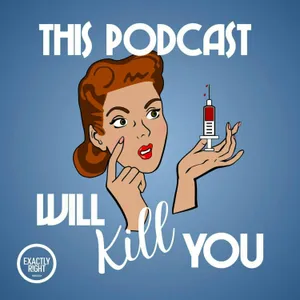
This podcast might not actually kill you, but Erin Welsh and Erin Allmann Updyke cover so many things that can. In each episode, they tackle a different topic, teaching listeners about the biology, history, and epidemiology of a different disease or medical mystery. They do the scientific research, so you don’t have to. Since 2017, Erin and Erin have explored chronic and infectious diseases, medications, poisons, viruses, bacteria and scientific discoveries. They’ve researched public health subjects including plague, Zika, COVID-19, lupus, asbestos, endometriosis and more. Each episode is accompanied by a creative quarantini cocktail recipe and a non-alcoholic placeborita. Erin Welsh, Ph.D. is a co-host of the This Podcast Will Kill You. She is a disease ecologist and epidemiologist and works full-time as a science communicator through her work on the podcast. Erin Allmann Updyke, MD, Ph.D. is a co-host of This Podcast Will Kill You. She’s an epidemiologist and disease ecologist curr
Latest Episodes
The most recent episodes — sign up to get AI-powered summaries of each one.
- 4 days ago1h 20m
Ep 223 ALS: Unraveling the mystery
Amyotrophic lateral sclerosis (ALS), also known as Lou Gehrig’s disease, has long mystified the medical community and brought tremendous sorrow to those impacted by the condition. But to tell the story of ALS as one solely of tragedy would do a disservice to those who have long fought to develop an effective treatment or raise awareness. Because it is through their tireless efforts that those with ALS will eventually be able to rewrite their own ending. In today’s episode, we attempt to convey the full picture of ALS: from what we know about its causes to the earliest medical descriptions, from the baseball player whose impassioned speech captured the public’s hearts to the promising research on the horizon. Tune in for all this and more. Support this podcast by shopping our latest sponsor deals and promotions at this link: https://bit.ly/3WwtIAuSee omnystudio.com/listener for privacy information.
- 1 weeks ago1h 6m
Ep 222 Vitamin K: Calling the shots
Shortly after birth, many newborns are given vitamin K to help their blood clot properly and reduce the chances of hemorrhage. Increasingly, especially here in the US, parents are refusing this life-saving intervention, leaving these babies more likely to develop deficiency bleeding which can lead to life-long brain damage and death. In this episode, we explore the many dimensions of vitamin K: how it acts in our bodies as an essential compound, when we discovered the clotting properties of this vitamin and applied that knowledge to prevent catastrophic bleeding in newborns, and why some people are turning away from this life-saving injection. You’ve seen the headlines, now tune in for the full story. Support this podcast by shopping our latest sponsor deals and promotions at this link: https://bit.ly/3WwtIAuSee omnystudio.com/listener for privacy information.
- 2 weeks ago52 min
Special Episode: Dr. Alanna Skuse & The Surgeon, The Midwife, The Quack
Imagine yourself as a 17th century English peasant or merchant or noble. Let’s say you’re dealing with some intense stomach pain or a cut on your leg that won’t heal. Where do you turn to for help? Today’s book club episode reveals that the answer depends on your medical needs, your wealth, your social standing, and your gender. But one thing’s for certain: you had some options up your sleeve. In The Surgeon, The Midwife, The Quack: How to Stay Alive in Renaissance England, Dr. Alanna Skuse, Associate Professor at the University of Reading, takes readers through the layered world of Renaissance medicine and the many different healers (both licensed and self-professed) that occupied it. As Dr. Skuse demonstrates, people have always sought experts to help them return to or remain in good health, and this has in turn fueled the growth of new medical professions as people carved out their healing niche. How did this era set the stage for the birth of modern medicine? Tune in to find out. Support this podcast by shopping our latest sponsor deals and promotions at this link: https://bit.ly/3WwtIAuSee omnystudio.com/listener for privacy information.
- 3 weeks ago58 min
Ep 221 Electroconvulsive Therapy Part 2: A current conversation
This week, we’re picking up where we left off last episode in our exploration of ECT by examining how this therapy is administered, which conditions it’s used for, and what we know about why it works. To start off, we take you through the procedure step-by-step, including prep and what someone might experience in the days or weeks that follow. We then examine the situations for which ECT might be recommended as well as the barriers preventing its wider use, which include issues with both access and stigma. How on earth does an electric shock improve symptoms of depression or catatonia? That burning question is one we do our best to answer. To help us present an accurate and comprehensive perspective of this important but underutilized therapy, we bring on an expert. Dr. Leonardo Lopez, Associate Professor of Psychiatry at Weill Cornell Medicine and Vice Chair of Inpatient Services in the Department of Psychiatry, works alongside NewYork-Presbyterian to expand access to ECT across multiple hospitals (check out the Advances in Care podcast episode featuring his work, The Positive Impact of Electroconvulsive Therapy for Severe Psychiatric Illness). Dr. Lopez shares with us a remarkable story of a young girl whose rare condition (anti-NMDA receptor encephalitis) was treated in part with ECT (watch the video of her journey). He also shines a light on the current limitations facing ECT as well as his hopes for the future. Tune in for a truly fascinating episode! Support this podcast by shopping our latest sponsor deals and promotions at this link: https://bit.ly/3WwtIAuSee omnystudio.com/listener for privacy information.
- Sep 1, 202650 min
Ep 220 Electroconvulsive Therapy Part 1: A charged history
For many, a mention of electroconvulsive therapy (ECT) conjures images of torture or mind control from popular media like One Flew Over the Cuckoo’s Nest or Requiem for a Dream. Comparatively few know that ECT is not only still used today but is an incredibly safe and effective treatment for an array of psychiatric conditions. In this and next week’s episode, we explore this stigmatized and misunderstood therapy from its questionable origins to its current uses. We start by diving into the history of ECT and placing its discovery in the broader context of psychiatric medicine and leading notions of the causes of mental illness. We learn that ECT’s troubling reputation is not entirely unearned but is a relic of the past, as substantial advancements in safety and administration have established this as a truly powerful therapy that has stood the test of time. Tune in for a big picture view of one of our oldest and most effective psychiatric treatments. Support this podcast by shopping our latest sponsor deals and promotions at this link: https://bit.ly/3WwtIAuSee omnystudio.com/listener for privacy information.
- Aug 25, 202644 min
Special Episode: Clayton Page Aldern & The Weight of Nature
Already this summer, heatwaves are causing thousands of deaths across the world, catastrophic flooding threatens millions, wildfires rage across enormous swathes of the globe, many regions face extreme drought conditions, and a very strong El Niño is predicted for later this year, leading to further climate chaos. It’s a lot to take in. The devastating consequences of climate change can be measured any number of ways, and in this week’s book club episode, we delve into some of the more insidious and less explored impacts: those on our cognition, our mental health, our brains, and our behavior. In The Weight of Nature: How a Changing Climate Changes our Brains, author Clayton Page Aldern, neuroscientist and journalist who leads the data journalism program at Grist, presents a compelling and sweeping examination of the many unseen ways that climate change is changing us. Why do we have a shorter fuse when it’s hot outside? How are our memories and language impacted by our changing climate? What pathogens pose a greater threat to our brains as the climate warms? And most importantly, how can we begin to process these effects on our inner selves? Tune in to find out. Support this podcast by shopping our latest sponsor deals and promotions at this link: https://bit.ly/3WwtIAuSee omnystudio.com/listener for privacy information.
- Aug 18, 202658 min
Ep 219 The Brown Recluse: Fearsome foe or slandered spider?
Few spiders hold the dubious honor of name recognition among the general public. Most that do, like black widows, Australian funnel-web, the Goliath birdeater, are renowned not for their cute colors or weaving skills but for being fearsome, dangerous predators. The brown recluse is no exception. A bite from one of these arachnids can send someone to the hospital with a painful necrotizing wound and weeks of recovery. But do these spiders actually deserve all the hatred they get? In this week’s episode, we argue no. Breaking down not just the bite of thebrown recluse but also its behaviors, its distribution, and its lore, we present a more complete picture of this vilified arachnid. Tune in for the low down on this shy spider. Support this podcast by shopping our latest sponsor deals and promotions at this link: https://bit.ly/3WwtIAuSee omnystudio.com/listener for privacy information.
- Aug 11, 202651 min
Special Episode: Deborah Cohen & Bad Influence
If you have a medical question, where do you turn? How often is google or social media your first stop? As you sift through the AI overview and countless reels professing to have the answers, it becomes harder and harder to separate fact from fiction. Do these supplements actually do what they promise? Should I be wary of this commonly prescribed medication? Even if you’re not directly seeking this information, it finds you anyway, preying on health anxieties and promising an easy fix. In this week’s TPWKY book club episode, Dr. Deborah Cohen, medically-trained, award-winning journalist, broadcaster, and editor, joins me to discuss the implications of this flood of health misinformation, which she explores in her recent book Bad Influence: How the Internet Hijacked Our Health. From podcast bros touting peptide injections to TikTok influencers swearing by supplements, Cohen demonstrates that the internet is a wild west in desperate need of consumer protections. But it has also been a double-edged sword, providing community and connection alongside these bad actors. How can we continue to leverage the good of the internet to democratize health information while putting guardrails on nefarious wellness influencers hawking lies for profit? Tune in to find out. Support this podcast by shopping our latest sponsor deals and promotions at this link: https://bit.ly/3WwtIAuSee omnystudio.com/listener for privacy information.
Get This Podcast Will Kill You summaries in your inbox
Free AI-powered daily recaps. Key takeaways, quotes, and mentions — in a 5-minute read.
Get Free Summaries →Free forever for up to 3 podcasts. No credit card required.
You Might Also Like
Listeners also like.

Murder, Mystery & Makeup
A beauty influencer explores true crime stories, from serial killers to cannibals, while doing makeup.
Wicked Words - A True Crime Talk Show with Kate Winkler Dawson
Kate Winkler Dawson interviews journalists and authors about their investigations into true crime cases.
The Real Killer
A cold case murder of a teenager is re-examined through conflicting evidence and unanswered questions.
Buried Bones - a historical true crime podcast with Kate Winkler Dawson and Paul Holes
A journalist and forensic expert reexamine historical crimes using modern science to assess past investigations and possible wrongful convictions.

Serial Killers & Murderous Minds
Examines the psychology of serial killers and violent criminals through true crime storytelling and forensic analysis.
Symptomatic: A Medical Mystery Podcast
Patients recount their struggles to diagnose mysterious chronic illnesses, guided by host Lauren Bright Pacheco.

Women Talkin’ ‘Bout Murder
Two fictional true crime podcasters bumble through murder investigations with comedic guest interviews.

Killer Psyche
A retired FBI agent examines the psychological motives behind notorious criminals and their crimes.

My Favorite Murder with Karen Kilgariff and Georgia Hardstark
Two hosts explore true crime cases and listener-submitted stories with humor and empathy.
Alive Again
People who survived life-threatening events share how their perspectives and lives changed afterward.
Morbid
A true crime and spooky history podcast blending research and dark humor, hosted by an autopsy technician and a hairstylist.
Unbiased Science
Dr. Jess Steier and guests analyze viral health claims using scientific evidence and explain key findings for everyday conversations.
About This Podcast Will Kill You
This podcast might not actually kill you, but Erin Welsh and Erin Allmann Updyke cover so many things that can. In each episode, they tackle a different topic, teaching listeners about the biology, history, and epidemiology of a different disease or medical mystery. They do the scientific research, so you don’t have to. Since 2017, Erin and Erin have explored chronic and infectious diseases, medications, poisons, viruses, bacteria and scientific discoveries. They’ve researched public health subjects including plague, Zika, COVID-19, lupus, asbestos, endometriosis and more. Each episode is accompanied by a creative quarantini cocktail recipe and a non-alcoholic placeborita. Erin Welsh, Ph.D. is a co-host of the This Podcast Will Kill You. She is a disease ecologist and epidemiologist and works full-time as a science communicator through her work on the podcast. Erin Allmann Updyke, MD, Ph.D. is a co-host of This Podcast Will Kill You. She’s an epidemiologist and disease ecologist curr
Customized Recaps
AI-powered recaps with compact key takeaways, quotes, and insights.
Straight to Your Inbox
Get key takeaways from This Podcast Will Kill You in a 5-minute read.
Save Hours Every Week
Stay current on your favorite podcasts without falling behind.
Frequently Asked Questions
What is Podzilla's This Podcast Will Kill You daily summary?
It's a free AI-powered email that summarizes new episodes of This Podcast Will Kill You as soon as they're published. You get the key takeaways, notable quotes, and links & mentions — all in a quick read.
How does the This Podcast Will Kill You podcast summary work?
When a new episode drops, our AI transcribes and analyzes it, then generates a personalized summary tailored to your interests and profession. It's delivered to your inbox every morning.
Is this an official This Podcast Will Kill You product?
No. Podzilla is an independent service that summarizes publicly available podcast content. We're not affiliated with or endorsed by Exactly Right and iHeartPodcasts.
Can I get summaries of other podcasts too?
Absolutely! The free plan covers up to 3 podcasts. Upgrade to Pro for 15, or Premium for 50. Browse our full catalog at /podcasts.
How often does This Podcast Will Kill You release new episodes?
This Podcast Will Kill You publishes weekly. Our AI generates a summary within hours of each new episode.
What topics does This Podcast Will Kill You cover?
This Podcast Will Kill You covers topics including Science, Fitness, Health & Fitness. Our AI identifies the specific themes in each episode and highlights what matters most to you.
Start getting This Podcast Will Kill You summaries tomorrow morning.
Free forever for up to 3 podcasts. No credit card required.
Free forever for up to 3 podcasts. No credit card required.