Free Daily Podcast Summary
To the Righthouse: Daily Summaries Delivered
by Global Campus of Human Rights
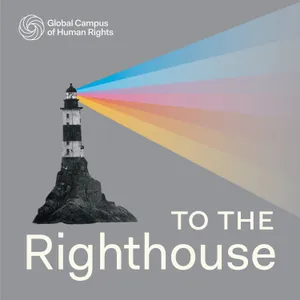
Much as a Lighthouse warns of dangers and guides travellers towards safety, our Righthouse alerts to risks for human rights and points towards secure protection. Like the Lighthouse of literary fame, our Righthouse symbolises the difference between what is desirable and what is real, with multiple points of views in between, the longing for something both enlightening and difficult to reach: a destination, stability, a solution.
Latest Episodes
The most recent episodes — sign up to get AI-powered summaries of each one.
- May 21, 202643 min
S5.5 - Empowering through remembrance
We conclude the series with a powerful episode on memorialization in Bosnia and Herzegovina.The conversation explores how memorialization itself becomes a form of justice — preserving victims’ humanity, amplifying survivors’ voices, resisting genocide denial, and sustaining collective memory when legal justice remains incomplete.It reflects on how remembrance can serve as both healing and resistance, ensuring that truth endures even where accountability falls short.🎧 A closing reflection on memory, dignity, and the enduring pursuit of justice.
- May 21, 202647 min
S5.4 - Demanding justice
This episode explores how survivors and activists in Ireland are confronting institutional abuse through memorialization, legal action, education, and movement lawyering.By preserving truth, demanding accountability, and challenging state denial of human rights violations, survivors are transforming remembrance into resistance and advocacy into lasting change.The conversation highlights the power of collective action in the ongoing strugglefor justice, recognition, and human dignity.A compelling discussion on memory, accountability, and the fight against silence.
- May 21, 202630 min
S5.3 - Transforming experiences
This episode highlights how the Mukwege Foundation and its survivor-led Red Lineinitiative are advancing a holistic, rights-based response to conflict-relatedsexual violence.By combining legal accountability, prevention, and survivor-centered support, theinitiative works to restore dignity, empower survivors, and strengthen pathwaysto justice that go beyond the courtroom.The conversation explores how survivor leadership is reshaping advocacy,challenging impunity, and building more inclusive systems of care and justice.A powerful discussion on dignity, resilience, and survivor-led change.
- May 21, 202619 min
S5.2 - Connecting voices
The series continues with a powerful episode exploring the Quipu Project and its workamplifying the voices of Peruvian women affected by forced sterilizations.Through storytelling and listening, personal testimonies become acts of resistance — transforming individual experiences into collective memory, recognition, and a wider struggle for justice and dignity beyond victimhood.This episode reflects on the power of survivors reclaiming their narratives and challenging silence through community, memory, and advocacy.A moving conversation on voice, memory, and the fight for justice.
- May 21, 202637 min
S5.1 - Solidarity networks
What happens when surviving enforced disappearance becomes the spark for a global fight for justice?In the first episode of this series, Thomas Unger sits down with Ram Bhandari to explore how Ram’s experience of enforced disappearance in Nepal transformed into a lifelong commitment to human rights activism.From survivor-led solidarity networks to the growing crisis of impunity and shrinking civic space worldwide, this conversation shines a light on the urgent need for collective, victim-centered pathways to justice — and the work of Inovas in making them possible.A powerful conversation on resilience, solidarity, and the fight for accountability.
- Mar 18, 202646 min
S.4.1 -Music and human rights: amplifying the resonances
The first episode of Sounds of Justice teases out the different dimensions of the relationship between music and human rights. The four guests, all co-editors of the Routledge Companion, explore what the language of music and the values of human rights have in common; and how music’s capacity to connect us to our common humanity while attuning us to difference can power ongoing struggles for justice.About the hostIgnacio Saiz is a human rights advocate and independent advisor to international organizations. He previously led the Center for Economic and Social Rights and held senior positions at Amnesty International. A lifelong passion for music has led him to explore how its power can be harnessed to advance human rights, including as creator and host of Sounds of Justice.* Julian Fiferis former Executive Director of Musicians for Human Rights. As cellist and founder of the Orpheus Chamber Orchestra, he conceived a method of orchestral music-making using democratic principles and collective leadership. The artistic outcomes have been documented by Deutsche Grammophon on 55 Orpheus recordings.* Angela Impeyis Emerita Professor of Ethnomusicology at SOAS, University of London and co-editor of the Routledge SOAS Studies in Music series. She has published widely on music and social justice in Africa, including the award-winning Song Walking: Women, Music, and Environmental Justice in an African Borderland.* Manfred Nowakis Professor of International Human Rights Law at the University of Vienna and Secretary General of the Global Campus of Human Rights, a network of some 100 universities in all world regions, based in Venice.* George Ulrichis Academic Director of the Global Campus of Human Rights (Venice, Italy). His research interests relate to the philosophy of human rights, global justice, and human rights and development cooperation.
- Mar 18, 202638 min
S.4.5-More-than-human rights: the music of nature and the nature of music
This episode of Sounds of Justice, the fourth series in the Global Campus “To the Righthouse” podcast programme, explores how listening to the sounds of the more-than-human world – from forests to fungi, from whales to waterways – can help us reimagine our relationship to the earth we inhabit. It looks at the role of music in Indigenous and Afro-descendant understandings of ecology and struggles for environmental justice, including in Latin America and Haiti.* Rebecca Dirksenis Laura Boulton Associate Professor of Ethnomusicology at Indiana University and co-founder and current director of the Diverse Environmentalisms Research Team (DERT). Working in and around Haiti, Dirksen’s research priorities encompass sacred ecologies, environmental justice, and politically engaged music. She is the author of After the Dance, the Drums Are Heavy: Carnival, Politics, and Musical Engagement in Haiti (2020) and co-editor of Performing Environmentalisms: Expressive Culture and Ecological Change (2021). * César Rodríguez-Garavitois Professor of Law and Chair of the Center for Human Rights and Global Justice at NYU School of Law. He is the founding director of the Earth Rights Research & Action (TERRA) Clinic, the More-Than-Human Rights (MOTH) Program and the Climate Law Accelerator. An Earth rights and human rights scholar and a field lawyer, he focuses on climate change, international environmental law, Indigenous peoples’ rights and more-than-human rights.
- Mar 18, 202637 min
s.4.4-Instruments of abuse: weaponizing music in human rights violations
This episode of the fourth series in the Global Campus “To the Righthouse” podcast programme explores how music has been used as an instrument of human rights abuse in different contexts, from torture and ill-treatment in US detention centers in Guantánamo to forced assimilation of Uyghurs in the Xinjiang Region in China. It also reveals how music can restore humanity and identity in the face of brutality and erasure.* Mansoor Adayfi-441is a Yemeni writer, activist, and former Guantánamo Bay detainee, imprisoned for nearly 15 years without charge. Since his release, he has become a committed advocate for human rights, highlighting the experiences of former detainees and the global consequences of the War on Terror. He is the author of Don’t Forget Us Here and the recently released Letter from Guantánamo. As the Guantánamo Project Coordinator at CAGE International, Mansoor co founded the Guantánamo Survivors Fund (GSF). * Rachel Harrisis Professor of Ethnomusicology at SOAS, University of London. She has published extensively on music and religious practice in Central Asia, and the politics of ethnicity and heritage in China. Her latest book is Soundscapes of Uyghur Islam (Indiana University Press). Her current project, “Maqām Beyond Nation” (2023-2028) explores maqām-based music-making across Asia, connecting histories of mobility and exchange with contemporary flows of people and culture.* Manfred Nowakis Professor of International Human Rights Law at the University of Vienna and Secretary General of the Global Campus of Human Rights. Among many expert functions, he was UN Special Rapporteur on Torture (2004-2010).
About To the Righthouse
Much as a Lighthouse warns of dangers and guides travellers towards safety, our Righthouse alerts to risks for human rights and points towards secure protection. Like the Lighthouse of literary fame, our Righthouse symbolises the difference between what is desirable and what is real, with multiple points of views in between, the longing for something both enlightening and difficult to reach: a destination, stability, a solution.
Customized Recaps
AI-powered recaps with compact key takeaways, quotes, and insights.
Straight to Your Inbox
Get key takeaways from To the Righthouse in a 5-minute read.
Save Hours Every Week
Stay current on your favorite podcasts without falling behind.
Frequently Asked Questions
What is Podzilla's To the Righthouse daily summary?
It's a free AI-powered email that summarizes new episodes of To the Righthouse as soon as they're published. You get the key takeaways, notable quotes, and links & mentions — all in a quick read.
How does the To the Righthouse podcast summary work?
When a new episode drops, our AI transcribes and analyzes it, then generates a personalized summary tailored to your interests and profession. It's delivered to your inbox every morning.
Is this an official To the Righthouse product?
No. Podzilla is an independent service that summarizes publicly available podcast content. We're not affiliated with or endorsed by Global Campus of Human Rights.
Can I get summaries of other podcasts too?
Absolutely! The free plan covers up to 3 podcasts. Upgrade to Pro for 15, or Premium for 50. Browse our full catalog at /podcasts.
How often does To the Righthouse release new episodes?
To the Righthouse publishes weekly. Our AI generates a summary within hours of each new episode.
What topics does To the Righthouse cover?
To the Righthouse covers topics including Science, Social Sciences. Our AI identifies the specific themes in each episode and highlights what matters most to you.
Start getting To the Righthouse summaries tomorrow morning.
Free forever for up to 3 podcasts. No credit card required.
Free forever for up to 3 podcasts. No credit card required.