Free Daily Podcast Summary
What You're Eating: Daily Summaries Delivered
by FoodPrint.org
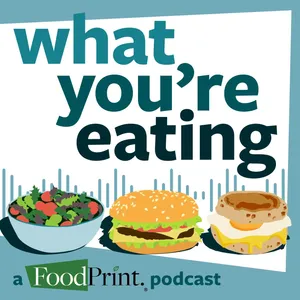
Whether it’s a salad, a hamburger or your morning egg sandwich, the way your meal gets made has an impact. What You’re Eating is here to help you understand how your food gets to your plate, and see the full impact of the food we eat on animals, planet and people. Host Jerusha Klemperer is the Director of FoodPrint.org, a website that uncovers the problems with the industrial food system, and offers examples of more sustainable practices, as well as practical advice for how you can help support a better system, through the food that you buy and the system changes you push for. From practical conversations with farmers about the true cost of raising chickens to tips from chefs about how to reduce kitchen waste to discussions with policy experts on the barriers to sustainability, FoodPrint’s new podcast covers everything from the why to the how.
Latest Episodes
The most recent episodes — sign up to get AI-powered summaries of each one.
- Yesterday1h 14m
Our Love of Sugary Drinks
Over a hundred years ago, we started drinking soda. Today, soda is part of a larger category called sugar sweetened beverages, that includes energy drinks, Dunkin’ frozen matcha lattes, giant Boba teas and Starbucks strawberry acai refreshers. How did these companies tap into our innate cravings to sell us more drinkable calories than we are supposed to eat in a week? In this episode we explore why we are so susceptible to sugar and how soda companies influenced the way we drink today, marketing their drinks aggressively (especially to children), externalizing costs, and making the consumer and society at large responsible: for our excess calorie consumption and for the waste created by single use drink containers. In this episode we speak with Lina Ghanem, director and co-founder of Saba Grocers Initiative; Marion Nestle, Professor of Nutrition, Food Studies, and Public Health, Emerita, at New York University and author of Soda Politics: Taking on Big Soda (and Winning); Michael Moss, author of Salt Sugar Fat: How the Food Giants Hooked Us; Anupama Joshi, Vice President of Programs at the Center for Science in the Public Interest; Bart Elmore, author of Citizen Coke: The Making of Coca-Cola Capitalism; and Mike Belliveau, director and founder of Bend the Curve. What You’re Eating is produced by Jerusha Klemperer, Nathan Dalton and FoodPrint.org, which is a project of the GRACE Communications Foundation. You can find us at www.FoodPrint.org where we have this podcast as well as articles, reports, a Food Label Guide and more. Follow @foodprintorg on Instagram, Facebook, Threads and Bluesky
- Dec 2, 20251h 4m
The Lie of the Little Red Barn
When most of us imagine a farm, it’s a little red barn with happy cows, a pig and a few chickens pecking in the grass. We are taught this story when we are children, through board books, the song “Old McDonald” and our ABCs. But do you really know what happens on an industrial farm? Have you ever seen a video made by animal rights activists, of animals in pain and being mistreated? Did you scroll by? Did you watch it? On today’s episode we talk about bearing witness to the way animals are raised for us to eat. And about the laws that have been passed in states around the country to keep us from doing so. Who benefits from us staying in the dark? And what are the larger repercussions of hiding these truths behind factory farm walls?This episode features Will Potter, author of Little Red Barns: Hiding the Truth, from Farm to Fable; Leah Garces, CEO of Mercy For Animals; Tyler Lobdell, senior staff attorney for Food & Water Watch; and cattle rancher Mike Callicrate, founder of Ranch Foods Direct.What You’re Eating is hosted by Jerusha Klemperer and produced by Nathan Dalton and FoodPrint.org, which is a project of the GRACE Communications Foundation. You can find us at www.FoodPrint.org where we have this podcast as well as articles, reports, a Food Label Guide and more.Follow @foodprintorg on Instagram, Facebook, Threads and BlueskyStay Informed. Get the latest food news, from FoodPrint.And if you’re enjoying the podcast, consider leaving us a positive review.
- Nov 19, 20251h 1m
What’s the Deal With MAHA?
On this episode we are joined by Helena Bottemiller Evich and Theodore Ross, the co-hosts of the podcast “Forked.” Every two weeks, they discuss “the politics and policy that are turning the American food system on its head.” For much of the past ten months, they have spent a huge amount of time discussing the Make America Healthy Again (MAHA) movement, its connections to de-facto leader, Health and Human Services Secretary Robert F. Kennedy Jr., and the ways in which he and the movement are shaping policy and practice, from federal and state laws to food companies’ promises to change the formulas of their products. Together we talk through who makes up this movement, what their priorities are, what progress MAHA is making towards its goals — and where it is falling short. Can it make America healthy again?What You’re Eating is hosted by Jerusha Klemperer and produced by Nathan Dalton and FoodPrint.org, which is a project of the GRACE Communications Foundation. You can find us at www.FoodPrint.org where we have this podcast as well as articles, reports, a Food Label Guide and more.Follow @foodprintorg on Instagram, Facebook, Threads and BlueskyStay Informed. Get the latest food news, from FoodPrint.And if you’re enjoying the podcast, consider leaving us a positive review.
- Nov 4, 202554 min
Eat More Beans
If we all ate less meat and more beans, it would be a terrific win for the environment. And that’s not the only thing to love about them! They are very good for you. And satisfying. And versatile. They are also culinary mainstays for a huge number of people from a wide variety of cultures. Beans have all the protein that the protein obsessives want right now. And they are very affordable during a time of true economic hardship. Also, they’re delicious.There’s a small but growing number of people who are passionate about beans’ many amazing qualities, but that number needs to grow. In this episode, we went looking for the bean freaks, to learn from them how we can get everyone as excited about beans as they are. Can they help us persuade the world to fall in love with beans?In this episode we speak with Steve Sando, founder and owner of Rancho Gordo, Joe Yonan, author of the cookbook "Cool Beans," Andrea Aliseda, author of "Make It Plant Based! Mexican," Kristen Loria, founder of Buttermilk Bean, Eve Turow-Paul, founder and executive director of Food for Climate League, and we take a visit to the Heirloom Bean Encuentro in Santa Ana, California.What You’re Eating is hosted by Jerusha Klemperer and produced by Nathan Dalton and FoodPrint.org, which is a project of the GRACE Communications Foundation. You can find us at www.FoodPrint.org where we have this podcast as well as articles, reports, a Food Label Guide and more.Follow @foodprintorg on Instagram, Facebook, Threads and BlueskyStay Informed. Get the latest food news, from FoodPrint.And if you’re enjoying the podcast, consider leaving us a positive review.
- Oct 21, 202537 min
Lives on the Line
Ever wondered how chicken nuggets are made? There’s the question of what’s actually in them — a continual source of jokes since the dawn of their existence — but the ingredients aren’t the only mystery. According to the United States Department of Agriculture, about half a million people work in meat-processing plants, slaughtering livestock and cutting carcasses into parts. In Arkansas, a kind of unofficial chicken capital, this work might also involve making a slurry of meat and skin and bones, then breading it and frying it, and finally freezing the little pieces and strips to become chicken fingers or nuggets. Most of these workers are immigrants; many are refugees. They are doing largely invisible work, while being underpaid, overworked and mistreated. Recently, the federal government has begun to criminalize immigration, a development unfolding at the same time that the dirty and dangerous work done by immigrants has been deemed essential. After all, meat — the most American of foods — is something we are told we cannot live without.In this episode we speak about these workers with Alice Driver, author of the 2024 book “Life and Death of the American Worker: The Immigrants Taking on America’s Largest Meatpacking Company.”What You’re Eating is hosted by Jerusha Klemperer and produced by Nathan Dalton and FoodPrint.org, which is a project of the GRACE Communications Foundation. You can find us at www.FoodPrint.org where we have this podcast as well as articles, reports, a Food Label Guide and more.Follow @foodprintorg on Instagram, Facebook, Threads and BlueskyStay Informed. Get the latest food news, from FoodPrint.And if you’re enjoying the podcast, consider leaving us a positive review.
- Apr 1, 20251h 11m
Going Nuts for Pistachios
Suddenly, it feels like pistachios are everywhere. From Dubai chocolate to pistachio lattes, croissants, nut butters and more … For two years now, pistachio has appeared on several lists of upcoming food trends. How do these food and flavor trends start? How does a product — once mostly eaten by Middle Eastern Americans but stuck on the sidelines with everyone else — hit the mainstream? Do we plant more pistachios because they’ve become hugely popular? Or have they become hugely popular because we’re suddenly growing so many? On this episode, we hunt for the origins of a trend and try to tease out the implications of a food going viral.This episode features Lena Derisavifard, founder of BiBi Baker in Brooklyn; Tom Philpott, senior research associate at the Center for a Livable Future at Johns Hopkins University and former food and agriculture correspondent for Mother Jones; and Errol Schweizer publisher and founder of the Checkout Grocery Update.What You’re Eating is produced by Nathan Dalton and FoodPrint.org, which is a project of the GRACE Communications Foundation. You can find us at www.FoodPrint.org where we have this podcast as well as articles, reports, a Food Label Guide and more.Follow @foodprintorg on Instagram, Facebook, Threads and BlueskyStay Informed. Get the latest food news, from FoodPrint.And if you’re enjoying the podcast, consider leaving us a positive review.
- Mar 11, 202556 min
You’re Probably a Vegan in Waiting
If becoming a vegan ever sounded to you like a joy-less task — like you’d have to give up too much, that you’d miss meat too much, that you’d have to transform into an entirely different person — Matt Halteman has some advice. As he writes in his book, Hungry Beautiful Animals: The Joyful Case for Going Vegan:"The destination of this journey is an inviting, empowering, and inclusive understanding of everyday vegan living that abandons the demoralizing goal of arriving once and for all at a perfected individual identity in favor of inspired but practical striving toward a global aspiration—to do what one enthusiastically can, within one's limits and always imperfectly—to live toward a truer, more beautiful, better vegan world. Instead of framing our individual efforts to go vegan unrealistically, in terms of the achievement of a one size fits all state of being, a so called cruelty free identity, we'll envision going vegan as a liberating journey of becoming that unfolds uniquely for every person based on what their individual and communal situations inspire and enable them to contribute."What You’re Eating is produced by Nathan Dalton and FoodPrint.org, which is a project of the GRACE Communications Foundation. You can find us at www.FoodPrint.org where we have this podcast as well as articles, reports, a Food Label Guide and more.Follow @foodprintorg on Instagram, Facebook, Threads and BlueskyStay Informed. Get the latest food news, from FoodPrint.And if you’re enjoying the podcast, consider leaving us a positive review.
- Mar 4, 202531 min
Buzzkill Epsiode 1: Save Which Bees?
The American bumblebee was once the most common bee species in the United States. Its numbers have declined by 90 percent in the last two decades. The problem is bigger than just the loss of an iconic species. Three-fourths of the food crops humans grow depend on pollinators – bees, butterflies, hummingbirds, and more. Industrial monocultures sap the soil. Rampant chemical use poisons our water and our bodies. Reckless stewardship of the land wastes our precious resources. Buzzkill asks why we raise food this way – and how we can change things for the better.Americans stepped up to do something about dying bees. But what if all those backyard colonies are making the problem worse? In Buzzkill’s premiere episode, host Teresa Cotsilos takes an in-depth look at whether raising domesticated bees, especially in cities, is harming the wild species we need to preserve biodiversity.Buzzkill is a six-part series from the Food & Environment Reporting Network, hosted by FERN staff writer and producer Teresa Cotsilos. Listen to more episodes at thefern.org.
Get What You're Eating summaries in your inbox
Free AI-powered daily recaps. Key takeaways, quotes, and mentions — in a 5-minute read.
Get Free Summaries →Free forever for up to 3 podcasts. No credit card required.
You Might Also Like
Listeners also like.

Gastropod
Explores the science and history behind food and farming, from ancient feasts to modern aquaculture and everything in between.
The Food Chain
Explores the business, science, and culture behind how food gets from source to plate.

Fed with Chris van Tulleken
A doctor investigates the complex forces behind humanity’s most consumed meat, exploring its impact on health, animals, and the planet.

Just Ingredients
Explores whole, non-toxic ingredients for nutrition, wellness, and daily living with expert guests discussing health and natural product choices.
The Beet: A Podcast For Plant Lovers
Explores gardening from basics to advanced techniques, featuring expert insights and innovations in plant science and agriculture.
The Food Programme
Explores all aspects of the food we eat, from production to consumption.
Sustainable World Radio- Ecology and Permaculture Podcast
Experts discuss ecology, permaculture, organic gardening, and sustainable living through interviews and commentary.

Food Friends: Home Cooking Made Easy
Two former personal chefs share easy, seasonal recipes and kitchen tips to help home cooks prepare quick, delicious meals.

Sliced Bread
Investigates trending consumer products and health fads to determine if they live up to the hype using science and expert analysis.

Quiet the Diet
A dietitian shares her experience and knowledge to help people heal their relationship with food and make health choices based on self-awareness.
A Better Way To Farm Podcast
Teaches farmers strategies to improve profitability and sustainability amid economic challenges.

The Splendid Table: Conversations & Recipes For Curious Cooks & Eaters
Explores food through cooking, culture, and conversation with chefs, writers, and experts.
About What You're Eating
Whether it’s a salad, a hamburger or your morning egg sandwich, the way your meal gets made has an impact. What You’re Eating is here to help you understand how your food gets to your plate, and see the full impact of the food we eat on animals, planet and people. Host Jerusha Klemperer is the Director of FoodPrint.org, a website that uncovers the problems with the industrial food system, and offers examples of more sustainable practices, as well as practical advice for how you can help support a better system, through the food that you buy and the system changes you push for. From practical conversations with farmers about the true cost of raising chickens to tips from chefs about how to reduce kitchen waste to discussions with policy experts on the barriers to sustainability, FoodPrint’s new podcast covers everything from the why to the how.
Customized Recaps
AI-powered recaps with compact key takeaways, quotes, and insights.
Straight to Your Inbox
Get key takeaways from What You're Eating in a 5-minute read.
Save Hours Every Week
Stay current on your favorite podcasts without falling behind.
Frequently Asked Questions
What is Podzilla's What You're Eating daily summary?
It's a free AI-powered email that summarizes new episodes of What You're Eating as soon as they're published. You get the key takeaways, notable quotes, and links & mentions — all in a quick read.
How does the What You're Eating podcast summary work?
When a new episode drops, our AI transcribes and analyzes it, then generates a personalized summary tailored to your interests and profession. It's delivered to your inbox every morning.
Is this an official What You're Eating product?
No. Podzilla is an independent service that summarizes publicly available podcast content. We're not affiliated with or endorsed by FoodPrint.org.
Can I get summaries of other podcasts too?
Absolutely! The free plan covers up to 3 podcasts. Upgrade to Pro for 15, or Premium for 50. Browse our full catalog at /podcasts.
How often does What You're Eating release new episodes?
What You're Eating publishes biweekly. Our AI generates a summary within hours of each new episode.
What topics does What You're Eating cover?
What You're Eating covers topics including Arts, Food. Our AI identifies the specific themes in each episode and highlights what matters most to you.
Start getting What You're Eating summaries tomorrow morning.
Free forever for up to 3 podcasts. No credit card required.
Free forever for up to 3 podcasts. No credit card required.