Free Daily Podcast Summary
When Wildfire Comes: Daily Summaries Delivered
by Christopher Potter, PhD
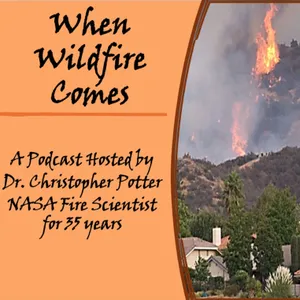
Hello, my name is Dr. Christopher Potter and I am a wildfire scientist with over 30 years of experience working for NASA, and with local communities impacted by wildland fires. I have studied wildfire on the urban interface using satellite imagery and ground measurements for all of the most destructive fires in the western United States, and I myself live in a high-risk wildfire zone in northern California. In this weekly podcast, titled "When Wildfire Comes", we will hear from a special guest about their close encounter with a major wildfire that occurred during the past several years. This is not a breaking news report, but 30 minutes during which our guest recounts their emotions and their first-hand observations of a wildfire approaching and burning in their town or community, and the lessons to be learned from such a horrifying event.
Latest Episodes
The most recent episodes — sign up to get AI-powered summaries of each one.
- 2 days ago42 min
Episode 13 - The Park Fire in 2024 with Chief Jeremey Pierce
The Park Fire is the largest most recent mega-fire in Northern California. This wildfire damaged several rural communities including burning most structures in the town of Cohasset, CA. Follow along with Chief Pierce as he describes the fire’s nearly uncontrollable path of destruction in the numerous steep drainages in Butte County and how the town of Paradise was again threatened after being completely destroyed by the Camp Fire of 2018. Daily progression of the Park Fire can be seen at https://hiform.org/projects/2024-park-fire-lassen-national-forest-ca
- May 2, 20261h 2m
Episode 12 - The Bear Fire in 2020 with Chief John Messina
The Bear Fire started in the Plumas National Forest of Butte County CA and became the North Complex Fire in 2020, killing sixteen people and destroying thousands of homes in the towns of Berry Creek and Feather Falls. As the Bear Fire exploded in unprecedented size (burning 220,000 acres in one day) and intensity overnight on September 9, 2020, its plume of smoke eventually covered the entire Sacramento Valley and the San Francisco Bay Area, leading to the event called the "Orange Skies Day" in the Bay Area. Follow along with Chief Messina as he describes 18 hours of the most intensive wildfire to burn in the recent history of the western US. Views of the Bear Fire can be viewed at https://gis.data.cnra.ca.gov/maps/CALFIRE-Forestry::north-complex-structure-status-map/ and https://www.youtube.com/watch?v=GivCgdNzV2c
- Apr 8, 202647 min
Episode 11 – The Palisades Fire in 2025 with Richard Thompson, NOAA
The Palisades Fire, which ignited on January 7, 2025, was a catastrophic wildfire in Los Angeles County driven by historically powerful Santa Ana winds. NOAA incident meteorologist Richard Thompson describes how the humidity levels during this extreme wind event were driven down to critical levels and cast burning embers into the city of Pacific Palisades to ultimately burn nearly 7000 structures. Listeners can see the progression of the fire into the urban zones of Pacific Palisades by going to the map found at https://the-lookout.org/2025/01/21/progression-of-the-palisades-fire/
- Mar 25, 202629 min
Episode 10 - The Eaton Fire and Devastation of Altadena in 2025
Podcast host Christopher Potter presents a new analysis of the destruction of thousands of homes in Altadena, CA during the Eaton Fire of January 2025. Mapping shows how structure density, urban biomass fuels, and wind-driven fire behavior contributed to the intensity of this devastating urban incident. The findings are vital for improving future wildfire risk assessments and informing post-fire recovery and rebuilding strategies in densely populated environments. Listeners should go to https://www.facebook.com/media/set/?set=a.122127036741079001&type=3 to follow along with the presentation slides.
- Mar 13, 202655 min
Episode 9 – Extreme Fire Weather with Dr. Daniel Swain
Massive cumulonimbus clouds can form over wildfires in the western United States and are likely increasing with the intensity of the wildfires themselves. Daniel Swain is a climate scientist at the University of California who focuses on the dynamics and impacts of extreme events, including floods, storms, and wildfires. In this episode, Dr. Swain discusses the formation of firestorms and the climate science that explains them.
- Feb 27, 20261h 7m
Episode 8 - The Dixie Fire in 2021 with Chief Sean Norman
The Dixie Fire was an enormous wildfire that burned almost 1 million acres in Butte, Plumas, Lassen, Shasta, and Tehama counties in Northern California. The wildfire damaged or destroyed several rural communities in the Sierra Nevada mountains, including Greenville, CA. This dynamic visualization (https://svs.gsfc.nasa.gov/4993) shows the spread of the Dixie Fire between July 14 and October 22, 2021, which enables listeners to follow along with Chief Norman, as he describes the fire’s nearly uncontrollable path of mass destruction.
- Feb 6, 202644 min
Episode 7 - Fire Weather and Climate Change with Matthew Mehle
Fire weather refers to the specific atmospheric conditions, such as extremely low humidity and high winds, that make it easier for wildfires to ignite, spread rapidly, and become difficult to control. Matthew Mehle, Lead Meteorologist and Spotter Program Manager for the San Francisco Bay Area Weather Forecast Office talks in depth about increase in fire weather days across the western U.S. and about the winds that have driven wildland blazes into urban areas across California. This is "master class" on fire weather and climate change.
- Jan 24, 202654 min
Episode 6 - The Eaton Fire in 2025 with Kelly Etter
On the one-year anniversary of the events of the 2025 wildfires in Los Angeles County, Eaton Fire survivor and Altadena home-owner Kelly Etter recounts a heartfelt story of loss and recovery. The Eaton Fire began on the evening of January 7, 2025 when powerful Santa Anna winds drove a small wildland blaze into the city of Altadena, ultimately killing 19 people and destroying more than 9,000 structures. This is an episode of community healing from such a devastating loss.
About When Wildfire Comes
Hello, my name is Dr. Christopher Potter and I am a wildfire scientist with over 30 years of experience working for NASA, and with local communities impacted by wildland fires. I have studied wildfire on the urban interface using satellite imagery and ground measurements for all of the most destructive fires in the western United States, and I myself live in a high-risk wildfire zone in northern California. In this weekly podcast, titled "When Wildfire Comes", we will hear from a special guest about their close encounter with a major wildfire that occurred during the past several years. This is not a breaking news report, but 30 minutes during which our guest recounts their emotions and their first-hand observations of a wildfire approaching and burning in their town or community, and the lessons to be learned from such a horrifying event.
Customized Recaps
AI-powered recaps with compact key takeaways, quotes, and insights.
Straight to Your Inbox
Get key takeaways from When Wildfire Comes in a 5-minute read.
Save Hours Every Week
Stay current on your favorite podcasts without falling behind.
Frequently Asked Questions
What is Podzilla's When Wildfire Comes daily summary?
It's a free AI-powered email that summarizes new episodes of When Wildfire Comes as soon as they're published. You get the key takeaways, notable quotes, and links & mentions — all in a quick read.
How does the When Wildfire Comes podcast summary work?
When a new episode drops, our AI transcribes and analyzes it, then generates a personalized summary tailored to your interests and profession. It's delivered to your inbox every morning.
Is this an official When Wildfire Comes product?
No. Podzilla is an independent service that summarizes publicly available podcast content. We're not affiliated with or endorsed by Christopher Potter, PhD.
Can I get summaries of other podcasts too?
Absolutely! The free plan covers up to 3 podcasts. Upgrade to Pro for 15, or Premium for 50. Browse our full catalog at /podcasts.
How often does When Wildfire Comes release new episodes?
When Wildfire Comes publishes biweekly. Our AI generates a summary within hours of each new episode.
What topics does When Wildfire Comes cover?
When Wildfire Comes covers topics including Science, Natural Sciences. Our AI identifies the specific themes in each episode and highlights what matters most to you.
Start getting When Wildfire Comes summaries tomorrow morning.
Free forever for up to 3 podcasts. No credit card required.
Free forever for up to 3 podcasts. No credit card required.