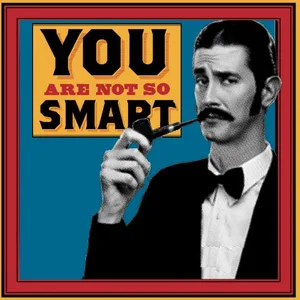
Free Daily Podcast Summary
You Are Not So Smart: Daily Summaries Delivered
by You Are Not So Smart
You Are Not So Smart is a show about psychology that celebrates science and self delusion. In each episode, we explore what we've learned so far about reasoning, biases, judgments, and decision-making.
Latest Episodes
The most recent episodes — sign up to get AI-powered summaries of each one.
- 5 days ago1h 12m
349 - AI Risk - Jesse Richardson
Jesse Richardson wants to improve our critical thinking about AI risk through the gamification of our rampant speculation. In this episode he explains AI safety isn't just one thing, there are a bunch of different risk profiles and each needs to be considered critically.Previous EpisodesHow Minds ChangeIs It Game OverSchool of ThoughtJesse Richardson’s WebsiteYour Bias IsYour Fallacy IsMelanie Mitchell on AI IntelligenceDavid McRaney’s TwitterDavid McRaney’s BlueSkyYANSS TwitterYANSS FacebookNewsletterPatreon Hosted by Simplecast, an AdsWizz company. See pcm.adswizz.com for information about our collection and use of personal data for advertising.
- 2 weeks ago43 min
348 - The Dress - Decoder Ring
We return to The Dress and the psychological lessons offered by one of the most viral moments in the history of the internet via an episode of Decoder Ring in which David McRaney shares some insights from his book, How Minds Change, with Willa Paskin, the host of Decoder Ring.Decoder RingDecoder Ring's The Dress PageWilla Paskin's TwitterCBC Interview with Willa PaskinIs It Game Over?How Minds ChangeDavid McRaney’s TwitterYANSS TwitterShow NotesNewsletterPatreon Hosted by Simplecast, an AdsWizz company. See pcm.adswizz.com for information about our collection and use of personal data for advertising.
- Aug 31, 20261h 10m
347 - Under Alien Skies - Phil Plait
Astronomer Phil Plait joins us to discuss his new book, Under Alien Skies, in which he describes what it would be like (through human eyes and real physical experiences) to actually travel to Saturn, Mars, asteroids, and distant stars. Also, we discuss the recent surge in UFO sighting as well as his famous talk at The Amazing Meeting. Previous Episodes How Minds Change Under Alien Skies Phil Plait's Newsletter Phil Plait's Substack David McRaney’s Twitter David McRaney’s BlueSky YANSS Twitter YANSS Facebook Newsletter Patreon Hosted by Simplecast, an AdsWizz company. See pcm.adswizz.com for information about our collection and use of personal data for advertising.
- Aug 17, 202659 min
346 - No Nocebo Effect - Helen Pilcher
The suffering is real, but the source may not be what you assume. That's the essence of the nocebo effect, the placebo effect's evil twin. As neuroscientist Dr. Helen Pilcher explains, illness is not simply a matter of biology. Our thoughts, conscious or otherwise, can make lead to symptoms in unexpected ways. Previous Episodes How Minds Change Dr. Helen Pilcher This Book May Cause Side Effects David McRaney’s Twitter David McRaney’s BlueSky YANSS Twitter YANSS Facebook Newsletter Patreon Hosted by Simplecast, an AdsWizz company. See pcm.adswizz.com for information about our collection and use of personal data for advertising.
- Aug 3, 20261h 6m
345 - A Pox on Fools - Thomas Levenson
MIT professor Thomas Levenson, the author of the book A Pox on Fools, takes us through the same repeating patterns throughout history which have led to antivaxxers and vaccine hesitancy since the very first vaccines. Previous Episodes How Minds Change Thomas Levenson A Pox on Fools A History of Vaccines David McRaney’s Twitter David McRaney's BlueSky YANSS Twitter YANSS Facebook Newsletter Patreon Hosted by Simplecast, an AdsWizz company. See pcm.adswizz.com for information about our collection and use of personal data for advertising.
- Aug 3, 20261h 7m
344 - Intellectual Humility - Tenelle Porter
Can intellectual humility be measured? What influences it and affects it, limits it and enhances it? What even is it, scientifically speaking? We explore all of this and then play an episode of How to Be A Better Human featuring psychologist Tenelle Porter telling comedian Chris Duffy how she is researching how to conduct better research into intellectual humility. Previous Episodes Transcript at TED How to Be A Better Human The Gateway Drugs to Intellectual Humility Tenelle Porter's Research Tenelle Porter's Website The Illusion of Explanatory Depth Kitted Shop The Story of Kitted How Minds Change David McRaney’s BlueSky David McRaney’s Twitter YANSS Twitter Show Notes Newsletter Patreon Hosted by Simplecast, an AdsWizz company. See pcm.adswizz.com for information about our collection and use of personal data for advertising.
- Jul 6, 20261h 8m
343 - Misguided - Matthew Facciani
What is misinformation? How does it differ from disinformation or just plain ‘ole propaganda? How do we protect ourselves from people with nefarious intentions using all of these things to affect our thoughts, feelings, and behavior? That’s what we discuss in this episode with Matthew Facciani, social scientist and author of Misguided: Where Misinformation Starts, How it Spreads, and What We Can Do About It. Matthew Facciani's Website The Misguided Podcast Misguided Kitted Shop The Story of Kitted How Minds Change David McRaney's BlueSky David McRaney’s Twitter YANSS Twitter Show Notes Newsletter Patreon Hosted by Simplecast, an AdsWizz company. See pcm.adswizz.com for information about our collection and use of personal data for advertising.
- Jun 22, 202647 min
342 - The Conspiracy Theorist Who Changed His Mind
Tim Harford of the podcast Cautionary Tales sits down with David McRaney to hear a story from David's book, How Minds Change, about how (and why) a prominent conspiracy theorist realized he was wrong. Charlie Veitch was certain that 9/11 was an inside job. The attack on the World Trade Center wasn’t the work of Al-Qaeda, but an elaborate conspiracy. He became a darling of so-called “9/11 truthers” until he actually visited Ground Zero to meet architects, engineers and the relatives of the dead. The trip changed his mind. His fellow “truthers” did not take Charlie’s conversion well. Kitted Previous Episodes How Minds Change Cautionary Tales Tim Harford David McRaney’s Twitter David McRaney’s BlueSky YANSS Twitter YANSS Facebook Newsletter Patreon Hosted by Simplecast, an AdsWizz company. See pcm.adswizz.com for information about our collection and use of personal data for advertising.
Get You Are Not So Smart summaries in your inbox
Free AI-powered daily recaps. Key takeaways, quotes, and mentions — in a 5-minute read.
Get Free Summaries →Free forever for up to 3 podcasts. No credit card required.
You Might Also Like
Listeners also like.
Who Smarted? - Educational Podcast for Kids
A daily educational podcast for kids that makes learning science and history fun through humor and engaging storytelling.
The Michael Shermer Show
Long-form conversations with scientists, philosophers, and thinkers on critical issues of our time.
Science Vs
A show that investigates popular topics and myths by analyzing scientific evidence to determine what’s fact, fiction, or uncertain.
Science Quickly
A bite-sized science podcast exploring discoveries with journalists and experts.
The Psychology Podcast
Explores human potential and possibility through conversations with scientists, thinkers, and self-actualized individuals.
Sidenote by AsapSCIENCE
Greg and Mitch explore the science behind controversial topics using research and anecdotes to inform and entertain.
Hidden Brain
Explores human behavior and the unconscious patterns that shape our decisions, relationships, and society through science and storytelling.
Note to Self
Explores how technology shapes human behavior and identity in modern life.
Growth Mindset Psychology: The Science of Self-Improvement
Explores the science behind lasting self-improvement through psychology, neuroscience, and timeless wisdom traditions.
Something You Should Know
Explores practical wisdom and expert insights to help listeners improve their lives, careers, and relationships.
The Science Show
Explores diverse scientific topics and research, from physics to politics, with a focus on Australian perspectives.
SmartLess
Three actors share humorous, improvised conversations with a rotating mystery guest, exploring life experiences with wit and curiosity.
About You Are Not So Smart
You Are Not So Smart is a show about psychology that celebrates science and self delusion. In each episode, we explore what we've learned so far about reasoning, biases, judgments, and decision-making.
Customized Recaps
AI-powered recaps with compact key takeaways, quotes, and insights.
Straight to Your Inbox
Get key takeaways from You Are Not So Smart in a 5-minute read.
Save Hours Every Week
Stay current on your favorite podcasts without falling behind.
Frequently Asked Questions
What is Podzilla's You Are Not So Smart daily summary?
It's a free AI-powered email that summarizes new episodes of You Are Not So Smart as soon as they're published. You get the key takeaways, notable quotes, and links & mentions — all in a quick read.
How does the You Are Not So Smart podcast summary work?
When a new episode drops, our AI transcribes and analyzes it, then generates a personalized summary tailored to your interests and profession. It's delivered to your inbox every morning.
Is this an official You Are Not So Smart product?
No. Podzilla is an independent service that summarizes publicly available podcast content. We're not affiliated with or endorsed by You Are Not So Smart.
Can I get summaries of other podcasts too?
Absolutely! The free plan covers up to 3 podcasts. Upgrade to Pro for 15, or Premium for 50. Browse our full catalog at /podcasts.
How often does You Are Not So Smart release new episodes?
You Are Not So Smart publishes biweekly. Our AI generates a summary within hours of each new episode.
What topics does You Are Not So Smart cover?
You Are Not So Smart covers topics including Science, Education, Culture, Society & Culture, Social Sciences. Our AI identifies the specific themes in each episode and highlights what matters most to you.
Start getting You Are Not So Smart summaries tomorrow morning.
Free forever for up to 3 podcasts. No credit card required.
Free forever for up to 3 podcasts. No credit card required.