Free Daily Podcast Summary
Inner Propaganda with Owen Fitzpatrick: Daily Summaries Delivered
by Owen Fitzpatrick
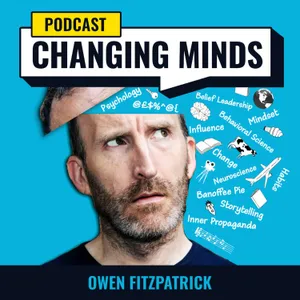
The most powerful propagandist in your life is you. Inner Propaganda with Owen Fitzpatrick explores the unconscious beliefs and stories that shape how we think, decide, and lead. Owen is a social psychologist, keynote speaker, and author of Inner Propaganda (Ideapress, 2026). For over two decades, he's studied belief systems, from global boardrooms to field research in North Korea, Rwanda, and Afghanistan. Each episode unpacks how beliefs form, why they resist change, and what it takes to lead through uncertainty. Ideas for leaders, thinkers, and anyone tired of soft-skill clichés.
Latest Episodes
The most recent episodes — sign up to get AI-powered summaries of each one.
- 4 days ago23 min
Why feelings feel like facts
I was lying on a wooden floor in the Amazon jungle, convinced I was finally seeing the truth. The colors were sharper. The connections were obvious. Everything made sense. There was just one problem: I am a psychologist who studies how people get tricked into believing things, and right at that moment, I was being tricked. What the ayahuasca did to my perception that night is a more extreme version of what is happening to every one of us every single day. Neuroscientist Lisa Feldman Barrett calls it affective realism. Your feelings do not just shape what you think. They construct what you see. In 2021, an ecologist named Martin Scheffer tracked emotional versus rational language in books and newspapers from 1850 to the present and found that we are living in the most emotionally engineered information environment in modern history. Most of us have no framework for navigating it. In this episode of Inner Propaganda, I explore how emotions work as constructions rather than reactions, what the body budget is, and why your physical state determines what you perceive as threatening, and how a 2007 research study revealed that simply naming an emotion precisely is enough to reduce its intensity. I also share the story of Robert Piché, a Canadian pilot who, in 2001, glided a powerless aircraft 120 kilometers over the Atlantic with 306 people on board and landed safely, because he had learned years earlier in a prison cell that fear does not have to steer you in the wrong direction. What you will discover: Why the emotional state you are in does not just color your mood but determines the version of reality you actually perceive How a 2021 study tracking 170 years of language reveals that emotional engineering in media and politics is not accidental, it is systematic Why modern neuroscience suggests emotions are constructions your brain builds in real time from your senses, your body, and your memories, not reactions to the world around you What the body budget is and why being tired, hungry, or stressed makes threats appear more real and more serious than they actually are <span style= "font-size: 11pt; font-family: Arial,sans-serif; color: #000000; background-color: transparent; font-weight: 400; font-style: normal; font-variant: n
- 1 weeks ago1h 24m
The belief that sabotages every conversation you have (with Tamsen Webster)
Socrates was executed for it. The ancient Greeks called it parrhesia: the practice of speaking truth openly, even at personal risk. The form of conversation it made possible, genuine dialogue aimed at mutual understanding, has quietly disappeared from the way most of us communicate today. What replaced it was debate. And debate, it turns out, is one of the least effective tools we have for actually changing minds. In this episode of Inner Propaganda, I sit down with Tamsen Webster, design expert, persuasion researcher, and doctoral candidate, to explore what it actually takes to change minds ethically and durably. Drawing on Habermas, sense-making and sense-giving theory, Bayesian probability, and the ancient Greek concept of parrhesia, we get into the real mechanics of how beliefs shift and what that means for anyone trying to communicate, lead, or connect. What you will discover: Why debate, discussion, and dialogue are three completely different tools with three completely different goals, and why entering the wrong one makes genuine understanding impossible How carrying a persuasive intent into a conversation can be the very thing that prevents persuasion from happening The two-word phrase that can shift how you experience disagreement in real time Why the if-then structure underpins all human understanding, and what that means for anyone trying to land a new idea The one belief Tamsen thinks too many people carry, and why it may be the single biggest obstacle to genuine connection Pre-order Inner Propaganda: <span style= "font-size: 11pt; font-family: Arial,sans-serif;
- 2 weeks ago22 min
The hidden psychology that decides whether your team will fight for you or walk away
At 25 years old, Anne Devlin was tortured, thrown into a cell with six inches of sewage on the floor, and offered the equivalent of $90,000 to talk. For three years, she endured it all without saying a single word. The psychology that explains her silence is the same psychology that determines whether the people on your team will give everything for your mission, or quietly walk away. In this episode of Inner Propaganda, I explore the three forces that drive deep commitment in any group, organization, or movement: labeling, belonging, and becoming. Drawing on Henry Tajfel's social identity theory, Solomon Asch's conformity studies, and Stanley Milgram's sidewalk experiment, I walk through exactly how identity shapes belief, and what leaders can do with that understanding. What you will discover: Why the labels we assign to people do not just describe identity, they create it Why social exclusion registers neurologically the same way physical pain does How identity fusion explains the most extraordinary acts of commitment and sacrifice What the science of belonging means for building teams that truly believe in what they are doing The dangers of groupthink, and how to protect against it Pre-order Inner Propaganda: https://innerpropaganda.com/ Visit: https://owenfitzpatrick.com/ <p dir="ltr" style= "line-height: 1
- 3 weeks ago36 min
Your brain has five versions of the truth, and most of them are wrong
Nobody thinks they're the one watching propaganda. It's always the other channel. That's naive realism, and it's one of the biggest barriers to meaningful conversation. In this episode of Inner Propaganda, I introduce the Five Types of Truth: past, objective, shared, emotional, and desired. Each one shapes how we think, decide, and relate to others. Each has its own power and its own risks. I also share a practical framework for using this model when you're trying to influence someone else, including a step-by-step example around helping someone move past their fear of artificial intelligence. What you'll discover: – Why naive realism shuts down real conversation – The five types of truth, with real-world examples for each – Why belief is often the admission fee for belonging to a group <p dir="ltr" style= "line-
- May 4, 202631 min
How the Emperor created Darth Vader: The psychology behind the dark side
This episode of Inner Propaganda is one I have been waiting to make for a long time. In honor of May the 4th, we are going full Star Wars to answer one of the most important questions in movie history: how did Emperor Palpatine turn the galaxy's greatest hero into a mass murderer? And how did Luke Skywalker manage to turn him back? In this episode, I break down how Palpatine engineered the conversion of Anakin Skywalker into Darth Vader, and how Luke Skywalker reversed it at the very end. This is not just a Star Wars deep dive. It is a masterclass in how beliefs are built and identities are hijacked. In this episode, you will discover: The real psychology behind Jedi mind tricks The three-part framework behind every major belief change: feels right, fits in, makes sense How fear and anger have been used to manipulate populations throughout history How Luke used belief and connection to bring his father back from the dark side Visit my website: https://owenfitzpatrick.com/ Join my newsletter: https://owenfitzpatrick.com/newsletter/ <span style= "font-size: 11pt; font-family: Arial,sans-serif; color: #000000; background-color: transparent; font-weight: 400; font-s
- Apr 27, 202625 min
Your brain has a context window, and it's lying to you
Welcome to the very first episode of Inner Propaganda. In this episode, I open up about the darkest moment of my life, at 14 years old, sitting down to write a goodbye note to my parents, and the one question that stopped me, shifted my beliefs, and ultimately saved my life. That moment became the foundation for everything I've built since. I also explore the fascinating difference between fact and truth, why your brain is the ultimate internal propagandist, and introduce one of the most powerful frameworks I've ever developed: The brain's context window, and how you can deliberately use it to change the stories you sell to yourself. In this episode, you'll discover: Why your brain doesn't show you reality — it sells you a story The study of 500,000 people across 145 countries that reveals when we're most miserable (spoiler: I'm living it) The difference between a fact and a truth, and why it changes everything <span style= "font-size: 11pt; font-family: Arial,sans-serif; color:
- Mar 23, 202637 min
Why Giving Up Can Help You Win
In this episode of Changing Minds, I sit down with resilience expert Courtney Clark to explore a powerful idea: sometimes the key to winning is knowing when to give up. We dive into why grit alone isn't enough, how flexible goal setting can outperform perseverance, and why letting go of the wrong path can actually move you closer to success. Courtney shares deeply personal stories, from surviving cancer to redefining what it means to achieve your goals, and introduces practical tools like "goal supersizing" and "stoptimism." If you've ever felt stuck, overwhelmed, or unsure whether to keep going or change direction, this episode will give you a new way to think about success, resilience, and growth. Learn more about Courtney ➡️ https://courtneyclark.com/ https://www.youtube.com/@CourtneyLClark Visit my website: https://owenfitzpatrick.com/ Join my Newsletter: https://owenfitzpatrick.com/newsletter/
- Mar 16, 202621 min
14 Big Ideas on Selling and Marketing Better
In this episode of Changing Minds, I walk through 14 powerful ideas that can transform the way you sell, market, and persuade. Drawing on some of the most influential thinkers in psychology, marketing, and negotiation, including Robert Cialdini, Dan Pink, Chris Voss, Seth Godin, Zoe Chance, and Will Storr, I explore the key principles behind effective persuasion. From understanding intrinsic motivation and the psychology of crowds to mastering storytelling and becoming truly remarkable in the marketplace, these ideas provide a practical roadmap for anyone who wants to communicate more effectively and influence others ethically. If you want to become better at selling ideas, marketing your work, and persuading people in meaningful ways, this episode will give you insights that can change how you approach communication forever. Visit my website: https://owenfitzpatrick.com/ Join my Newsletter: https://owenfitzpatrick.com/newsletter/
About Inner Propaganda with Owen Fitzpatrick
The most powerful propagandist in your life is you. Inner Propaganda with Owen Fitzpatrick explores the unconscious beliefs and stories that shape how we think, decide, and lead. Owen is a social psychologist, keynote speaker, and author of Inner Propaganda (Ideapress, 2026). For over two decades, he's studied belief systems, from global boardrooms to field research in North Korea, Rwanda, and Afghanistan. Each episode unpacks how beliefs form, why they resist change, and what it takes to lead through uncertainty. Ideas for leaders, thinkers, and anyone tired of soft-skill clichés.
Customized Recaps
AI-powered recaps with compact key takeaways, quotes, and insights.
Straight to Your Inbox
Get key takeaways from Inner Propaganda with Owen Fitzpatrick in a 5-minute read.
Save Hours Every Week
Stay current on your favorite podcasts without falling behind.
Frequently Asked Questions
What is Podzilla's Inner Propaganda with Owen Fitzpatrick daily summary?
It's a free AI-powered email that summarizes new episodes of Inner Propaganda with Owen Fitzpatrick as soon as they're published. You get the key takeaways, notable quotes, and links & mentions — all in a quick read.
How does the Inner Propaganda with Owen Fitzpatrick podcast summary work?
When a new episode drops, our AI transcribes and analyzes it, then generates a personalized summary tailored to your interests and profession. It's delivered to your inbox every morning.
Is this an official Inner Propaganda with Owen Fitzpatrick product?
No. Podzilla is an independent service that summarizes publicly available podcast content. We're not affiliated with or endorsed by Owen Fitzpatrick.
Can I get summaries of other podcasts too?
Absolutely! The free plan covers up to 3 podcasts. Upgrade to Pro for 15, or Premium for 50. Browse our full catalog at /podcasts.
How often does Inner Propaganda with Owen Fitzpatrick release new episodes?
Inner Propaganda with Owen Fitzpatrick publishes weekly. Our AI generates a summary within hours of each new episode.
What topics does Inner Propaganda with Owen Fitzpatrick cover?
Inner Propaganda with Owen Fitzpatrick covers topics including Science, Education, Social Sciences, Self-Improvement. Our AI identifies the specific themes in each episode and highlights what matters most to you.
Start getting Inner Propaganda with Owen Fitzpatrick summaries tomorrow morning.
Free forever for up to 3 podcasts. No credit card required.
Free forever for up to 3 podcasts. No credit card required.