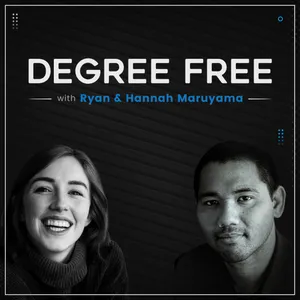
Free Daily Podcast Summary
Degree Free: Daily Summaries Delivered
by Degree Free
Welcome to Degree Free! It’s our job to share fundamentals we’ve discovered and the mistakes we’ve made while self educating, getting work, building businesses, and making money. We’ll tell you how to make it happen, no degree needed!
Latest Episodes
The most recent episodes — sign up to get AI-powered summaries of each one.
- 3 days ago51 min
The Career Conversation Every Parent Should Have First (Degree Free #208)
Want to guide your 16-20 year old to careers that help them reach their goals? Check out our workbook set: ➡️ https://degreefree.com/book Want a custom career plan for your 16-20 year old? Apply for the Degree Free Launch Program: ➡️ https://degreefree.com/launch Most families plan the college step before they plan the career. We think that is the root problem. The FutureEd report "Future Shock: The Crisis in Career Navigation" shows how few teenagers feel ready to choose a career, even while many plan to buy a college degree. School counselors cannot solve this alone. The average counselor serves hundreds of students while also handling college advising, mental health needs, and urgent crises. There is no realistic way for one person in that role to research a custom career plan for every young adult. Parents also confuse career options with training options. College, trade school, and the military are ways to get somewhere. They are not careers. Start with what your child wants their work and life to look like. Then find careers that fit. After that, identify the skills, licenses, certifications, or degree each career truly requires. We also explain why vocational creativity matters. Young adults choose from the work they can see. Parents can expand that view by pointing out the people behind everyday work and by helping their child try small, real actions. A young person who wants to create content should start posting, not buy a content creation degree first. The goal comes first. The method comes second. The credential comes last, if it is needed at all.
- 5 days ago23 min
Your Daughter’s Backup Plan Is the Trap (The Hannah Maruyama Show #12)
Want to guide your 16-20 year old to careers that help them reach their goals? Check out our workbook set: ➡️ https://degreefree.com/book Want a custom career plan for your 16-20 year old? Apply for the Degree Free Launch Program: ➡️ https://degreefree.com/launch I watched George Kamel ask a high school student about her plans. She said she had to go to college to get paid, then named pediatric sonography. When asked about debt, she said she would borrow up to $300,000 because she expected her degree to pay it back. Her answers show what happens when young adults are asked to choose a career before they know what they need from work. I don't blame her. Adults reward answers that sound impressive. They also offer a narrow choice between college and trades such as plumbing or electrical work. Those trades may fit some women. But they are only a few of the paths open to your daughter. Sales, technology, and other skilled work may fit her goals too. The point is to find the fit before choosing a path. The sonography example makes the cost of guessing clear. Diagnostic medical sonography can often begin with an associate's degree or a certificate, rather than the four-year degree and huge debt the student imagined. But even a less costly program is a poor choice if the hours, setting, or work itself do not fit her life. Liking children or wanting to help people is not enough to settle those questions. Start with four things: schedule, income, work environment, and location. Ask your daughter which matters most and what she needs from each. Then look for careers that match, check the real entry requirements, and work backward to the classes, training, and first job she can pursue now. A clear plan protects more of her choices than a degree bought on a guess.
- 1 weeks ago47 min
What the College System Isn’t Telling Parents (Degree Free #207)
Want to guide your 16-20 year old to careers that help them reach their goals? Check out our workbook set: ➡️ https://degreefree.com/book Want a custom career plan for your 16-20 year old? Apply for the Degree Free Launch Program: ➡️ https://degreefree.com/launch Colleges are facing a financial reckoning. Moody's expects more private colleges to run at a loss, and closures can leave students with debt but no credential. We share one case where a nearly finished dental hygiene student lost her program overnight. If your child needs a degree for a licensed career, checking the school's finances now belongs on the list with income, schedule, work environment, and location. Student debt does not disappear when borrowers get older. Millions of Americans over 60 still owe student loans, and some face collection through Social Security. Younger borrowers hold larger balances while wages have not kept pace. That means today's families are taking on more risk than the generations already struggling to retire. Trust in elite colleges is falling too. We trace that loss of trust back to price, value, and accountability. A famous name cannot protect a family from a bad purchase. And switching the default from a four-year college to community college or trade school does not fix the core problem. Start with your child's goals. Ask what they want from their location, income, schedule, and work environment. Then work backward to the education, license, skill, or experience that serves that goal. The destination comes first. The institution comes last.
- 1 weeks ago12 min
Turn Any Teen Job Into a Real Advantage (Here’s How) (The Hannah Maruyama Show #11)
Want to guide your 16-20 year old to careers that help them reach their goals? Check out our workbook set: ➡️ https://degreefree.com/book Want a custom career plan for your 16-20 year old? Apply for the Degree Free Launch Program: ➡️ https://degreefree.com/launch Parents worry that skipping college will trap their teen in a job with no future. But a job is only a dead end when it does not serve a clear goal. The same grocery store role can become a holding pattern for one young adult and the first rung of a management career for another. I call the right starting point strategic entry-level work. A young adult starts with the life they want, finds work that can provide it, and then identifies a role they can enter now. From there, they build skills, earn certificates or licenses, gain experience, and move up. Starting at 18 also gives them time to test a path while their costs and obligations are low. College graduates still need strategic entry-level work. They often reach that starting line years later with debt, higher pay expectations, and little work experience. Meanwhile, an 18-year-old can spend those same years getting paid and building a track record. The test is simple. Ask what job your child would take next month. Then ask what that job builds toward. If they can name the skill, experience, promotion, or career it leads to, the job may be strategic. If they cannot, even an impressive title can become a dead end. A clear goal protects them, not a piece of paper.
- 2 weeks ago28 min
Parents Are Scared of AI. Nobody’s Warning Them About This (Degree Free #206)
Want to guide your 16-20 year old to careers that help them reach their goals? Check out our workbook set: ➡️ https://degreefree.com/book Want a custom career plan for your 16-20 year old? Apply for the Degree Free Launch Program: ➡️ https://degreefree.com/launch Recent college grad underemployment is at 42.5 percent, but that problem did not begin with AI. Many grads leave school without work experience, expect pay their skills do not support, and struggle to get the first job that can shape the rest of their career. Colleges would rather blame AI than admit their product is not preparing many young adults for work. The fear also looks bigger because the loudest layoffs get the most attention. University staff and other online professional groups receive long news stories when their jobs disappear. Other workers often lose jobs with far less coverage. AI companies added to the fear by promising that their tools would replace whole groups of workers. Those same companies still hire highly paid engineers. What we see instead is a low-hire, low-fire market. Companies know AI will change jobs, but many still do not know which tasks it should handle, what it will cost, or which people they need around it. The tools can produce more work without producing better business results. We expect work to change and grow, not vanish. That makes direction more urgent for your child. One family waited more than a year for clarity to appear on its own. Their hardworking young adult stayed employed but had no career target. Parents do not become job market analysts overnight. Once you know direction is the problem, shorten that lost window. Turn goals into a clear plan with real next steps.
- 2 weeks ago15 min
Your Kid Can Have the College Life Without the Debt (The Hannah Maruyama Show #10)
Want to guide your 16-20 year old to careers that help them reach their goals? Check out our workbook set: ➡️ https://degreefree.com/book Want a custom career plan for your 16-20 year old? Apply for the Degree Free Launch Program: ➡️ https://degreefree.com/launch Parents often say they do not want college for their child, but they still fear taking away the college experience. I break down what that phrase really means. Most families are thinking about friends, parties, games, an apartment, independence, and time around other young adults. None of those things require enrollment. The two things that create this experience are proximity and free time. Your child can move to a college town, live in many of the same off-campus apartments, and find strategic entry-level work. They can join a gym, sports league, church, volunteer group, class, or professional meetup. They can also build the skills, licenses, and certificates that help them move forward at work. After four years, they can have the same social life as enrolled students plus work experience, a professional network, a resume, and savings. College enrollment is facing a demographic decline, but many college towns still draw new residents. The town and the age create the experience. A degree is not the price of admission. I also explain how a clear 12-month plan can tie the move, the job, the skills, and the social life together. Your child does not have to choose between independence and a career. With some planning, they can build both without the debt.
- 3 weeks ago26 min
How Colleges Use Merit Aid to Trap Families (Degree Free #205)
Want to guide your 16-20 year old to careers that help them reach their goals? Check out our workbook set: ➡️ https://degreefree.com/book Want a custom career plan for your 16-20 year old? Apply for the Degree Free Launch Program: ➡️ https://degreefree.com/launch Merit aid sounds like a reward. We think parents should see it as a sales tool. We start with a Ramsey Show caller whose family already has $200,000 in debt, student loans, a home equity loan, and a large mortgage. His daughter receives merit aid, and that small discount helps make another round of borrowing feel reasonable. But nobody asks the first question: What career does she want, and does it require a degree? We explain why merit aid works like a coupon. The college attaches status to the offer, tells your family the award reflects your child's hard work, and makes walking away feel wasteful. Colleges can also study a family's income, work, and assets to estimate what they may pay. The aid is not the value of the degree. It is the discount the school believes may close the sale. Then we look at the college enrollment cliff. Fewer young adults are reaching college age, but many families are also choosing to leave the college line. The University of Oregon expects far fewer nonresident freshmen and a major tuition gap. Hannah warns that colleges will chase new sources of full-price tuition as that pressure grows. We close with one practical test for degree holders who cannot get hired: make a second resume without the degree and compare the response. Stop defending sunk costs. Test what employers value now.
- 3 weeks ago21 min
Your Kid Can Be an Engineer Without a Degree (Here’s How) (The Hannah Maruyama Show #9)
Want to guide your 16-20 year old to careers that help them reach their goals? Check out our workbook set: ➡️ https://degreefree.com/book Want a custom career plan for your 16-20 year old? Apply for the Degree Free Launch Program: ➡️ https://degreefree.com/launch Parents hear engineering and picture one path: choose a major, buy a four-year degree, then apply for a job. That skips the most important question. What type of engineering fits the life your child wants? I explain what a Professional Engineer license is and why most engineering work does not require one. Then I walk through roles beyond civil engineering and architecture, including industrial, manufacturing, field service, HVAC, sales, security, and automation engineering. Many of these paths start with technician work. Your child can enter early, gain real experience, and learn whether the field fits before paying for school. The Degree Free Four gives your family a place to start. Define the schedule, work setting, income, and location your child needs. Then research the engineering category that matches those needs. Use the rest of high school to build useful proof through shop classes, certifications, internships, and part-time work. I also share Aiden's story. He left Texas A&M, built a plan around his real goals, and started a field service engineering role without a degree. The point is not that nobody should buy a degree. It is that college can wait until your child knows exactly why they need it. Start with the goal. Then shorten the distance to the right entry-level work.
Get Degree Free summaries in your inbox
Free AI-powered daily recaps. Key takeaways, quotes, and mentions — in a 5-minute read.
Get Free Summaries →Free forever for up to 3 podcasts. No credit card required.
You Might Also Like
Listeners also like.

Borrowed Future
A deep look at the student loan crisis, examining the rising cost of college and whether higher education is worth the debt.

Financial Feminist
A feminist guide to personal finance, teaching women how to earn, save, and grow wealth while challenging systemic economic inequality.

The Lazy Genius Podcast
A practical guide to simplifying life by focusing energy on what matters and letting go of the rest.

Becoming You with Suzy Welch
A podcast exploring personal growth, career choices, and life decisions with candid conversations and practical insights.

Working Hard with Grace Beverley
Real people share hard-won lessons on success, resilience, and life balance across diverse fields, from activism to business and beyond.

Let's Talk Offline
Two career experts discuss real talk on work-life balance, pay negotiation, and office relationships for early-career professionals.

The Christy-Faith Show
A podcast offering educational and homeschooling insights for intentional parents.

Two Parents & A Podcast
Two parents navigate raising kids, building a relationship, and tackling topics from entrepreneurship to dental industry critiques.

Raising Parents with Emily Oster
An economist examines data-driven approaches to modern parenting challenges, from child independence to teen mental health.

The Entrepreneur DNA
Entrepreneurs share lessons on building businesses and personal growth through real experiences and mistakes.

Money Guy Show
Teaches wealth-building strategies to help listeners grow their assets and achieve financial goals efficiently.

The $100 MBA Show
Short, actionable business lessons from a serial entrepreneur on starting and growing companies with minimal resources.
Customized Recaps
AI-powered recaps with compact key takeaways, quotes, and insights.
Straight to Your Inbox
Get key takeaways from Degree Free in a 5-minute read.
Save Hours Every Week
Stay current on your favorite podcasts without falling behind.
Frequently Asked Questions
What is Podzilla's Degree Free daily summary?
It's a free AI-powered email that summarizes new episodes of Degree Free as soon as they're published. You get the key takeaways, notable quotes, and links & mentions — all in a quick read.
How does the Degree Free podcast summary work?
When a new episode drops, our AI transcribes and analyzes it, then generates a personalized summary tailored to your interests and profession. It's delivered to your inbox every morning.
Is this an official Degree Free product?
No. Podzilla is an independent service that summarizes publicly available podcast content. We're not affiliated with or endorsed by Degree Free.
Can I get summaries of other podcasts too?
Absolutely! The free plan covers up to 3 podcasts. Upgrade to Pro for 15, or Premium for 50. Browse our full catalog at /podcasts.
How often does Degree Free release new episodes?
Degree Free publishes 2x weekly. Our AI generates a summary within hours of each new episode.
What topics does Degree Free cover?
Degree Free covers topics including Education, Business, Careers. Our AI identifies the specific themes in each episode and highlights what matters most to you.
Start getting Degree Free summaries tomorrow morning.
Free forever for up to 3 podcasts. No credit card required.
Free forever for up to 3 podcasts. No credit card required.