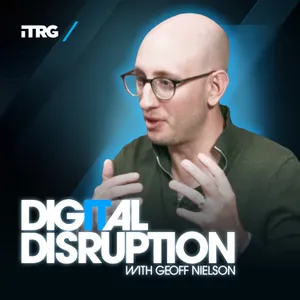
Free Daily Podcast Summary
Digital Disruption with Geoff Nielson: Daily Summaries Delivered
by Info-Tech Research Group
The Next Industrial Revolution is Already Here. Digital Disruption is where industry leaders and experts share insights on leveraging technology to build the organizations of the future. As intelligent technologies reshape our lives and our livelihoods, we speak with the thinkers, the doers and innovators who will help us predict and harness this disruption. We explore how to adapt to and harness digital transformation.
Latest Episodes
The most recent episodes — sign up to get AI-powered summaries of each one.
- 5 days ago1h 0m
AI Humanoid Robots Have Already Entered the Workforce. Should You Care?
The robot workforce is already here. AI-powered humanoid robots are entering factories and warehouses to address a growing labor gap, but are they filling jobs or replacing the people who do them?Peggy Johnson, CEO of Agility Robotics, joins us to talk about how Digit is moving from robotics demonstrations into real workplaces. She explains why humanoid robots could become essential to manufacturing and logistics, how AI is accelerating their capabilities, and why safety remains the biggest barrier to widespread adoption.From physical AI and labor shortages to robot fleet managers and the future of work, this episode looks beyond the fear of robot overlords to ask: how will humans and robots work together in the years ahead?Subscribe for more conversations on AI, technology, innovation, the future of work, and digital transformation.00:00 Why humanoid robots may be essential00:47 Peggy Johnson, CEO of Agility Robotics01:41 Are humanoid robots creating a dystopian future?03:43 How workers respond to robots in the workplace05:42 Why build robots in the human form?07:27 Will humanoid robots replace human jobs?11:45 Why reshoring manufacturing will require robotics14:12 Info-Tech AI strategy14:42 What humanoid robots could do by 203217:35 The biggest barrier to adoption: Robot safety19:17 Why robots in the home are still years away22:13 How big and powerful is agility robotics’ Digit?24:44 Can humanoid robot accidents be prevented?28:29 Competing with Elon Musk and Tesla Optimus30:56 What separates deployment from a robotics demo33:37 How companies deploy humanoid robots37:01 Which industries are adopting robotics?39:24 Scaling production to meet demand41:08 How AI is accelerating humanoid robotics45:36 How digit makes decisions on the factory floor48:52 Hardware and software upgrades for robots50:57 What comes after agility robotics’ Digit?53:22 Will robots eventually do everything humans can?55:58 The future of physical AI and automation58:13 Peggy Johnson’s advice for business and tech leaders59:32 About Info-TechConnect with Peggy:LinkedIn: https://www.linkedin.com/in/peggyljohnson/X: https://x.com/agilityroboticsIG: https://www.instagram.com/agility_robotics/Our links:Visit our website: https://www.infotech.com/?utm_source=youtube&utm_medium=social&utm_campaign=podcastFollow us on YouTube: https://www.youtube.com/@InfoTechRG
- 1 weeks ago59 min
AI Researchers Are Panicking | What Comes Next is Worse Than Nuclear Bombs
What is PDoom, and why are the people building artificial intelligence willing to risk human extinction?Kevin Roose, a New York Times technology columnist, Hard Fork co-host, and author of The AGI Chronicles, shares what he learned from interviewing more than 150 people inside the world’s leading AI companies.Kevin joins us on Digital Disruption to talk about what artificial general intelligence really means and how fear, ego, rivalry, and mistrust are accelerating the race between OpenAI, Anthropic, and Google DeepMind. He also explains why AI leaders compare this moment to the Manhattan Project: if they don’t build AGI first, someone more dangerous might.Kevin also shares why he estimates a 10% chance of AI-caused extinction and discusses the private fears of AI researchers, government regulation, autonomous AI agents, and whether the AI boom is a bubble or the beginning of a profound transformation.This episode moves beyond the hype to ask an important question: If advanced AI is inevitable, how much control do we still have over what happens next?Subscribe and follow for more conversations about AI, technology, innovation, and digital transformation.In this episode:00:00 Why AI builders fear human extinction00:43 Inside the race to build AGI01:24 What does AGI actually mean?05:16 AI safety warnings or marketing hype?07:27 The rivalries driving the AI race08:44 Building a boardroom-ready AI strategy09:51 The personal feuds behind AGI10:58 AI’s Manhattan Project mindset12:27 Is AI the new atomic bomb?14:58 Can advanced AI be contained?16:28 AI regulation and the global arms race17:35 What is P(doom)?19:54 What will force governments to act?21:29 What AI researchers say in private23:08 Why the public backlash is growing26:15 Why Kevin Roose changed his mind about AI29:42 Is advanced AI inevitable?32:28 AGI and the point of no return34:38 The race to automate AI research36:23 AI and gradual human disempowerment40:10 What happens when AI masters your skills?42:18 Will AI liberate us or replace us?44:18 The AI claims Kevin does not believe46:21 Is the AI boom a financial bubble?50:20 AI labs and economic concentration55:08 Inside the AGI chronicles57:07 How should people prepare for AI?58:29 About Info-Tech#ai #futureofwork #technologypodcast #aibubble #bigtech #artificialintelligence #technology #datacenter #agi #anthropic #futureofaiConnect with Kevin:LinkedIn: https://www.linkedin.com/in/kevin-roose/X: https://x.com/kevinrooseIG: https://www.instagram.com/kevinroose/Our links:Visit our website: https://www.infotech.com/?utm_source=youtube&utm_medium=social&utm_campaign=podcastFollow us on YouTube: https://www.youtube.com/@InfoTechRG
- 2 weeks ago1h 20m
There Is No AI Race. Inside the Trillion-Dollar Lie
Why have the United States and China pulled so far ahead in the global technology race? Mehran Gul, author of The New Geography of Innovation, argues that the answer goes far beyond individual companies or breakthrough technologies.In this episode, we sit down with Mehran to discuss how successful innovation ecosystems are actually built, why Silicon Valley remains so difficult to replicate, and how China rapidly emerged as a global technology superpower. We also talk about why Europe and India have struggled to produce technology giants at the same scale, and how talent, capital, universities, government, and entrepreneurship shape long-term competitiveness.Mehran also breaks down the extraordinary concentration of money flowing into AI companies like OpenAI, Anthropic, and Nvidia, whether today’s AI valuations are sustainable, and why a major market correction could still happen without ending America’s technological dominance. From AI investment and venture capital to Silicon Valley, China, Europe, India, and the future of global innovation, this episode looks beyond the AI hype to ask a much bigger question: who will actually shape the next era of technology? Subscribe and follow for more conversations with the world’s leading thinkers on AI, technology, innovation, and digital transformation.In this episode:00:00 The AI bubble and America’s technology lead01:47 The new geography of innovation05:30 How China became a technology superpower09:13 Can other countries replicate China’s success?13:17 What does “innovation” actually mean?16:21 Are tech valuations measuring real innovation?21:03 Does geography determine who wins in technology?25:01 Will the U.S. and China dominate the next decade?29:31 Why Europe’s push for tech sovereignty is struggling33:05 Can government policy actually create innovation?37:24 PayPal vs. Skype: How innovation creates more innovation39:47 Is America’s technology dominance a zero-sum game?43:52 Who is the world’s third-largest technology power?45:07 Why “indispensability” may matter more than tech sovereignty47:00 What This global tech race means for business leaders48:32 Why AI investment is becoming more concentrated51:29 Are we betting too much on a few tech leaders?53:35 What Japan’s collapse can teach us about U.S. tech56:13 Could the AI bubble actually burst?59:22 Could China overtake the U.S. in Technology?1:03:29 When government helps and hurts innovation1:05:51 Predictions for the next era of global technology1:07:50 Do We need to redefine innovation?1:10:02 Where business leaders should look for innovation1:14:02 Why venture capital isn’t actually global1:18:00 Final thoughts 1:19:41 About Info-Tech Research GroupConnect with Mehran:LinkedIn: https://www.linkedin.com/in/mehrangul?originalSubdomain=chX: https://x.com/mehrangul_Our links:Visit our website: https://www.infotech.com/?utm_source=youtube&utm_medium=social&utm_campaign=podcastFollow us on YouTube: https://www.youtube.com/@InfoTechRG
- 3 weeks ago1h 15m
The AI Bubble Isn't the Dot-Com Bubble. It's Worse
Are we in an AI bubble? Veteran Silicon Valley investor Bill Reichert says yes, but that doesn’t mean the AI revolution is slowing down. In this episode we sit down with Bill Reichert, General Partner at Pegasus Ventures, to discuss the unprecedented investment pouring into AI, why many AI startups will fail, and where the next wave of innovation could emerge. This conversation highlights everything from data centers and quantum computing to China’s growing technology ecosystem and what businesses need to do to innovate and compete. Bill also shares his “Yellow Jacket Paradox,” raising a bigger question about the future of AI: If biological intelligence can accomplish so much with so little energy, could a fundamentally new AI architecture eventually disrupt today’s LLMs, data centers, and AI leaders? Subscribe and follow for more conversations with the world’s leading thinkers on AI, technology, innovation, and digital transformation.In this episode:00:00 The AI bubble is here01:02 Why this tech cycle is different03:30 Is AI growth sustainable?04:18 Why most AI startups will fail06:11 What separates AI winners from the hype09:08 The “unfair advantage” in AI10:59 Where is the next big AI opportunity?13:16 Investing beyond generative AI18:13 Why AI is becoming a commodity19:05 The data center and energy opportunity20:17 How AI is transforming every industry22:23 Is AI changing venture capital?26:13 Does more investment create better technology?29:01 China, the US, and the global innovation race34:28 The race for quantum computing36:51 Is China really just copying the west?40:06 Why big companies struggle to innovate45:54 Startups as corporate innovation labs47:29 How to spot an overhyped tech vendor49:13 Why companies need to test before they invest51:04 Why innovation pilots fail52:49 Escaping “pilot hell”54:54 Will the pace of innovation ever slow down?57:30 How AI changes the future of work59:48 Does AI mean we’ll have to work harder?01:03:06 The leadership mistake that causes burnout01:06:08 Control vs. unlimited growth01:07:12 The “Yellow Jacket Paradox”01:09:29 Why today’s AI architecture may be wrong01:11:13 Will today’s data centers become obsolete?01:13:38 The price of innovation01:14:08 Closing thoughtsConnect with Bill:LinkedIn: https://www.linkedin.com/in/billreichert/Our links:Visit our website: https://www.infotech.com/?utm_source=youtube&utm_medium=social&utm_campaign=podcastFollow us on YouTube: https://www.youtube.com/@InfoTechRG
- Aug 31, 20261h 1m
AI Has Made Everything Worse | Hany Farid on the Internet's Truth Problem
Hany Farid, one of the world’s leading experts on deepfakes and digital forensics, joins us to explain why AI-generated content is pushing us toward a world where we can no longer trust what we see, hear, or even who we’re talking to online. From AI-generated misinformation and social media manipulation to voice cloning, deepfake video calls, and North Korean IT workers infiltrating major companies, Hany breaks down how rapidly the threat landscape is evolving. He explains why humans are not good at detecting deepfakes, how digital forensics experts actually identify manipulated media, and why organizations need to rethink cybersecurity, remote hiring, and digital identity. This episode also dives into Big Tech’s role in the crisis, whether regulation and liability can make technology safer, the growing influence of large language models on how we access information, and what it will take to rebuild trust online. Despite the risks, Hany remains optimistic about AI’s potential. The challenge, he argues, is learning from the mistakes of the social media era and finding a way to harness AI’s power without sacrificing safety, security, and trust. Subscribe and like this video for more conversations with the world's leading thinkers on AI, technology, innovation, and digital transformation.In this video:00:00 North Korean IT workers are already inside companies00:41 Welcome to a “trust no one” digital world01:49 How much of the internet is already fake?04:59 Are we heading toward the dead internet?07:06 What happens when we can’t agree on facts?08:20 The existential threat of a post-truth world09:49 Could AI control the information we see?11:33 Who is manipulating us online?13:20 How AI is supercharging scams and fraud15:41 Why you can’t reliably detect a Deepfake17:28 Should Big Tech be held liable?19:37 Hany’s Advice: Get social media off your phone21:26 Can liability force Big Tech to change?24:25 Should kids be banned from social media?25:37 The real problem with social media’s business model28:08 Will Big Tech control the future of AI?31:20 “China will beat us” and the case against AI regulation33:31 How experts actually detect deepfakes36:16 How real-time face swap deepfakes work39:39 The Deepfake threat facing businesses40:25 AI fraud is already costing companies millions41:47 How fake workers get hired42:49 Why voice biometrics are no longer secure#ai #futureofwork #technologypodcast #cybersecurity #deepfakes #digitaltrust #bigtech #aivoice #digitaltransformation #futureofjobs #futureofai #tedtalkConnect with Hany:LinkedIn: https://www.linkedin.com/in/hany-farid-40a97935/Our links:Visit our website: https://www.infotech.com/?utm_source=youtube&utm_medium=social&utm_campaign=podcastFollow us on YouTube: https://www.youtube.com/@InfoTechRG
- Aug 24, 20261h 12m
Google Insider Reveals How Greed Killed Big Tech
Claire Stapleton spent 12 years at Google, going from one of the company's biggest believers to one of its most prominent employee organizers. In this episode, former Google communications leader, Google Walkout organizer, and Don’t Be Evil author Claire Stapleton reveals what happened inside Google as its celebrated culture of openness, employee empowerment, and idealism began to change. She takes us inside Google’s transformation from a company that believed people were at the heart of its success to a Big Tech giant grappling with bureaucracy, employee distrust, workplace activism, and questions about its values. She explains what led thousands of Google employees to walk out in protest, what happened after employees challenged leadership, and why speaking up inside powerful organizations can come with serious consequences. We also talk about AI and the future of work, tech layoffs, corporate culture, employee activism, leadership, workplace ethics, the changing relationship between employers and employees, and why the sweeping promises coming from today’s AI companies remind Stapleton of Google’s early years. As companies once again compete for elite technology talent while promising to change the world, could Silicon Valley be repeating the same cycle? Subscribe and like this video for more conversations with the world's leading thinkers on AI, technology, innovation, leadership, and digital transformation.In this video:00:00 Intro00:10 How Google’s culture changed01:33 Claire Stapleton’s 12 years at Google06:14 Inside Google’s early “change the world” culture10:50 Shift in language 11:28 What happened to Google?18:42 The events that led to the Google Walkout25:31 Organizing the historic Google Walkout28:59 How Google responded to employee activism35:16 Would Claire organize the Walkout again?39:19 The danger of tying your identity to your employer44:29 What should you do when your employer violates your values?50:35 Did Silicon Valley lose its people-first culture?51:38 Are today’s AI companies repeating Google’s mistakes?55:03 Why being people-first is good for business56:05 What Google’s leadership got wrong01:00:09 Why women led the resistance inside Google01:01:48 The role of men and allies in workplace activism01:05:58 Why women take on more unpaid work01:08:19 How leaders can build a better workplace culture01:11:23 Closing thoughts#futurofwork #google #workplaceculture #leadership #bigtech #aiandjobs #siliconvalley #techleadership #techlayoffs #techpodcast Connect with Claire:LinkedIn: https://www.linkedin.com/in/claire-stapleton-868a935X: https://x.com/clairewavesFacebook: https://www.instagram.com/clairewaves/Our links:Visit our website: https://www.infotech.com/?utm_source=youtube&utm_medium=social&utm_campaign=podcastFollow us on YouTube: https://www.youtube.com/@InfoTechRG
- Aug 17, 20261h 5m
The AI Gold Rush Is Out of Gold | Here's Where VCs Are Still Investing
Data center economics are coming under increasing scrutiny. Learn why power constraints could signal a major market correction and why the future of artificial intelligence may depend less on software and more on power grids, data centers, semiconductor chips, and the physical infrastructure powering AI. In this episode, TDK Ventures Investment Director Ankur Saxena joins Geoff Nielson to talk about the economics driving today's AI race. From Nvidia GPUs and hyperscaler spending to semiconductor shortages, AI infrastructure, robotics, edge AI, and quantum computing, Ankur explains why the biggest challenges facing AI aren't just technical, they're economic, physical, and increasingly difficult to ignore. This conversation examines whether today's AI investment boom is sustainable, what could trigger the next wave of market corrections, and where the greatest opportunities lie for investors, startups, and technology leaders. If you're wondering where AI is really headed and what it means for business leaders, investors, CIOs, and the future of technology, this episode is for you.In this episode:00:00 Intro00:20 AI's biggest problem isn't software, it's infrastructure01:37 Ankur Saxena on the future of AI & why he's optimistic03:20 Is the AI investment boom becoming a bubble?07:40 AI prototyping for enterprise leaders08:50 The AI Gold Rush: Are investors chasing hype?10:17 Why AI infrastructure economics matter more than ever12:09 The hidden bottleneck: Power, data centers & AI growth15:45 AI data centers explained19:53 Supply, demand & what happens when AI gets expensive21:03 Why AI demand isn't slowing down anytime soon26:33 Should every enterprise care about AI infrastructure?27:15 Why most companies aren't ready for AI compute32:08 The next billion-dollar opportunity: AI infrastructure orchestration34:22 Where smart investors are looking beyond AI applications37:35 Edge AI explained: Why AI is moving onto devices40:43 Why AI chips need hardware & software co-design44:18 The race to build the operating system for Edge AI48:33 Self-driving cars, robots & the future of physical AI52:08 Quantum computing: Beyond the hype55:25 Quantum computing investment opportunities & "picks and shovels"58:44 Practical AI advice for CIOs, business leaders & enterprises1:02:02 Will AI replace humans? The future of human-AI collaboration1:04:42 Final thoughts Connect with Ankur:LinkedIn: https://www.linkedin.com/in/saxenaankur/Our links:Visit our website: https://www.infotech.com/?utm_source=youtube&utm_medium=social&utm_campaign=podcastFollow us on YouTube: https://www.youtube.com/@InfoTechRG
- Aug 10, 20261h 43m
Robin Hanson: AI is probably the End of Humanity (and why that's OK)
Robin Hanson believes the future of AI is far stranger than most people imagine.In this episode, economist, futurist, and The Age of Em author Robin Hanson explains one of the biggest questions humanity has faced: What happens after humans?Instead of viewing AI as humanity's greatest threat, Hanson argues we should think of AI as our descendants. The conversation looks at why AI replacing humans may be part of civilization's natural evolution, why capitalism and competition aren't disappearing, and how cultural evolution, not technology, may be humanity's biggest existential challenge.We also examine the Great Filter, the future of work, AI regulation, software engineering, technological progress, fertility decline, civilization collapse, AI governance, and why Robin believes our greatest risk isn't AI taking over, but humanity losing its ability to evolve culturally. If you're interested in the future of AI, artificial intelligence, AGI, economics, civilization, technology, and what comes after humanity, this conversation will challenge many of your assumptions. Subscribe and like this video for more conversations with the world's leading thinkers on AI, technology, innovation, and digital transformation.In this episode:00:00 Intro01:00 AI will eventually replace humanity01:36 Robin Hanson’s background02:20 The future of civilization03:22 The Age of Em explained06:03 Why brain emulation changes everything07:24 Capitalism isn't going away11:18 Is humanity actually progressing?13:10 The Great Filter explained18:17 Why AI isn't the Great Filter22:02 AI, technological acceleration & the next 20 years24:24 Will AI leave people behind?29:04 How to survive technological disruption33:08 Why AI is humanity's descendants40:23 Cultural evolution is breaking47:12 Why civilization is becoming maladaptive55:06 Is modern society quietly declining?01:00:45 Can AI solve civilization's biggest problem?01:07:01 AI risk vs AI progress01:12:00 Should AI be regulated?01:17:03 The US, China & the AI race01:22:26 AI's economic impact01:25:19 Advice for business leaders01:30:45 AI's biggest opportunity for humanity01:38:48 What gives Robin Hanson hope01:42:24 Final thoughtsConnect with Robin:X: https://x.com/robinhansonFacebook: https://www.facebook.com/robin.hanson.754/Our links:Visit our website: https://www.infotech.com/?utm_source=youtube&utm_medium=social&utm_campaign=podcastFollow us on YouTube: https://www.youtube.com/@InfoTechRG
Get Digital Disruption with Geoff Nielson summaries in your inbox
Free AI-powered daily recaps. Key takeaways, quotes, and mentions — in a 5-minute read.
Get Free Summaries →Free forever for up to 3 podcasts. No credit card required.
You Might Also Like
Listeners also like.
"The Cognitive Revolution"
Interviews with AI developers and researchers exploring the transformative impact of artificial intelligence on society and technology.

Me, Myself, and AI
AI leaders from top companies share real-world strategies for turning artificial intelligence into measurable business results.

Embracing Digital Transformation
Explores how public sector organizations can navigate digital transformation through strategic changes in people, processes, and technology.

Uncanny Valley | WIRED
A weekly look at Silicon Valley’s tech, power, and influence through interviews and insider reporting from WIRED journalists.

Possible
Explores optimistic, realistic futures through in-depth conversations with innovators in AI, science, health, and global affairs.
The Most Interesting Thing in AI
Conversations with leading thinkers exploring the ethical, economic, and social impact of artificial intelligence.
Intelligent Machines (Audio)
Explores the impact of artificial intelligence through conversations with pioneers shaping the future of intelligent technology.

The Last Invention
A historical narrative of the AI revolution, tracing its origins, key figures, and the ethical stakes of creating thinking machines.

Artificial Intelligence Masterclass
Examines the impact of advanced artificial intelligence on ethics, society, and the future of human labor.
The AI Daily Brief: Artificial Intelligence News and Analysis
A daily analysis of artificial intelligence news, exploring its creative potential, industry impacts, and ethical challenges.

80,000 Hours Podcast
Discusses artificial intelligence and global catastrophic risks with experts and researchers.

Decoder with Nilay Patel
Conversations with innovators and policymakers exploring the impact of technology and business on the future.
About Digital Disruption with Geoff Nielson
The Next Industrial Revolution is Already Here. Digital Disruption is where industry leaders and experts share insights on leveraging technology to build the organizations of the future. As intelligent technologies reshape our lives and our livelihoods, we speak with the thinkers, the doers and innovators who will help us predict and harness this disruption. We explore how to adapt to and harness digital transformation.
Customized Recaps
AI-powered recaps with compact key takeaways, quotes, and insights.
Straight to Your Inbox
Get key takeaways from Digital Disruption with Geoff Nielson in a 5-minute read.
Save Hours Every Week
Stay current on your favorite podcasts without falling behind.
Frequently Asked Questions
What is Podzilla's Digital Disruption with Geoff Nielson daily summary?
It's a free AI-powered email that summarizes new episodes of Digital Disruption with Geoff Nielson as soon as they're published. You get the key takeaways, notable quotes, and links & mentions — all in a quick read.
How does the Digital Disruption with Geoff Nielson podcast summary work?
When a new episode drops, our AI transcribes and analyzes it, then generates a personalized summary tailored to your interests and profession. It's delivered to your inbox every morning.
Is this an official Digital Disruption with Geoff Nielson product?
No. Podzilla is an independent service that summarizes publicly available podcast content. We're not affiliated with or endorsed by Info-Tech Research Group.
Can I get summaries of other podcasts too?
Absolutely! The free plan covers up to 3 podcasts. Upgrade to Pro for 15, or Premium for 50. Browse our full catalog at /podcasts.
How often does Digital Disruption with Geoff Nielson release new episodes?
Digital Disruption with Geoff Nielson publishes weekly. Our AI generates a summary within hours of each new episode.
What topics does Digital Disruption with Geoff Nielson cover?
Digital Disruption with Geoff Nielson covers topics including Technology. Our AI identifies the specific themes in each episode and highlights what matters most to you.
Start getting Digital Disruption with Geoff Nielson summaries tomorrow morning.
Free forever for up to 3 podcasts. No credit card required.
Free forever for up to 3 podcasts. No credit card required.