Free Daily Podcast Summary
The Most Interesting Thing in AI: Daily Summaries Delivered
by Atlantic Re:think and PwC
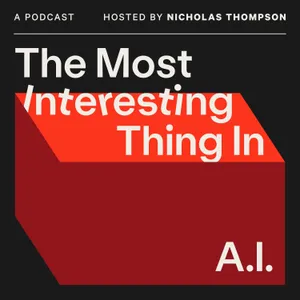
A podcast series examining how AI is reshaping our world. Hosted by Nicholas Thompson, each episode features a conversation with a leading thinker who offers a fresh perspective on the far-reaching ethical, economic, and social implications of this technology.
Latest Episodes
The most recent episodes — sign up to get AI-powered summaries of each one.
- 3 days ago54 min
The Risks of Artificial Relationships - Sherry Turkle with Nicholas Thompson
AI wants to be your friend. And your therapist. And your lover. It’s not an entirely new offer, author and MIT professor Sherry Turkle reminds us, but it’s one that’s grown more dire as AI has improved. In a conversation with Nicholas Thompson, CEO of The Atlantic, Turkle describes the dangers of anthropomorphizing generative AI, gleaned from hundreds of conversations she conducted (with real humans) for her new book, Artificial Intimacy: Who We Become When We Talk To Machines. What do we lose when we make machines our best friends? And what, if anything, do we stand to gain? Turkle details her own experience creating a simulation of her mother, and the wounds that we risk reopening. Produced independently of The Atlantic’s editorial staff. Supporting sponsor: PwC. Introduction The surprising return of relational machines Why Sherry wrote her new book, Artificial Intimacy The problem with delegating parenting, education, and therapy to AI Why people seek emotional support from chatbots Sherry’s concept of “dual consciousness” Regulating generative AI use for kids Can college students still read and write? Distinguishing between useful AI tools and harmful delegations How chatbots mimicking deceased loved ones can cause new psychological harm What Sherry would do with unlimited AI funds Learn more about your ad choices. Visit podcastchoices.com/adchoices
- 1 weeks ago1h 2m
The Case Against the AI Bubble - Azeem Azhar with Nicholas Thompson
Among the many eye-popping numbers of the AI industry—from trillions in investments to billions in spending—one stands out: $0 in profit among leading AI companies. According to Bloomberg, “never before has so much money been spent so rapidly on a technology that, for all its potential, remains largely unproven as an avenue for profit-making.” That imbalance, and the industry’s reliance on circular financing, has led to fears of a bubble. But those concerns are overblown, according to Azeem Azhar, author of the Exponential View newsletter, who earlier this year released a report on the AI economy. In conversation with Nicholas Thompson, CEO of The Atlantic, Azhar expands on his findings. He says AI’s finances are sound: the demand is there, revenue is growing, and the technology will advance enough to deliver on the necessary ROI. Produced independently of The Atlantic’s editorial staff. Supporting sponsor: PwC. Introduction Mapping the AI economy through forensic accounting How to think about infrastructure spend The "J-curve" of AI adoption How cheaper tokens will change the market China's AI strategy Is there something that could break Azeem’s model? What could happen when the AI firms IPO The effects of the culture in Silicon Valley Which bubble-breaker scenario worries Azeem the most What Azeem would do if he had an unlimited budget to invest in AI Learn more about your ad choices. Visit podcastchoices.com/adchoices
- 2 weeks ago1h 6m
The Future of Economic Power - Circle’s Jeremy Allaire with Nicholas Thompson
Technological waves often arrive with a promise. The internet was going to democratize information. Blockchain was going to decentralize power. Now, AI's boosters say it will bring unprecedented prosperity. Few people are better positioned to speak to that possibility than Jeremy Allaire. As the CEO of the fintech company Circle—issuer of the USDC stablecoin—and a longtime internet entrepreneur, Allaire has been at the center of the first two technological waves. With AI, he says we’re going through a change that’s “bigger than the Industrial Revolution.” He sees a future of financially-empowered agents—and believes this technology could be the one that finally fulfills the promise of shared wealth. In a conversation with Nicholas Thompson, CEO of The Atlantic, Allaire describes how the agentic economy might work, why regulation will be critical to its success, and what’s missing from the conversation around AI’s effect on society. Produced independently of The Atlantic’s editorial staff. Supporting sponsor: PwC. Introduction Jeremy’s early fascination with open networks Creating the first online archive of Noam Chomsky's work The promise of the early web How the internet centralized power through social media giants Founding Circle with the vision of creating "HTTP for money" Navigating crypto's reputation challenges Why Jeremy wrote The Agentic Economy Treatise How AI agents could change the fundamental structure of companies The risks of extreme capital concentration with AI The choice we face with AI regulation What Jeremy would do if he had an unlimited budget to invest in AI Learn more about your ad choices. Visit podcastchoices.com/adchoices
- 3 weeks ago1h 8m
The Race to Superintelligence - Richard Socher with Nicholas Thompson
As AI’s capabilities improve, reports of “rogue” agents and misaligned systems are becoming more frequent. In response, some activists, academics, and politicians have called for a pause in development, warning of the dangers that superintelligent AI could pose. But Richard Socher, the CEO of AI startup Recursive as well as the AI search engine You.com, sees another path. In his new book, The Eureka Machine, Socher lays out his vision for how self-improving AI could lead to breakthroughs in science, medicine, economics, and more. In conversation with Nicholas Thompson, CEO of The Atlantic, he details some of the ways we can mitigate its risks, explains why the limits of our own minds could hold AI back, and considers whether we’re projecting too many fears about human behavior onto an insensate technology. Produced independently of The Atlantic’s editorial staff. Introduction Richard's childhood in East Germany and Ethiopia What Richard got wrong about AI hype and the DeepMind acquisition The idea behind The Eureka Machine How AIs can compete to make each other safer Are fears about synthetic data overblown? When hallucinations are actually helpful How human intelligence could hold AI back The metacognition tension The OpenAI-Hugging Face hack Would narrower AI goals have put us in a better spot? Richard’s debate with Yoshua Bengio: are we building a dominant species? What breakthrough will finally win over AI skeptics? The case for widely available superintelligence What Richard would do if he had an unlimited budget to invest in AI Learn more about your ad choices. Visit podcastchoices.com/adchoices
- Sep 2, 202650 min
How to Get Hired in the AI Era - Clara Shih with Nicholas Thompson
For years, tech CEOs have promised that AI will take on the menial, repetitive tasks that have long been a part of office life. Typically, those tasks are assigned to younger, less experienced workers—and poll after poll shows Gen Z is increasingly concerned about what AI will mean for their job prospects. Clara Shih says those fears are, at least partly, justified. As the former head of Meta's Business AI Group, and the CEO of Salesforce AI before that, Shih knows firsthand how companies are deploying AI and where it's affecting hiring. Now, as the founder of the New Work Foundation, Shih is building tools to help young workers navigate this complex hiring maze. In conversation with Nicholas Thompson, CEO of The Atlantic, Shih details the skills students should focus on to prepare for the AI era, how employees can leverage the technology, and why more people—of all ages—might soon find themselves working for an algorithm. Produced independently of The Atlantic’s editorial staff. Introduction What New Work Foundation is doing for Gen Z job seekers Is your major cooked? Testing the "Field Report" tool What AI exposure scores don’t capture How colleges should prepare students for the AI era Why beginners shouldn't use AI to learn something new Is college still worth it? Why applying for a job is harder than it used to be AI will make big companies more efficient—and less fun How the bitter lesson could apply to entire organizations The three buckets all white-collar work might soon fall into Are companies actually laying people off because of AI? What Clara would do if she had an unlimited budget to invest in AI Learn more about your ad choices. Visit podcastchoices.com/adchoices
- Aug 26, 202649 min
Kara Swisher on What Silicon Valley Is Getting Right—and Wrong—in AI
Kara Swisher has done a bit of everything. She’s covered the rise of Silicon Valley’s tech giants, founded and sold her own startup publication, and dabbled in Hollywood, with appearances in films such as The Devil Wears Prada 2 and Tron: Ares. She’s now the host of multiple podcasts about tech and politics, as well as Kara Swisher Wants To Live Forever, a CNN series about the longevity industry. After decades of chronicling the Valley’s foibles, Swisher has many thoughts on AI—where the technology currently is and where it’s going. In conversation with Nicholas Thompson, CEO of The Atlantic, Swisher goes deep on whether the Big Tech companies are capable of managing AI responsibly; if the technology will deliver on the hype they’ve generated; and how media companies and creators can best leverage it. Recorded in Bar Harbor, Maine. Produced independently of The Atlantic’s editorial staff. Supporting sponsor: PwC. Introduction What Kara’s most excited about with AI What the political backlash against data centers shows Are we repeating the dot-com bubble with massive AI spending? OpenAI's self-inflicted wounds What the US should do about open-source AI Will AI-driven social algorithms push politics toward the center? Why young people are turning on Big Tech How AI is reshaping the relationship between creators and media institutions Will AI make trusted media brands more valuable? How media business models should adapt in the age of AI What Kara would do if she had an unlimited budget to invest in AI Learn more about your ad choices. Visit podcastchoices.com/adchoices
- Aug 19, 20261h 4m
How AI Could Upend Global Politics - Ian Bremmer with Nicholas Thompson
AI may have leveled the playing field in coding and app development, but it’s also put potentially dangerous tools in reach of nefarious actors. Now, empowered by AI, state-backed intelligence agencies and non-state actors alike can access tools that enable everything from mass surveillance to cyberattacks to bioweapon development. This dynamic could lead to a catastrophe, warns Eurasia Group’s Ian Bremmer. In conversation with Nicholas Thompson, CEO of The Atlantic, Bremmer describes the risks of open-source AI, the opportunities for international collaboration (including an “AI stability board”), and how to increase investment in safety and alignment. Will AI cause socially-destabilizing inequality? What are the chances it helps democracy rather than hurt it? And how concerned should we be about AI companions? For more thought-provoking conversations, subscribe to The Most Interesting Thing in AI here:https://www.youtube.com/channel/UCz9wYvDKycD7CgYxJICU_Aw?sub_confirmation=1 Produced independently of The Atlantic’s editorial staff. Supporting sponsor: PwC. Introduction Why cyberattacks aren’t the primary threat of AI What we should (and shouldn't) take away from the Mythos incident How AI could enable the creation of bioweapons within a year The surveillance trilemma: balancing existential risk mitigation, privacy rights, and open-source freedom Could a FINRA-style global AI stability board enforce safety standards? Why market dynamics alone cannot ensure AI safety Could a US-China bilateral agreement be enough to address governance? Does AI solve social media’s polarization issue? Will AI-driven inequality threaten democratic foundations? The vertical vs. horizontal race: can civil society and nonprofits build ethical guardrails fast enough to catch up? China’s AI strategy: prioritizing industrial robotics and defense What role will Europe play in the AI era? The emerging anti-AI backlash: a new wave of economic populism driven by displaced white-collar professionals Career advice for the AI era How AI impacts consultancies like the Eurasia Group What Ian would do if he had an unlimited budget to invest in AI Learn more about your ad choices. Visit podcastchoices.com/adchoices
- Aug 12, 202659 min
Writing in the Age of AI - Gemini Notebook’s Steven Johnson with Nicholas Thompson
Steven Johnson spent decades figuring out the best ways to turn his research into words on the page. Now, he’s adapting those methods for Gemini Notebook, Google’s AI-powered interactive bibliography. (Until recently, it was called NotebookLM.) But in building a tool designed to synthesize ideas, is there a risk of taking humans too far out of the writing process? In conversation with The Atlantic’s Nicholas Thompson, Johnson discusses the best practices, ethics, and limitations of using AI as a collaborator. The Atlantic has a licensing agreement with Gemini Notebook, and Google also advertises with The Atlantic. This episode was not a part of those deals. Produced independently of The Atlantic’s editorial staff. Supporting sponsor: PwC. Introduction The evolution of Steven's writing process Managing the "iceberg" of research The ethics of AI-assisted writing What happens when AI becomes as good at writing as humans Why some genres could change drastically with AI How AI might undo polarization Designing educational guardrails for AI What will AI do to writing styles? Licensing author personas and protecting creators A rule of thumb for how to use AI What Steven would do if he had an unlimited budget to invest in AI Learn more about your ad choices. Visit podcastchoices.com/adchoices
Get The Most Interesting Thing in AI summaries in your inbox
Free AI-powered daily recaps. Key takeaways, quotes, and mentions — in a 5-minute read.
Get Free Summaries →Free forever for up to 3 podcasts. No credit card required.
You Might Also Like
Listeners also like.
"The Cognitive Revolution"
Interviews with AI developers and researchers exploring the transformative impact of artificial intelligence on society and technology.

Possible
Explores optimistic, realistic futures through in-depth conversations with innovators in AI, science, health, and global affairs.
Me, Myself, and AI
AI leaders from top companies share real-world strategies for turning artificial intelligence into measurable business results.

80,000 Hours Podcast
Discusses artificial intelligence and global catastrophic risks with experts and researchers.

Crazy/Genius
Explores how the internet shapes society, politics, and reality through discussions on AI, misinformation, and digital culture.
The AI Daily Brief: Artificial Intelligence News and Analysis
A daily analysis of artificial intelligence news, exploring its creative potential, industry impacts, and ethical challenges.

OpenAI Podcast
Conversations with OpenAI researchers and builders exploring how frontier AI models are developed and used in practice.

AI Breakdown
Explores advancements, ethics, and real-world impacts of artificial intelligence across industries.

Pivot
Sharp, unfiltered analysis of tech, business, and politics with bold predictions and lively debate.

The AI XR Podcast.
Industry insiders interview top founders and executives on AI, spatial computing, VR/AR, and synthetic media.

AI For Humans: Weekly AI News, Tools & Trends
A weekly breakdown of major AI news, tools, and breakthroughs for both newcomers and seasoned enthusiasts.

Uncanny Valley | WIRED
A weekly look at Silicon Valley’s tech, power, and influence through interviews and insider reporting from WIRED journalists.
About The Most Interesting Thing in AI
A podcast series examining how AI is reshaping our world. Hosted by Nicholas Thompson, each episode features a conversation with a leading thinker who offers a fresh perspective on the far-reaching ethical, economic, and social implications of this technology.
Customized Recaps
AI-powered recaps with compact key takeaways, quotes, and insights.
Straight to Your Inbox
Get key takeaways from The Most Interesting Thing in AI in a 5-minute read.
Save Hours Every Week
Stay current on your favorite podcasts without falling behind.
Frequently Asked Questions
What is Podzilla's The Most Interesting Thing in AI daily summary?
It's a free AI-powered email that summarizes new episodes of The Most Interesting Thing in AI as soon as they're published. You get the key takeaways, notable quotes, and links & mentions — all in a quick read.
How does the The Most Interesting Thing in AI podcast summary work?
When a new episode drops, our AI transcribes and analyzes it, then generates a personalized summary tailored to your interests and profession. It's delivered to your inbox every morning.
Is this an official The Most Interesting Thing in AI product?
No. Podzilla is an independent service that summarizes publicly available podcast content. We're not affiliated with or endorsed by Atlantic Re:think and PwC.
Can I get summaries of other podcasts too?
Absolutely! The free plan covers up to 3 podcasts. Upgrade to Pro for 15, or Premium for 50. Browse our full catalog at /podcasts.
How often does The Most Interesting Thing in AI release new episodes?
The Most Interesting Thing in AI publishes weekly. Our AI generates a summary within hours of each new episode.
What topics does The Most Interesting Thing in AI cover?
The Most Interesting Thing in AI covers topics including Technology. Our AI identifies the specific themes in each episode and highlights what matters most to you.
Start getting The Most Interesting Thing in AI summaries tomorrow morning.
Free forever for up to 3 podcasts. No credit card required.
Free forever for up to 3 podcasts. No credit card required.