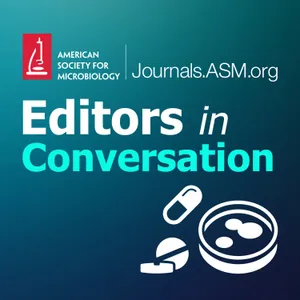
Free Daily Podcast Summary
Editors in Conversation: Daily Summaries Delivered
by American Society for Microbiology
Editors in Conversation features discussions between ASM Journals Editors, researchers and clinicians working on the most cutting edge issues in the microbial sciences. Topics include laboratory diagnosis and clinical treatment of infectious diseases, antimicrobial resistance, epidemiology of infections, multidrug-resistant organisms, pharmacology of antimicrobial agents, susceptibility testing, and more. The podcast is directed to microbiologists, infectious diseases clinicians, pharmacists and basic, clinical and translational researchers interested in the microbial sciences. A particular emphasis is on basic, epidemiological and pharmacological aspects of infectious diseases, including antimicrobial resistance and therapeutics.
Latest Episodes
The most recent episodes — sign up to get AI-powered summaries of each one.
- Yesterday48 min
Ebola: Is Your Laboratory Prepared To Handle a Potential Case?
An outbreak of Ebola disease caused by the Bundibugyo virus remains in a period of intense transmission, in the Democratic Republic of the Congo. Since it's first detection in May, 6757 cases have been confirmed across 6 provinces of the DRC, along with 20 cases in Uganda and one in France (as of September 8). A crude case fatality ratio of 48% underscores the severity of the disease and the ongoing challenges towards case detection, clinical care and, ultimately, interruption of transmission. Unchecked transmission of Bundibugyo in the DRC heightens the risk of exportation across international borders. Furthermore, healthcare workers recovering from the disease have been medically evacuated to both Germany and France for enhanced care. Is your laboratory prepared to handle a potential case? Watch this episode: https://youtu.be/zIDFuwflo8Q Guests: Daniel Rhoads, M.D., Zoe Weiss, M.D., Beverley Orr, MT(ASCP), Nicholas Heger, Ph.D.
- 2 weeks ago41 min
Group B Strep After Antibiotics: Survival, Persistence, and Evolution
In this episode of Editors in Conversation mBio edition, Marvin Whiteley speaks with Macy Pell and Shannon Manning about how group B Streptococcus (GBS) responds to antibiotics given during childbirth to prevent newborn infections. GBS can cause serious neonatal disease, and intrapartum antibiotic prophylaxis has greatly reduced early-onset infections. But some GBS strains persist after treatment. The conversation explores a recent mBio study comparing GBS isolates collected from the same individuals before and after antibiotic treatment and childbirth. Rather than simply acquiring new resistance genes, persistent strains accumulated mutations associated with adaptation, including the emergence of strains with unusually high mutation rates. Pell and Manning discuss what these findings reveal about bacterial persistence, evolution under antibiotic pressure, and why understanding GBS survival may require looking beyond antibiotic resistance alone. <p class="MsoNormal" style= "margin: 0in; font-size: 16px; font-family: Aptos, sans-serif; caret-color: #212121; color: #212121; font-style: normal; font-variant-caps: normal; font-weight: 400; letter-spacing: normal; orphans: 2; text-align: sta
- Aug 28, 202645 min
Diagnostic Access and Equity
Equitable access to healthcare, and more specifically diagnostic testing, remains elusive globally, negatively impacting the health and wellbeing of all people. A not-so-distant illustration was access to testing during the COVID-19 pandemic, when testing sites globally, including here in the United States, underserved the very populations who bore a disproportionate burden of COVID-19 cases and deaths. There is a tremendous opportunity for research on diagnostic access, as well as the epidemiology and diseases that impact underrepresented groups, in clinical microbiology. In 2026, JCM launched a new section, entitled "Diagnostic Access and Equity". In today's episode of Editors in Conversation, I'm joined by the Editor overseeing this section, Dr. Ellie Theel, and one of our editorial board members, Dr. Shawn Lockhart of the Centers for Disease Control and Prevention, to discuss diagnostic access, equity and what the clinical microbiology community is doing to move the needle on these issues. Guests: Elitza Theel, Ph.D., D(ABMM) Shawn Lockhart, Ph.D., D(ABMM) Links: Remote regions, rapid recognition: performance and timeliness of BIOFIRE FilmArray BCID2 for diagnosing bloodstream infection in remote northern Australia This episode is brought to you by the Journal of Clinical Microbiology. Visit asm.org/jcm to browse issues and/or submit a manuscript. If you plan to publish in JCM, ASM Members get up to 50% off publishing fees. Visit asm.org/joinasm to sign up.
- Aug 8, 202643 min
Gram-Negative Resistance: A Decade of Evolution with Laurent Poirel, Ph.D.
Multidrug-resistant Gram-negative infections remain one of the most urgent public health challenges worldwide, with some infections approaching the limits of available treatment options. In this special edition of Editors in Conversation, we celebrate the remarkable 10-year tenure of Dr. Laurent Poirel, whose pioneering work has profoundly shaped our understanding of antimicrobial resistance. Through his unique perspective, we will explore the evolving landscape of resistance in Gram-negative organisms, reflect on the major advances and challenges of the past decade, and discuss what the future may hold for this rapidly changing field. View this episode: https://youtu.be/3OuzU4HjZcY Topics discussed: The most important events in Gram-negative resistance in the last 10 years How the antibiotic pipeline has responded to the challenge of Gram-negative resistance How the field would move in the next 10 years. Guest: Laurent Poirel, Ph.D. Senior Researcher, Medicine Section. University of Fribourg, Fribourg, Switzerland, Editor AAC 2016-2026. Links: This episode is brought to you by the Antimicrobial Agents and Chemotherapy Journal. Visit asm.org/aac to browse issues and/or submit a manuscript. If you plan to publish in AAC, ASM Members get up to 50% off publishing fees. Visit asm.org/joinasm to sign up.
- Jul 31, 202630 min
Technology and Discovery in Modern Microbiology
New imaging and measurement approaches are revealing previously hidden aspects of microbial life, challenging long-held assumptions and creating opportunities to answer questions that were once out of reach. Marvin Whiteley, Heran Darwin and Jeffrey Moffitt talk about how technological innovation is transforming microbiology. Guests: Heran Darwin, Ph.D. - NYU Grossman School of Medicine Jeffrey Moffitt, Ph.D. - Boston Children's Research This episode of Editors in Conversation is brought to you by mBio® and hosted by mBio Editor in Chief, Marvin Whiteley, Ph.D. Visit journals.asm.org/journal/mbio to read articles and/or submit a manuscript. Receive up to 50% off fees when you publish in mBio® or any of the ASM journals by becoming an ASM member. Sign up at asm.org/joinasm.
- Jul 19, 202628 min
Cyclospora In The Lab
It starts out with a couple of stomach twinges, maybe a little nausea, maybe some sharp pains, and then… before you know it, you are running to the closest toilet with which you become very, very familiar. Cyclospora causes frequent watery diarrhea with sometime "explosive" bowel movements, but is typically a relatively rare cause of infectious diarrhea. However, the U.S. is in the midst of one of the largest documented cyclosporiasis outbreaks. How does one acquire this parasite? What are the risks? And – most importantly for our audience – how does the lab approach diagnosis? Guests: Daniel Rhoads, M.D. Bobbi Pritt, M.D. Marc Couturier, Ph.D., D(ABMM) Links: This episode is brought to you by the Journal of Clinical Microbiology. Visit asm.org/jcm to browse issues and/or submit a manuscript. If you plan to publish in JCM, ASM Members get up to 50% off publishing fees. Visit asm.org/joinasm to sign up.
- Jul 10, 202629 min
Next Gen Careers in Clinical Microbiology
So, you think you want a career in clinical microbiology? This field demands more than technical skill—it's driven by curiosity, growth, and the confidence to lead. From mastering diagnostics to pushing innovation and mentoring the next generation, success comes to those who keep evolving. In this episode, we explore the many paths into the field—and spotlight the Laboratory Director role through a candid conversation between early- and mid-career leaders, sharing the real highs, lows, and advice for those ready to step up. Guests: Amanda Roth, Ph.D. Janiece Glover, Ph.D., MS Links: This episode is brought to you by the Journal of Clinical Microbiology. Visit asm.org/jcm to browse issues and/or submit a manuscript. If you plan to publish in JCM, ASM Members get up to 50% off publishing fees. Visit asm.org/joinasm to sign up.
- Jul 1, 202643 min
AI and Antibiotic Discovery
Artificial intelligence is revolutionizing the world in many ways. One of the most exciting applications of artificial intelligence is in the area of drug discovery. Particularly the discovery of antimicrobial molecules that are in the environment or even hidden within our own body. Today, we discuss some of the uses of artificial intelligence in the discovery of antimicrobials with an outstanding expert in the field. Topics discussed: How artificial intelligence can help the discovery of new antimicrobial moieties Antibiotic discovery and challenges to bring molecules to the clinic The implications for artificial intelligence and infectious diseases in particularly in the discovery of antibiotics. Guest: César de la Fuente, Ph.D., FRSB, Presidential Associate Professor at the University of Pennsylvania. Director, Machine Biology Group. This episode is brought to you by the Antimicrobial Agents and Chemotherapy journal available at https://asm.org/aac. If you plan to publish in AAC, ASM Members get up to 50% off publishing fees. Visit https://asm.org/joinasm to sign up. Visit https://asm.org/aac to browse issues and/or submit a manuscript. Follow Cesar on twitter at https://twitter.com/SuperBugDoc for AAC updates. Get the audio only podcast at https://asm.org/eic.
Get Editors in Conversation summaries in your inbox
Free AI-powered daily recaps. Key takeaways, quotes, and mentions — in a 5-minute read.
Get Free Summaries →Free forever for up to 3 podcasts. No credit card required.
You Might Also Like
Listeners also like.

Science Magazine Podcast
Weekly episodes covering original scientific research, global science news, and expert commentary.
Bringing Chemistry to Life
Talks with leading chemists about their discoveries, careers, and the science shaping our world.
This Podcast Will Kill You
Two epidemiologists explore the science, history, and impact of diseases and medical mysteries, one deadly topic at a time.
Unbiased Science
Dr. Jess Steier and guests analyze viral health claims using scientific evidence and explain key findings for everyday conversations.
In the Interim...
Explores Bayesian statistics and adaptive clinical trial designs in medical research with insights from industry experts.

Inquiring Minds
Explores the intersection of science and society through critical thinking and in-depth analysis.
Cannabis Cultivation and Science Podcast
Experts discuss science-based organic cannabis cultivation techniques and advancements in growing technology.
The Curbsiders Internal Medicine Podcast
Expert-led internal medicine discussions with clinical insights and humor for primary care and hospital medicine providers.
CSPI Podcast
Conversations with CSPI scholars and experts on topics in science, technology, and politics.
Modern Chemistry Podcast
Paul Orange Ph.D.
The Internet Book of Critical Care Podcast
A podcast exploring critical care medicine through chapter discussions and evidence-based updates from The Internet Book of Critical Care.

Osterholm Update
An infectious disease expert analyzes the latest COVID-19 data, guidance, and pandemic preparedness issues in weekly updates.
About Editors in Conversation
Editors in Conversation features discussions between ASM Journals Editors, researchers and clinicians working on the most cutting edge issues in the microbial sciences. Topics include laboratory diagnosis and clinical treatment of infectious diseases, antimicrobial resistance, epidemiology of infections, multidrug-resistant organisms, pharmacology of antimicrobial agents, susceptibility testing, and more. The podcast is directed to microbiologists, infectious diseases clinicians, pharmacists and basic, clinical and translational researchers interested in the microbial sciences. A particular emphasis is on basic, epidemiological and pharmacological aspects of infectious diseases, including antimicrobial resistance and therapeutics.
Customized Recaps
AI-powered recaps with compact key takeaways, quotes, and insights.
Straight to Your Inbox
Get key takeaways from Editors in Conversation in a 5-minute read.
Save Hours Every Week
Stay current on your favorite podcasts without falling behind.
Frequently Asked Questions
What is Podzilla's Editors in Conversation daily summary?
It's a free AI-powered email that summarizes new episodes of Editors in Conversation as soon as they're published. You get the key takeaways, notable quotes, and links & mentions — all in a quick read.
How does the Editors in Conversation podcast summary work?
When a new episode drops, our AI transcribes and analyzes it, then generates a personalized summary tailored to your interests and profession. It's delivered to your inbox every morning.
Is this an official Editors in Conversation product?
No. Podzilla is an independent service that summarizes publicly available podcast content. We're not affiliated with or endorsed by American Society for Microbiology.
Can I get summaries of other podcasts too?
Absolutely! The free plan covers up to 3 podcasts. Upgrade to Pro for 15, or Premium for 50. Browse our full catalog at /podcasts.
How often does Editors in Conversation release new episodes?
Editors in Conversation publishes biweekly. Our AI generates a summary within hours of each new episode.
What topics does Editors in Conversation cover?
Editors in Conversation covers topics including Science, Natural Sciences, Life Sciences. Our AI identifies the specific themes in each episode and highlights what matters most to you.
Start getting Editors in Conversation summaries tomorrow morning.
Free forever for up to 3 podcasts. No credit card required.
Free forever for up to 3 podcasts. No credit card required.