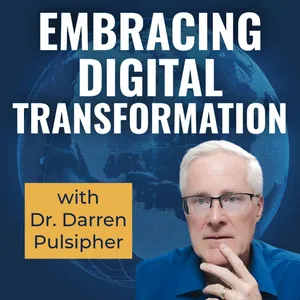
Free Daily Podcast Summary
Embracing Digital Transformation: Daily Summaries Delivered
by Dr. Darren Pulsipher
Dr. Darren Pulsipher, Chief Enterprise Architect for Public Sector, author and professor, investigates effective change leveraging people, process, and technology. Which digital trends are a flash in the pan—and which will form the foundations of lasting change? With in-depth discussion and expert interviews, Embracing Digital Transformation finds the signal in the noise of the digital revolution. Workers are at the heart of many of today’s biggest digital transformation projects. Learn how to transform public sector work in an era of rapid disruption, including overcoming the security and scalability challenges of the remote work explosion. Building an innovative IT organization in the public sector starts with developing the right processes to evolve your information management capabilities. Find out how to boost your organization to the next level of data-driven innovation. From the data center to the cloud, transforming public sector IT infrastructure depends on having the right technology solutions in place. Sift through confusing messages and conflicting technologies to find the true lasting drivers of value for IT organizations.
Latest Episodes
The most recent episodes — sign up to get AI-powered summaries of each one.
- 3 days ago35 min
#390 AI Search Is Rewriting SEO: What Leaders Need to Know
Check out my new book AI Augmented Teams on Amazon or on my website paidar.ai/books.AI search is rewriting SEO—and business leaders need a new playbook. Host Dr. Darren welcomes SEO strategist Leopold von Lee to unpack how AI search, Google Business Profile, media coverage, and social proof now shape visibility. They explore why authority is no longer just about backlinks, and what leaders must do to get found in an AI-driven search world. ## Key Takeaways - SEO is shifting from a page-level tactic to an ecosystem strategy shaped by authority, consistency, and trust. - AI search tools compare signals across websites, media mentions, reviews, social platforms, and local listings. - A strong website still matters, but it’s no longer enough on its own to win visibility. - Media coverage and third-party validation can significantly improve how AI systems evaluate your brand. - LinkedIn, YouTube, Facebook, TikTok, and Google Business Profile can all support AI visibility when used strategically. - Avoid spammy tactics, weak content, and client-side-heavy sites that bots may struggle to crawl and understand. ## Chapters - **00:00** Welcome to the show and today’s topic - **01:01** Leo’s backstory and career journey - **08:18** How SEO has changed in the age of AI search - **12:05** The three pillars of SEO: technical, content, and authority - **15:30** How AI compares signals beyond your website - **19:10** Building trust with media coverage and third-party mentions - **24:05** Why Google Business Profile is making a comeback - **27:40** Social media platforms that matter for AI visibility - **32:10** SEO mistakes and AI search traps to avoid - **37:20** Final takeaways on authority, trust, and visibility
- 5 days ago34 min
#389 AI Search Still Runs on SEO Authority
Check out my new book AI Augmented Teams on Amazon or on my website paidar.ai/books.AI search is rewriting the rules of digital visibility, trust, and persuasion. Host Darren Pulsifer sits down with SEO and AI expert Kevin C. Roy to unpack how search, content credibility, and local ranking are changing in the age of AI. They explore practical ways businesses can build authority, improve AI SEO, and stay visible in an increasingly automated information landscape. ## Key Takeaways - AI search still relies heavily on credibility, relevance, and authority signals — not just keywords. - Strong SEO foundations continue to matter for AI visibility, especially when content is logically organized and well linked. - Author bios, consistent naming, and external mentions help establish subject matter expertise for AI systems. - Internal linking and topical clusters make it easier for both search engines and AI models to understand your site. - Local businesses should not ignore Google Maps, reviews, and review responses, since local SEO remains a major visibility driver. - High-authority, relevant links from trusted sources can still boost rankings and strengthen trust signals. ## Chapters - 00:00 Introduction to AI search and digital persuasion - 02:10 Kevin C. Roy’s background in early web and SEO - 07:05 How AI search is changing visibility and rankings - 11:20 Why authority, credibility, and E-E-A-T still matter - 16:15 Building logical site structure and internal links - 21:30 Using author bios, mentions, and external proof - 27:10 Local SEO, Google Maps, and review strategies - 32:40 Final advice for businesses navigating AI and SEO
- 1 weeks ago39 min
#388 AI Literacy and the Hidden Power of Digital Persuasion
Check out my new book AI Augmented Teams on Amazon or on my website paidar.ai/books.AI is reshaping not just what we see, but how we think, trust, and decide. Host Dr. Darren sits down with Diego Bonilla, CSU professor and AI literacy expert, to unpack digital persuasion, privacy, critical thinking, and how AI can move from personalized influence toward collective intelligence. ## Key Takeaways - **AI literacy is now leadership literacy.** Understanding how AI shapes attention, persuasion, and decision-making is essential for technologists and business leaders. - **Critical thinking applies across every medium.** From mass media to social platforms to generative AI, the core defense is the ability to question outputs and recognize bias. - **Advertising drives much of today’s digital ecosystem.** Free platforms often rely on persuasive design, which can fuel addiction, echo chambers, and cognitive overload. - **Centralized AI creates dependency risk.** Leaders should evaluate vendor lock-in, model control, and the consequences of relying on a single platform or system. - **AI can support collective intelligence.** Beyond individualized chat, AI can be designed to help groups reason together, share knowledge, and solve problems collaboratively. - **The future belongs to organizations that think together.** Teams that build judgment, literacy, and dialog will be better prepared for AI’s next wave. ## Chapters - **00:00** Welcome and AI literacy introduction - **03:12** Diego Bonilla’s background in digital media and cognition - **08:10** Why critical thinking is the foundation of media literacy - **13:25** Social media, psychographics, and persuasive design - **18:40** Echo chambers, advertising, and digital addiction - **24:05** AI companions, personalization, and behavior shaping - **29:30** Why AI is different from traditional digital media - **34:15** Centralized models, open source, and AI control risk
- 1 weeks ago32 min
#387 Why Technical Leaders Need Storytelling Before Slides
Check out my new book AI Augmented Teams on Amazon or on my website paidar.ai/books.Clarity wins in the age of AI. Host Dr. Darren sits down with Nir Zavaro to unpack how leaders, engineers, and founders can turn complex ideas into clear, memorable stories—without hiding behind slides. From AI-assisted drafting to presentation structure and emotional storytelling, this conversation is a practical guide to better **business communication**, **public speaking**, and **storytelling for leaders**. ## Key Takeaways - **Slides should support the message, not carry it.** If the deck is doing all the work, the story needs more strength. - **Start with the outcome.** Before building a talk, decide what the audience should think, feel, or do afterward. - **Emotion gives logic traction.** Facts matter, but people act when the message connects emotionally. - **Use AI to reduce friction, not thinking.** Transcribe, draft, shorten, and refine with AI tools, but keep control of the core idea. - **Practice makes presentations clearer.** Rehearsing your opener, closer, and key scenes helps you speak with confidence and precision. - **Focus on your audience, not your ego.** The best talks are about their needs, not how impressive you are. ## Chapters - **00:00** Intro and why AI and storytelling matter - **01:06** Neer’s origin story: sales, writing, and marketing - **06:04** Why slides are becoming a crutch - **10:02** Writing first, then speaking with clarity - **13:16** How AI can help people express ideas - **16:08** A simple framework for practicing talks - **20:03** Slides as support, not the main event - **22:08** Using AI to improve pitch decks and meetings - **25:11** Why audience emotion drives decisions - **28:18** The message must be about them, not you - **31:37** How to make AI and education talks more compelling - **34:25** Where to find Neer and join the community
- 2 weeks ago42 min
#386 AI Transformation Fails Without Context: What Enterprise Leaders Need to Know
Check out my new book AI Augmented Teams on Amazon or on my website paidar.ai/books.AI transformation fails when teams skip the most important ingredient: context. Host Dr. Darren welcomes Artem Koren, Chief Product Technology Officer at Sembly AI, to unpack why enterprise AI success depends on clear intent, quality standards, and better requirements—not just buying a platform. They explore digital transformation, AI workflow redesign, and how to make AI actually useful in the real world. ## Key Takeaways - **AI is changing transformation from automation to reimagining work.** Many workflows are no longer just faster—they’re fundamentally different. - **Context is the missing layer.** AI performs best when it understands the business problem, the user, the brand, and the operating environment. - **“Intent technology” needs stronger requirements.** Unlike traditional software, AI outputs can vary, so leaders must define what good looks like up front. - **Large organizations face a bigger challenge.** Tribal knowledge, consistency, and brand standards make enterprise AI harder to deploy well. - **ROI requires a specific use case.** Don’t ask whether your company “uses AI”; ask whether AI improves a measurable business outcome. - **Presentation formats may need to evolve.** AI can help teams move beyond traditional slide decks and create more effective, audience-specific communication. ## Chapters - **00:00** Introduction: Why AI transformation fails without context - **02:00** Artem Koren’s background in technology, consulting, and AI - **07:10** How digital transformation has changed in the AI era - **12:40** Functional software vs. intent technology - **17:30** Why AI requires richer requirements and quality standards - **23:05** The role of context, culture, and tribal knowledge in enterprise AI - **29:10** Why “we use AI” is not a real ROI strategy - **35:20** Defining success for AI-powered workflows and presentations - **42:00** Reimagining slides, presentations, and communication with AI - **47:15** Sembly AI, the new product release, and how to connect with Artem
- 2 weeks ago32 min
#385 AI-Augmented Organizations
Check out my new book AI Augmented Teams on Amazon or on my website paidar.ai/books.AI governance is no longer a side project—it’s becoming an enterprise operating model. Doctor Darren and guest host Paige Pulsipher sit down with coauthor Jeremy Harris to unpack the new AI Augmented book for executives, exploring why responsible AI adoption, privacy, and clear measurement matter more than speed alone. ## Key Takeaways - **Adoption is not the same as value.** Measuring AI success by usage or spend misses the real question: is AI improving outcomes? - **Executives need an AI governance operating model.** C-suite leaders should define ownership, controls, and standards before scaling AI. - **Human judgment still matters.** AI should support decision-making, not replace accountability, expertise, or ethics. - **Shadow AI is a real risk.** If employees are already using AI tools, organizations need visibility, policy, and guardrails. - **The best AI strategy is deliberate.** Responsible AI implementation can reduce risk, improve speed, and strengthen business performance. - **AI augmentation is about amplifying people.** The goal is to free teams from repetitive work so they can focus on higher-value thinking and creativity. ## Chapters - **00:00** Introduction to AI governance for the enterprise - **02:05** Jeremy Harris’s background in law, privacy, and healthcare - **05:00** Why Darren brought Jeremy in as coauthor - **08:15** Writing the AI Augmented book as a collaboration - **12:10** What the new book covers: enterprise AI operating models - **16:05** Measuring AI success: ROI, KPIs, and adoption myths - **20:20** Who the book is for: CIOs, CEOs, legal, privacy, and executive leaders - **23:10** Fictional healthcare scenarios and field reports in the book - **27:00** Are Darren and Jeremy still friends after writing together? - **30:10** The AI Augmented Institute and the future of education - **35:05** AI, ethics, and concerns about dehumanization - **40:00** Why deliberate governance beats reactive AI adoption - **44:10** Final thoughts and call to action
- 3 weeks ago36 min
#384 Why Great Teachers May Have the Best AI Strategy
Check out my new book AI Augmented Teams on Amazon or on my website paidar.ai/books.The real AI literacy challenge isn’t learning the tool — it’s protecting human judgment while using it well. Dr. Darren sits down with Casey Cooney, California Teacher of the Year, to explore how AI in education can deepen learning, sharpen feedback, and keep curiosity, domain expertise, and empathy at the center of digital transformation. ## Key Takeaways - AI should **augment human thinking**, not replace it. The goal is better judgment, not faster shortcuts. - The pandemic showed the limits of putting learning entirely on screens; **human connection remains essential**. - In the classroom, AI can supercharge **formative assessment** by helping teachers spot misconceptions and adjust instruction in real time. - Students and workers need more than speed: they need **metacognition** (thinking about how you think) and **inquiry** (asking better questions). - Beautiful output is not the same as deep work — **domain expertise still matters** when using AI for writing, design, and research. - The future belongs to people who become **AI-augmented**: curious, adaptable, and confident enough to keep learning. ## Chapters - **00:00** AI, Human Judgment, and Why This Matters Now - **01:05** Casey Cooney’s Background Story - **05:40** Becoming a Teacher After Business and Cancer Survival - **09:15** What COVID and Remote Learning Taught Educators - **13:10** How AI Can Improve Formative Assessment - **17:20** Raising the Bar: Expect More From Students With AI - **21:10** AI Fakers vs. Real Domain Expertise - **25:05** Creativity, Writing, and Why Humans Still Matter - **29:00** Careers, Anxiety, and the Changing Job Market - **33:15** The Two Skills Students Need Most: Metacognition and Inquiry - **37:20** Leading With Empathy in the AI Era - **40:30** Casey’s AI Teaching App, Wit - **43:10** Closing Thoughts: AI Literacy and the Future of Learning
- 3 weeks ago42 min
#383 Sovereign AI Starts With Data Control, Not Bigger Models
Check out my new book AI Augmented Teams on Amazon or on my website paidar.ai/books.Sovereign AI is moving from a policy buzzword to a boardroom risk question, and Dr. Darren sits down with Usman Khalid to unpack why. Together they explore how data sovereignty, model governance, and AI accountability are reshaping enterprise AI strategy, especially for leaders balancing innovation, jurisdiction, and sensitive data protection. ## Key Takeaways - Sovereign AI is about control: owning the data, infrastructure, model behavior, and governance needed to keep systems running under your rules. - Many organizations can start with existing open-source or commercial models instead of building from scratch. - Clean, structured data is the first step; master data management and strong data classification create the foundation for trustworthy AI. - Annotation quality matters because AI outcomes depend on how data is labeled and reviewed. - Human-in-the-loop oversight remains essential for high-stakes decisions, especially in regulated industries. - RAG and agentic workflows are useful entry points, but they are not substitutes for true sovereign AI. ## Chapters - 00:00 Sovereign AI and why control matters - 02:10 Usman Khalid’s global background and perspective - 05:18 What sovereign AI really means - 09:42 Data sovereignty, jurisdiction, and trust - 14:10 Culture, morality, and multiple versions of truth - 19:05 Building sovereign AI without starting from scratch - 24:18 Why data annotation is the real bottleneck - 29:30 RAG, workflows, and enterprise AI maturity - 35:40 Human accountability and decision-making - 40:12 Practical first steps for organizations - 44:20 Closing thoughts and how to connect
Get Embracing Digital Transformation summaries in your inbox
Free AI-powered daily recaps. Key takeaways, quotes, and mentions — in a 5-minute read.
Get Free Summaries →Free forever for up to 3 podcasts. No credit card required.
You Might Also Like
Listeners also like.

Digital Disruption with Geoff Nielson
Industry leaders and innovators discuss how to adapt to and leverage digital transformation in the evolving technological landscape.
The Engineering Leadership Podcast
Insights and practices from top software engineering leaders to advance leadership skills in the tech industry.
The Intelligence Shift
Industry leaders discuss how AI is transforming fields like sports, film, and healthcare with a Chief AI Officer.

Me, Myself, and AI
Leaders from top companies share real-world strategies for turning artificial intelligence into measurable business results.
"The Cognitive Revolution"
Explores the transformative impact of artificial intelligence through interviews with innovators shaping its future.

A Podcast About Leadership
Examines modern leadership through interviews with experts in business, psychology, and human performance.

The Best SEO Podcast
A practical guide to SEO in the age of AI, focusing on real-world strategies that work and insights from experienced marketers.

Expert Intelligence with Paul Estes
Explores the intersection of human expertise and AI in shaping the future of work through interviews with industry leaders and innovators.

FundraisingAI
Examines the ethical and practical use of AI in fundraising, including trends, data privacy, and social impact.

Total Disruption Podcast
Entrepreneurs discuss mindset, business growth, and operational frameworks to move beyond hustle culture and build scalable companies.

Taylor Lorenz’s Power User
Examines how technology and internet culture reshape society, fame, and free speech through weekly deep dives and policy discussions.

Everyday AI Podcast – An AI and ChatGPT Podcast
Covers practical uses of AI tools like ChatGPT and Midjourney to help people work more efficiently and advance their careers.
About Embracing Digital Transformation
Dr. Darren Pulsipher, Chief Enterprise Architect for Public Sector, author and professor, investigates effective change leveraging people, process, and technology. Which digital trends are a flash in the pan—and which will form the foundations of lasting change? With in-depth discussion and expert interviews, Embracing Digital Transformation finds the signal in the noise of the digital revolution. Workers are at the heart of many of today’s biggest digital transformation projects. Learn how to transform public sector work in an era of rapid disruption, including overcoming the security and scalability challenges of the remote work explosion. Building an innovative IT organization in the public sector starts with developing the right processes to evolve your information management capabilities. Find out how to boost your organization to the next level of data-driven innovation. From the data center to the cloud, transforming public sector IT infrastructure depends on having the right technology solutions in place. Sift through confusing messages and conflicting technologies to find the true lasting drivers of value for IT organizations.
Customized Recaps
AI-powered recaps with compact key takeaways, quotes, and insights.
Straight to Your Inbox
Get key takeaways from Embracing Digital Transformation in a 5-minute read.
Save Hours Every Week
Stay current on your favorite podcasts without falling behind.
Frequently Asked Questions
What is Podzilla's Embracing Digital Transformation daily summary?
It's a free AI-powered email that summarizes new episodes of Embracing Digital Transformation as soon as they're published. You get the key takeaways, notable quotes, and links & mentions — all in a quick read.
How does the Embracing Digital Transformation podcast summary work?
When a new episode drops, our AI transcribes and analyzes it, then generates a personalized summary tailored to your interests and profession. It's delivered to your inbox every morning.
Is this an official Embracing Digital Transformation product?
No. Podzilla is an independent service that summarizes publicly available podcast content. We're not affiliated with or endorsed by Dr. Darren Pulsipher.
Can I get summaries of other podcasts too?
Absolutely! The free plan covers up to 3 podcasts. Upgrade to Pro for 15, or Premium for 50. Browse our full catalog at /podcasts.
How often does Embracing Digital Transformation release new episodes?
Embracing Digital Transformation publishes 2x weekly. Our AI generates a summary within hours of each new episode.
What topics does Embracing Digital Transformation cover?
Embracing Digital Transformation covers topics including Technology, Business. Our AI identifies the specific themes in each episode and highlights what matters most to you.
Start getting Embracing Digital Transformation summaries tomorrow morning.
Free forever for up to 3 podcasts. No credit card required.
Free forever for up to 3 podcasts. No credit card required.