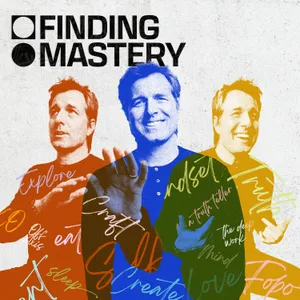
Free Daily Podcast Summary
Finding Mastery with Dr. Michael Gervais: Daily Summaries Delivered
by Dr. Michael Gervais
Dive into the minds of the world’s greatest athletes, leaders, thinkers, and doers with Dr. Michael Gervais—a high performance psychologist and world-renowned expert on the relationship between high performance and the mind. Dr. Gervais’s client roster includes Super Bowl winning NFL teams, Fortune 50 CEOs, Olympic medalists, internationally acclaimed artists, and more. On Finding Mastery, Dr. Gervais sits down with the best at what they do, like David Goggins, Brene Brown, Toto Wolff, soccer legend Abby Wambach, neuroscientist Dr. Andrew Huberman, and Microsoft CEO Satya Nadella — translating their life stories, mental skills, and personal practices into applicable tools you can use to unlock your potential. Walk with us to the edge of human possibility and learn what you are capable of.
Latest Episodes
The most recent episodes — sign up to get AI-powered summaries of each one.
- Yesterday58 min
The Psychology of Storytelling | IN-Q
“…the stories that we tell ourselves and other people become our lives.”— IN-QThis is a conversation about the story you are living inside, about creativity as a practice rather than a talent, and about why being witnessed helps us release what we might otherwise carry alone.Before this conversation started, IN-Q walked the entire Finding Mastery team through a poetry workshop. Each person wrote about a personal experience with risk that changed the direction of their life, then read it out loud to the room. Mike opens this episode saying he has never started a podcast feeling the way he felt coming out of it.IN-Q is a spoken word artist, two-time Emmy-nominated lyricist, multi-platinum songwriter, keynote speaker, and bestselling author of Inquire Within. He has written songs with Selena Gomez, Miley Cyrus, and Aloe Blacc, and he was one of the original members of Da Poetry Lounge in Los Angeles, the open mic he calls church without religion.IN-Q and Mike get into the three guidelines he gives people before they write, and the night he read his old breakup poems and realized every one of them applied to the new breakup.He also describes giving himself the room every morning to decide not to be a poet. Choosing it again each day – instead of waking up already being one – keeps the work from turning into a life he inherited from a version of himself that has already faded away.Both of them tell stories about an old chip on the shoulder, and the two trace back to a similar place. The chip became fuel. IN-Q calls it unhealthy fuel, and describes chipping away at it now, trying to turn it into a sculpture.Change your story, change your life, is how he puts it. He also tells you exactly where to start.Enjoy the conversation.____________________________________________________________________________Links & ResourcesIN-Q’s Website: in-q.comIN-Q’s Books: Inquire Within, The Never Ending Now Poetry JournalIN-Q’s Album: The Never Ending Now (featuring Isabella Turso)IN-Q’s Poetry Special: IN-Q – Live at the Ace Theatre, streaming on Amazon Prime VideoIN-Q’s Poetry Workshops and Retreats: in-q.com/poetry-workshopsSubscribe to our Youtube Channel for more conversations at the intersection of high performance, leadership, and wellbeing: https://www.youtube.com/c/FindingMasteryGet exclusive discounts and support our amazing sponsors!Go to: https://findingmastery.com/sponsors/Subscribe to the Finding Mastery newsletter for weekly high performance insights: https://www.findingmastery.com/newsletterDownload Dr. Mike’s Morning Mindset Routine: https://www.findingmastery.com/morningmindsetFollow on YouTube, Instagram, LinkedIn, and XSee Privacy Policy at https://art19.com/privacy and California Privacy Notice at https://art19.com/privacy#do-not-sell-my-info.
- 1 weeks ago33 min
The Psychology of Inner Peace | Gurudev Sri Sri Ravi Shankar
What if the calmest person in the room isn’t avoiding pressure, but experiencing it differently?Gurudev Sri Sri Ravi Shankar is one of the world’s most recognized spiritual teachers and humanitarian leaders. He founded the Art of Living, which teaches meditation, breathwork, and service in 180 countries, and he is the author of Notes for the Journey Within.Stress has a use, and Gurudev compares it to a pinch of salt in food, useful in that amount and unconsumable past it. Most of us have taken on far more than that, and have never learned how to put it down or work well with it.Gurudev and Mike get into why he defines success as exhibiting your limitation, why he thinks failure is worth being proud of, and why authority over your own mind is the only authority there really is. Mike asks him when his body last went into fight or flight. He says it never has.This one is for people who are working hard and running warm. What Gurudev points back to is small and repeatable, breathing and meditation, and he says the first sitting is enough to feel the difference.Near the end, Mike asks him to finish a sentence. Mastery is... Gurudev’s answer: recognizing you are not there.Enjoy the conversation.______________________________________________________Links & Resources:Gurudev Sri Sri Ravi Shankar’s Website: gurudev.artofliving.orgGurudev Sri Sri Ravi Shankar’s Books: Notes for the Journey Within: Essentials of the Art of Living, An Intimate Note to the Sincere Seeker, Celebrating SilenceThe Art of Living Foundation: artofliving.orgSubscribe to our Youtube Channel for more conversations at the intersection of high performance, leadership, and wellbeing: https://www.youtube.com/c/FindingMasteryGet exclusive discounts and support our amazing sponsors!Go to: https://findingmastery.com/sponsors/Subscribe to the Finding Mastery newsletter for weekly high performance insights: https://www.findingmastery.com/newsletterDownload Dr. Mike’s Morning Mindset Routine: findingmastery.com/morningmindsetFollow on YouTube, Instagram, LinkedIn, and XSee Privacy Policy at https://art19.com/privacy and California Privacy Notice at https://art19.com/privacy#do-not-sell-my-info.
- 2 weeks ago1h 17m
The Psychology of Pain | Dr Tom Walters
How much of the time you spend in pain comes from the injury itself, and how much comes from the fear around it?Dr. Tom Walters is a board-certified orthopedic physical therapist, strength and conditioning specialist, educator, and founder of Rehab Science. He has spent more than two decades helping people understand pain, movement, and injury recovery, and he is the author of Rehab Science: How to Overcome Pain and Heal from Injury.Tom’s starting point is that pain and injury are not the same thing. Pain is an unpleasant sensory or emotional experience tied to actual or potential tissue damage, which means what you believe about your body can change what you feel in it.Tom and Mike get into the nocebo effect, how a clinician’s words or reaction to a scan can amplify pain, why the field traded the word chronic for persistent, and how to manage exercise loads as your body adapts.Mike tells the story of an MRI he had around the age of 23. The doctor looked at the film, his eyes got big, and he asked if Mike was okay. Mike says his pain felt worse instantly.Tom says many musculoskeletal conditions improve with time and movement. He encourages people to take an active role in recovery: try an appropriate movement, notice how your body responds, and adjust from there.Enjoy the conversation.___________________________________________________________________Links & Resources:Dr. Tom Walters’ Website: rehabscience.comDr. Tom Walters’ Books: Rehab Science: How to Overcome Pain and Heal from Injury, plus the 2026 Rehab Science body-region series: Knee, Back and Spine, Hip, Shoulder, Elbow, Wrist & Hand, Ankle and Foot, and Head & NeckDr. Tom Walters’ YouTube Channel: Rehab ScienceThe Rehab Science App: Rehab Science on the App StoreSubscribe to our Youtube Channel for more conversations at the intersection of high performance, leadership, and wellbeing: https://www.youtube.com/c/FindingMasteryGet exclusive discounts and support our amazing sponsors!Go to: https://findingmastery.com/sponsors/Subscribe to the Finding Mastery newsletter for weekly high performance insights: https://www.findingmastery.com/newsletterDownload Dr. Mike’s Morning Mindset Routine: findingmastery.com/morningmindsetFollow on YouTube, Instagram, LinkedIn, and XSee Privacy Policy at https://art19.com/privacy and California Privacy Notice at https://art19.com/privacy#do-not-sell-my-info.
- 3 weeks ago1h 44m
The Psychology of Motivation | Dr. Masud Husain
A letter landed on Masud Husain’s desk about a man in his thirties who had stopped doing anything at all.David had been highly productive, worked in finance, and was charming company. Then he lost his job, stopped showering, and could not be bothered to claim the benefits that would have covered his rent. Asked why he no longer listened to music, he said it would take five minutes to connect the cables.Dr. Masud Husain is a clinical neurologist, neuroscientist, and Professor of Neurology and Cognitive Neuroscience at the University of Oxford. He is Editor-in-Chief of the journal Brain and author of Our Brains, Our Selves, winner of the 2025 Royal Society Trivedi Science Book Prize.David was not depressed. He had suffered two tiny strokes in the basal ganglia, the structures deep in the brain that connect what we want to what we do. Nothing was worth the effort to him anymore.Masud's team started him on a drug that acts on the dopamine system. Three months later David came back with a haircut, a suit, a new job, and a new girlfriend.Addiction researchers had arrived at that same circuit from the other direction, as the one nearly every addictive drug hijacks. Masud and Mike get into what that overlap means about the science of motivation, why apathy and depression are different conditions, what over two hundred causes of dementia means for prevention, and whether there is a self to be found in the brain at all.This is a conversation for anyone who has decided to do something and then not done it. Masud frames motivation as a calculation of whether the reward is worth the effort, so the way through is to make the effort smaller and leave the cue somewhere you will trip over it.After thirty years of seeing patients, the thing Masud says he has learned is that the self is not set in stone. You can change.Enjoy the conversation.______________________________________________________Links & Resources:Dr. Masud Husain’s Website: masudhusain.orgDr. Masud Husain’s Books: Our Brains, Our Selves: What a Neurologist’s Patients Taught Him About the Brain, Oxford Textbook of Cognitive Neurology and Dementia (co-editor)Dr. Masud Husain’s Journal: Brain, where he is Editor-in-ChiefSubscribe to our Youtube Channel for more conversations at the intersection of high performance, leadership, and wellbeing: https://www.youtube.com/c/FindingMasteryGet exclusive discounts and support our amazing sponsors!Go to: https://findingmastery.com/sponsors/Subscribe to the Finding Mastery newsletter for weekly high performance insights: https://www.findingmastery.com/newsletterDownload Dr. Mike’s Morning Mindset Routine: findingmastery.com/morningmindsetFollow on YouTube, Instagram, LinkedIn, and X#FindingMastery #MasudHusain #DrMichaelGervais #OurBrainsOurSelves #Neuroscience #Neurology #Motivation #Apathy #Dopamine #Attention #Dementia #BrainHealth #Consciousness #Identity #HighPerformance #PsychologySee Privacy Policy at https://art19.com/privacy and California Privacy Notice at https://art19.com/privacy#do-not-sell-my-info.
- 4 weeks ago1h 16m
The Psychology of The 10 Commandments| Jamie Metzl
What moral code do we need when our tools can reshape intelligence and biology itself?Jamie Metzl is a technology and healthcare futurist and geopolitical expert, founder and chair of OneShared.World, and a Senior Fellow at the Atlantic Council. He has served on the U.S. National Security Council and with the United Nations in Cambodia, and he is the author of Hacking Darwin, Superconvergence, and his newest book, The AI Ten Commandments.The book began as a question Jamie put to a popular AI model, asking what ten principles, drawn from all of recorded human history, would produce the most peace and human flourishing. What came back pulled from traditions he already knew and others he had never encountered.Jamie and Mike get into what it takes to be a participant in this rather than a bystander, why Jamie thinks the moment belongs to all of us rather than to a handful of technologists and billionaires, and what he would keep from the original Ten Commandments.Mike’s push is that principles on their own do not necessarily hold. Most of us sign off on them easily. What happens to them in a high stress, consequential environment is the harder question.Jamie says technology is what gets us to this conversation, and the conversation is about values. The unsexy word for the rest of it, he says, is governance, and it starts with governance of the self.Enjoy the conversation.Links & ResourcesJamie Metzl’s Website: jamiemetzl.comJamie Metzl’s Books: The AI Ten Commandments: A New Moral Code for Humanity, Superconvergence, Hacking Darwin, Eternal SonataOneShared.World, where Jamie is founder and chairAtlantic Council, where Jamie is a Senior Fellow: atlanticcouncil.org/expert/jamie-metzlSubscribe to our Youtube Channel for more conversations at the intersection of high performance, leadership, and wellbeing: https://www.youtube.com/c/FindingMasteryGet exclusive discounts and support our amazing sponsors!Go to: https://findingmastery.com/sponsors/Subscribe to the Finding Mastery newsletter for weekly high performance insights: https://www.findingmastery.com/newsletterDownload Dr. Mike’s Morning Mindset Routine: findingmastery.com/morningmindsetFollow on YouTube, Instagram, LinkedIn, and XSee Privacy Policy at https://art19.com/privacy and California Privacy Notice at https://art19.com/privacy#do-not-sell-my-info.
- Sep 2, 202658 min
The Psychology of Menopause | Tamsen Fadal
Tamsen Fadal was 47 and anchoring the evening news when the first hot flash hit.She got off the set and laid down on the bathroom floor. She had never heard the word perimenopause. A few weeks later, a note landed in her patient portal with four words: “In menopause, any questions?”Tamsen Fadal is an Emmy Award-winning journalist, executive producer of the documentary The M Factor, and New York Times bestselling author of How to Menopause. She spent thirty years in television news before turning to the thing nobody had explained to her.Tamsen and Mike get into what menopause actually is, why the symptoms are read as anxiety or depression, what changed after the 2002 hormone study, and how partners and teammates can be useful instead of awkward.Mike talks about watching his wife go through it, and what the two of them missed.Tamsen calls what comes next “the next 30.” Her point is that these are the years to decide what you want them to look like, and to start now.Enjoy the conversation.___________________________________________________Links & Resources:Tamsen Fadal’s Website: tamsenfadal.comTamsen Fadal’s Books: How to Menopause: Take Charge of Your Health, Reclaim Your Life, and Feel Even Better than Before, The New Single, Why Hasn’t He Proposed?, Why Hasn’t He Called?Tamsen Fadal’s Documentaries: The M Factor: Shredding the Silence on Menopause and The (M) Factor 2: Before the Pause, both on PBSTamsen Fadal’s Podcast: The Tamsen ShowSubscribe to our Youtube Channel for more conversations at the intersection of high performance, leadership, and wellbeing: https://www.youtube.com/c/FindingMasteryGet exclusive discounts and support our amazing sponsors!Go to: https://findingmastery.com/sponsors/Subscribe to the Finding Mastery newsletter for weekly high performance insights: https://www.findingmastery.com/newsletterDownload Dr. Mike’s Morning Mindset Routine: findingmastery.com/morningmindsetFollow on YouTube, Instagram, LinkedIn, and XSee Privacy Policy at https://art19.com/privacy and California Privacy Notice at https://art19.com/privacy#do-not-sell-my-info.
- Aug 26, 20261h 18m
The Psychology of Fighting Dementia | Dr Tommy Wood
What are the things we can do today to help minimize our chances of developing dementia as we age?Dr. Tommy Wood is a physician and neuroscientist, Associate Professor of Pediatrics and Neuroscience at the University of Washington, and author of The Stimulated Mind.The book takes on a belief many of us still hold, that the adult brain becomes fixed at an early age and then declines from there. Tommy traces that idea back to 1906 and to the words of a Nobel laureate. Then he unpacks what the latest research and data say, and it’s not what you might think.This is a conversation about a tough subject, mental decline and dementia. Many of us have been touched by this in our own families, and what Tommy has to say gives all of us hope that we have more agency than we think when it comes to this part of our health.Tommy and Mike get into the 14 modifiable risk factors named by the Lancet Commission, why midlife is when risk starts to diverge, and the three buckets Tommy sorts everything into: stimulus, supply, and support. Mike talks about his grandfather, who had vascular dementia and covered for it so well that the family did not see it for years.Tommy tells us that “At 70 years old now, you are less likely to be diagnosed with dementia than any other time in history.” The trajectory is not fixed, but there’s a lot more work to be done.Enjoy the conversation.____________________________________________Links & ResourcesDr. Tommy Wood’s Website: drtommywood.comDr. Tommy Wood’s Book: The Stimulated Mind: Future-Proof Your Brain from Dementia and Stay Sharp at Any AgeBetterBrain, where Tommy is Chief Science Officer: betterbrain.comSubscribe to our Youtube Channel for more conversations at the intersection of high performance, leadership, and wellbeing: https://www.youtube.com/c/FindingMasteryGet exclusive discounts and support our amazing sponsors!Go to: https://findingmastery.com/sponsors/Subscribe to the Finding Mastery newsletter for weekly high performance insights: https://www.findingmastery.com/newsletterDownload Dr. Mike’s Morning Mindset Routine: findingmastery.com/morningmindsetFollow on YouTube, Instagram, LinkedIn, and XSee Privacy Policy at https://art19.com/privacy and California Privacy Notice at https://art19.com/privacy#do-not-sell-my-info.
- Aug 19, 202639 min
The Psychology of Positive Habits | Jon Gordon
This is a conversation about habits, the ones you want to build and the ones you want to get rid of.Jon Gordon has written more than 30 books on leadership, habits and mindset. Recently he called his daughter and asked which of his own habits was the worst. She said simply: you're controlling.She was confirming something he had already come to see. Jon traces that habit of control back to a father who left when he was a year old, and to a feeling of powerlessness he thought he'd already healed. In reality, he still had more work to do. Jon's most recent book is titled The Power of Positive Habits, and it tackles a critical issue so many of us face - how do I break the habits that no longer serve me, and how do I build ones that will help me flourish? This is a conversation about self-awareness, self-challenge, and how to build practical habits, like gratitude, visualization, and something Jon calls the habit before the habit. Links & ResourcesLearn more about Jon here: https://jongordon.com/Subscribe to our Youtube Channel for more conversations at the intersection of high performance, leadership, and wellbeing: https://www.youtube.com/c/FindingMasteryGet exclusive discounts and support our amazing sponsors!Go to: https://findingmastery.com/sponsors/Subscribe to the Finding Mastery newsletter for weekly high performance insights: https://www.findingmastery.com/newsletterDownload Dr. Mike’s Morning Mindset Routine: findingmastery.com/morningmindsetFollow on YouTube, Instagram, LinkedIn, and XJon Gordon’s Books: The Power of Positive Habits, The Energy Bus, The Power of Positive Leadership, The Power of a Positive Team, The One Truth, The Coffee Bean, and The Hard HatSee Privacy Policy at https://art19.com/privacy and California Privacy Notice at https://art19.com/privacy#do-not-sell-my-info.
Get Finding Mastery with Dr. Michael Gervais summaries in your inbox
Free AI-powered daily recaps. Key takeaways, quotes, and mentions — in a 5-minute read.
Get Free Summaries →Free forever for up to 3 podcasts. No credit card required.
You Might Also Like
Listeners also like.
Growth Mindset Psychology: The Science of Self-Improvement
Explores the science behind lasting self-improvement through psychology, neuroscience, and timeless wisdom traditions.
Modern Wisdom
Discussions with experts on psychology, philosophy, and self-improvement to help navigate life’s challenges.

The David Guttman Podcast
Conversations with top leaders on building wealth, integrity, and a meaningful life through real-world lessons and authentic mentorship.

Life is an Inside Job with Coach Mike Basevic
Explores subconscious emotional patterns affecting high achievers who struggle with self-doubt despite external success.

Perform with Dr. Andy Galpin
Explores science-based strategies for optimizing physical and mental performance for all fitness levels.
Thriving Minds with Alberto Zandi
Conversations with experts and high achievers explore practical insights for thriving in business, career, and personal growth.

Passion Struck with John R. Miles
Explores purpose, resilience, and human potential through conversations with experts in psychology, neuroscience, and performance.
Becoming UnDone with Dr. Toby Brooks
Explores how high-achievers rebuild after hitting rock bottom, facing burnout, or losing their identity.

Business MVP
Athletes and sports entrepreneurs discuss how their experiences shape leadership, business, and community impact.

The Tim Ferriss Show
Deconstructs world-class performers across diverse fields to uncover practical tools and tactics for self-improvement.

The Balanced, Beautiful and Abundant Show - Rebecca Whitman
A coach helps high-achieving women overcome burnout using a framework centered on spiritual, emotional, physical, and financial well-being.
The Psychology Podcast
Explores human potential and possibility through conversations with scientists, thinkers, and self-actualized individuals.
About Finding Mastery with Dr. Michael Gervais
Dive into the minds of the world’s greatest athletes, leaders, thinkers, and doers with Dr. Michael Gervais—a high performance psychologist and world-renowned expert on the relationship between high performance and the mind. Dr. Gervais’s client roster includes Super Bowl winning NFL teams, Fortune 50 CEOs, Olympic medalists, internationally acclaimed artists, and more. On Finding Mastery, Dr. Gervais sits down with the best at what they do, like David Goggins, Brene Brown, Toto Wolff, soccer legend Abby Wambach, neuroscientist Dr. Andrew Huberman, and Microsoft CEO Satya Nadella — translating their life stories, mental skills, and personal practices into applicable tools you can use to unlock your potential. Walk with us to the edge of human possibility and learn what you are capable of.
Customized Recaps
AI-powered recaps with compact key takeaways, quotes, and insights.
Straight to Your Inbox
Get key takeaways from Finding Mastery with Dr. Michael Gervais in a 5-minute read.
Save Hours Every Week
Stay current on your favorite podcasts without falling behind.
Frequently Asked Questions
What is Podzilla's Finding Mastery with Dr. Michael Gervais daily summary?
It's a free AI-powered email that summarizes new episodes of Finding Mastery with Dr. Michael Gervais as soon as they're published. You get the key takeaways, notable quotes, and links & mentions — all in a quick read.
How does the Finding Mastery with Dr. Michael Gervais podcast summary work?
When a new episode drops, our AI transcribes and analyzes it, then generates a personalized summary tailored to your interests and profession. It's delivered to your inbox every morning.
Is this an official Finding Mastery with Dr. Michael Gervais product?
No. Podzilla is an independent service that summarizes publicly available podcast content. We're not affiliated with or endorsed by Dr. Michael Gervais.
Can I get summaries of other podcasts too?
Absolutely! The free plan covers up to 3 podcasts. Upgrade to Pro for 15, or Premium for 50. Browse our full catalog at /podcasts.
How often does Finding Mastery with Dr. Michael Gervais release new episodes?
Finding Mastery with Dr. Michael Gervais publishes weekly. Our AI generates a summary within hours of each new episode.
What topics does Finding Mastery with Dr. Michael Gervais cover?
Finding Mastery with Dr. Michael Gervais covers topics including Education, Fitness, Health & Fitness, Mental Health, Self-Improvement. Our AI identifies the specific themes in each episode and highlights what matters most to you.
Start getting Finding Mastery with Dr. Michael Gervais summaries tomorrow morning.
Free forever for up to 3 podcasts. No credit card required.
Free forever for up to 3 podcasts. No credit card required.