Free Daily Podcast Summary
Grow Everything Biotech Podcast: Daily Summaries Delivered
by Messaginglab
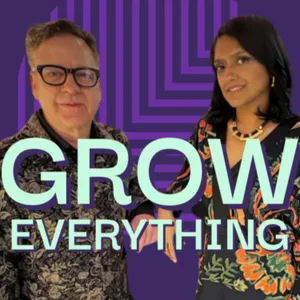
Grow Everything explores the world of biology as technology. Hosts Erum Khan and Karl Schmieder interview leaders and influencers biologizing industries with tools like synthetic biology, precision fermentation, bioprospecting, and more. These companies make biomaterials from waste, cosmetics that restore healthy hair and skin, and delicious cultivated foods in a bioreactor and so much more. Join us as we discuss the latest and greatest across biotech, engineered biology, entrepreneurship, and culture and how this transition is solving healthcare and climate change challenges.
Latest Episodes
The most recent episodes — sign up to get AI-powered summaries of each one.
- 5 days ago1h 6m
191. Beyond the Lab Bench: Karl & Erum on Human Connections as the Ultimate Biotech Moat
With Episode 200 coming up, Karl and Erum switch roles and interview each other the way they usually interview their guests. Karl shares why he decided not to become a doctor, how interviewing bands in college taught him to connect with anyone, and what he learned about storytelling during a decade in public relations before starting Messaging Lab. Erum talks about her unexpected path from studying forensic chemistry and working in pharmaceutical labs to executive coaching, joining a startup accelerator on a ship traveling around the world, and working in energy policy from the Navajo Nation to Brussels. They also discuss what waiting tables taught them about sales and humility, why early-stage startups should sometimes stay quiet until they have real traction, and why strong relationships are something AI cannot replace. Along the way, they revisit favorite moments from past guests, including Vishaal Bhuyan, Casey Lardner, Glennis Mehra, Linnea Fletcher, Elizabeth Hénaff, Phil Morle, Michael Specter, and Sabriya Stukes. Their conversation is a reminder that there is no single path into the bioeconomy.Grow Everything brings the bioeconomy to life. Hosts Karl Schmieder and Erum Azeez Khan share stories and speak with the leaders and innovators using biology to change the world. Biology is the world’s oldest technology, and it can be engineered. So, what are we growing?Learn more at www.messaginglab.com/groweverythingChapters: Karl and Erum interview each other ahead of Episode 200 Erum’s experience building a startup at sea with the Unreasonable Institute Genspace’s Break Into Biotech program and lessons from college Leaving the pharmaceutical lab for positive psychology and executive coaching What working in restaurants teaches about sales, empathy, and humility How energy and water policy work with the Navajo Nation shaped Erum’s perspective Why staying quiet can be better than making a big launch announcement for an early-stage biotech company Michael Specter discusses mistrust in science and the need for greater biology education Career changes, layoffs, and staying adaptable in the age of AI Advice for their younger selves and quick-fire questionsLinks and Resources:45. Insuring Your Lunch: Aanika’s Vishaal Bhuyan Cracks the Microbial Code of Food Security139. Cultivating a Culture of Cultures? Genspace's Casey Lardner on Community Biotech30. Breaking into Biotech: Linnea Fletcher's Inclusive Education and Workforce Upskilling at InnovATEBIO117. From Lab Coats to CEO Notes: BioLabs' Glennis Mehra on Biotech Business in NYC104. Unseen Worlds: Exploring Environmental Microbiomes and Their Secrets of Human and Climate Impact with Dr. Elizabeth Henaff149. Beyond Capital: Phil Morle of Main Sequence Ventures on Collaboration as the New Competitive Edge44. Spec-Tacular Science: A Chat with Michael Specter on Denying Denialism39. From Microbe to Unicorn: IndieBio's Sabriya Stukes on the Journey of Biotech StartupsAI Value PyramidGrow Everything LinkedInBioInnovations Events - For 25% off use code: Grow Everything
- 1 weeks ago1h 0m
190. Pour Some Sugar on Yeast: Lisa Roessler Scales Biology at Amyris
Lisa Ressler has spent more than 35 years working in science-based businesses, including DuPont and Evonik, and now serves as Chief Commercial Officer at Amyris. In this conversation, she joins Karl and Erum to discuss where Amyris stands today, what the company learned from Chapter 11, and why returning its focus to B2B science was the right move. Lisa explains the company’s 1.5 million-liter fermentation facility in Barra Bonita, Brazil, its partnership with Wacker to develop bio-based personal care ingredients, and the simple framework she uses to decide which markets are worth pursuing. She also shares what it takes for a bio-based ingredient to move beyond higher “green” pricing and reach large-scale commercial use, making the case that strong performance is ultimately what convinces customers.Grow Everything brings the bioeconomy to life. Hosts Karl Schmieder and Erum Azeez Khan share stories and interview the leaders and influencers changing the world by growing everything. Biology is the oldest technology. And it can be engineered. What are we growing?Learn more at www.messaginglab.com/groweverythingChapters: - Introduction and catching up after the Fourth of July - Soil health, regenerative agriculture, and current biotech trends - Biomanufacturing in China and the global race for scale and speed - Meet Lisa Ressler, Chief Commercial Officer at Amyris - What Amyris produces and how it works with partners across the supply chain - Amyris’s return to B2B and what enterprise customers want after Chapter 11 - How Amyris and Wacker collaborate from research through development - Proprietary molecules and how Amyris chooses which markets to pursue - Exploring Amyris’s molecule portfolio, from squalane to vaccines - The future of precision fermentation and quick-fire questionsLinks and Resources:AmyrisLisa RoesslerAmyris' sustainable squaleneAmyris, Inc. Launches New Production Line at Brazil Precision Fermentation PlantWACKER and biomanufacturing pioneer Amyris join forces in the personal-care sector179. D.C. Climate Week LIVE: The Road to Remake Everything183. The American Biotech Blueprint: Senator Todd Young on Biodiversity as National Security73. At the Bleeding Edge: Cresilon's Joe Landolina on Rapid Wound Care141. Gut Check! Viome’s Momo & Guru Decode Your Inner Microbiome158. Mycelium On, Sound Off: How GOB's Lauryn Menard Makes Biomaterials Feel Like CultureSilvaBio and Foray Bioscience Announce Acceleration to Restore the American ChestnutCommon Ground - agriculture documentarySiphonophore - longest animalBioI
- 2 weeks ago42 min
189. Infinite Threads: Recycling Athleisure Waste with Samsara’s Vanessa Vongsouthi
Vanessa Vongsouthi, Research Founder and Head of Bioengineering at Samsara Eco, joins host Erum on the Grow Everything Podcast to discuss how engineered enzymes and AI are unlocking infinite recyclability for textiles and plastics. Vanessa walks through Samsara's process of breaking complex polymers like Nylon 6,6 down into their chemical building blocks using AI-assisted protein design and ancestral sequence reconstruction, then feeding those monomers back into existing supply chains as virgin-equivalent materials — indistinguishable from what's extracted from petrochemicals today. She shares the story behind the world's first enzymatically recycled Nylon 6,6 jacket created in partnership with Lululemon, how Samsara was built using Main Sequence Ventures' orchestration model alongside partners like Woolworths and ANU from day one, and what a future of distributed local recycling infrastructure could mean for designers, manufacturers, and consumers everywhere.Grow Everything brings the bioeconomy to life. Hosts Karl Schmieder and Erum Azeez Khan share stories and interview the leaders and influencers changing the world by growing everything. Biology is the oldest technology. And it can be engineered. What are we growing?Learn more at www.messaginglab.com/groweverythingChapters: - Intro: Heat waves, climate impacts, and the bioeconomy - Would Big Tech buy a pharmaceutical company? - Brewed human collagen: Gelatech x Hugel partnership - France bans fast fashion: Shein, Temu, and the Atacama Desert - Introducing Vanessa Vongsouthi of Samsara Eco - Biology as future industrial infrastructure - Programming enzymes with AI and ancestral sequence reconstruction - The Lululemon jacket: proof that enzymatic recycling scales - Distributed recycling and a circular material economy - Post-interview debrief and key takeawaysLinks and Resources:Forbes - Vanessa VongsouthiSamsara EcoSamsara Eco - LinkedInHow Samsara Eco made a jacket with Lululemon from enzymatically recycled polyesterlululemon and Samsara Eco Announce 10-Year Plan to Advance Recycled Material PortfolioThe world has an anchovy problemAI Age Anthropic launches AI drug discovery program, joining tech giants in betting on healthcareFDA to fast-track food as medicineJellatech Partners with South Korea’s Hugel to Bring Cell-Cultured Human Collagen to MarketFrench parliament passes fast fashion bill targeting Shein and Temu149. Beyond Capital: Phil Morle of Main Sequence Ventures on Collaboration as the New Competitive Edge45. Insuring Your Lunch: Aanika’s Vishaal Bhuyan Cracks the Microbial Code of Food Security<a href="https://open.spotify.com/episode/2gjg3arQPkTORhxHStSNCF?si=jPNA4pFYTsyR1DHLEJpA4Q" target="_blank" rel="ugc
- 3 weeks ago1h 11m
188. Which Came First: Chicken, Egg, or Medicine? Neion Bio Turns Evolution into a Precision Factory
What happens when an evolutionary biologist and an aerospace engineer both arrive at the same conclusion — that the future of drug manufacturing isn't steel, it's biology? In this episode, Karl Schmieder and Erum Azeez Khan sit down with Sam Levin (Co-Founder & CTO) and Dimi Kellari (Co-Founder & CEO) of Neion Bio to unpack one of the most counterintuitive ideas in modern biomanufacturing: producing therapeutic medicines inside genetically engineered chicken eggs. Rather than optimizing the same mammalian cell culture systems that have defined biopharma for 50 years, Neion Bio's Raptor platform replaces complex steel bioreactor infrastructure with a self-replicating, two-input biological system — chicken feed and water in, life-saving medicines out. The conversation covers their stealth-to-commercial journey, a multi-product monoclonal antibody partnership announced alongside $11M in seed funding, the scalability and supply chain resilience advantages of egg-based manufacturing, how they navigate FDA regulation with a living bioreactor, and their North Star: dropping end-to-end production costs of monoclonal antibodies below $10 per gram — an order of magnitude that could fundamentally reshape who has access to biologics and where they're made.Grow Everything brings the bioeconomy to life. Hosts Karl Schmieder and Erum Azeez Khan share stories and interview the leaders and influencers changing the world by growing everything. Biology is the oldest technology. And it can be engineered. What are we growing?Learn more at www.messaginglab.com/groweverythingChapters: - Intro & 4th of July: America's 250th anniversary celebrations - America's Living Library Act & NDAA biotech provisions - Midjourney's ultrasonic body scanner & patient data ownership - NVIDIA's AI co-scientist, the AI value pyramid & AbbVie's $11B Apogee acquisition - Introducing Sam Levin & Dimi Kellari of Neion Bio - Neion Bio's Raptor platform: making medicines inside chicken eggs - Scalability, onshoring & true supply chain resilience - Downstream purification: cracking eggs vs. CHO cell lysate - FDA pathways & batch-to-batch consistency in a living bioreactor - Drug supply chain fragility & national health security - $10/gram North Star: end-to-end cost breakdown - Quickfire Q&A: engineering challenges, union demands & investor misconceptions - Outro: calls to action & what's next for Neion BioLinks and Resources:Neion BioContact to partner with Neion BioChicken Eggs Become BiorectorsNeion Bio Raises Oversubscribed $23 Million Series A to Advance Biologics Manufacturing Platform and Expand Pipeline183. The American Biotech Blueprint: Senator Todd Young on Biodiversity as National Security186. N.Y. Tech Week Live Demo: Engineering the Future of Manufacturing with Roebling's Brentan Alexander170. There's a Bug for That: Sophia Xu on CarbonBridge's Notebook Bioreactors176. Dare to Commercialize: Damien Perriman’s eXoZymes PlaybookNVIDIA announces BioNeMo<a href="https://www.linkedin.com/posts/erumazeez_study-this-
- Jun 26, 20261h 19m
187. One Small Step for a Microbe: Lynn Rothschild’s Leap from Astrobiology to Bioengineering at NASA
What does it actually take to keep humans alive on Mars? Not the SpaceX version — the biology version. Dr. Lynn Rothschild, research scientist at NASA Ames and adjunct professor at Brown and Stanford, has spent decades at the intersection of astrobiology and synthetic biology, and her answer is both elegant and radical: life itself is the technology. On this episode, Karl and Erum sit down with one of the scientists who helped build NASA's synthetic biology program to talk about on-demand drug manufacturing in space, growing habitats out of fungal mycelium, engineering bacteria to pull specific metals from e-waste, and the audacious "Hell Cell" project that aims to stack every survival superpower nature has ever evolved into a single organism. If you've ever wondered what it looks like when evolutionary biology meets aerospace engineering meets materials science — with a healthy dose of iGEM undergrads and Tetris metaphors — this one's for you.Grow Everything brings the bioeconomy to life. Hosts Karl Schmieder and Erum Azeez Khan share stories and interview the leaders and influencers changing the world by growing everything. Biology is the oldest technology. And it can be engineered. What are we growing?Learn more at www.messaginglab.com/groweverythingChapters: - NYC energy, the Knicks parade, and when does biotech get its ticker tape? - Peptides: biohacking goes mainstream, and why the back alley of your gym is not a pharmacy - Bemotrizinol: the first new active sunscreen ingredient cleared in the US in over 20 years - Listener shoutouts and a night with sci-fi legend Kim Stanley Robinson at Pioneer Works - SpaceX goes public at a $2.5 trillion valuation — what the space economy actually means - Why biology — not steel or solar — is the only real answer to the upmass problem - Lynn's origin story: from studying extremophiles to being told to engineer them for NASA - The astro pharmacy: programming bacteria to brew medicine on demand during a six-month Mars transit - The Hell Cell, AI in the lab, and Lynn's Tetris approach to building multi-disciplinary teams - Gravity, radiation, the 2030s Mars timeline, and what from Lynn's lab shows up in your house firstLinks and Resources:Lynn RothschildNASA interview with Lynn RothschildNature's Hardware Store - Lynn on Building the Future with BiologyThe Peptide Gold RushBemotrizinol - new FDA approved sunscreen ingredient185. Brick Happens: Chris Maurer of Redhouse Studio Redesigns Remote Living for Earth and Mars93. Houston, We Have a Protocol: NASA's Kate Rubins on Biotech in Space116. Cell Yeah for Space!: Pioneer Labs' Erika DeBenedictis on Engineering Life for Mars156. When Matter Makes Decisions: Michael Levin on the Intelligence of Form111. Space Genes and Subway Scenes: Chris Mason on Planning Life’s Next Big LeapBioInnovations Events - For 25% off use code: Grow EverythingTopics Covered:Synthetic biology in space, astrobiology, space biomanufac
- Jun 18, 202639 min
186. N.Y. Tech Week Live Demo: Engineering the Future of Manufacturing with Roebling's Brentan Alexander
Recorded live at New York Tech Week, Karl and Erum sit down with Brenton Alexander (CTO at Roebling) to unpack one of the biggest bottlenecks in scaling “biology as technology”: figuring out what it really takes to design and finance physical infrastructure. Brenton walks through how Roebling uses AI alongside deterministic engineering models (physics/thermodynamics) to accelerate early facility design, generate capex/opex estimates with uncertainty ranges (not false precision), and help teams run scenarios fast—so founders, investors, and operators can make better go/no-go decisions earlier, reduce wasteful iteration across siloed teams, and focus human expertise where it matters most.Grow Everything brings the bioeconomy to life. Hosts Karl Schmieder and Erum Azeez Khan share stories and interview the leaders and influencers changing the world by growing everything. Biology is the oldest technology. And it can be engineered. What are we growing?Learn more at www.messaginglab.com/groweverythingChapters: Welcome to Grow Everything Live at NY Tech Week The “infrastructure gap”: why feasibility work is slow and expensive What Roebling does: accelerating the path from R&D to final investment decision Live demo setup: building a yeast-based fermentation facility for a red bio-dye What the platform decides (and why inputs matter): equipment, DSP, and cost drivers “Why not just use Claude?” Deterministic models + AI tooling for defensible results Handling uncertainty: ranges, distributions, and Monte Carlo-style scenario runs What changes for engineers/consultants: shifting effort from manual work to judgment Reading the outputs: capex/opex, IRR, and the “tornado chart” of uncertainty drivers Audience Q&A: logistics/customer delivery, AI’s impact on costs, review fatigue, and assumptions Long-term direction: more fidelity, narrower bounds, EPC-ready handoff Audience Q&A begins Q1: logistics + customer delivery costs (not just “at the gate”) Q2: how AI changes operating cost assumptions over time Q3: review fatigue—how to structure checks and triage what matters Q4: what did the model assume for “colorant”? (and why specificity matters) Wrap-up + thank-yousLinks and Resources:RoeblingRoebling Early Access ProgramBrentan AlexandarEdward Shenderovich65. Scaling Cells, Dreaming Big: The Biomanufacturing Cloud with Synonym’s Edward Shenderovich166. The Great Reformulation: Joshua Lachter Rethinks How We Make Everything at Scale172. Generating Needles in Haystacks: Elise de Reus Designs Proteins with CradleBioInnovations Events - For 25% off use code: Grow EverythingTopics Covered:Roebling, bioprocess modeling, techno-economic analysis, fermentation economics, food dyes, bio-based ingredients, process engineering, AI for biomanufacturing, scale-up planning, regulatory considerations, industrial engineering AI.Have a question or comment? Message us here:Text or Call (804) 505-5553Instagram / Twitter / LinkedIn / <a href="https://www.youtube.com/channel/UCyfFwKFgFVMfEz4VWYwL
- Jun 12, 20261h 19m
185. Brick Happens: Chris Maurer of Redhouse Studio Redesigns Remote Living for Earth and Mars
What if the building you live in could be grown instead of built, feed people while it goes up, and lock away carbon for a century? Architect Chris Maurer of Red House Architecture and MycoHab joins Karl and Erum to explain how he turns 12 tons of invasive bush into mushrooms that feed a community and mycelium blocks that test stronger than concrete. He breaks down the now famous sledgehammer test, why a ductile living material survives the earthquakes that shatter cinder block, and the counterintuitive truth that more mycelium does not make a stronger brick. Then things get cosmic. Chris walks through his NASA backed work growing habitats that pack down tight, fly to Mars, and unfold to grow their own radiation shielding from algae and fungi, plus the Biocycler that eats the toxins out of old houses and turns that waste into something safe. If you care about biomaterials, regenerative design, and the business models that could actually build us out of the climate crisis, this conversation will rewire how you see the walls around you.Grow Everything brings the bioeconomy to life. Hosts Karl Schmieder and Erum Azeez Khan share stories and interview the leaders and influencers changing the world by growing everything. Biology is the oldest technology. And it can be engineered. What are we growing?Learn more at www.messaginglab.com/groweverythingChapters: Cold open and the first trillion dollar biotech Robling's live demo: an AI process engineer for biomanufacturing The Longevity Global Summit and the business of living longer A warming planet is unleashing flesh eating microbes Meet Chris Maurer: architecture that grows, decays, and feeds people What Africa taught him about regenerative architecture Building MycoHab with MIT and Standard Bank The sledgehammer test: ductile mycelium versus brittle concrete Failures, tuning biology, and the 60 day sweet spot Does biology first design give the Global South an advantage? Deployable Mars habitats that grow their own walls The Biocycler: turning old toxic buildings into new ones How fungi break down petrochemicals and chelate heavy metals The hard nut of building a business around mycelium The economics of mushrooms, materials, and carbon credits Eco luxury myco habs and the first buyers Why biobased construction becomes the rule by mid century Earth or Mars, the weirdest material, and meeting Lynn RothschildLinks and Resources:Redhouse Studio ArchitectureChris MaurerNASA Innovative Advanced Concepts (NIAC) ProgramCan 'mycotecture' provide the building blocks?143. Sunscreen from Space? Delavie’s Kyle Landry Turns Space Microbes into Skincare 173. They Put the Ore in Organisms: Liz Dennett’s Microbial Mining at Endolith156. When Matter Makes Decisions: Michael Levin on the Intelligence of Form 126. Sizzling Success: Eben Bayer of MyForest Foods on Scaling Mycelium Magic159. The Future Is Fungi Awards: From Mushroom Dreams to Real-World Things<a href="https://www.linkedin.com/posts/murat_just-as-we-dont-care-whether-aws-uses-a-activity-7467724507454160897-V527?utm_source=share&utm_medium=
- Jun 5, 20261h 13m
184. The Multiverse of Microbes: Henry Lee on Building Cultivarium and Training with Titans
Most of biotech runs on a tiny handful of "model" organisms — E. coli, baker's yeast — while millions of wild species sit unstudied in what scientists call microbial dark matter. In this episode, Karl and Erum sit down with Henry Lee, co-founder of Cultivarium, to explore why the future of synthetic biology depends on learning to grow, study, and engineer the organisms we've ignored. Henry breaks down the real difference between model and non-model organisms, why simply culturing a new microbe can take years, and how Cultivarium is standardizing growth recipes and building an open digital platform so any researcher can work with strains that were once impossible to handle. Along the way: a fistulated cow, a spectacular failure that ultimately cracked the genetics of cement-making bacteria, extreme microbes that could free fermentation from fresh water, and Cultivarium's evolution from a Focused Research Organization into a "Frontier Research Contractor." The conversation closes on the state of American science — funding, public trust, and AI — plus the America's Living Library Act and a quick-fire round on archaea, overused buzzwords, and whether we're alone in the universe. Before the interview, Karl and Erum spill some biotech tea on "Biotech Barbie" Cathy Tie and unpack what the video game Stray gets right about engineered microbes escaping into the wild.Grow Everything brings the bioeconomy to life. Hosts Karl Schmieder and Erum Azeez Khan share stories and interview the leaders and influencers changing the world by growing everything. Biology is the oldest technology. And it can be engineered. What are we growing?Learn more at www.messaginglab.com/groweverythingChapters: — Summer vibes & a little biotech gossip: meet "Biotech Barbie" — What a video game about a lost cat teaches us about runaway microbes — How Henry went from building circuits to falling for biology — So what actually is a "non-model" organism? — Yes, we really talk about a cow with a window in its stomach — Step inside Cultivarium: incubators, recipes & happy accidents — Borrowing nature's best ideas: fungi, archaea & glowing jellyfish — The failure that taught us everything (a cement-making bacteria story) — Could the ocean fuel the future of fermentation? — Real talk: science funding, public trust & the promise of AI — Reinventing how big science gets funded — and a library of life — Dream organisms, pet-peeve buzzwords & "are we alone?" — Karl & Erum unpack their favorite momentsLinks and Resources:CultivariumBiosphere Project27. Charting the Unexplored Microverse for Biological Gold with CULTIVARIUM’s Nili Ostrov147. Shhh…They’re Talking: Holoclara's Dr. Andrea Choe Tunes Into Worm Signals for Health98. Gotta Get Them All: bitBiome's Quest to Decode All Microbes with Yuji Suzuki183. The American Biotech Blueprint: Senator Todd Young on Biodiversity as National SecurityKathy Tie Biotech Barbie Gene EditingStray - A Synthetic Biology Video GameBioInnovations Events - For 25% off use code: Grow EverythingTopics Covered:non-model organisms, microbial dark matter, model or
About Grow Everything Biotech Podcast
Grow Everything explores the world of biology as technology. Hosts Erum Khan and Karl Schmieder interview leaders and influencers biologizing industries with tools like synthetic biology, precision fermentation, bioprospecting, and more. These companies make biomaterials from waste, cosmetics that restore healthy hair and skin, and delicious cultivated foods in a bioreactor and so much more. Join us as we discuss the latest and greatest across biotech, engineered biology, entrepreneurship, and culture and how this transition is solving healthcare and climate change challenges.
Customized Recaps
AI-powered recaps with compact key takeaways, quotes, and insights.
Straight to Your Inbox
Get key takeaways from Grow Everything Biotech Podcast in a 5-minute read.
Save Hours Every Week
Stay current on your favorite podcasts without falling behind.
Frequently Asked Questions
What is Podzilla's Grow Everything Biotech Podcast daily summary?
It's a free AI-powered email that summarizes new episodes of Grow Everything Biotech Podcast as soon as they're published. You get the key takeaways, notable quotes, and links & mentions — all in a quick read.
How does the Grow Everything Biotech Podcast podcast summary work?
When a new episode drops, our AI transcribes and analyzes it, then generates a personalized summary tailored to your interests and profession. It's delivered to your inbox every morning.
Is this an official Grow Everything Biotech Podcast product?
No. Podzilla is an independent service that summarizes publicly available podcast content. We're not affiliated with or endorsed by Messaginglab.
Can I get summaries of other podcasts too?
Absolutely! The free plan covers up to 3 podcasts. Upgrade to Pro for 15, or Premium for 50. Browse our full catalog at /podcasts.
How often does Grow Everything Biotech Podcast release new episodes?
Grow Everything Biotech Podcast publishes weekly. Our AI generates a summary within hours of each new episode.
What topics does Grow Everything Biotech Podcast cover?
Grow Everything Biotech Podcast covers topics including Science, Life Sciences. Our AI identifies the specific themes in each episode and highlights what matters most to you.
Start getting Grow Everything Biotech Podcast summaries tomorrow morning.
Free forever for up to 3 podcasts. No credit card required.
Free forever for up to 3 podcasts. No credit card required.