Free Daily Podcast Summary
Inner Propaganda with Owen Fitzpatrick: Daily Summaries Delivered
by Owen Fitzpatrick
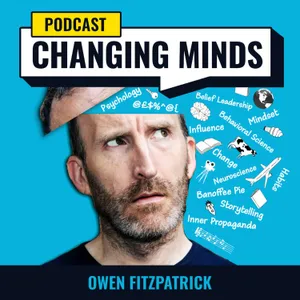
The most powerful propagandist in your life is you. Inner Propaganda with Owen Fitzpatrick explores the unconscious beliefs and stories that shape how we think, decide, and lead. Owen is a social psychologist, keynote speaker, and author of Inner Propaganda (Ideapress, 2026). For over two decades, he's studied belief systems, from global boardrooms to field research in North Korea, Rwanda, and Afghanistan. Each episode unpacks how beliefs form, why they resist change, and what it takes to lead through uncertainty. Ideas for leaders, thinkers, and anyone tired of soft-skill clichés.
Latest Episodes
The most recent episodes — sign up to get AI-powered summaries of each one.
- Today37 min
Why doing good as an organization pays with Jess Pettitt
What if your competitors are wrestling with the same dilemma you are, and nobody is brave enough to ask? My friend Jess Pettitt, a Hall of Fame speaker and crisis advisor, believes this fear is keeping good organizations from doing better. In her new book, Doing Good Better, Jess adapts Maslow's hierarchy of needs for organizations. At the top sits outlasting the cycle: surviving recession, disruption, and crisis while staying true to your values. She argues that every mistake you have made prepares you to recognize the next one faster. In this episode of Inner Propaganda, I explore with Jess why leaders fear admitting mistakes, the internal and external pressures behind that fear, and the two questions she asks leadership teams that reveal where they really stand. We also discuss the shareholder-versus-stakeholder debate, a protein loophole in the food industry, an oil refinery racing its competitors, and what it would take for AI leaders to agree on a shared off button. What you will discover: How organizations can climb their own version of Maslow's hierarchy Why past mistakes are preparation for recognizing new ones How internal and external pressure shape the decisions leaders make Why collaboration with competitors can create collective decisions that do good How to take back control of your own sense of urgency <span style= "font-size: 11pt; font-family: Arial,sans-serif; color: #000000; back
- 1 weeks ago32 min
How to talk back to the voice that hates you
Whenever I feel anxious or down, a voice in my head speaks with complete authority. It tells me I'm a fraud, that I'm broken, that nothing I do matters. I call it the inner dictator, and I have named him Dick. Inner propaganda is how we convince ourselves of the ideas we hold. The stories we sell to ourselves become the beliefs we buy into, and the inner dictator is the voice that sells the darkest of them with total certainty. In this episode of Inner Propaganda, I explore why recognizing the inner dictator weakens its hold, drawing on the persuasion knowledge model and my own experiences of propaganda in North Korea. I then go through the most common lines Dick uses on me, from "You're a freak" to "The world is so full of pain," and share how I talk back to each one. What you will discover: Why naming the inner dictator makes its messages less convincing How the change of meaning principle works inside your own mind Why your mood decides which evidence feels like proof Simple questions that expose the vague claims behind self-doubt How to judge a thought by its usefulness rather than its accuracy If you enjoyed this episode, check out my brand-new book, Inner Propaganda<span style= "font-size: 11pt; font-family: Arial,sans-serif; color: #000000; background-color: transparent; font-weight: 400; font-style: normal; font-variant: normal; text-decoration: none; vertical-align: baseline; white-space: p
- 2 weeks ago24 min
How to feel good enough
If you have ever felt like you are not a good enough parent, partner, friend, or professional, you have met the inner dictator. It is a voice of absolute certainty that tells you the limits of your potential, and it can sabotage your chances of success. The belief "I am not good enough" is so vague and abstract that it is hard to pin down and easy to accept. It is a form of inner propaganda, a story your mind tells you to keep things simple and stable. In this episode of Inner Propaganda, I explore how to tackle this belief from every angle, drawing on my book, cognitive behavioral therapy, neurolinguistic programming, and mindfulness. I share the belief audit, a way to define what "good" and "enough" actually mean, and questions that test how much evidence sits behind the belief. What you will discover: Why "I am not good enough" is inner propaganda from the inner dictator The four questions of the belief audit How to define "good" and "enough" so the belief becomes specific and testable How to build an antifragile identity that turns mistakes into growth Questions that test how certain you really are, including rating your certainty from one to ten If you enjoyed this episode, check out my brand new book, Inner Propaganda, where I show how the stories your mind tells you take hold and share the tools you can use to challenge them. It draws on stories from history, the latest research, and everyday life to explain what leads us to believe what we do. <p dir="ltr" style= "line-h
- 3 weeks ago52 min
What makes you persuasive online (ft. LinkedIn's #1 branding creator)
Most people chasing followers are playing the wrong game entirely. In this episode, Howie Chan, founder of the Behavioring Company and LinkedIn's number one branding creator, explains why the visible metrics of likes and reposts often hide the real currency of influence. Howie built his career by switching tribes, moving from stem cell science into brand strategy and eventually into entrepreneurship after being laid off from the agency he helped grow to over 2,000 people. That experience shaped his belief that behavior change, not belief change, is usually the fastest and most reliable path to real influence. In this episode of Inner Propaganda, we explore why LinkedIn behaves more like a risk management exercise than a true social platform, why belief often follows behavior rather than the other way around, and why the smartest people online are usually optimizing for authority rather than applause. Howie also breaks down his six-part framework for building influence and his CARE method for earning trust quickly. What you will discover: Why the mechanics of a platform matter less than the psychology of its audience Why LinkedIn users protect their reputation more than they chase engagement How changing default settings can shift behavior faster than changing beliefs The six-part framework for moving someone from noticing you to recommending you The CARE method for building trust: competence, authenticity, repeatability, and empathy If you enjoyed this episode, check out my brand new book, <span style= "font-size: 11pt; font-family: Arial,sans-serif; color: #000000; background-color: transparent; font-weight: 400; font-style: italic; font-varia
- 4 weeks ago19 min
The reality behind my book launch
A few weeks ago, I posted photos of myself signing books at Barnes & Noble on Fifth Avenue and at my local bookstore. It looked like a win. What I didn't share was how some stores I visited hadn't stocked the book at all, or had a single copy on order from a friend of mine who had put in the order. There is a story I heard years ago from my friend Philippe about Grigory Potemkin, who supposedly built fake, beautiful villages along a riverbank just so Catherine the Great would believe everything was thriving. That image has stuck with me, because most of what we see on social media works the same way. In this episode of Inner Propaganda, I pull back the curtain on the last six months of launching my book. I talk about landing incredible endorsements from people like Tony Robbins and Robert Cialdini, and about the far larger pile of rejections that never make it onto Instagram. I talk about hitting USA Today's bestseller list and missing the New York Times list I wanted. And I break down what I call the story war, the way our minds can take the same fact and spin it into two completely different realities depending on which internal narrative wins that day. What you will discover: The Potemkin village metaphor and why so much of what we present publicly is a curated version of reality How the same piece of news can trigger either a confidence-boosting story or a self-defeating one Why "am I good enough" is a question with no useful answer, and what to ask instead <span style= "font-size: 11pt; font-family: Arial,sans-serif; color: #000000; background-color:
- Aug 31, 202613 min
How to heal polarization
Ian Paisley and Martin McGuinness spent decades as sworn enemies in one of the bloodiest conflicts in modern history. Then they became genuine friends, so close the press nicknamed them the Chuckle Brothers. If they could bridge that gap, the divide behind your last political argument may not be as permanent as it feels. In this episode of Inner Propaganda, I explore why disagreement now so often feels like disrespect, and what is actually driving us apart. Not just human nature, but a set of forces, from the way our brains sort people into us and them in milliseconds, to feeds engineered to keep us certain and furious, that are pulling us further apart than we would ever go on our own. I also explore the research behind polarization and share the four moves I use to bridge even the deepest divides. I draw on my own experience sitting down with people in North Korea, Afghanistan, and Iran whose beliefs seemed completely alien to me, and I walk through the deep canvassing research showing that a single honest conversation, built on real curiosity rather than argument, can shift a belief and make it last for months. What you will discover: Why we overestimate how extreme the other side actually is How social media turns an ancient psychological effect into a machine for manufacturing outrage Why shaming someone out of a belief almost always backfires The four moves that actually bridge deep divides Why the goal is never to win, but to find the common ground underneath Visit my website: <span style= "font-size: 11pt; font-family: Arial,sans-serif; color: #1155cc; background-colo
- Aug 24, 202619 min
How influence works
In the early 1980s, Steve Jobs asked an engineer to save 10 seconds off the Macintosh boot-up time. The engineer found 28. His skills never changed. The story he was working inside of did. This episode brings together everything I have taught this summer on logic and story into one complete system I call DELP: Demos, Ethos, Logos, Pathos. It is built on Aristotle's original framework, with the one piece he never had to think about added back in: knowing your audience before anything else. In this episode of Inner Propaganda, I explore what real, ethical influence looks like in practice. I walk through Sophia Jex-Blake's fight to study medicine, the unsettling truth behind Milgram's obedience experiments, why a mint on a restaurant bill can raise tips by 23 percent, and the single three-word question that gets other people to argue your case for you. What you will discover: Why influence, done right, is something you do for someone rather than to someone The four elements of the DELP framework and why order matters How the same fact can produce completely different decisions depending on how it is framed Why conceding a point first builds more trust than any amount of extra evidence A three-word question that gets people to talk themselves into a decision Visit my website: <span style= "font-size: 11pt; font-family: Arial,sans-serif; color: #1155cc; background-color: transparent; font-weight: 400; font-style: normal; font-variant: normal; text-decoration: underline; -webkit-text-decoration-skip: none; text-decoration-skip-ink: none; vertical-align: baseline; white-space: pre-w
- Aug 17, 202617 min
How to make better decisions
I almost said "pick up the phone" was the wrong call for Stanislav Petrov to make. His training said launch. The screen said launch. He said wait, and that pause is the reason the world is still standing. Most of our decisions will never carry those stakes, but the machinery behind them is identical. Your mind was built to keep you alive, not to get things right, and that single fact explains why brilliant people make reckless calls and why the rest of us default to whatever is easiest. In this episode of Inner Propaganda, I explore why even Isaac Newton, a man who mapped gravity, lost a fortune chasing a stock bubble he knew was irrational. I walk through the four-part toolkit I use to make better decisions: Defusion, Debiasing, Decision Modeling, and Discernment, and I share why grading your decisions by their outcome instead of their soundness teaches you exactly the wrong lessons. Before we get into it, I have AMAZING news to share. Last week, Inner Propaganda was listed at No. 8 on the USA Today national bestseller list, No. 2 in nonfiction, No. 1 in psychology, and No. 1 in business on the same list!! It also made the LA Times bestseller list and the Independent Press Top 40 for nonfiction. This result far exceeds my expectations. I am still over the moon! Thank you for your support and feedback. If you have already picked up a copy, thank you, and I would love it if you took a moment to leave a review on Amazon. If you have not grabbed it yet, you can find it at innerpropaganda.com, on Amazon, or at your favorite bookstore. <p dir="ltr" style= "line-height: 1.38; margin-top:
Get Inner Propaganda with Owen Fitzpatrick summaries in your inbox
Free AI-powered daily recaps. Key takeaways, quotes, and mentions — in a 5-minute read.
Get Free Summaries →Free forever for up to 3 podcasts. No credit card required.
You Might Also Like
Listeners also like.

Influence Anyone
Explores the psychology of influence through expert interviews on mindset, persuasion, branding, and leadership.

Decoded | Unlock The Secrets of Human Behavior, Emotion and Motivation
Analyzes subconscious patterns in human behavior and provides methods to change them.
A Podcast About Leadership
Examines modern leadership through interviews with experts in business, psychology, and human performance.
A Bit of Optimism
Conversations with thinkers and doers exploring what drives purpose, growth, and meaning in life.

Modern Wisdom
Discussions with experts on psychology, philosophy, and self-improvement to help navigate life’s challenges.

The One You Feed | Personal Growth, Emotional Resilience & Purpose
Conversations with thought leaders explore personal growth, emotional resilience, and living with purpose through small, consistent actions.

The Jordan Harbinger Show
Conversations with top performers across fields, distilling actionable insights on success, relationships, and personal growth.

Deepak Chopra’s Infinite Potential
Deepak Chopra explores consciousness, identity, and human potential through conversations with thought leaders and experts.
Growth Mindset Psychology: The Science of Self-Improvement
Explores the science behind lasting self-improvement through psychology, neuroscience, and timeless wisdom traditions.
The Curiosity Shop with Brené Brown and Adam Grant
Two researchers examine leadership, connection, and change by combining qualitative and quantitative insights.

Passion Struck with John R. Miles
Explores purpose, resilience, and human potential through conversations with experts in psychology, neuroscience, and performance.

Unblinded with Sean Callagy
A legally blind entrepreneur shares insights on ethical influence, peak performance, and mastering hidden patterns in business and life.
About Inner Propaganda with Owen Fitzpatrick
The most powerful propagandist in your life is you. Inner Propaganda with Owen Fitzpatrick explores the unconscious beliefs and stories that shape how we think, decide, and lead. Owen is a social psychologist, keynote speaker, and author of Inner Propaganda (Ideapress, 2026). For over two decades, he's studied belief systems, from global boardrooms to field research in North Korea, Rwanda, and Afghanistan. Each episode unpacks how beliefs form, why they resist change, and what it takes to lead through uncertainty. Ideas for leaders, thinkers, and anyone tired of soft-skill clichés.
Customized Recaps
AI-powered recaps with compact key takeaways, quotes, and insights.
Straight to Your Inbox
Get key takeaways from Inner Propaganda with Owen Fitzpatrick in a 5-minute read.
Save Hours Every Week
Stay current on your favorite podcasts without falling behind.
Frequently Asked Questions
What is Podzilla's Inner Propaganda with Owen Fitzpatrick daily summary?
It's a free AI-powered email that summarizes new episodes of Inner Propaganda with Owen Fitzpatrick as soon as they're published. You get the key takeaways, notable quotes, and links & mentions — all in a quick read.
How does the Inner Propaganda with Owen Fitzpatrick podcast summary work?
When a new episode drops, our AI transcribes and analyzes it, then generates a personalized summary tailored to your interests and profession. It's delivered to your inbox every morning.
Is this an official Inner Propaganda with Owen Fitzpatrick product?
No. Podzilla is an independent service that summarizes publicly available podcast content. We're not affiliated with or endorsed by Owen Fitzpatrick.
Can I get summaries of other podcasts too?
Absolutely! The free plan covers up to 3 podcasts. Upgrade to Pro for 15, or Premium for 50. Browse our full catalog at /podcasts.
How often does Inner Propaganda with Owen Fitzpatrick release new episodes?
Inner Propaganda with Owen Fitzpatrick publishes weekly. Our AI generates a summary within hours of each new episode.
What topics does Inner Propaganda with Owen Fitzpatrick cover?
Inner Propaganda with Owen Fitzpatrick covers topics including Science, Education, Social Sciences, Self-Improvement. Our AI identifies the specific themes in each episode and highlights what matters most to you.
Start getting Inner Propaganda with Owen Fitzpatrick summaries tomorrow morning.
Free forever for up to 3 podcasts. No credit card required.
Free forever for up to 3 podcasts. No credit card required.