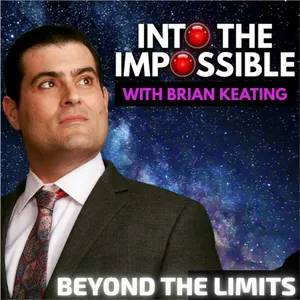
Free Daily Podcast Summary
Into the Impossible With Brian Keating: Daily Summaries Delivered
by Big Bang Productions Inc.
Think like a physicist. Wonder like a human. Into the Impossible is where Cosmic Conversations happen — uniting Nobel Prize winners, iconoclasts, authors, and technologists to explore reality’s deepest questions. From AI to aliens, from biophysics to the brain, from the cosmos to the multiverse, Brian Keating, Chancellor’s Distinguished Professor of Physics at UC San Diego covers it all. If you’ve ever asked What’s out there? or What’s next?, this is where curiosity meets clarity.
Latest Episodes
The most recent episodes — sign up to get AI-powered summaries of each one.
- Today13 min
AI Is the New Tower of Babel (And Its Builders Know It)
The new Tower of Babel, and its builders are becoming like gods to us. The bigger threat isn't killer robots; it's how much of your own mind you've already handed over. I joined Mike Slater on Politics By Faith (The First) to talk about AI, faith, and the people building it. We cover: why Babel is always the city AND the tower, how the same AI that discovers drugs can build super viruses, what I'm seeing in my own classroom as term begins, why cognitive offloading scares me more than Terminators, and the one thing AI still can't do without us. AI belongs in your hands as a thinking partner, never the primary creator. Chapters: 00:00 Mike Slater introduces Brian Keating (cosmologist, not cosmetologist) 00:37 Why AI is the Tower of Babel — the city and the tower 02:05 The double-edged sword: new drugs vs. super viruses 02:57 Altman, Amodei, Musk — "they become like gods to us" 03:42 "Regulate us, take us over" — who really wants that 04:23 A scientist weighs progress: "I'm an accelerationist" 05:19 AI as a curiosity amplifier, not a shortcut 06:04 First day of class at UC San Diego — the war over AI 07:22 Thinking partner, not primary creator — and the nuclear analogy 08:20 Cognitive offloading — how many phone numbers do you remember? 09:17 The worldview of the people running AI 10:35 Why I'm not a doomer — and what to actually do (local models) ——— 📬 Get the transcript, fascinating bonus content, and my Monday M.A.G.I.C. Message: https://briankeating.com/yt 🌠 Have a .edu email and live in the USA 🇺🇸? You automatically win a meteorite: https://BrianKeating.com/edu 🔔 Subscribe: https://www.youtube.com/DrBrianKeatin... 🎯 Support Into the Impossible on Patreon — get my weekly M.A.G.I.C. Message, unfiltered bonus content, and live monthly Office Hours with me: / drbriankeating ⭐ Join this channel for perks, monthly Office Hours, and your name in the Member Roster at the end of every episode: / @drbriankeating 📚 My books: Losing the Nobel Prize (memoir): http://amzn.to/2sa5UpA Think Like a Nobel Prize Winner: https://a.co/d/03ezQFu Focus Like a Nobel Prize Winner: https://a.co/d/hi50U9U Galileo's Dialogue (first-ever audiobook): https://a.co/d/iZPi9Un 🌐 More: 🏄♂️ Twitter: /briankeating 📚 Substack https://briankeating.substack.com/ss ✍️ Blog: https://briankeating.com/blog 🎙️ Audio-only: https://briankeating.com/podcast #intotheimpossible #briankeating #science #physics #astronomy #cosmology #podcast #universe Learn more about your ad choices. Visit megaphone.fm/adchoices
- 3 days ago1h 0m
Robert Wright: AI Alignment Is a Moral Problem, Not a Technical One
The real AI alignment problem is not technical. It is moral. You cannot align a superintelligence to human values if humans cannot agree on what those values are, and you cannot get that agreement without a level of global cooperation we have never managed before. Subscribe if you want science with evidence, not speculation. The Tower of Babel is the AI parable nobody is reading. Technology that outpaces wisdom fragments the people building it. The Fermi paradox offers the grimmer version: civilizations that reach the capacity to blow themselves up typically do. Robert Wright has been watching this longer than almost anyone, he was reporting on neural networks in 1983, and his conclusion is not that the machines will fail the test. It is that we will. Wright’s book argues that superintelligence is not the danger and AI alignment is not the solution unless it comes with a moral advance. Passing the God test requires something no lab can ship. What you’ll hear: -Why Wright thinks p(doom) fails as a scientific concept -What the binding of Isaac and the Tower of Babel have in common as moral tests -Why global cooperation is the only thing that can actually slow AI down -What Lee Smolin’s cosmological natural selection has to do with the Fermi paradox -What Wright thinks Eastern and Western enlightenment have in common and why it matters now -Whether there is a role for humanity inside the global brain or only for the machines “We face the kind of test that God would give.” — Robert Wright CHAPTERS 00:00 The man who interviewed Hinton in 1983 05:04 The God test and its two meanings 08:36 Religious faith in technological progress 14:10 Hinton then versus Hinton now 19:38 Why slowing AI down requires international cooperation 26:02 How LLMs reverse-engineer the meaning of words 32:08 Brian's Einstein test: can Claude have a happy thought? 40:06 AGI is impossible. Here is why Brian thinks that. 47:04 The Fermi paradox as a moral filter 51:10 What passing the God test actually looks like Get the transcript, fascinating bonus content, and my Monday M.A.G.I.C. Message: https://briankeating.com/yt Have a .edu email and live in the USA? You automatically win a meteorite: https://BrianKeating.com/edu Enter the debate: briankeating.com/ai Subscribe: https://www.youtube.com/DrBrianKeating?sub_confirmation=1 Support Into the Impossible on Patreon, get my weekly M.A.G.I.C. Message, unfiltered bonus content, and live monthly Office Hours with me: https://www.patreon.com/drbriankeating Join this channel for perks, monthly Office Hours, and your name in the Member Roster at the end of every episode: https://www.youtube.com/channel/UCmXH_moPhfkqCk6S3b9RWuw/join Featured Guest: The God Test (book): https://thegodtest.net Robert Wright on Twitter/X: https://x.com/RWrighter My books: Losing the Nobel Prize (memoir): http://amzn.to/2sa5UpA Think Like a Nobel Prize Winner: https://a.co/d/03ezQFu Focus Like a Nobel Prize Winner: https://a.co/d/hi50U9U Galileo’s Dialogue (first-ever audiobook): https://a.co/d/iZPi9Un Twitter/X: https://x.com/BrianKeating Substack: https://briankeating.substack.com Blog: https://briankeating.com/blog Audio-only: https://briankeating.com/podcast #RobertWright #AIalignment #superintelligence #FermiParadox #briankeating #intotheimpossible #AI Learn more about your ad choices. Visit megaphone.fm/adchoices
- 1 weeks ago1h 3m
Former NASA Physicist: The UAP Maneuver That Should Have Exploded
A physics professor ran the energy budget on the Nimitz tic-tac. The maneuver needs about a thousand gigawatts, more than ten times every nuclear plant in the United States combined. Nothing we build survives its own waste heat at that scale. So what was flying? Kevin Knuth is a professor of physics at the University at Albany and a former NASA scientist who now applies Bayesian statistics to UAP sensor data. We cover: why a 5,400 g maneuver would turn a pilot into soup, where the energy went when the object stopped and no explosion followed, the 1954 radar measurements nobody wants to talk about, the New Zealand frigate that went dark and adrift in three seconds, and why the records from that deployment stay classified until 2062. Knuth says the power numbers alone rule out human technology. I push back on whether the sensors agree. Newsletter, full transcript, and my Monday M.A.G.I.C. Message: briankeating.com/aliens CHAPTERS 00:00 Why this field needs gatekeepers 03:50 How anomalous is anomalous? 06:40 The UFO photo that was a seagull 10:40 Radar clocked them at 19 km/s in 1954 15:00 5,400 g and a body weighing 227 tonnes 19:00 The radar return problem he had not considered 21:45 A gigawatt of waste heat and nowhere to put it 24:30 The 747 chased by something carrier sized 29:00 Why a number without an error bar is worthless 34:30 The NASA job he was not qualified for 37:00 Proxima Centauri in a day and a half 41:00 The warship that lost all power in 3 seconds 46:30 Pushing a column of water that cannot compress 48:45 The light that burned bark off the trees 53:00 What the power numbers rule out 56:00 The 95 percent problem Learn more about your ad choices. Visit megaphone.fm/adchoices
- 1 weeks ago1h 6m
Carlo Rovelli: Free Will Is Real. Physics Can Prove It.
This episode is sponsored by Abacus AI agent: agent.abacus.ai/keating I fed it Carlo's recent papers and asked for the argument, the counterargument, and the evidence that would support or refute each side. Some of the questions and animations in this interview came out of that. It runs the top frontier models in one place, turns a dense PDF into a research report or a presentation with charts, builds interactive dashboards off a spreadsheet, and takes API access if you want it wired into your own tools. Plans start at $10 a month. My link gets you the first month for $7: agent.abacus.ai/keating The physicist who built loop quantum gravity says the second law does not say what you were taught it says, and that freedom does not require breaking a single law of nature. Order builds itself. Your head is older than your feet. And neither one is the strangest thing here. Carlo Rovelli founded the loop quantum gravity program and wrote the relational interpretation of quantum mechanics. We cover: why oil separating from water is not a violation of entropy, what Galileo got wrong about the one discovery he is most famous for, the paper Einstein published denying gravitational waves, why a chess program that deliberates tells you what your own freedom actually is, and what Rovelli would build with ten years and unlimited money. “To imagine that to be free you have to violate the laws of nature is stupid.” — Carlo Rovelli CHAPTERS 00:00 Your head is older than your feet 00:48 Things left alone get ordered. Who ordered them? 07:00 Low entropy might be about you, not the universe 08:38 You can be in two cities at once, just not to you 11:02 Why start with Galileo when Einstein knew more? 19:34 Galileo misunderstood his own discovery 22:32 Einstein published a paper denying gravitational waves 25:08 The definition of time that explains nothing 26:50 Two clocks, two metres apart, two answers 31:06 Nothing gets recorded without something being lost 33:12 The chess program deliberates. So do you. 37:06 Can a machine have Einstein’s happiest thought? 39:52 Thirty minutes versus a month 44:10 Dark matter made of black holes the size of a hair 51:10 Ten years, unlimited money, a room full of junctions Rovelli told me the second law does not say what I was taught it says. Order builds itself. Transcript, bonus content, and my Monday M.A.G.I.C. Message: https://briankeating.com/yt Three moments worth the rewatch: 07:00 The entropy you were taught is a point of view 26:50 Why your head is older than your feet 39:52 The thing Claude did in 30 minutes Get the transcript, fascinating bonus content, and my Monday M.A.G.I.C. Message: https://briankeating.com/yt Have a .edu email and live in the USA? You automatically win a meteorite: https://BrianKeating.com/edu Subscribe: https://www.youtube.com/DrBrianKeating?sub_confirmation=1 Support Into the Impossible on Patreon, get my weekly M.A.G.I.C. Message, unfiltered bonus content, and live monthly Office Hours with me: https://www.patreon.com/drbriankeating Join this channel for perks, monthly Office Hours, and your name in the Member Roster at the end of every episode: https://www.youtube.com/channel/UCmXH_moPhfkqCk6S3b9RWuw/join Featured Guest: Carlo Rovelli website: https://www.cpt.univ-mrs.fr/~rovelli/ The Relational Universe (book): https://www.amazon.com/dp/0735216118 Carlo Rovelli on Twitter/X: https://x.com/carlorovelli My books: Losing the Nobel Prize (memoir): http://amzn.to/2sa5UpA Think Like a Nobel Prize Winner: https://a.co/d/03ezQFu Focus Like a Nobel Prize Winner: https://a.co/d/hi50U9U Galileo’s Dialogue (first-ever audiobook): https://a.co/d/iZPi9Un Twitter/X: https://x.com/BrianKeating Substack: https://briankeating.substack.com Blog: https://briankeating.com/blog Audio-only: https://briankeating.com/podcast #CarloRovelli #freewill #entropy #physics #quantumgravity #briankeating #intotheimpossible Learn more about your ad choices. Visit megaphone.fm/adchoices
- 2 weeks ago2h 5m
They Built the Quietest Place on Earth to Find Dark Matter
They Built the Quietest Place on Earth to Find Dark Matter One event in 220 days. That is what the search for dark matter looks like right now. In this episode I talk with Rick Gaitskell, professor of physics at Brown University and a leader on the LZ dark matter experiment, about what it takes to build a detector that can see almost nothing at all: seven tonnes of liquid xenon, a mile of rock in an old gold mine, and shielding so careful that the radon seeping out of ordinary concrete counts as a serious enemy. We get into why the field spent decades hunting the WIMP, what happens to a 3.4 sigma result when you look at it honestly, and why a single event, however beautiful, cannot tell you what you want it to tell you. We also talk about the human side of a project like this. The grad student who waited nine years for data. The physicist who walked away from investment banking. The uncomfortable fact that something like ninety-five percent of research does not work out, and what keeps people going anyway. And the line that sits under all of it: we only get one damn universe, and nature does not care whether your theory is beautiful. Chapters 00:00 One event in 220 days 06:00 Why they named it a WIMP 13:00 Ninety-five percent of research fails 20:00 He left investment banking for this 23:00 You are less than five percent of the universe 30:00 The fifty-year-old idea nobody can kill 45:00 The grad student who waited nine years 58:00 A gold mine and the quietest place on Earth 1:06:00 The radon in your basement is the enemy 1:21:00 The assumption that was hiding the signal 1:32:00 The event, and why they will not call it blinded 1:40:00 How 3.4 sigma becomes 2.6 1:49:00 The fog nobody can scrub 1:56:00 The dark matter we detected in 1956 My books Losing the Nobel Prize (memoir) Think Like a Nobel Prize Winner Focus Like a Nobel Prize Winner Galileo's Dialogue (first-ever audiobook) Socials Twitter/X: https://x.com/BrianKeating Substack: https://briankeating.substack.com Blog: https://briankeating.com/blog Audio-only: https://briankeating.com/podcast #intotheimpossible #briankeating #RickGaitskell #darkmatter #physics #AI #emergence #podcast Learn more about your ad choices. Visit megaphone.fm/adchoices
- 2 weeks ago15 min
Dark Matter Has a Problem. So Does MOND.
For 50 years I taught my students that dark matter surrounds the Milky Way in a giant halo, or that Newton’s laws break down at low accelerations. The Gaia satellite just measured something that makes both of those answers uncomfortable. Subscribe if you want science with evidence, not speculation. Gaia has measured over a billion stars. What its third data release shows is that the outer rotation curve of our own galaxy appears to decline in a Keplerian fashion. That should not happen if a dark matter halo is doing what we think it does. It also should not happen if MOND is right, because MOND produces flat curves for isolated galaxies. Both camps predicted something flatter. Neither got it. I walk you through the physics from Kepler to Vera Rubin to Gaia DR3, show you why systematic errors from asymmetric drift, the Large Magellanic Cloud, and the Sagittarius dwarf galaxy matter enormously before anyone draws a conclusion, and lay out the three scenarios that still survive. The most interesting question here is not which side lost. It is why both sides were expecting the wrong curve from our own galaxy. What you’ll hear: -Why the neutrino technically counts as dark matter and why that still leaves most of the problem unsolved -What Kepler’s first law of fatherhood has to do with galactic dynamics -Why Stacy McGaugh and Mordehai Milgrom might be celebrating too soon -What Cepheids, stellar streams, and globular clusters could tell us that Gaia cannot -Whether the Milky Way is too messy to ever give us a clean answer “The question is not which camp won, but why we were both expecting the wrong curve.” — Brian Keating CHAPTERS 00:00 Two solutions. One problem. Neither wins. 02:12 What Vera Rubin actually found 03:18 We're inside the galaxy. That's the problem. 04:24 The asymmetric drift problem 05:04 What Gaia DR3 actually shows 06:34 Why the mass estimate is model-dependent 08:04 MOND: no radius, no problem. Until now. 08:56 Gaia may be saying both sides are wrong 09:24 Flaws lead to new laws 10:22 LMC, Sagittarius, and the galactic warp 12:28 Three viable explanations 12:42 Dark matter adjusts. MOND adjusts. But is that enough? 13:14 What could settle this 14:04 Are we expecting the wrong curve? Get the transcript, fascinating bonus content, and my Monday M.A.G.I.C. Message: https://briankeating.com/yt Have a .edu email and live in the USA? You automatically win a meteorite: https://BrianKeating.com/edu Subscribe: https://www.youtube.com/DrBrianKeating?sub_confirmation=1 Support Into the Impossible on Patreon, get my weekly M.A.G.I.C. Message, unfiltered bonus content, and live monthly Office Hours with me: https://www.patreon.com/drbriankeating Join this channel for perks, monthly Office Hours, and your name in the Member Roster at the end of every episode: https://www.youtube.com/channel/UCmXH_moPhfkqCk6S3b9RWuw/join Related episodes: Stacy McGaugh episode: https://www.youtube.com/watch?v=NnpyFk2WlME My books: Losing the Nobel Prize (memoir): http://amzn.to/2sa5UpA Think Like a Nobel Prize Winner: https://a.co/d/03ezQFu Focus Like a Nobel Prize Winner: https://a.co/d/hi50U9U Galileo’s Dialogue (first-ever audiobook): https://a.co/d/iZPi9Un Twitter/X: https://x.com/BrianKeating Substack: https://briankeating.substack.com Blog: https://briankeating.com/blog Audio-only: https://briankeating.com/podcast #darkmatter #MOND #MilkyWay #cosmology #briankeating #intotheimpossible #physics Learn more about your ad choices. Visit megaphone.fm/adchoices
- 3 weeks ago1h 18m
OpenAI’s Navier–Stokes Claim: Is This What AGI Looks Like? | Emad Mostaque
Did OpenAI just solve Navier–Stokes—and what would that actually mean for AGI? Emad Mostaque joins Brian Keating LIVE to examine the claimed breakthrough, what would count as a verified solution, and whether AI solving a major mathematical problem changes the debate about intelligence—or control. Watch my explainer about AI and the Navier-Stokes problem, including insights from Terry Tao https://youtu.be/je9X59psm6U?si=wGbcLhXmf47jeCHL?sub_confirmation=1 A convincing answer isn’t necessarily a proof. A mathematical breakthrough isn’t automatically AGI. But if this claim holds up, how much should we update our expectations? Emad helped bring Stable Diffusion to the world and signed the letter calling for a pause on frontier AI development. In his previous conversation with Brian and AI safety researcher Roman Yampolskiy, he questioned how such a pause could work—and highlighted swarm intelligence as a particularly dangerous and unpredictable risk. Now we return to the question underneath the excitement: if AI’s capabilities are accelerating, is our ability to understand and control them keeping up? ON THE TABLE: • What exactly is being claimed about Navier–Stokes? • What separates a proposed solution from an accepted mathematical proof? • If the result holds up, does it demonstrate AGI—or something narrower? • Can AI produce discoveries that humans struggle to verify? • What would this change about open-source AI and the argument for a pause? • Are we watching the wrong risk: a single superintelligence, or swarms of AI agents? • What evidence would change Emad’s mind? Bring your questions. We’ll examine the claim, the evidence, and what follows if it’s right. This livestream discusses a claimed result; it does not assume the Millennium Prize Problem has been resolved. FEATURED GUEST: Emad Mostaque on Twitter/X: https://x.com/EMostaque I.I.I. Inc.: https://ii.inc/ Stable Diffusion / Stability AI: https://stability.ai/ Get the transcript, fascinating bonus content, and my Monday M.A.G.I.C. Message: https://briankeating.com/yt Have a .edu email and live in the USA? Claim your meteorite: https://BrianKeating.com/edu Subscribe: https://www.youtube.com/DrBrianKeating?sub_confirmation=1 Support Into the Impossible on Patreon for unfiltered bonus content and live monthly Office Hours: https://www.patreon.com/drbriankeating Join this channel for perks, monthly Office Hours, and your name in the Member Roster: https://www.youtube.com/channel/UCmXH_moPhfkqCk6S3b9RWuw/join MY BOOKS: Losing the Nobel Prize: http://amzn.to/2sa5UpA Think Like a Nobel Prize Winner: https://a.co/d/03ezQFu Focus Like a Nobel Prize Winner: https://a.co/d/hi50U9U Galileo’s Dialogue audiobook: https://a.co/d/iZPi9Un CONNECT WITH BRIAN: Twitter/X: https://x.com/BrianKeating Substack: https://briankeating.substack.com Blog: https://briankeating.com/blog Audio-only: https://briankeating.com/podcast #OpenAI #NavierStokes #AGI #EmadMostaque #ArtificialIntelligence #BrianKeating #IntoTheImpossible Learn more about your ad choices. Visit megaphone.fm/adchoices
- Sep 1, 202658 min
Roman Yampolskiy vs Emad Mostaque: I Was The Only Optimist
The man who open-sourced the most-used AI image model in history sat down with the man who has spent a decade proving superintelligence cannot be controlled. Brian set up a debate. What emerged was something more unsettling than any debate. Roman Yampolskiy is the computer scientist who coined the term AI safety and author of AI: Unexplainable, Unpredictable, Uncontrollable. Emad Mostaque is the co-founder of Stable Diffusion and the only AI CEO who signed the pause letter. He now says he doesn’t know how a pause could work. Yampolskiy thinks that is the only option left. The question underneath everything is simple: if you have a 50% chance of wiping out civilization and you build it anyway, what are you actually doing? We cover what AI safety researchers actually think the danger is, why nobody has published a paper, filed a patent, or shipped a prototype for controlling a superintelligence, what the Qwen weights being out means for the pause argument, and why Mostaque thinks swarm intelligence is the most dangerous and most unpredictable risk vector we have. What you’ll hear: -Why both guests think P(doom) tells you less than you’d hope -What it means that no company, no lab, and no team has a patent on controlling superintelligence -Why the models the public receives are slightly lobotomized -The difference between an AI swarm and the ASI everyone is debating -Why giving every psychopath access to a cutting-edge intelligence weapon is incoherent safety strategy -What it would actually take to update Yampolskiy’s assessment “We either do it, or we die. There is nothing for you to gain by doing it.” — Roman Yampolskiy CHAPTERS 00:00 A debate that wasn't a debate 00:36 Turing test, AGI, superintelligence: where are we? 02:02 The open source argument nobody wins 03:32 Pause frontier AI forever. Which button? 05:04 P(doom): parameterizing our ignorance 09:02 Nukes are inefficient. AI isn't. 11:46 The lobotomized model problem 18:04 Decade-old problems solved weekly now 26:18 We either do it or we die 31:10 Stop the training or stop the funders 33:34 Lipstick on a Shoggoth 35:50 No paper. No patent. No framework. 39:42 Train only on what you need 44:14 What lowers Mostaque's p(doom)? 52:00 Same future. Two perspectives. Get the transcript, fascinating bonus content, and my Monday M.A.G.I.C. Message: https://briankeating.com/yt Have a .edu email and live in the USA? You automatically win a meteorite: https://BrianKeating.com/edu Subscribe: https://www.youtube.com/DrBrianKeating?sub_confirmation=1 Support Into the Impossible on Patreon, get my weekly M.A.G.I.C. Message, unfiltered bonus content, and live monthly Office Hours with me: https://www.patreon.com/drbriankeating Join this channel for perks, monthly Office Hours, and your name in the Member Roster at the end of every episode: https://www.youtube.com/channel/UCmXH_moPhfkqCk6S3b9RWuw/join Featured Guests: Roman Yampolskiy on Twitter/X: https://x.com/romanyam?lang=en AI: Unexplainable, Unpredictable, Uncontrollable (book): https://www.amazon.com/dp/103257626X MIRI: https://intelligence.org Emad Mostaque on Twitter/X: https://x.com/EMostaque I.I.I. Inc.: https://ii.inc/ Stable Diffusion: https://stability.ai/ My books: Losing the Nobel Prize (memoir): http://amzn.to/2sa5UpA Think Like a Nobel Prize Winner: https://a.co/d/03ezQFu Focus Like a Nobel Prize Winner: https://a.co/d/hi50U9U Galileo’s Dialogue (first-ever audiobook): https://a.co/d/iZPi9Un Twitter/X: https://x.com/BrianKeating Substack: https://briankeating.substack.com Blog: https://briankeating.com/blog Audio-only: https://briankeating.com/podcast #AIrisk #aisafety #stablediffusion #RomanYampolskiy #EmadMostaque #briankeating #intotheimpossible Learn more about your ad choices. Visit megaphone.fm/adchoices
Get Into the Impossible With Brian Keating summaries in your inbox
Free AI-powered daily recaps. Key takeaways, quotes, and mentions — in a 5-minute read.
Get Free Summaries →Free forever for up to 3 podcasts. No credit card required.
You Might Also Like
Listeners also like.

Theories of Everything with Curt Jaimungal
A deep, rigorous exploration of theories uniting physics, consciousness, AI, and metaphysics through analytical and unconventional thinking.

Possible
Explores optimistic, realistic futures through in-depth conversations with innovators in AI, science, health, and global affairs.

Latent Space: The AI Engineer Podcast
Explores AI engineering breakthroughs in foundation models, code generation, and AI agents through interviews with researchers and developers.
The World, the Universe and Us
Explores big scientific questions about life, consciousness, climate, and the cosmos with expert scientists and New Scientist journalists.
Math & Physics Podcast
Two University of Toronto students discuss topics in math and physics.

Artificial Intelligence Masterclass
Examines the impact of advanced artificial intelligence on ethics, society, and the future of human labor.
Inner Cosmos with David Eagleman
Neuroscientist David Eagleman examines how the brain interprets reality through science, stories, and interviews.
Inquiring Minds
Explores the intersection of science and society through critical thinking and in-depth analysis.

The Michael Shermer Show
Long-form conversations with scientists, philosophers, and thinkers on critical issues of our time.
Sean Carroll's Mindscape: Science, Society, Philosophy, Culture, Arts, and Ideas
Conversations with leading thinkers exploring fundamental ideas in science, philosophy, culture, and the arts.
Mayim Bialik's Breakdown
Explores the intersection of science and spirituality through conversations on consciousness, healing, and unexplained phenomena.

The Kevin Rose Show
Conversations with experts in tech, science, and performance to uncover unconventional wisdom for personal and professional growth.
About Into the Impossible With Brian Keating
Think like a physicist. Wonder like a human. Into the Impossible is where Cosmic Conversations happen — uniting Nobel Prize winners, iconoclasts, authors, and technologists to explore reality’s deepest questions. From AI to aliens, from biophysics to the brain, from the cosmos to the multiverse, Brian Keating, Chancellor’s Distinguished Professor of Physics at UC San Diego covers it all. If you’ve ever asked What’s out there? or What’s next?, this is where curiosity meets clarity.
Customized Recaps
AI-powered recaps with compact key takeaways, quotes, and insights.
Straight to Your Inbox
Get key takeaways from Into the Impossible With Brian Keating in a 5-minute read.
Save Hours Every Week
Stay current on your favorite podcasts without falling behind.
Frequently Asked Questions
What is Podzilla's Into the Impossible With Brian Keating daily summary?
It's a free AI-powered email that summarizes new episodes of Into the Impossible With Brian Keating as soon as they're published. You get the key takeaways, notable quotes, and links & mentions — all in a quick read.
How does the Into the Impossible With Brian Keating podcast summary work?
When a new episode drops, our AI transcribes and analyzes it, then generates a personalized summary tailored to your interests and profession. It's delivered to your inbox every morning.
Is this an official Into the Impossible With Brian Keating product?
No. Podzilla is an independent service that summarizes publicly available podcast content. We're not affiliated with or endorsed by Big Bang Productions Inc..
Can I get summaries of other podcasts too?
Absolutely! The free plan covers up to 3 podcasts. Upgrade to Pro for 15, or Premium for 50. Browse our full catalog at /podcasts.
How often does Into the Impossible With Brian Keating release new episodes?
Into the Impossible With Brian Keating publishes 2x weekly. Our AI generates a summary within hours of each new episode.
What topics does Into the Impossible With Brian Keating cover?
Into the Impossible With Brian Keating covers topics including Science. Our AI identifies the specific themes in each episode and highlights what matters most to you.
Start getting Into the Impossible With Brian Keating summaries tomorrow morning.
Free forever for up to 3 podcasts. No credit card required.
Free forever for up to 3 podcasts. No credit card required.