Free Daily Podcast Summary
Life, Automated: Daily Summaries Delivered
by Ryan Institute on Complexity at Northwestern University’s Kellogg School of Management
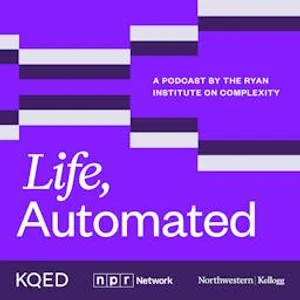
Life, Automated explores how to live, work, and make decisions in a world increasingly shaped by machines. Through thoughtful conversations with researchers, practitioners, artists, and more, we do our best to make sense of how technology is changing—and how it is changing us. We ask: What does the economy look like if AI can do much of what humans can? Will AI tools isolate us further, or steer us back toward community and common ground? Can the average person expect to be better off a decade from now? And what the heck should we tell a sixteen-year-old who wants to know whether learning German (or design, or coding, or the piano) is still worth it? Life, Automated is grounded and non-ideological, going deep without getting too technical. Because you shouldn’t need to be an “AI person” to understand the future we’re collectively building. Host Jess Love is a science writer with a PhD in cognitive psychology and is the Sr. Director for the Ryan Institute on Complexity at Northwestern University’s Kellogg School of Management. Her writing has appeared in The American Scholar, Discover, Quartz, and more.
Latest Episodes
The most recent episodes — sign up to get AI-powered summaries of each one.
- 1 weeks ago36 min
Should You Delegate the Drudgery to AI? (with Gavriel Cohen and Sarit Markovich)
The appeal of an AI personal assistant is straightforward: let the machine handle your busywork so you can do more important things. But are these tools ready for primetime? Are we ready for these tools? And how much of our lives can we outsource to AI and still remain in charge? This episode, Gavriel Cohen, creator of a new AI assistant Nanoclaw, paints a picture of a world where AI agents schedule our meetings, monitor our inboxes, and generally keep us organized and on track–all so we can fulfill our dreams. Host Jess Love puts Nanoclaw to the test purchasing her family’s airline tickets. And economist Sarit Markovich explains how our individual choices to use AI assistants today could shape the future of this technology. Life, Automated is a production of the Ryan Institute on Complexity, at Northwestern’s Kellogg School of Management. The host is Jess Love, senior director. Distributed by KQED. Senior Producer: Jesse Dukes Assistant Producer: Tom Dixon Music: Steven Jackson Recording Help: George Christensen, Will Feeney, Jimmy Zarembski Promotion: Ananya Mallapragada, Lauren Ko Editorial Assistance: David Macey
- 3 weeks ago37 min
Is Math the Canary in the AI Coal Mine? (with Bryna Kra)
What happens when AI can produce a mathematical proof before any human understands it? And what does that mean for the rest of us? Northwestern mathematician Bryna Kra, a former president of the American Mathematical Society, joins Jess Love to explore how AI is changing mathematical discovery. Generative AI has already brought about extraordinary breakthroughs, but they’re also unsettling the culture of collaboration, upending how young mathematicians learn, and raising a deceptively difficult question: Is solving a problem the same as understanding it? Kra explains why some mathematicians are becoming wary of sharing unfinished ideas and how she cautiously makes space for AI in her own research. Despite the disruption she still enthusiastically encourages students to enter the field. Life, Automated is a production of the Ryan Institute on Complexity, at Northwestern’s Kellogg School of Management. The host is Jess Love, senior director. Distributed by KQED. Senior Producer: Jesse Dukes Assistant Producer: Tom Dixon Music: Steven Jackson Recording Help: George Christensen, Will Feeney Promotion: Ananya Mallapragada, Lauren Ko Editorial Assistance: Rob Mitchum, Laura Pavin
- Oct 14, 202633 min
Is Technology Making Our Lives Less Gratifying? (with Ian Bogost)
Modern technology has generally made our lives faster, easier, and more convenient. But in swapping out stick shifts and paper menus for automatic transmissions and QR codes, have we accidentally optimized away many of the rich sensory experiences that make living so pleasurable? Journalist, academic and award-winning video-game designer Ian Bogost joins host Jess Love to discuss insights from his book The Small Stuff: How to Lead a More Gratifying Life. He makes the case that we’re losing some of the everyday pleasures of interacting with the world. But if technology has disconnected us from sensory gratification, can it also be part of the solution? Life, Automated is a production of the Ryan Institute on Complexity, at Northwestern’s Kellogg School of Management. The host is Jess Love, senior director. Distributed by KQED. Senior Producer: Jesse Dukes Producer and Sound Design: Tom Dixon Music: Steven Jackson Recording Help: George Christensen, Will Feeney Promotion: Ananya Mallapragada, Lauren Ko Editorial Assistance: Rob Mitchum, Laura Pavin We used field audio recorded by by Ambient-X.
- Sep 30, 202636 min
The Cybersecurity Crisis Is About More Than “Rogue AI” (with V.S. Subrahmanian)
AI is making cyberattacks cheaper, faster, and more sophisticated. Recent reports of autonomous agents compromising Hugging Face show how quickly misaligned systems can create real-world risk. But ideally those same tools could help defenders find and fix vulnerabilities before attackers exploit them. Cybersecurity researcher V.S. Subrahmanian joins host Jess Love to examine the impact of that escalating race on everything from phishing scams and insecure apps to the systems that underpin the electric grid and other critical infrastructure. They discuss what the hacking of Hugging Face reveals about AI alignment and safety guardrails, why frontier labs are only one part of the problem, and why telecoms, app makers, financial institutions, utilities, and governments may need to take much greater responsibility for the security of the products and networks they operate. Life, Automated is a production of the Ryan Institute on Complexity, at Northwestern’s Kellogg School of Management. The host is Jess Love, senior director. Distributed by KQED. Producer: Jesse Dukes Music: Steven Jackson Recording: George Christensen, Will Feeney Promotional help from Ananya Mallapragada Editorial and background help from Laura Pavin, Rob Mitchum, and Raghu Katakam
- Sep 16, 202633 min
Will We Still Learn Languages When Machines Can Translate? (with Abby Walker)
Live AI translation tools are making it easier to converse across languages without a human translator, a phrasebook, or years of study. So will we all just stop taking Spanish or Mandarin classes? Sociolinguist Abby Walker doesn’t think so. She shares the many reasons we learn new languages, some of which have little to do with functional communication at all. We also hear how one AI-assisted conversation brought two future in-laws together, why machine translation is still so darn buggy, and why some languages are attracting a resurgence of new learners even in the age of translation apps. Life, Automated is a production of the Ryan Institute on Complexity, at Northwestern’s Kellogg School of Management. The host is Jess Love, senior director. Distributed by KQED. Producer: Jesse Dukes Music: Steven Jackson Recording: George Christensen, Will Feeney Promotional help from Ananya Mallapragada Editorial guidance from Laura Pavin Special thanks to Larry Berliner and Georgi Demirev for their help testing out live translation tools
- Sep 2, 202650 min
AI, Artists, and the Future of Creative Work
Generative AI is able to conjure new images, stories, and songs at lightning speed. So what does this mean for humans artists, storytellers, and musicians? In this special Labor Day episode, we speak with economists Ben Jones and Sam Goldberg, as well as artist Yevgenia Nayberg, to find out what happens when AI enters creative markets. We learn that, at least today, key bottlenecks prevent AI from replicating some aspects of creativity. But there’s no guarantee those bottlenecks will exist tomorrow, raising vital questions about what we value in human labor. Life, Automated is a production of the Ryan Institute on Complexity, at Northwestern’s Kellogg School of Management. The host is Jess Love, senior director. Distributed by KQED. Producer: Steven Jackson Senior Producer: Jesse Dukes Music: Steven Jackson Associate Producer: Stacia Sliger Recording: George Christensen, Will Feeney Promotional help from Ananya Mallapragada and Charlotte Simmons.
- Aug 19, 202642 min
Why AI Might Not Change Education Much at All (with Justin Reich)
“AI will revolutionize education!” “No, it will destroy it!” Well, which is it? If history is any guide, the impact will be limited in either direction. In this episode, MIT education researcher Justin Reich walks through a century of hype cycles — from filmstrips and radio to MOOCs and smartphones — to show what actually changed in classrooms, and what didn’t. Drawing on interviews with 120 teachers and students across the U.S., he explains why new tools tend to extend old habits, why gains from new technology are usually modest, and why they tend to benefit affluent schools most. (Part 2/2 in our back-to-school series.) Life, Automated is a production of the Ryan Institute on Complexity, at Northwestern’s Kellogg School of Management. The host is Jess Love, senior director. Distributed by KQED. Producer: Jesse Dukes Music: Steven Jackson Associate Producer: Stacia Sliger Recording: George Christensen and Will Feeney Promotional help from Ananya Mallapragada and Charlotte Simmons.
- Aug 12, 202634 min
An Optimist’s Take on AI and the Future of Learning (with Sébastien Martin)
As AI tools spread through classrooms, many educators see a “cheating factory.” Kellogg Professor Sébastien Martin sees things differently: as a chance to reinvent how and what we teach. In his operations management class, students trade PDFs for lifelike chatbots, log conversations with Socratic AI tutors, and use AI to explore the kinds of social and political dynamics that students normally have to learn on the job. But Martin also grapples with harder questions: What about public schools with fewer resources? When should kids use AI at all? And how can students stay hopeful and true to their own interests in a wildly uncertain future? (Part 1/2 in our back-to-school series.) Life, Automated is a production of the Ryan Institute on Complexity, at Northwestern’s Kellogg School of Management. The host is Jess Love, senior director. Distributed by KQED Producer: Jesse Dukes Music: Steven Jackson Associate Producer: Stacia Sliger Additional Production: Nathan Ray Recording: George Christensen and Will Feeney Promotional help from Ananya Mallapragada and Charlotte Simmons.
Get Life, Automated summaries in your inbox
Free AI-powered daily recaps. Key takeaways, quotes, and mentions — in a 5-minute read.
Get Free Summaries →Free forever for up to 3 podcasts. No credit card required.
You Might Also Like
Listeners also like.
Me, Myself, and AI
Leaders from top companies share real-world strategies for turning artificial intelligence into measurable business results.

Intelligent Machines (Audio)
Explores the impact of artificial intelligence through conversations with pioneers shaping the future of intelligent technology.

Artificial Intelligence Masterclass
Examines the philosophical and ethical dimensions of artificial intelligence and its impact on society, meaning, and the future of work.

Intentional AI
Two productivity experts explore practical applications of artificial intelligence to improve work efficiency and daily workflows.
Possible with Reid Hoffman
Explores optimistic, realistic futures through in-depth conversations with innovators in AI, science, health, and global affairs.
Hands-On AI (Video)
Teaches practical ways to understand and use artificial intelligence in daily tasks through clear, hands-on examples.
Everyday AI Podcast – An AI and ChatGPT Podcast
Covers practical uses of AI tools like ChatGPT and Midjourney to help people work more efficiently and advance their careers.
The AI Daily Brief: Artificial Intelligence News and Analysis
A daily analysis of artificial intelligence news, exploring its creative potential, industry impacts, and ethical challenges.

AI For Humans: Weekly AI News, Tools & Trends
A weekly breakdown of major AI news, tools, and breakthroughs for both newcomers and seasoned enthusiasts.
"The Cognitive Revolution"
Explores the transformative impact of artificial intelligence through interviews with innovators shaping its future.

80,000 Hours Podcast
Discusses artificial intelligence and global catastrophic risks with experts and researchers.

The TWIML AI Podcast (formerly This Week in Machine Learning & Artificial Intelligence)
Explores machine learning and artificial intelligence through interviews with leading researchers, engineers, and industry experts.
About Life, Automated
Life, Automated explores how to live, work, and make decisions in a world increasingly shaped by machines. Through thoughtful conversations with researchers, practitioners, artists, and more, we do our best to make sense of how technology is changing—and how it is changing us. We ask: What does the economy look like if AI can do much of what humans can? Will AI tools isolate us further, or steer us back toward community and common ground? Can the average person expect to be better off a decade from now? And what the heck should we tell a sixteen-year-old who wants to know whether learning German (or design, or coding, or the piano) is still worth it? Life, Automated is grounded and non-ideological, going deep without getting too technical. Because you shouldn’t need to be an “AI person” to understand the future we’re collectively building. Host Jess Love is a science writer with a PhD in cognitive psychology and is the Sr. Director for the Ryan Institute on Complexity at Northwestern University’s Kellogg School of Management. Her writing has appeared in The American Scholar, Discover, Quartz, and more.
Customized Recaps
AI-powered recaps with compact key takeaways, quotes, and insights.
Straight to Your Inbox
Get key takeaways from Life, Automated in a 5-minute read.
Save Hours Every Week
Stay current on your favorite podcasts without falling behind.
Frequently Asked Questions
What is Podzilla's Life, Automated daily summary?
It's a free AI-powered email that summarizes new episodes of Life, Automated as soon as they're published. You get the key takeaways, notable quotes, and links & mentions — all in a quick read.
How does the Life, Automated podcast summary work?
When a new episode drops, our AI transcribes and analyzes it, then generates a personalized summary tailored to your interests and profession. It's delivered to your inbox every morning.
Is this an official Life, Automated product?
No. Podzilla is an independent service that summarizes publicly available podcast content. We're not affiliated with or endorsed by Ryan Institute on Complexity at Northwestern University’s Kellogg School of Management.
Can I get summaries of other podcasts too?
Absolutely! The free plan covers up to 3 podcasts, any in the catalog. Basic raises that to 15, Pro to 40 and Max to 100. Browse our full catalog at /podcasts.
How often does Life, Automated release new episodes?
Life, Automated publishes biweekly. Our AI generates a summary within hours of each new episode.
What topics does Life, Automated cover?
Life, Automated covers topics including Technology, Culture, Society & Culture. Our AI identifies the specific themes in each episode and highlights what matters most to you.
Start getting Life, Automated summaries tomorrow morning.
Free forever for up to 3 podcasts. No credit card required.
Free forever for up to 3 podcasts. No credit card required.