Free Daily Podcast Summary
The TWIML AI Podcast (formerly This Week in Machine Learning & Artificial Intelligence): Daily Summaries Delivered
by Sam Charrington
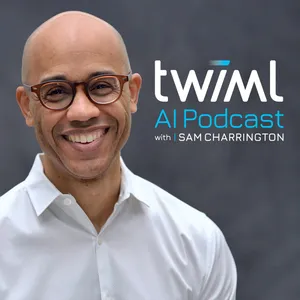
Machine learning and artificial intelligence are dramatically changing the way businesses operate and people live. The TWIML AI Podcast brings the top minds and ideas from the world of ML and AI to a broad and influential community of ML/AI researchers, data scientists, engineers and tech-savvy business and IT leaders. Hosted by Sam Charrington, a sought after industry analyst, speaker, commentator and thought leader. Technologies covered include machine learning, artificial intelligence, deep learning, natural language processing, neural networks, analytics, computer science, data science and more.
Latest Episodes
The most recent episodes — sign up to get AI-powered summaries of each one.
- 2 days ago47 min
Why Models Are AI’s Next Training Dataset with Damian Borth - #772
For more than a decade, AI has advanced by training ever-larger models on ever-larger datasets. But as high-quality training data becomes harder to find and pretraining grows increasingly expensive, researchers are looking for new ways to keep foundation models improving. In this episode, Damian Borth, professor of AI and machine learning at the University of St. Gallen, argues we’ve been overlooking an important source of knowledge: the models we’ve already trained. His group’s work on weight space learning treats trained neural networks themselves as data, learning from the distilled results of millions of GPU hours of optimization rather than starting from raw data each time. We explore what it means to build foundation models of neural networks, how knowledge can be transferred across architectures and domains, why this approach could dramatically reduce the cost of developing specialized models, and whether future AI systems may be trained on collections of existing models instead of ever-growing datasets. 🗒️ Full show notes: https://twimlai.com/go/772.
- 3 weeks ago59 min
How AI Learns to Smell with Alex Wiltschko - #771
In this episode, Alex Wiltschko, founder and CEO of Osmo, joins the show to discuss his goal of giving computers a sense of smell and what it takes to build olfactory intelligence. We explore the science behind smell, from the hundreds of olfactory receptors in the human nose to the challenge of mapping the relationship between molecular structure and odor, ensuring safety regulations are met, and building foundation models for smell. Alex explains how graph neural networks and advanced embedding spaces allow AI to capture the multi-dimensional structure of scents, grouping them into perceptual neighborhoods, and creating a machine learning representation that predicts how molecules smell. We also cover how Osmo built the largest proprietary olfactory dataset from scratch to train a fleet of predictive models, and how olfactory intelligence could eventually power applications far beyond fragrance, including disease detection, emotion sensing, and consumer devices. 🗒️ Full show notes: https://twimlai.com/go/771.
- Jun 16, 202656 min
Why AI Agents Break the GenAI Security Model with Devvret Rishi - #770
In this episode, Sam talks with Dev Rishi, GM of AI at Rubrik, about what happens when agents move beyond answering questions and start taking action across tools, systems, and business processes. We explore why the enterprise playbook of static guardrails plus human approval starts to break down in the agent era. Agents are useful because they can plan, call tools, update systems, write code, send messages, and operate across workflows at machine speed, but those same capabilities make them difficult to govern with rules written in advance or approval prompts reviewed one at a time. Dev explains why tool access increases blast radius, why agents can route around controls in surprising ways, and why human-in-the-loop review can become security theater when agents operate at scale. We also discuss what enterprises need instead: better visibility, runtime enforcement, policy-aware governance, agent observability, and recovery mechanisms for when something goes wrong. Along the way, we dig into MCP and tool sprawl, small language models for policy enforcement, defense in depth, agent rewind, and why AI may be needed to help secure AI. 🗒️ Full show notes: https://twimlai.com/go/770.
- Jun 9, 202651 min
Is RAG Dead? Lessons from Building AI for Tax Law with Alex Bowcut - #769
As context windows grow into the millions of tokens, many AI practitioners are questioning whether retrieval-augmented generation (RAG) is still necessary. If modern models can ingest entire libraries of documents, why bother with retrieval at all? In this episode, Alex Bowcut, Head of Engineering at Sphere, explains why the answer depends on the application. Sphere uses AI to automate global tax compliance—an environment where getting the answer right isn’t enough. Every conclusion must be backed by the correct legal citation, and every decision must withstand expert review. We explore how Sphere built TRAM (Tax Review and Assessment Model), a production AI system that combines retrieval, reasoning models, legal review workflows, reinforcement learning, and deterministic systems to help tax experts move nearly two orders of magnitude faster while maintaining accuracy. Along the way, we discuss why RAG remains critical in high-stakes domains, how Sphere processes legal and regulatory documents from jurisdictions around the world, retrieval architectures, semantic chunking, dense versus sparse retrieval, expert feedback loops, and the challenges of building AI systems that people can actually trust. 🗒️ Full show notes: https://twimlai.com/go/769.
- May 21, 20261h 6m
Relational Foundation Models for Enterprise Data with Jure Leskovec - #768
In this episode, Jure Leskovec, co-founder and chief scientist at Kumo and professor of computer science at Stanford, joins us to explore two fronts of his work: AI for science and relational deep learning. We begin with AI Virtual Cell, a multiscale effort to learn data-driven representations from proteins to cells to patients using single-cell RNA-seq data, protein language models like ESM, and structure models like AlphaFold—without hand-encoding biology. Jure then dives into relational deep learning, reframing enterprise databases as graphs and training neural networks directly on raw multi-table data. He explains Kumo’s Relational Foundation Model (RFM2), which performs in-context learning over subgraphs to make accurate predictions on new databases and tasks with no training, and how this approach benchmarks against RelBench and other multi-table datasets. We also discuss real-world deployments at companies like Reddit, DoorDash, and Coinbase, explainability via attention over tables and columns, integration with agentic systems, deployment options, and practical limitations. The complete show notes for this episode can be found at https://twimlai.com/go/768.
- May 7, 202653 min
How to Find the Agent Failures Your Evals Miss with Scott Clark - #767
In this episode, Scott Clark, co-founder and CEO of Distributional, joins us to explore how teams can reliably operate and improve complex LLM systems and agents in production. Scott introduces a Maslow’s hierarchy of observability: telemetry for logging, monitoring for known signals, and post-production or online analytics to surface unknown unknowns. We dig into examples of real-world failures Scott’s team has seen in production systems, such as “lazy” tool-use hallucinations that standard evals miss, and how mapping traces into vector fingerprints enables clustering and topic discovery to uncover emergent behaviors. Scott explains how analytics can feed the data flywheel by generating evals, guardrails, and training data, and why online, adaptive approaches are essential for non-stationary models. We also touch on practical how-to’s such as instrumentation with OpenTelemetry, the GenAI semantic conventions, and the role of dedicated analytics tools. The complete show notes for this episode can be found at https://twimlai.com/go/767.
- Apr 30, 202654 min
How to Engineer AI Inference Systems with Philip Kiely - #766
In this episode, Philip Kiely, head of AI education at Baseten, joins us to unpack the fast-evolving discipline of inference engineering. We explore why inference has become the stickiest and most critical workload in AI, how it blends GPU programming, applied research, and large-scale distributed systems, and where the line sits between inference and model serving. Philip shares how research-to-production can move in hours, not months, and why understanding “the knobs” of inference—batching, quantization, speculation, and KV cache reuse—lets teams design better products and SLAs. We trace the inference maturity journey from closed APIs to dedicated deployments and in-house platforms, discuss GPU lifecycles, and survey today’s runtime landscape, including vLLM, SGLang, and TensorRT LLM. Finally, we look ahead to agents and multimodality, making the case for specialized, workload-specific runtimes when performance and efficiency matter most. The complete show notes for this episode can be found at https://twimlai.com/go/766.
- Apr 16, 202654 min
How Capital One Delivers Multi-Agent Systems with Rashmi Shetty - #765
In this episode, Rashmi Shetty, senior director of enterprise generative AI platform at Capital One, joins us to explore how the company is designing, deploying, and scaling multi-agent systems in a highly regulated environment. Rashmi walks us through Chat Concierge, a multi-agent chat experience for auto dealerships that handles intent disambiguation, tool invocation, and human handoffs to deliver safer, more personalized customer journeys. We discuss Capital One’s platform-centric approach to AI agents and how it separates design from runtime governance, embedding policies, guardrails, and cyber controls across agent threat boundaries. Rashmi shares how the team approaches the developer experience for agent builders, observability, and evals for stochastic, multi-agent workflows; and strategies for model specialization, including fine-tuning and distillation. We also cover standards and abstraction, closed-loop learning from production telemetry, and key lessons for enterprises building agentic systems. The complete show notes for this episode can be found at https://twimlai.com/go/765.
Get The TWIML AI Podcast (formerly This Week in Machine Learning & Artificial Intelligence) summaries in your inbox
Free AI-powered daily recaps. Key takeaways, quotes, and mentions — in a 5-minute read.
Get Free Summaries →Free forever for up to 3 podcasts. No credit card required.
You Might Also Like
Listeners also like.

Intelligent Machines (Audio)
Explores the rise of artificial intelligence through conversations with pioneers shaping the future of intelligent machines.
The AI Daily Brief: Artificial Intelligence News and Analysis
A daily analysis of artificial intelligence news, exploring its creative potential, industry impacts, and ethical challenges.
Machine Learning Street Talk (MLST)
Discussions with leading AI researchers and thinkers exploring machine learning, cognitive science, and philosophy of mind without hype.

OpenAI Podcast
Conversations with OpenAI researchers and builders exploring how frontier AI models are developed and used in practice.
The Most Interesting Thing in AI
Conversations with leading thinkers exploring the ethical, economic, and social impact of artificial intelligence.
Everyday AI Podcast – An AI and ChatGPT Podcast
Practical AI and ChatGPT tips for professionals to improve productivity and grow their careers.

The AI in Business Podcast
Executives discuss practical AI adoption in business through interviews focused on strategy, use-cases, and ROI.
"The Cognitive Revolution" | AI Builders, Researchers, and Live Player Analysis
Interviews with AI developers and researchers exploring the transformative impact of artificial intelligence on society and technology.

This Day in AI Podcast
Two friends discuss artificial intelligence, sharing casual insights, personal experiments, and humorous experiences with AI tools and technology.

Latent Space: The AI Engineer Podcast
Covers advances in AI engineering, including foundation models, code generation, and AI agents, through interviews with researchers and developers.

AI For Humans: Weekly AI News, Tools & Trends
A weekly breakdown of major AI news, tools, and breakthroughs for both newcomers and seasoned enthusiasts.

NVIDIA AI Podcast
Explores how artificial intelligence and emerging technologies are driving innovation across science, sustainability, and industry.
About The TWIML AI Podcast (formerly This Week in Machine Learning & Artificial Intelligence)
Machine learning and artificial intelligence are dramatically changing the way businesses operate and people live. The TWIML AI Podcast brings the top minds and ideas from the world of ML and AI to a broad and influential community of ML/AI researchers, data scientists, engineers and tech-savvy business and IT leaders. Hosted by Sam Charrington, a sought after industry analyst, speaker, commentator and thought leader. Technologies covered include machine learning, artificial intelligence, deep learning, natural language processing, neural networks, analytics, computer science, data science and more.
Customized Recaps
AI-powered recaps with compact key takeaways, quotes, and insights.
Straight to Your Inbox
Get key takeaways from The TWIML AI Podcast (formerly This Week in Machine Learning & Artificial Intelligence) in a 5-minute read.
Save Hours Every Week
Stay current on your favorite podcasts without falling behind.
Frequently Asked Questions
What is Podzilla's The TWIML AI Podcast (formerly This Week in Machine Learning & Artificial Intelligence) daily summary?
It's a free AI-powered email that summarizes new episodes of The TWIML AI Podcast (formerly This Week in Machine Learning & Artificial Intelligence) as soon as they're published. You get the key takeaways, notable quotes, and links & mentions — all in a quick read.
How does the The TWIML AI Podcast (formerly This Week in Machine Learning & Artificial Intelligence) podcast summary work?
When a new episode drops, our AI transcribes and analyzes it, then generates a personalized summary tailored to your interests and profession. It's delivered to your inbox every morning.
Is this an official The TWIML AI Podcast (formerly This Week in Machine Learning & Artificial Intelligence) product?
No. Podzilla is an independent service that summarizes publicly available podcast content. We're not affiliated with or endorsed by Sam Charrington.
Can I get summaries of other podcasts too?
Absolutely! The free plan covers up to 3 podcasts. Upgrade to Pro for 15, or Premium for 50. Browse our full catalog at /podcasts.
How often does The TWIML AI Podcast (formerly This Week in Machine Learning & Artificial Intelligence) release new episodes?
The TWIML AI Podcast (formerly This Week in Machine Learning & Artificial Intelligence) publishes biweekly. Our AI generates a summary within hours of each new episode.
What topics does The TWIML AI Podcast (formerly This Week in Machine Learning & Artificial Intelligence) cover?
The TWIML AI Podcast (formerly This Week in Machine Learning & Artificial Intelligence) covers topics including Science, News, Technology. Our AI identifies the specific themes in each episode and highlights what matters most to you.
Start getting The TWIML AI Podcast (formerly This Week in Machine Learning & Artificial Intelligence) summaries tomorrow morning.
Free forever for up to 3 podcasts. No credit card required.
Free forever for up to 3 podcasts. No credit card required.