Free Daily Podcast Summary
Misquoting Jesus with Bart Ehrman: Daily Summaries Delivered
by Bart Ehrman
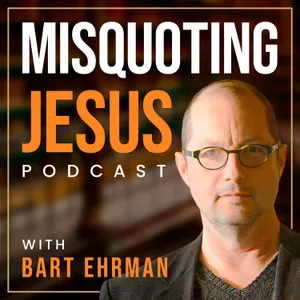
"Misquoting Jesus" uncovers the many fascinating, little known facts about the New Testament, the historical Jesus, and the rise of Christianity. The show features Dr. Bart Ehrman and host, Megan Lewis.
Latest Episodes
The most recent episodes — sign up to get AI-powered summaries of each one.
- 4 days ago41 min
Was Daniel Jesus' Favorite Book?
The Book of Daniel is set in the sixth century BCE, during the Babylonian exile. It describes visions of empires rising and falling — and for a long stretch, the sequence tracks real history with remarkable precision. Kingdom after kingdom, exactly as it happened. Then, at a certain point, it stops being right. That break is one of the most important pieces of evidence. Bart joins host Megan Lewis to explain what Daniel gets right, where it goes wrong, and why the exact point of failure tells us when the book was really written. And Bart will talk about how this book and its ideas may have shaped Jesus' thinking.
- 1 weeks ago44 min
Is The King James Bible the Worst Study Bible Ever?
The King James Bible is arguably the most influential book in the English language, and Bart thinks it's a literary masterpiece. He also thinks it's one of the worst Bibles you can study from. In this episode of Misquoting Jesus, Bart and host Megan Lewis trace where the KJV came from, starting with William Tyndale, whose translation it largely reuses and who was burned at the stake for making it. They look at why its unicorns and cockatrices trip up modern readers, and why the words you think you understand, like "conversation," "strange," and "admiration," are more misleading than the ones you don't. They cover the theological choices its translators made, the late Greek manuscripts behind its New Testament, and a 1631 printing that told readers "thou shalt commit adultery." Bart also shares which modern translations he recommends instead. In the listener Q&A: where the doctrine of original sin came from, whether early Christians evangelized door to door, and what Jesus meant about eunuchs in Matthew 19:12.
- 2 weeks ago37 min
Fixing Gospel Contradictions: 2nd Century to Now
Around 170 CE, a Syrian Christian named Tatian noticed what a lot of readers have noticed since: the four Gospels don't always agree. So he fixed it. Tatian wove all four into a single, seamless account of Jesus' life. And for roughly two hundred years, in the Syriac-speaking churches of the East, that harmony was the Gospel. Then the church came for it. Bishops collected copies and destroyed them. Tatian was condemned as a heretic. Today not a single copy survives in its original language — we know the text only through a commentary, some translations, and a sixth-century Latin Bible that still carries its shape. Bart unpacks what Tatian actually did to the Gospels, why the church found it so threatening, and what it means that an entire branch of Christianity once read a Bible we can no longer read.
- 3 weeks ago44 min
Why Are There Four Gospels?
Most Christians are used to reading four Gospels. But why are there four? Why not one? Or twelve? The early Church thinker Irenaeus fought hard to keep Christians reading all four gospels, but it wasn't a foregone conclusion. In this episode, Bart unpacks how a four gospel new testament came to be, and what could have been the alternative.
- Sep 1, 202640 min
Was Paul an Eyewitness of Jesus' Resurrection?
In a recent response to Wes Huff, Bart said the only eyewitness we know of who's converting people is Paul. A lot of people pointed out that Paul never met Jesus. Fair. But Paul is also the only person in the New Testament who tells us, in his own words, that he saw Jesus alive after his death. Everyone else reaches us secondhand. Bart unpacks what Paul actually claims to have seen, why Paul is the only person who claims to see a resurrected Jesus, and why the earliest firsthand evidence for the resurrection suggests visions.
- Aug 25, 202642 min
How Bart Learned to Live Without God
For many religious people who deconvert, losing their faith leaves a giant hole in their lives. They can lose their community, their purpose in life, and their understanding of how the world works. What does life look like on the other side of deconversion, once the dust has settled? Today we're talking about how Bart lives without God. We also have our bonus segment at the end, which this week is listener's questions, where I'll be asking Bart - among other things - whether he uses early Christian art as a source for his research.
- Aug 18, 202636 min
Where did Satan actually come from?
In the Old Testament, Satan is a minor figure at best, and one fully under the control of YHWH. He appears briefly in the New Testament, notably in the temptation of Jesus. How did Christianity take those minor references and end up with the lord of all evil?
- Aug 11, 202645 min
What Moody Bible College Didn't Prepare Me For
Those familiar with Dr. Bart Ehrman's career trajectory will know that he attended Moody Bible Institute, where he received his early training in textual criticism - but what is a "bible institute", exactly, and why do people attend them?
Get Misquoting Jesus with Bart Ehrman summaries in your inbox
Free AI-powered daily recaps. Key takeaways, quotes, and mentions — in a 5-minute read.
Get Free Summaries →Free forever for up to 3 podcasts. No credit card required.
You Might Also Like
Listeners also like.

Ask NT Wright Anything
A weekly podcast exploring theology and biblical questions through discussions with NT Wright, hosted by Mike Bird.

The Eric Metaxas Show
A podcast featuring discussions on truth, humor, and hope from a Christian worldview.

BibleThinker
Teaches biblical theology, apologetics, and verse-by-verse Bible studies to help listeners think biblically and defend the Christian faith.

I Don't Have Enough FAITH to Be an ATHEIST
Examines ideas and Christianity in relation to truth.
The Holy Post
Phil Vischer and Skye Jethani discuss pop culture, media, and theology from a Christian perspective in a post-Christian world.

The Becket Cook Show
A former gay man turned Christian speaker discusses faith, sexuality, and biblical truth based on his personal journey.

Kids Bible Stories
Bible stories for kids brought to life with sound, voice, and storytelling to connect faith with everyday life.

The Remnant Radio's Podcast
Explores Christian theology, church history, and spiritual gifts through respectful dialogue with believers across denominations.

The Erick Erickson Show
Daily political and cultural commentary from a conservative Christian perspective, focusing on accountability and traditional values.

Bible Mysteries
Explores hidden meanings in the Bible to reveal insights about the modern world.
The BEMA Podcast
Examines the Bible through historical context to challenge and reshape common interpretations.

The Mark Driscoll Podcast
Bible teaching and discussions on Christian manhood from a conservative evangelical perspective.
About Misquoting Jesus with Bart Ehrman
"Misquoting Jesus" uncovers the many fascinating, little known facts about the New Testament, the historical Jesus, and the rise of Christianity. The show features Dr. Bart Ehrman and host, Megan Lewis.
Customized Recaps
AI-powered recaps with compact key takeaways, quotes, and insights.
Straight to Your Inbox
Get key takeaways from Misquoting Jesus with Bart Ehrman in a 5-minute read.
Save Hours Every Week
Stay current on your favorite podcasts without falling behind.
Frequently Asked Questions
What is Podzilla's Misquoting Jesus with Bart Ehrman daily summary?
It's a free AI-powered email that summarizes new episodes of Misquoting Jesus with Bart Ehrman as soon as they're published. You get the key takeaways, notable quotes, and links & mentions — all in a quick read.
How does the Misquoting Jesus with Bart Ehrman podcast summary work?
When a new episode drops, our AI transcribes and analyzes it, then generates a personalized summary tailored to your interests and profession. It's delivered to your inbox every morning.
Is this an official Misquoting Jesus with Bart Ehrman product?
No. Podzilla is an independent service that summarizes publicly available podcast content. We're not affiliated with or endorsed by Bart Ehrman.
Can I get summaries of other podcasts too?
Absolutely! The free plan covers up to 3 podcasts. Upgrade to Pro for 15, or Premium for 50. Browse our full catalog at /podcasts.
How often does Misquoting Jesus with Bart Ehrman release new episodes?
Misquoting Jesus with Bart Ehrman publishes weekly. Our AI generates a summary within hours of each new episode.
What topics does Misquoting Jesus with Bart Ehrman cover?
Misquoting Jesus with Bart Ehrman covers topics including History, Religion & Spirituality, Spirituality, Christianity. Our AI identifies the specific themes in each episode and highlights what matters most to you.
Start getting Misquoting Jesus with Bart Ehrman summaries tomorrow morning.
Free forever for up to 3 podcasts. No credit card required.
Free forever for up to 3 podcasts. No credit card required.