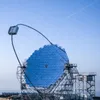
Record-Breaker: Catching Gamma Rays from the Distant Quasar OP 313
In this episode, we dive into a groundbreaking astronomical discovery: the detection of very-high-energy (VHE) gamma rays from the quasar OP 313. Located at a redshift of $z = 0.997$, OP 313 has shattered records to become the most distant Active Galactic Nucleus (AGN) ever observed in this extreme energy range. We explore the massive flare event from December 2023 that made this detection possible. During this outburst, OP 313 shone roughly 50 times brighter than its average high-energy state, triggering an intense multi-wavelength observation campaign. We also discuss the cutting-edge technology behind the discovery, notably the Large-Sized Telescope prototype (LST-1) and the MAGIC telescopes located in the Canary Islands.Tune in to learn how astronomers use the light from this incredibly distant blazar to measure the Extragalactic Background Light (EBL)—the cumulative "fog" of radiation from all stars and galaxies throughout the history of the universe—and how they map the extreme physics of black hole-powered jets.Reference:Abe, K., et al. (May 27, 2026). Detection of the distant quasar OP 313 with the first Large-Sized Telescope of CTAO. Astronomy & Astrophysics.Acknowledements: Podcast prepared with Google/NotebookLM. Illustration credits: Tomohiro Inada
Podzilla Summary coming soon
Sign up to get notified when the full AI-powered summary is ready.
Free forever for up to 3 podcasts. No credit card required.
Listen to This Episode
More from Multi-messenger astrophysics
Ripples in Spacetime: Unpacking the GWTC-5.0 Catalog
SN 2017egm : Fermi-LAT's Breakthrough Gamma-Ray Detection
Supernovae on the RISE: Why Dead Stars Wake Up Decades Later

The SVOM Satellite: A New Era in Multi-Messenger Astronomy
Get summaries like this every morning.
Free AI-powered recaps of Multi-messenger astrophysics and your other favorite podcasts, delivered to your inbox.
Free forever for up to 3 podcasts. No credit card required.