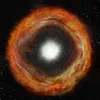
Supernovae on the RISE: Why Dead Stars Wake Up Decades Later
In this episode, we explore the fascinating phenomenon of core-collapse supernovae that refuse to fade away quietly. Years, or even decades, after their initial explosion, some of these stellar deaths experience a surprising "late-time radio rebrightening". We dive into how astronomers are using these delayed radio signals as a time machine to study the final centuries of a massive star's life. Key Highlights:The 18-Year Echo: We discuss the incredible discovery by the RISE (Rebrightening in Interacting Supernova Emission) collaboration, which detected radio emission from the Type II supernova SN 2007it a full 18 years after it exploded. Smashing into the Past: Why do these dead stars light up again? We break down how the expanding supernova shockwave eventually slams into a dense shell of circumstellar material (CSM) that the star shed long before it died. For SN 2007it, this shell is estimated to be around 3 solar masses.A Broader Look at Stellar Mass Loss: Drawing on a comprehensive study of 16 Type IIn and II-L supernovae using the Very Large Array (VLA), we explore how long-lasting radio emissions—sometimes persisting for 20 years post-explosion—reveal that these stars sustained extreme mass loss for hundreds or thousands of years before core collapse. Blurring the Lines: We look at how this late-time radio data proves that different supernova classifications (like IIn and II-L) actually exist on a continuum, separated mainly by the density and timing of their pre-explosion mass loss.Articles Discussed in this Episode:Acero, F., et al. (The RISE Collaboration). (2026). SN 2007it on the RISE - a radio detection of an interacting supernova 18 years post-explosion.Kilpatrick, C. D., et al. (2026). Probing the Mass-loss Histories of Type IIn and II-L Supernovae with Late-time Radio Observations.Acknowledements: Podcast prepared with Google/NotebookLM. Illustration credits: NRAO
Podzilla Summary coming soon
Sign up to get notified when the full AI-powered summary is ready.
Free forever for up to 3 podcasts. No credit card required.
Listen to This Episode
More from Multi-messenger astrophysics
Record-Breaker: Catching Gamma Rays from the Distant Quasar OP 313
Ripples in Spacetime: Unpacking the GWTC-5.0 Catalog
SN 2017egm : Fermi-LAT's Breakthrough Gamma-Ray Detection
The SVOM Satellite: A New Era in Multi-Messenger Astronomy
Get summaries like this every morning.
Free AI-powered recaps of Multi-messenger astrophysics and your other favorite podcasts, delivered to your inbox.
Free forever for up to 3 podcasts. No credit card required.