Free Daily Podcast Summary
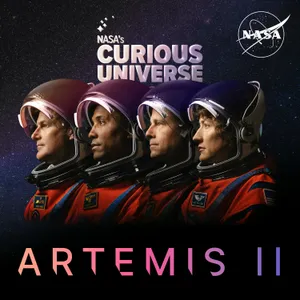
NASA's Curious Universe: Daily Summaries Delivered
by National Aeronautics and Space Administration (NASA)
An official NASA podcast bringing you mind-blowing stories you won’t find anywhere else. What does it take to launch a rocket? What happens when we go looking for life beyond Earth? And what can the universe teach us next? With extraordinary access to the people and places behind NASA’s exploration of space, Curious Universe brings you closer to the discoveries shaping what we know about our universe.
Latest Episodes
The most recent episodes — sign up to get AI-powered summaries of each one.
- 1 weeks ago25 min
Encore: Welcome to the Dark Side
Normal matter—the kind that makes up our home planet and everything we can see—adds up to just five percent of the known universe. The other 95 percent is dark matter and dark energy. NASA’s Nancy Grace Roman Space Telescope will settle essential questions about this dark side, especially dark energy, one of the biggest mysteries in all of science. In this encore presentation, hear how NASA astrophysicists study dark matter and dark energy and why they are making scientists reconsider our basic understanding of the universe. This episode was originally published in 2023. For the latest news about NASA’s Nancy Grace Roman Space Telescope, visit nasa.gov/roman.
- 4 weeks ago21 min
Roman Series: Liftoff!
NASA’s Nancy Grace Roman Space Telescope is in space, taking its first steps to explore the cosmos. Relive Roman’s launch—and the emotion that goes along with the roar of a rocket—with NASA experts who worked on the telescope for years. Plus, learn what happens next and when to expect Roman’s first images. Learn more about the Nancy Grace Roman Space Telescope at nasa.gov/roman.
- Aug 27, 202626 min
Roman Series: Why NASA’s Roman Space Telescope Will Make Unexpected Discoveries
Take a deep dive into the science of NASA’s Nancy Grace Roman Space Telescope with Julie McEnery, Roman's senior project scientist. Learn why Roman’s survey data will be so detailed that they could cover a 4K screen the size of dozens of city blocks and why Julie says she doesn’t hope Roman changes our understanding of the universe—she knows it will. A video version of this episode is available on YouTube.
- Aug 25, 202632 min
Roman Series: The Technology Inside NASA’s Newest Space Telescope
What makes NASA’s Nancy Grace Roman Space Telescope a powerful tool with an unprecedented wide view of the cosmos? NASA engineers who designed, built, and tested Roman pop the hood to explain the unique technology inside. Go inside the huge NASA clean room where Roman was built, and get an up-close look at the testing campaign that ensures Roman will succeed in the cold, inhospitable conditions of space. Learn more about the Nancy Grace Roman Space Telescope at nasa.gov/roman
- Aug 18, 202630 min
Roman Series: Jupiters Around Other Suns
NASA’s Nancy Grace Roman Space Telescope is on a quest to discover planets outside our solar system. NASA scientists Bertrand Mennesson and Vanessa Bailey explain how Roman’s wide view will spot as many as 100,000 new exoplanets in a galactic census that will change how we understand planetary system formation. And we’ll learn about an experimental camera that will allow scientists to take direct pictures of Jupiter-sized exoplanets around Sun-like stars – and analyze their atmospheres.
- Aug 11, 202638 min
Roman Series: NASA’s New View of the Dark Universe
Meet NASA’s newest space telescope: Roman. With similar resolution to Hubble but a field of view 100 times larger, the Nancy Grace Roman Space Telescope will settle essential questions in astronomy. NASA scientists Josh Schlieder and Alina Kiessling explain how that wide view will help us understand dark energy, one of the most puzzling mysteries in space. We’ll also meet Nancy Grace Roman, who joined NASA at the dawn of the space age and pushed for large space telescopes, which have revolutionized our understanding of the universe. Learn more about the Nancy Grace Roman Space Telescope at nasa.gov/roman
- Aug 4, 20264 min
Launching Soon: NASA’s Roman Space Telescope
NASA is about to launch the Nancy Grace Roman Space Telescope, which will change the way we see the universe and settle essential questions about some of the biggest mysteries out there. In a new limited series, Curious Universe takes you behind the scenes with NASA scientists and engineers who made Roman a reality—no Ph.D. required. Learn more about the Roman Space Telescope at nasa.gov/roman
- Jul 21, 202633 min
There’s More Space in Your Life Than You Think
In its mission to explore the unknown in air and space, NASA ends up inventing a lot of new things. Then, the agency “spins off” those inventions to companies that produce products to make our lives easier and safer here on Earth. From memory foam mattresses and cordless power tools to wireless headphones and dating apps, NASA Technology is all around you, even if you’re not an astronaut. To read NASA's Spinoff publication, visit spinoff.nasa.gov.
Get NASA's Curious Universe summaries in your inbox
Free AI-powered daily recaps. Key takeaways, quotes, and mentions — in a 5-minute read.
Get Free Summaries →Free forever for up to 3 podcasts. No credit card required.
You Might Also Like
Listeners also like.

Cosmos in a Pod
Explores space, science, philosophy, and technology to reveal the wonders of the universe and humanity's place within it.
Planetary Radio: Space Exploration, Astronomy and Science
Explores space exploration, astronomy, and science through conversations with experts and advocates shaping humanity's journey beyond Earth.

Houston We Have a Podcast
Explore human spaceflight through interviews with astronauts, scientists, and engineers at NASA’s Johnson Space Center.

The World, the Universe and Us
Explores big scientific questions about life, consciousness, climate, and the cosmos with expert scientists and New Scientist journalists.
Bedtime Astronomy
A calming exploration of cosmic wonders, sharing stories about stars, planets, and celestial phenomena to inspire curiosity before sleep.

13 Minutes: Trouble with Hubble
The story of the Hubble Space Telescope’s flawed mirror and the mission to save it.
Astrum Space
Explores the planets and wonders of the Solar System through images and videos from space missions.
The 365 Days of Astronomy
A daily podcast featuring diverse voices exploring astronomy and space science topics.
Daniel and Kelly’s Extraordinary Universe
Two scientists explore diverse topics across the universe, from particles to ecosystems, with accessible and engaging explanations.

Dear People of Earth Science and Physics- The UFO Podcast - Disclosure - Aliens - UAP
Explores UFO and UAP phenomena through scientific analysis, physics, and expert discussions on credible sightings and cosmic mysteries.
Through the Telescope
Two hosts explore key astronomy topics in digestible episodes, making the cosmos accessible and engaging for all knowledge levels.

Curious Matter Anthology
Immersive audio adaptations of sci-fi and horror stories, including an epic Mars colony narrative with sound from NASA’s Perseverance Rover.
About NASA's Curious Universe
An official NASA podcast bringing you mind-blowing stories you won’t find anywhere else. What does it take to launch a rocket? What happens when we go looking for life beyond Earth? And what can the universe teach us next? With extraordinary access to the people and places behind NASA’s exploration of space, Curious Universe brings you closer to the discoveries shaping what we know about our universe.
Customized Recaps
AI-powered recaps with compact key takeaways, quotes, and insights.
Straight to Your Inbox
Get key takeaways from NASA's Curious Universe in a 5-minute read.
Save Hours Every Week
Stay current on your favorite podcasts without falling behind.
Frequently Asked Questions
What is Podzilla's NASA's Curious Universe daily summary?
It's a free AI-powered email that summarizes new episodes of NASA's Curious Universe as soon as they're published. You get the key takeaways, notable quotes, and links & mentions — all in a quick read.
How does the NASA's Curious Universe podcast summary work?
When a new episode drops, our AI transcribes and analyzes it, then generates a personalized summary tailored to your interests and profession. It's delivered to your inbox every morning.
Is this an official NASA's Curious Universe product?
No. Podzilla is an independent service that summarizes publicly available podcast content. We're not affiliated with or endorsed by National Aeronautics and Space Administration (NASA).
Can I get summaries of other podcasts too?
Absolutely! The free plan covers up to 3 podcasts. Upgrade to Pro for 15, or Premium for 50. Browse our full catalog at /podcasts.
How often does NASA's Curious Universe release new episodes?
NASA's Curious Universe publishes weekly. Our AI generates a summary within hours of each new episode.
What topics does NASA's Curious Universe cover?
NASA's Curious Universe covers topics including Science, Documentary, Culture, Kids & Family, Society & Culture. Our AI identifies the specific themes in each episode and highlights what matters most to you.
Start getting NASA's Curious Universe summaries tomorrow morning.
Free forever for up to 3 podcasts. No credit card required.
Free forever for up to 3 podcasts. No credit card required.