Free Daily Podcast Summary
PBS Space Time: Daily Summaries Delivered
by PBS
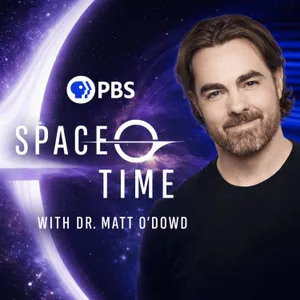
Space Time explores the outer reaches of space, the craziness of astrophysics, the possibilities of sci-fi, and anything else you can think of beyond Planet Earth with our astrophysicist host: Matthew O’Dowd. Matt O'Dowd spends his time studying the universe, especially really far-away things like quasars, super-massive black holes, and evolving galaxies. He uses telescopes in space to do it. Matt completed his Ph.D. at NASA's Space Telescope Science Institute, followed by work at the University of Melbourne and Columbia University. He's now a professor at the City University of New York's Lehman College and an Associate at the American Museum of Natural History's Hayden Planetarium. Previous host Gabe Perez-Giz is an astrophysicist who studies black hole physics. He received his Ph.D. from Columbia University and also hosted PBS Infinite Series.
Latest Episodes
The most recent episodes — sign up to get AI-powered summaries of each one.
- Today13 min
Scientists Have Detected the First Stars
Viewers like you help make PBS (Thank you 😃) . Support your local PBS Member Station here: https://to.pbs.org/DonateSPACE What do the first stars in the universe, dark matter, and superior siege engines have in common? You can further support us on Patreon at https://www.patreon.com/pbsspacetime Get your own Space Time t-shirt at http://bit.ly/1QlzoBi Tweet at us! @pbsspacetime Facebook: facebook.com/pbsspacetime Email us! pbsspacetime [at] gmail [dot] com Comment on Reddit: http://www.reddit.com/r/pbsspacetime Trebuchet Challenge Winners: Vineet Gala Valerie Sinclair Alex Funiciello David Shearn Gwyn Paske Bruce & Angela Tremain Help translate our videos! https://www.youtube.com/timedtext_cs_panel?tab=2&c=UC7_gcs09iThXybpVgjHZ_7g Previous Episode: Hawking Radiation https://www.youtube.com/watch?v=qPKj0YnKANw Sometimes space news sneaks by without getting much attention. Not everything wows like gravitational waves or spacefaring sportscars. That’s the case with the recent discovery of earliest stars in the universe. In a Nature paper published a few weeks ago, Judd Bowman and collaborators report a signal from the very first stars to form in our universe. The same result also hints at brand new physics that may help explain the nature of dark matter. This result flew under the radar in part because it’s a subtle and clever result that requires a bit of interpretation. Today we’re doing a Space Time Journal Club to explain this discovery. We’ll follow that with the solution to our recent trebuchet challenge question. Written and Hosted by Matt O'Dowd Produced by Rusty Ward Graphics by Grayson Blackmon Assistant Editing and Sound Design by Mike Petrow and Linda Huang Made by Kornhaber Brown (www.kornhaberbrown.com) Special thanks to our Patreon Big Bang, Quasar and Hypernova Supporters: Big Bang CoolAsCats David Nicklas Faisal Saud Anton Lifshits Joey Redner Quasar Tambe Barsbay Mayank M. Mehrota Mars Yentur Mark Rosenthal Dean Fuqua Roman Pinchuk Frank Secilia ColeslawPurdie Hypernova Edmund Fokschaner Matthew O’Connor Eugene Lawson Martha Hunt Joseph Salomone Chuck Zegar Jordan Young Ratfeast John Hofmann Barry Hatfield Craig Peterson Kevin Costello Thanks to our Patreon Gamma Ray Burst Supporters: James Hughes Fabian Olesen Kris Fernet Jane Meyers James Flowers Greg Allen TJMadison Denys Ivanov Nick Virtue Alexey Eromenko Nicholas Rose Scott Gossett Mark Vasile Patrick Murray Sultan Alkhulaifi Alex Soto Michal-Peanut Karmi Erik Stein Daniel Lyons Kevin Warne JJ Bagnell J Rejc Avi Goldfinger John Pettit Florian Stinglmayr Benoit Pagé-Guitard Nathan Leniz Brandon Labonte David Crane Greg Weiss Learn more about your ad choices. Visit megaphone.fm/adchoices
- Yesterday15 min
The Andromeda-Milky Way Collision
Viewers like you help make PBS (Thank you 😃) . Support your local PBS Member Station here: https://to.pbs.org/DonateSPACE The Andromeda galaxy is heading straight toward our own Milky Way. The two galaxies will inevitably collide. Will that be the very last night sky our solar system witnesses? You can further support us on Patreon at https://www.patreon.com/pbsspacetime Get your own Space Time t-shirt at http://bit.ly/1QlzoBi Tweet at us! @pbsspacetime Facebook: facebook.com/pbsspacetime Email us! pbsspacetime [at] gmail [dot] com Comment on Reddit: http://www.reddit.com/r/pbsspacetime Help translate our videos! https://www.youtube.com/timedtext_cs_panel?tab=2&c=UC7_gcs09iThXybpVgjHZ_7g Previous Episode: Scientists Have Detected the First Stars https://www.youtube.com/watch?v=-R9F2_D76TE See that fuzzy blob on the sky? The one just left of the Milky Way center in the constellation of Andromeda. That’s M31 – the Andromeda galaxy. It’s two and a half million light years away and host to a trillion stars. It has a beautiful spiral structure spanning its gently rotating disk 220 thousand light years in diameter, and a central bulge that hides a giant black hole that contains the mass of well over a hundred million Suns. Andromeda is also racing towards our galaxy at 110 km/s. Written and Hosted by Matt O'Dowd Produced by Rusty Ward Graphics by Grayson Blackmon Assistant Editing and Sound Design by Mike Petrow and Linda Huang Made by Kornhaber Brown (www.kornhaberbrown.com) Comments Matt responded to include: The Exoplanets Channel https://www.youtube.com/watch?v=-R9F2_D76TE&lc=UgzYOYV-1GsJrSwlmZ14AaABAg Patrick Horgan https://www.youtube.com/watch?v=-R9F2_D76TE&lc=UgxB8ZoEtScJ4vFBSo94AaABAg And Springville High School’s AP Physics Class! Special thanks to our Patreon Big Bang, Quasar and Hypernova Supporters: Big Bang CoolAsCats David Nicklas Faisal Saud Anton Lifshits Joey Redner Quasar Tambe Barsbay Mayank M. Mehrota Mars Yentur Mark Rosenthal Dean Fuqua Justin Lloyd Roman Pinchuk Hypernova Kevin Costello Edmund Fokschaner Matthew O’Connor Eugene Lawson Barry Hatfield Martha Hunt Joseph Salomone Chuck Zegar Jordan Young Ratfeast John Hofmann Craig Peterson Thanks to our Patreon Gamma Ray Burst Supporters: James Hughes Fabian Olesen Kris Fernet Jane Meyers James Flowers Greg Allen TJMadison Denys Ivanov Nick Virtue Alexey Eromenko Nicholas Rose Scott Gossett Mark Vasile Patrick Murray Sultan Alkhulaifi Alex Seto Michal-Peanut Karmi Erik Stein Kevin Warne JJ Bagnell J Rejc Avi Goldfinger John Pettit Florian Stinglmayr Benoit Pagé-Guitard Nathan Leniz Brandon Labonte David Crane Greg Weiss Brandon Cook Learn more about your ad choices. Visit megaphone.fm/adchoices
- 2 days ago14 min
The Unruh Effect
Viewers like you help make PBS (Thank you 😃) . Support your local PBS Member Station here: https://to.pbs.org/DonateSPACE Worried about black holes? Consider this: Every time you accelerate - you generate an event horizon behind you. The more you accelerate away from it the closer it gets. Don’t worry, it can never catch up to you, but the Unruh radiation it generates sure can. You can further support us on Patreon at https://www.patreon.com/pbsspacetime Get your own Space Time t-shirt at http://bit.ly/1QlzoBi Tweet at us! @pbsspacetime Facebook: facebook.com/pbsspacetime Email us! pbsspacetime [at] gmail [dot] com Comment on Reddit: http://www.reddit.com/r/pbsspacetime Help translate our videos! https://www.youtube.com/timedtext_cs_panel?tab=2&c=UC7_gcs09iThXybpVgjHZ_7g Previous Episode: The Andromeda-Milky Way Collision https://www.youtube.com/watch?v=_P1xKh_kZFU Around the same time that Stephen Hawking was demonstrating the existence of the black hole radiation that would bear his name, three other researchers, Stephen Fulling, Paul Davis, and William Unruh, were looking at an effect that now seems eerily similar. They were independently studying how the nature of quantum fields appears to change depending on whether or not an observer is accelerating. They found that simple act of acceleration cuts off your causal access to a region of the universe. It creates a type of event horizon. As we saw in our episode on horizon radiation, the presence of horizons distorts the quantum vacuum in a way that can create particles. Hosted by Matt O'Dowd Written by Graeme Gossel and Matt O'Dowd Produced by Rusty Ward Graphics by Grayson Blackmon Assistant Editing and Sound Design by Mike Petrow and Linda Huang Made by Kornhaber Brown (www.kornhaberbrown.com) Classical analogue of the Unruh effect Leonhardt, Griniasty, Wildeman, Fort, & Fink https://arxiv.org/abs/1709.02200 Special thanks to our Patreon Big Bang, Quasar and Hypernova Supporters: Big Bang CoolAsCats David Nicklas Faisal Saud Anton Lifshits Joey Redner Quasar Tambe Barsbay Mayank M. Mehrota Mars Yentur Mark Rosenthal Dean Fuqua Roman Pinchuk ColeslawPurdie Hypernova Edmund Fokschaner Matthew O’Connor Eugene Lawson Barry Hatfield Martha Hunt Joseph Salomone Chuck Zegar Jordan Young Ratfeast John Hofmann Craig Peterson Thanks to our Patreon Gamma Ray Burst Supporters: James Hughes Fabian Olesen Kris Fernet Jane Meyers James Flowers Greg Allen TJMadison Denys Ivanov Nick Virtue Alexey Eromenko Nicholas Rose Scott Gossett Mark Vasile Patrick Murray Sultan Alkhulaifi Alex Seto Michal-Peanut Karmi Erik Stein Kevin Warne JJ Bagnell J Rejc Avi Goldfinger John Pettit Florian Stinglmayr Benoit Pagé-Guitard Nathan Leniz Brandon Labonte David Crane Greg Weiss Learn more about your ad choices. Visit megaphone.fm/adchoices
- 2 days ago18 min
The Physics of Life (ft. It's Okay to be Smart & PBS Eons!)
Viewers like you help make PBS (Thank you 😃) . Support your local PBS Member Station here: https://to.pbs.org/DonateSPACE It's OK to be Smart - Where Did Life Come From? https://youtu.be/_uAJY1mqtw4 Eons - What Was the Ancestor of Everything? https://youtu.be/pk213XSSktQ Our universe is prone to increasing disorder and chaos. So how did it generate the extreme complexity we see in life? Actually, the laws of physics themselves may demand it. You can further support us on Patreon at https://www.patreon.com/pbsspacetime Get your own Space Time t-shirt at http://bit.ly/1QlzoBi Tweet at us! @pbsspacetime Facebook: facebook.com/pbsspacetime Email us! pbsspacetime [at] gmail [dot] com Comment on Reddit: http://www.reddit.com/r/pbsspacetime Help translate our videos! https://www.youtube.com/timedtext_cs_panel?tab=2&c=UC7_gcs09iThXybpVgjHZ_7g Previous Episode: The Unruh Effect https://www.youtube.com/watch?v=7cj6oiFDEXc How did life begin? We can seek the answer in the chemistry of the early earth, or in the biology of the first cell. In fact our friends at PBS Eons and It’s OK to be Smart will do just that in companion videos to this one. But we all know that chemistry and biology are just applied physics. So can we approach the question of the origin and the very nature of life from the point of view of physics? We’re sure going to try. Hosted and written by Matt O'Dowd Produced by Rusty Ward Graphics by Grayson Blackmon Assistant Editing and Sound Design by Mike Petrow and Linda Huang Made by Kornhaber Brown (www.kornhaberbrown.com) Special thanks to our Patreon Big Bang, Quasar and Hypernova Supporters: Big Bang CoolAsCats David Nicklas Anton Lifshits Joey Redner Quasar Tambe Barsbay Mayank M. Mehrota Mars Yentur Mark Rosenthal Dean Fuqua Roman Pinchuk ColeslawPurdie Hypernova Edmund Fokschaner Matthew O’Connor Eugene Lawson Barry Hatfield Martha Hunt Joseph Salomone Chuck Zegar Jordan Young Ratfeast John Hofmann Craig Peterson Thanks to our Patreon Gamma Ray Burst Supporters: James Hughes Fabian Olesen Kris Fernet Jane Meyers James Flowers Greg Allen TJMadison Denys Ivanov Nick Virtue Alexey Eromenko Nicholas Rose Scott Gossett Mark Vasile Patrick Murray Sultan Alkhulaifi Alex Seto Michal-Peanut Karmi Erik Stein Kevin Warne JJ Bagnell J Rejc Avi Goldfinger John Pettit Florian Stinglmayr Benoit Pagé-Guitard Nathan Leniz Brandon Labonte David Crane Greg Weiss Learn more about your ad choices. Visit megaphone.fm/adchoices
- 3 days ago16 min
Using Stars to See Gravitational Waves
Viewers like you help make PBS (Thank you 😃) . Support your local PBS Member Station here: https://to.pbs.org/DonateSPACE Thank you to Brilliant for sponsoring this episode! To find out more, visit: https://brilliant.org/SpaceTime Now that gravitational waves are definitely a thing, it’s time to think about some of the crazy things we can figure out with them. In some cases we’re going to need a gravitational wave observatory - in fact, we've already built one. You can further support us on Patreon at https://www.patreon.com/pbsspacetime Get your own Space Time t-shirt at http://bit.ly/1QlzoBi Tweet at us! @pbsspacetime Facebook: facebook.com/pbsspacetime Email us! pbsspacetime [at] gmail [dot] com Comment on Reddit: http://www.reddit.com/r/pbsspacetime Help translate our videos! https://www.youtube.com/timedtext_cs_panel?tab=2&c=UC7_gcs09iThXybpVgjHZ_7g Previous Episode: The Physics of Life (ft. It's Okay to be Smart & PBS Eons!) https://www.youtube.com/watch?v=GcfLZSL7YGw&t=25s We are at the cusp of a golden age of gravitational wave astronomy. We’ve already talked about the Laser Interferometer Gravitational Wave Observatory–LIGO, and the first discovery of gravitational waves here. Those videos came out almost two years ago. A lot has happened since then. First, an update on LIGO. In its two and a half years of operation, LIGO has observed five certain black hole–black hole mergers. These events have been consistently surprising. Reinterpreting Low Frequency LIGO/Virgo Events as Magnified Stellar-Mass Black Holes at Cosmological Distances Broadhurst, Diego & Smoot (2018) https://arxiv.org/abs/1802.05273 On Stellar-Mass Black Hole Mergers in AGN Disks Detectable with LIGO McKernan et al. 2018 https://arxiv.org/abs/1702.07818 Stars as Resonant Absorbers of Gravitational Waves McKernan, Ford, Kocsis & Haiman https://arxiv.org/abs/1405.1414 Hosted by Matt O'Dowd Written by Drew Rosen and Matt O'Dowd Produced by Rusty Ward Graphics by Grayson Blackmon Assistant Editing and Sound Design by Mike Petrow and Linda Huang Made by Kornhaber Brown (www.kornhaberbrown.com) Special thanks to our Patreon Big Bang, Quasar and Hypernova Supporters: Big Bang CoolAsCats David Nicklas Faisal Saud Anton Lifshits Joey Redner Fabrice Eap Quasar Tambe Barsbay Mayank M. Mehrota Mars Yentur Mark Rosenthal Dean Fuqua Roman Pinchuk ColeslawPurdie Hypernova Edmund Fokschaner Matthew O’Connor Eugene Lawson Barry Hatfield Martha Hunt Joseph Salomone Chuck Zegar Jordan Young Ratfeast John Hofmann Craig Peterson Thanks to our Patreon Gamma Ray Burst Supporters: James Hughes Fabian Olesen Kris Fernet Jane Meyers James Flowers Greg Allen TJMadison Denys Ivanov Nick Virtue Alexey Eromenko Nicholas Rose Scott Gossett Mark Vasile Patrick Murray Sultan Alkhulaifi Alex Seto Michal-Peanut Karmi Erik Stein Kevin Warne JJ Bagnell J Rejc Avi Goldfinger John Pettit Florian Stinglmayr Benoit Pagé-Guitard Nathan Leniz Brandon Labonte David Crane Greg Weiss Brandon Cook Daniel Lyons Learn more about your ad choices. Visit megaphone.fm/adchoices
- 4 days ago15 min
Black Hole Swarms | Space Time
Viewers like you help make PBS (Thank you 😃) . Support your local PBS Member Station here: https://to.pbs.org/DonateSPACE It’s been conjectured that the center of the Milky Way is swarming with tens of thousands of black holes. And now we’ve actually seen them. You can further support us on Patreon at https://www.patreon.com/pbsspacetime Get your own Space Time t-shirt at http://bit.ly/1QlzoBi Tweet at us! @pbsspacetime Facebook: facebook.com/pbsspacetime Email us! pbsspacetime [at] gmail [dot] com Comment on Reddit: http://www.reddit.com/r/pbsspacetime Help translate our videos! https://www.youtube.com/timedtext_cs_... Previous Episode: Using Stars to See Gravitational Waves https://www.youtube.com/watch?v=xnwXyPU_ps0 This episode of Space Time Journal Club looks at the paper: A density cusp of quiescent X-ray binaries in the central parsec of the Galaxy by Hailey, Mori, Bauer, Berkowitz, Hong & Hord (2018) https://www.nature.com/articles/nature25029 The core of our galaxy is a wild place. The stars are so densely packed that the night sky would be 500 times brighter. A supermassive black hole, 4 million times the mass of our Sun lurks in the center. It flings nearby stars into extreme slingshot orbits. It consumes anything that gets too close is consumed, burping a blast of X-rays. We know these things because we see them from our comfortable vantage point 28,000 light years out in the galactic disk. But there’s one particularly terrible feature of the core of our galaxy that, until now, has only been has only be hypothesized: The central few light years of the Milky Way is thought to contain a vast swarm of smaller black holes that have rained in from the surrounding galaxy. Hosted by Matt O'Dowd Written by Matt O'Dowd Graphics by Grayson Blackmon Assistant Editing and Sound Design by Mike Petrow and Linda Huang Made by Kornhaber Brown (www.kornhaberbrown.com) Special thanks to our Patreon Big Bang, Quasar and Hypernova Supporters: Big Bang CoolAsCats David Nicklas Anton Lifshits Joey Redner Fabrice Eap Quasar Tambe Barsbay Mayank M. Mehrota Mars Yentur Mark Rosenthal Dean Fuqua Roman Pinchuk ColeslawPurdie Hypernova Edmund Fokschaner Matthew O’Connor Eugene Lawson Barry Hatfield Martha Hunt Joseph Salomone Chuck Zegar Jordan Young Ratfeast John Hofmann Craig Peterson Thanks to our Patreon Gamma Ray Burst Supporters: James Hughes Shannan Catalano Fabian Olesen Kris Fernet Jane Meyers James Flowers Greg Allen TJMadison Denys Ivanov Nick Virtue Alexey Eromenko Nicholas Rose Scott Gossett Mark Vasile Patrick Murray Sultan Alkhulaifi Alex Seto Michal-Peanut Karmi Erik Stein Kevin Warne JJ Bagnell J Rejc Avi Goldfinger John Pettit Florian Stinglmayr Benoit Pagé-Guitard Nathan Leniz Brandon Labonte David Crane Greg Weiss Brandon Cook Daniel Lyons Learn more about your ad choices. Visit megaphone.fm/adchoices
- 5 days ago14 min
The Star at the End of Time
Viewers like you help make PBS (Thank you 😃) . Support your local PBS Member Station here: https://to.pbs.org/DonateSPACE If we, or any conscious being is around to witness the very distant future our galaxy, what will they see? How long will life persist as the stars begin to die? Subscribe to Hot Mess: https://www.youtube.com/channel/UCsaEBhRsI6tmmz12fkSEYdw You can further support us on Patreon at https://www.patreon.com/pbsspacetime Get your own Space Time t-shirt at http://bit.ly/1QlzoBi Tweet at us! @pbsspacetime Facebook: facebook.com/pbsspacetime Email us! pbsspacetime [at] gmail [dot] com Comment on Reddit: http://www.reddit.com/r/pbsspacetime Help translate our videos! https://www.youtube.com/timedtext_cs_panel?tab=2&c=UC7_gcs09iThXybpVgjHZ_7g Previous Episode: Black Hole Swarms https://www.youtube.com/watch?v=UVhtKAnp3G4 For the sake of argument, let’s say that humanity survives the several ends of the world that await us. We somehow persist the gradual heating of our Sun and the evaporation of our oceans. Our descendants cling to existence through countless generations we watch the Andromeda galaxy merge with the Milky Way, forming a vast elliptical galaxy. We seek refuge in the outer solar system as the Sun finally expands into a red giant – twice! And finally our heirs or successors find new homes among the stars after the Sun’s final death and transformation into a dim white dwarf. Hosted by Matt O'Dowd Written by Drew Rosen and Matt O'Dowd Graphics by Grayson Blackmon Assistant Editing and Sound Design by Mike Petrow and Linda Huang Made by Kornhaber Brown (www.kornhaberbrown.com) Special thanks to our Patreon Big Bang, Quasar and Hypernova Supporters: Big Bang CoolAsCats David Nicklas Anton Lifshits Joey Redner Fabrice Eap Quasar Tambe Barsbay Mayank M. Mehrota Mars Yentur Mark Rosenthal Dean Fuqua Roman Pinchuk ColeslawPurdie Hypernova Edmund Fokschaner Matthew O’Connor Eugene Lawson Barry Hatfield Martha Hunt Joseph Salomone Chuck Zegar Craig Peterson Jordan Young Ratfeast John Hofmann Thanks to our Patreon Gamma Ray Burst Supporters: James Hughes Fabian Olesen Kris Fernet Jane Meyers James Flowers Greg Allen Denys Ivanov Nick Virtue Alexey Eromenko Nicholas Rose Scott Gossett Mark Vasile Patrick Murray Sultan Alkhulaifi Alex Seto Michal-Peanut Karmi Erik Stein Daniel Lyons Kevin Warne JJ Bagnell Avi Goldfinger John Pettit Florian Stinglmayr Benoit Pagé-Guitard Nathan Leniz Brandon Labonte David Crane Greg Weiss Shannan Catalano Brandon Cook Learn more about your ad choices. Visit megaphone.fm/adchoices
- 5 days ago14 min
How Gaia Changed Astronomy Forever
Viewers like you help make PBS (Thank you 😃) . Support your local PBS Member Station here: https://to.pbs.org/DonateSPACE The great advances in any science tend to come in sudden leaps. April 25th of 2018 marks the beginning of just such a leap for much of astronomy. In the early hours of the morning, the Gaia mission’s second data release dropped. Our understanding of our own galaxy will never be the same again. You can further support us on Patreon at https://www.patreon.com/pbsspacetime Get your own Space Time t-shirt at http://bit.ly/1QlzoBi Tweet at us! @pbsspacetime Facebook: facebook.com/pbsspacetime Email us! pbsspacetime [at] gmail [dot] com Comment on Reddit: http://www.reddit.com/r/pbsspacetime Help translate our videos! https://www.youtube.com/timedtext_cs_panel?tab=2&c=UC7_gcs09iThXybpVgjHZ_7g Previous Episode: The Star at the End of Time https://www.youtube.com/watch?v=-iWGtQ03OZM The Gaia satellite was launched in late 2013, entirely built and operated by the European Space Agency. It’s primary goal is to map the stars of the Milky Way with a scale and precision orders of magnitude greater than ever before. Gaia’s predecessor, Hipparcos, catalogued 120 thousand stars, Gaia blows it out of the water with positions, colors and brightnesses of nearly 1.7 billion stars. Gaia can see orders of magnitude fainter and further away than previous missions. But its greatest superpower is its precise astrometry – Gaia can pin down a star’s position to the equivalent of a human hair’s width at 1000 km. That’s one-to-two thousand times smaller than the resolution of the Hubble Space Telescope. Hosted by Matt O'Dowd Written by Drew Rosen and Matt O'Dowd Graphics by Grayson Blackmon Assistant Editing and Sound Design by Mike Petrow and Linda Huang Made by Kornhaber Brown (www.kornhaberbrown.com) Special thanks to our Patreon Big Bang, Quasar and Hypernova Supporters: Big Bang CoolAsCats David Nicklas Anton Lifshits Joey Redner Fabrice Eap Quasar Tambe Barsbay Mayank M. Mehrota Mars Yentur Mark Rosenthal Dean Fuqua Roman Pinchuk ColeslawPurdie Hypernova Edmund Fokschaner Matthew O’Connor Eugene Lawson Barry Hatfield Martha Hunt Joseph Salomone Chuck Zegar Craig Peterson Jordan Young Ratfeast John Hofmann Thanks to our Patreon Gamma Ray Burst Supporters: James Hughes Fabian Olesen Kris Fernet Jane Meyers James Flowers Greg Allen Denys Ivanov Nick Virtue Alexey Eromenko Nicholas Rose Scott Gossett Mark Vasile Patrick Murray Sultan Alkhulaifi Alex Seto Michal-Peanut Karmi Erik Stein Kevin Warne JJ Bagnell Avi Goldfinger John Pettit Florian Stinglmayr Benoit Pagé-Guitard Nathan Leniz Brandon Labonte David Crane Greg Weiss Shannan Catalano Brandon Cook Learn more about your ad choices. Visit megaphone.fm/adchoices
Get PBS Space Time summaries in your inbox
Free AI-powered daily recaps. Key takeaways, quotes, and mentions — in a 5-minute read.
Get Free Summaries →Free forever for up to 3 podcasts. No credit card required.
You Might Also Like
Listeners also like.
SpaceTime with Stuart Gary
Weekly explorations of astronomy, space, and science news with insights from a veteran science journalist and industry experts.

Ask a Spaceman!
An astrophysicist answers listener questions about space, time, and the universe.
Planetary Radio: Space Exploration, Astronomy and Science
Explores space exploration, astronomy, and science through conversations with experts and advocates shaping humanity's journey beyond Earth.
StarTalk with Neil deGrasse Tyson
Astrophysicist Neil deGrasse Tyson blends science, pop culture, and comedy with guests to explore space, physics, and life in the universe.
Spacewalk with Everyday Astronaut
Answers listener questions and explores space topics with a mix of technical depth and casual conversation.
Astrum Space
Explores the Solar System through detailed planetary series, featuring imagery and discoveries from space missions.
Bedtime Astronomy
A calming exploration of cosmic wonders, sharing stories about stars, planets, and celestial phenomena to inspire curiosity before sleep.
Cosmos in a Pod
Explores space, science, philosophy, and technology to reveal the wonders of the universe and humanity's place within it.
Through the Telescope
Two hosts explore key astronomy topics in digestible episodes, making the cosmos accessible and engaging for all knowledge levels.
The 365 Days of Astronomy
A daily podcast featuring diverse voices exploring astronomy and space science topics.
13 Minutes: Trouble with Hubble
The story of the Hubble Space Telescope’s flawed mirror and the mission to save it.
Math & Physics Podcast
Two University of Toronto students discuss topics in math and physics.
About PBS Space Time
Space Time explores the outer reaches of space, the craziness of astrophysics, the possibilities of sci-fi, and anything else you can think of beyond Planet Earth with our astrophysicist host: Matthew O’Dowd. Matt O'Dowd spends his time studying the universe, especially really far-away things like quasars, super-massive black holes, and evolving galaxies. He uses telescopes in space to do it. Matt completed his Ph.D. at NASA's Space Telescope Science Institute, followed by work at the University of Melbourne and Columbia University. He's now a professor at the City University of New York's Lehman College and an Associate at the American Museum of Natural History's Hayden Planetarium. Previous host Gabe Perez-Giz is an astrophysicist who studies black hole physics. He received his Ph.D. from Columbia University and also hosted PBS Infinite Series.
Customized Recaps
AI-powered recaps with compact key takeaways, quotes, and insights.
Straight to Your Inbox
Get key takeaways from PBS Space Time in a 5-minute read.
Save Hours Every Week
Stay current on your favorite podcasts without falling behind.
Frequently Asked Questions
What is Podzilla's PBS Space Time daily summary?
It's a free AI-powered email that summarizes new episodes of PBS Space Time as soon as they're published. You get the key takeaways, notable quotes, and links & mentions — all in a quick read.
How does the PBS Space Time podcast summary work?
When a new episode drops, our AI transcribes and analyzes it, then generates a personalized summary tailored to your interests and profession. It's delivered to your inbox every morning.
Is this an official PBS Space Time product?
No. Podzilla is an independent service that summarizes publicly available podcast content. We're not affiliated with or endorsed by PBS.
Can I get summaries of other podcasts too?
Absolutely! The free plan covers up to 3 podcasts. Upgrade to Pro for 15, or Premium for 50. Browse our full catalog at /podcasts.
How often does PBS Space Time release new episodes?
PBS Space Time publishes daily. Our AI generates a summary within hours of each new episode.
What topics does PBS Space Time cover?
PBS Space Time covers topics including Science, Education, Astronomy. Our AI identifies the specific themes in each episode and highlights what matters most to you.
Start getting PBS Space Time summaries tomorrow morning.
Free forever for up to 3 podcasts. No credit card required.
Free forever for up to 3 podcasts. No credit card required.