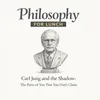
Episode #003 - Carl Jung and the Shadow: The Parts of You That You Don't Claim
Think about the person who irritates you most — not someone who has wronged you, but the one whose very presence gets under your skin in a way you can't quite explain. Carl Jung had a theory about that feeling. And it points directly back at you.In this episode, Shawn and Claire Spainhour unpack one of Jung's most durable and personally confronting ideas: the shadow. Not the pop-psychology version — the real one. The shadow is the unconscious part of the personality that the ego refuses to claim: the anger you were told was unacceptable, the ambition you learned to hide, the spontaneity you traded away to become reliable. It doesn't disappear when you disown it. It accumulates. And eventually, it shows up in your relationships, your reactions, and the patterns you can't seem to break no matter how hard you try.This episode covers how the shadow forms in childhood; why the qualities that irritate us most in others are often a map of our own interior; what Jung actually meant by "shadow integration" (it's not what social media says it is), and why the shadow contains not just darkness but unlived potential—the capacities and gifts you set aside to become who you are.Jung said the shadow is ninety percent pure gold. This episode is about how to find it.25 minutes. No prior knowledge of Jung required.SHOW NOTESPrimary SourcesJung, C. G. (1959). Aion: Researches into the Phenomenology of the Self (R. F. C. Hull, Trans.). Princeton University Press. (Collected Works Vol. 9ii)Jung, C. G. (1968). The Archetypes and the Collective Unconscious (R. F. C. Hull, Trans.). Princeton University Press. (Collected Works Vol. 9i)Jung, C. G. (1963). Memories, Dreams, Reflections (A. Jaffé, Ed.; R. & C. Winston, Trans.). Pantheon Books. (The most accessible entry point into Jung's own voice — part memoir, part psychology.)Biographical & ContextualBair, D. (2003). Jung: A Biography. Little, Brown.Hayman, R. (1999). A Life of Jung. Norton.Works Referenced in This EpisodeJohnson, R. A. (1991). Owning Your Own Shadow. HarperOne. (Short, practical, highly recommended as a follow-up to this episode.)Zweig, C., & Abrams, J. (Eds.). (1991). Meeting the Shadow. Tarcher.Von Franz, M.-L. (1995). Shadow and Evil in Fairy Tales (rev. ed.). Shambhala.Accessible Starting PointsStorr, A. (1983). The Essential Jung. Princeton University Press.Sharp, D. (1991). Jung Lexicon: A Primer of Terms and Concepts. Inner City Books.New episodes every Sunday. Philosophy for Lunch · Big ideas. Human conversations.
Podzilla Summary coming soon
Sign up to get notified when the full AI-powered summary is ready.
Free forever for up to 3 podcasts. No credit card required.
Listen to This Episode
More from Philosophy for Lunch
Episode #008 - Cognitive Bias: The Philosophy Behind the Shortcuts
Episode #007 - Gödel's Incompleteness Theorem: The Proof That Broke Mathematics
Episode #006 - Aristotle's Happiness: Why Feeling Good Is Not the Same as Living Well
Episode #005 - The Philosophy of Grief: What the Best Thinkers Actually Said About Loss
Get summaries like this every morning.
Free AI-powered recaps of Philosophy for Lunch and your other favorite podcasts, delivered to your inbox.
Free forever for up to 3 podcasts. No credit card required.