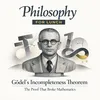
Episode #007 - Gödel's Incompleteness Theorem: The Proof That Broke Mathematics
Most of us were raised on an implicit promise: that if you think carefully enough, gather enough evidence, and reason rigorously enough, you can in principle get to the bottom of any question. Science will eventually explain everything. Logic will eventually resolve every contradiction. Reason, given enough time, is sufficient.Kurt Gödel proved that promise was false. Not in a vague, philosophical hand-waving way — but with a formal mathematical proof that no one has ever refuted, and no one ever will.In this episode, Shawn and Claire take one of the most profound and least understood results in intellectual history and make it genuinely accessible — not as a mathematical curiosity, but as a philosophical reckoning. Because what Gödel discovered is not just about arithmetic. It is about the nature of knowledge itself: that every system of thought, no matter how rigorous, contains truths it cannot reach from the inside. That reason has a ceiling. And that the ceiling is not a failure — it is a feature of what it means to think at all.They also go back further, to Georg Cantor's discovery that infinity is not one thing but many — that some infinities are measurably larger than others — and why that discovery, which his contemporaries denounced as dangerous, turned out to be one of the most beautiful results in the history of human thought.This episode asks the questions that connect the mathematics to lived experience: What does it mean to accept that some truths are permanently beyond proof? How should that change the confidence with which we hold our own frameworks? And what does it say about the human mind that we can somehow perceive truths that no formal system can verify?This is the episode for anyone who has ever suspected that reality is stranger — and richer — than the explanations on offer. It is.Shawn and Claire together. No prior mathematics required.SHOW NOTESPrimary Mathematical TextsCantor, G. (1915). Contributions to the Founding of the Theory of Transfinite Numbers (P. E. B. Jourdain, Trans.). Open Court. (Original work published 1895–1897)Gödel, K. (1992). On Formally Undecidable Propositions of Principia Mathematica and Related Systems (B. Meltzer, Trans.). Dover. (Original work published 1931)Biographical & ContextualDauben, J. W. (1979). Georg Cantor: His Mathematics and Philosophy of the Infinite. Harvard University Press.Goldstein, R. (2005). Incompleteness: The Proof and Paradox of Kurt Gödel. Norton. (The best accessible biography and intellectual history of Gödel — highly recommended as a follow-up.)Philosophy of MathematicsBenacerraf, P., & Putnam, H. (Eds.). (1983). Philosophy of Mathematics: Selected Readings (2nd ed.). Cambridge University Press.Penrose, R. (1989). The Emperor's New Mind: Concerning Computers, Minds, and the Laws of Physics. Oxford University Press.Wigner, E. P. (1960). The unreasonable effectiveness of mathematics in the natural sciences. Communications on Pure and Applied Mathematics, 13(1), 1–14.New episodes every Sunday. Philosophy for Lunch · Big ideas. Human conversations.
Podzilla Summary coming soon
Sign up to get notified when the full AI-powered summary is ready.
Free forever for up to 3 podcasts. No credit card required.
Listen to This Episode
More from Philosophy for Lunch
Episode #008 - Cognitive Bias: The Philosophy Behind the Shortcuts
Episode #006 - Aristotle's Happiness: Why Feeling Good Is Not the Same as Living Well
Episode #005 - The Philosophy of Grief: What the Best Thinkers Actually Said About Loss
Episode #004 - Do You Actually Have Free Will? The Philosophy That Changes How You See Yourself
Get summaries like this every morning.
Free AI-powered recaps of Philosophy for Lunch and your other favorite podcasts, delivered to your inbox.
Free forever for up to 3 podcasts. No credit card required.