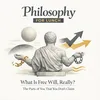
Episode #004 - Do You Actually Have Free Will? The Philosophy That Changes How You See Yourself
You made a decision this morning. Maybe several. But here is the question philosophers have been wrestling with for centuries: did you actually choose, or did something choose for you? Your genetics, your upbringing, your brain chemistry, a chain of causes that stretches back before you were born?In this solo episode, Claire takes one of the oldest and most personally confronting questions in philosophy and walks it all the way through—not to unsettle you, but to hand you something genuinely useful on the other side.She covers the three main positions: hard determinism (the universe is a closed causal system, and nothing could have been otherwise), libertarian free will (you are a genuine first cause, an agent who stands outside the chain), and compatibilism (freedom is real, but it is not what you think it is). She unpacks the famous Libet neuroscience experiments that seemed to show your brain decides before you do, what Spinoza believed understanding your own causes can actually do for you, and why the question of moral luck—how much of who you are was simply given to you—may be the most important practical implication of this entire debate.Claire lands somewhere honest. And wherever you land, this episode will change the emotional register of how you relate to your own history — and how quickly you judge someone else's.Claire solo. No prior philosophy required.SHOW NOTESPrimary Sources & Key Philosophical TextsSpinoza, B. (1994). Ethics (E. Curley, Trans.). Princeton University Press. (Original work published 1677)Hume, D. (1975). Enquiries Concerning Human Understanding and Concerning the Principles of Morals (3rd ed., L. A. Selby-Bigge & P. H. Nidditch, Eds.). Oxford University Press. (Original work published 1748)Frankfurt, H. G. (1971). Freedom of the will and the concept of a person. Journal of Philosophy, 68(1), 5–20.Contemporary Works ReferencedKane, R. (1998). The Significance of Free Will. Oxford University Press.Pereboom, D. (2001). Living Without Free Will. Cambridge University Press.Libet, B., Gleason, C. A., Wright, E. W., & Pearl, D. K. (1983). Time of conscious intention to act in relation to onset of cerebral activity. Brain, 106(3), 623–642.Baumeister, R. F., Masicampo, E. J., & DeWall, C. N. (2009). Prosocial benefits of feeling free: Disbelief in free will increases aggression and reduces helpfulness. Personality and Social Psychology Bulletin, 35(2), 260–268.Accessible Starting PointsHarris, S. (2012). Free Will. Free Press.Dennett, D. C. (2003). Freedom Evolves. Viking.Strawson, G. (2010). Freedom and Belief (rev. ed.). Oxford University Press.New episodes every Sunday. Philosophy for Lunch · Big ideas. Human conversations.
Podzilla Summary coming soon
Sign up to get notified when the full AI-powered summary is ready.
Free forever for up to 3 podcasts. No credit card required.
Listen to This Episode
More from Philosophy for Lunch
Episode #008 - Cognitive Bias: The Philosophy Behind the Shortcuts
Episode #007 - Gödel's Incompleteness Theorem: The Proof That Broke Mathematics
Episode #006 - Aristotle's Happiness: Why Feeling Good Is Not the Same as Living Well
Episode #005 - The Philosophy of Grief: What the Best Thinkers Actually Said About Loss
Get summaries like this every morning.
Free AI-powered recaps of Philosophy for Lunch and your other favorite podcasts, delivered to your inbox.
Free forever for up to 3 podcasts. No credit card required.