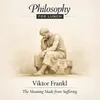
Episode #014 - Viktor Frankl and the Meaning Made from Suffering
There is a question that arrives most forcefully when circumstances are at their worst. Not why is this happening in the causal sense, but the question underneath that one: what does this mean? Is there anything here worth enduring for? Is there a reason to keep going?Viktor Frankl spent three years inside the Nazi concentration camp system. He lost his parents, his brother, and his wife. He survived. And what he built from that experience — both the psychological framework and the life that followed — is one of the most personally tested contributions to the philosophy of suffering in the twentieth century.In this episode, Shawn and Claire work through Frankl's logotherapy and its central claim: that the primary human drive is not pleasure, as Freud argued, or power, as Adler argued, but meaning. The will to meaning. And that the capacity to find or make meaning, even in conditions designed to destroy it, is the one thing that cannot finally be taken from a human being.They cover Frankl's three pathways to meaning: through what you create, through what you experience and love, and — most difficult — through the attitude you choose toward suffering that cannot be avoided. They address the contemporary research on post-traumatic growth and what it actually shows: that suffering does not produce growth automatically, but that the meaning-making that follows suffering can. And they examine the distinction Frankl draws between meaning and happiness, why happiness cannot be pursued directly and why the person who pursues meaning tends to find that happiness arrives as a companion to it rather than a destination in itself.The episode also places Frankl in conversation with Camus and Sartre, and explains why his answer to the question of meaning, forged in conditions neither of them faced, is both quieter and harder than theirs.Shawn and Claire together. No prior philosophy required.SHOW NOTESPrimary SourcesFrankl, V. E. (2006). Man's Search for Meaning. Beacon Press. (Original work published 1946) (One of the most widely read books of the twentieth century — short, essential, and unlike almost anything else.)Frankl, V. E. (1988). The Will to Meaning: Foundations and Applications of Logotherapy. Meridian.Frankl, V. E. (1986). The Doctor and the Soul: From Psychotherapy to Logotherapy (R. & C. Winston, Trans.). Vintage.Works Referenced in This EpisodeTedeschi, R. G., & Calhoun, L. G. (1996). The posttraumatic growth inventory: Measuring the positive legacy of trauma. Journal of Traumatic Stress, 9(3), 455–471.Yalom, I. D. (1980). Existential Psychotherapy. Basic Books.Nietzsche, F. (1998). Twilight of the Idols (D. Large, Trans.). Oxford University Press. (Original work published 1889)Philosophical ContextCamus, A. (1991). The Myth of Sisyphus and Other Essays (J. O'Brien, Trans.). Vintage. (Original work published 1942)Sartre, J.-P. (2007). Existentialism Is a Humanism (C. Macomber, Trans.). Yale University Press. (Original work published 1946)If you are currently in crisis or need support, the 988 Suicide & Crisis Lifeline is available twenty-four hours a day, seven days a week, by call or text: dial or text 988.New episodes every Monday. Philosophy for Lunch · Big ideas. Human conversations.
Podzilla Summary coming soon
Sign up to get notified when the full AI-powered summary is ready.
Free forever for up to 3 podcasts. No credit card required.
Listen to This Episode
More from Philosophy for Lunch
Episode #016 - Nietzsche: God Is Dead — Now What?
Episode #015 - William James and the Will to Believe
Episode #013 - What Does It Mean to Live Philosophically?
Episode #012 - Hannah Arendt: Power, Evil, and the Life of the Mind
Get summaries like this every morning.
Free AI-powered recaps of Philosophy for Lunch and your other favorite podcasts, delivered to your inbox.
Free forever for up to 3 podcasts. No credit card required.