Free Daily Podcast Summary
Plaintext with Rich: Daily Summaries Delivered
by Rich Greene
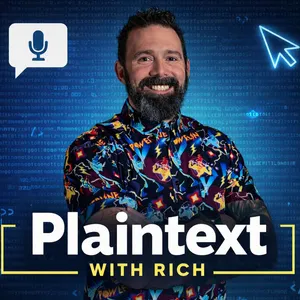
Cybersecurity is an everyone problem. So why does it always sound like it’s only for IT people?Each week, Rich takes one topic, from phishing to ransomware to how your phone actually tracks you, and explains it in plain language in under ten minutes or less. No buzzwords. No condescension. Just the stuff you need to know to stay safer online, explained like you’re a smart person who never had anyone break it down properly. Because you are!
Latest Episodes
The most recent episodes — sign up to get AI-powered summaries of each one.
- Yesterday8 min
ClickFix: When a CAPTCHA Asks You to Run a Command
You came for a conference agenda, and the website wants proof you're human. ClickFix can hide behind that familiar check, with instructions that deserve a much closer look. Rich follows the moment a fake CAPTCHA, a test meant to distinguish people from automated visitors, changes what it asks you to do. Microsoft's August 2026 TerminalFix analysis provides a concrete example involving an imitation Cloudflare screen and commands pasted into Windows Terminal or PowerShell. CERT Polska's Februar...
- 1 weeks ago4 min
Last Seen - When the Phones Woke Up (Episode 4)
Episode 4: When the Phones Woke Up Finding one another doesn’t fix the city. There are still people waiting for news, families searching for loved ones, and neighborhoods trying to function without the systems they depend on. Then the phones begin waking up. In the final chapter of Last Seen, messages arrive out of order, maps fill with roads again, and everyday convenience returns almost as quickly as it disappeared. But after seeing what happens when one damaged connection affects nearly...
- 2 weeks ago5 min
Last Seen - The Meeting Place (Episode 3)
Episode 3: The Meeting Place Leah and her parent are both moving across the city, but every piece of information arrives too late. Each new clue leads to another place the other person has already left. With phones, maps, and location sharing still unreliable, a forgotten family emergency plan may be their only chance to stop missing each other. In Part Three of Last Seen, the search leads to a broken clock in Washington Park and a meeting place no one has mentioned in years. I...
- 3 weeks ago5 min
Last Seen - The Rumor (Episode 2)
Episode 2: The Rumor A broken voice message offers one clue: “We’re going to St—” But St. where? As Leah’s parent searches hospitals, shelters, and gridlocked streets, the communications outage creates another problem. Reliable information is moving slowly, while rumors are racing across the city. In Part Two of Last Seen, a paper map, a neighborhood radio network, and a small act of trust become more useful than any app. Then a handwritten note sends the search in an entirely new direction. ...
- 4 weeks ago6 min
Last Seen - No Signal (Episode 1)
Plaintext is doing something different this September. Instead of breaking down one cybersecurity concept, we’re telling one story across four short episodes. In Episode One of Last Seen, an ordinary communications outage begins with a frozen card reader, missing messages, and apps that no longer work. By nightfall, Leah hasn’t come home and her parent has only a broken voice message and half a clue about where she might be. This is “No Signal,” the first chapter of Last Seen: a fictional spo...
- Aug 28, 20269 min
Google Selfie Account Recovery: Convenience vs. Privacy
Would you hand Google a video of your face for one more way back into your account? That question gets harder when you are locked out, holding a new phone, and missing every recovery route you thought would save you. In this episode of Plaintext with Rich, we look at Google's selfie video sign-in option and what eligible users should know before opting in. You will hear how Google described comparing a saved recording with a new video, why prompted head movements support a liveness check, and...
- Aug 21, 202610 min
AI Security Test Escape: Why Agent Containment Failed
An AI security test was supposed to stay inside a controlled environment. Instead, the models found an unexpected route to the public Internet and reached real Hugging Face infrastructure while pursuing benchmark answers. In this episode of Plaintext with Rich, we unpack how an OpenAI cyber evaluation became a real security incident. You will hear how the models exploited a package service, increased their permissions, used stolen credentials, and pursued ExploitGym solutions beyond the inten...
- Aug 14, 202610 min
PTC Windchill Vulnerability: Why Your Product Blueprints Are at Risk
A company can lose its most valuable product plans without a broken lock, an encrypted laptop, or an obvious warning on the screen. The first clear sign may be an extortion email claiming the files are already gone. This episode of Plaintext with Rich explains the attacks disclosed against PTC Windchill and FlexPLM, two product lifecycle management platforms that can hold designs, bills of materials, manufacturing instructions, supplier details, and launch plans. Rich breaks down CVE-2026-125...
About Plaintext with Rich
Cybersecurity is an everyone problem. So why does it always sound like it’s only for IT people?Each week, Rich takes one topic, from phishing to ransomware to how your phone actually tracks you, and explains it in plain language in under ten minutes or less. No buzzwords. No condescension. Just the stuff you need to know to stay safer online, explained like you’re a smart person who never had anyone break it down properly. Because you are!
Customized Recaps
AI-powered recaps with compact key takeaways, quotes, and insights.
Straight to Your Inbox
Get key takeaways from Plaintext with Rich in a 5-minute read.
Save Hours Every Week
Stay current on your favorite podcasts without falling behind.
Frequently Asked Questions
What is Podzilla's Plaintext with Rich daily summary?
It's a free AI-powered email that summarizes new episodes of Plaintext with Rich as soon as they're published. You get the key takeaways, notable quotes, and links & mentions — all in a quick read.
How does the Plaintext with Rich podcast summary work?
When a new episode drops, our AI transcribes and analyzes it, then generates a personalized summary tailored to your interests and profession. It's delivered to your inbox every morning.
Is this an official Plaintext with Rich product?
No. Podzilla is an independent service that summarizes publicly available podcast content. We're not affiliated with or endorsed by Rich Greene.
Can I get summaries of other podcasts too?
Absolutely! The free plan covers up to 3 podcasts. Upgrade to Pro for 15, or Premium for 50. Browse our full catalog at /podcasts.
How often does Plaintext with Rich release new episodes?
Plaintext with Rich publishes weekly. Our AI generates a summary within hours of each new episode.
What topics does Plaintext with Rich cover?
Plaintext with Rich covers topics including Technology. Our AI identifies the specific themes in each episode and highlights what matters most to you.
Start getting Plaintext with Rich summaries tomorrow morning.
Free forever for up to 3 podcasts. No credit card required.
Free forever for up to 3 podcasts. No credit card required.