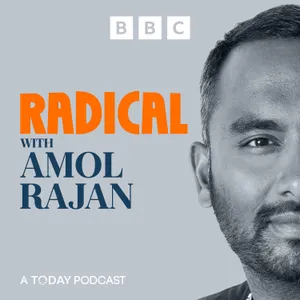
Free Daily Podcast Summary
Radical with Amol Rajan: Daily Summaries Delivered
by BBC Radio 4
Open mind, critical lens. Conversations with radical people about radical ideas to change the world. At a time of radical change, in politics and technology, in culture and the natural environment, Radical with Gabriel Gatehouse is a twice-weekly podcast where thinkers, innovators and heretics explore bold ideas reshaping our world.Can these ideas, and the people driving them, really change the world? And if so, will it be for better, or worse?Award-winning journalist and podcaster Gabriel Gatehouse (host of The Coming Storm and former Newsnight International Editor) approaches every conversation with an open mind and a critical eye, exploring what happens when radical ideas collide with reality.LISTEN:Listen to Radical every Monday and Thursday on BBC Sounds or wherever you get your podcasts.You can also listen on your smart speaker. Just say: "Ask BBC Sounds to play Radical".WATCH:You can also catch Radical with Gabriel Gatehouse on You
Latest Episodes
The most recent episodes — sign up to get AI-powered summaries of each one.
- Today54 min
Abolish Borders: Should You Be Free yo Live Wherever You Want? (Gracie Mae Bradley)
National borders are often seen as essential for security, sovereignty and social cohesion, but writer and campaigner Gracie Mae Bradley believes they are harmful and should be abolished altogether. In their place she argues for a world where everyone enjoys the freedom to move, live and work wherever they want, regardless of where they were born.Gracie, who co-authored the book 'Against Borders: A Case for Abolition', says modern immigration systems fuel racial divisions, entrench global inequalities, and take billions of dollars away from more deserving projects. She argues they also create vast bureaucracies of surveillance, control and exclusion, restricting access to everything from healthcare and housing to employment and banking, and that this should be a concern for all of us.But what would a world without borders actually look like? Would total freedom of movement empower millions of people or trigger political and social upheaval? Could states still provide public services, maintain security and hold communities together? And if borders disappeared, would the nation state itself survive?Producer: Ivana Davidovic Series Producer: Simon Tulett Technical Producer: Michael Regaard Senior News Editor: Sam BonhamLISTEN:Listen to Radical every Thursday on BBC Sounds or wherever you get your podcasts. You can also listen on your smart speaker. Just say: "Ask BBC Sounds to play Radical".WATCH: You can also catch Radical with Gabriel Gatehouse on YouTube at www.youtube.com/bbcnews.GET IN TOUCH: • WhatsApp: 0330 123 9480 • Email: radical@bbc.co.uk • Or join the conversation on social media using the hashtag #BBCRadical
- 1 weeks ago50 min
End Of Ageing: Do You Want To Live To 1000? (Aubrey de Grey)
Ageing is often viewed as an unavoidable part of life - and death - but Aubrey de Grey believes it should be treated as a medical condition that can be cured, thus extending our lives potentially by hundreds of years. He argues that ageing is responsible for the vast majority of human suffering and death, and that rather than accepting growing old as inevitable, scientists should focus on repairing the cellular damage that accumulates in our bodies over time. Aubrey, a gerontologist and president of the Longevity Escape Velocity Foundation, tells Gabriel how close he thinks we are to future generations routinely living far longer than people do today, and why the first person to reach the age of 1,000 may already have been born. But what would a world of dramatically extended lifespans actually look like? Would longer lives deepen inequality, strain resources and concentrate power in the hands of a fortunate few? Would the global economy need to be completely reshaped? Would people want to live that long anyway?Producer: Ivana Davidovic Series Producer: Simon Tulett Technical Producer: Stephen Bailey Senior News Editor: Sam BonhamLISTEN:Listen to Radical every Thursday on BBC Sounds or wherever you get your podcasts.You can also listen on your smart speaker. Just say: "Ask BBC Sounds to play Radical".WATCH:You can also catch Radical with Gabriel Gatehouse on YouTube at www.youtube.com/bbcnews.GET IN TOUCH:• WhatsApp: 0330 123 9480 • Email: radical@bbc.co.uk • Or join the conversation on social media using the hashtag #BBCRadical
- 2 weeks ago49 min
Climate Violence: Has Peaceful Protest Failed? (Andreas Malm)
Environmental activists have long been committed to non-violent protest, but as global emissions continue to rise Andreas Malm thinks they should change their tactics. The climate scholar, and author of 'How to Blow Up a Pipeline', thinks the destruction and sabotage of fossil fuel infrastructure is now a legitimate and necessary weapon in the fight against climate change. One of the most controversial figures in climate politics, Andreas argues that decades of marches, petitions and symbolic protest have failed. He tells Gabriel Gatehouse how he draws on examples from history - like anti-slavery campaigns or the suffragette movement - where violence played a key role in bringing about change (although he does not advocate violence against people). If governments refuse to phase out fossil fuels quickly enough, Andreas argues, then damaging the infrastructure driving climate breakdown may be morally justified. But can such illegal acts be justified, and how do you convince activists to commit them, risking lengthy prison sentences in the process? Plus, would destruction garner support or resentment from everyone else?Producer: Ivana Davidovic Series Producer: Simon Tulett Technical Producer: Dafydd Evans Senior News Editor: Sam Bonham LISTEN: Listen to Radical every Thursday on BBC Sounds or wherever you get your podcasts. You can also listen on your smart speaker. Just say: "Ask BBC Sounds to play Radical". WATCH: You can also catch Radical with Gabriel Gatehouse on YouTube at www.youtube.com/bbcnews. GET IN TOUCH: • WhatsApp: 0330 123 9480 • Email: radical@bbc.co.uk • Or join the conversation on social media using the hashtag #BBCRadical
- 3 weeks ago42 min
Unschooling: Do Children Need School? (Naomi Fisher)
As school attendance falls and concerns grow about children’s mental health and special educational needs, is it time to rethink what education should look like? Clinical psychologist, Naomi Fisher believes the problem may not lie with children struggling to attend school, but with a system that is failing to meet their needs. Specialising in trauma and neurodiversity, she has spent years working with children and families who struggle with mainstream education. She has also chosen to home educate her own children.Drawing on her professional and personal experience, Naomi argues that rising levels of school avoidance should be seen as feedback about the education system, rather than a problem with children’s behaviour. She explains why she believes families should have far greater freedom over how their children learn, and what a more flexible education system could look like. Her radical thought is that while every child deserves an education, not every child needs to go to school.Series Producer: Simon Tulett Producers: Ivana Davidovic and Farhana Haider Technical Producer: Jonny Hall Senior News Editor: Sam BonhamLISTEN:Listen to Radical every Thursday on BBC Sounds or wherever you get your podcasts.You can also listen on your smart speaker. Just say: "Ask BBC Sounds to play Radical".WATCH:You can also catch Radical with Gabriel Gatehouse on YouTube at www.youtube.com/bbcnews.GET IN TOUCH:• WhatsApp: 0330 123 9480 • Email: radical@bbc.co.uk • Or join the conversation on social media using the hashtag #BBCRadical
- 4 weeks ago49 min
Future of Film: Can AI Turn Anyone into a Movie Maker? (Jenny Krakovsky)
Jenny Krakovsky has spent years trying to get her films made the traditional way. A working-class girl from South London, who was kicked out of school aged 14, she trained as a filmmaker and built a career making documentaries and adverts for high-end brands. But after repeatedly hitting a wall trying to get her feature scripts financed, she decided to take a radical gamble: could she make an entire feature film with AI, using only her laptop, in just a few weeks?Jenny tells Gabriel about the tech behind the female-driven 1960s crime caper, how she documented the process online, and how she then found herself at the centre of a fierce debate about the future of cinema. She explains why she believes AI could be a democratising force for filmmaking, giving outsiders the chance to bypass industry gatekeepers and tell stories that Hollywood might never make.Series Producer: Simon Tulett Producer: Ivana Davidovic Technical Producer: Jonny Hall Senior News Editor: Sam BonhamLISTEN:Listen to Radical every Thursday on BBC Sounds or wherever you get your podcasts.You can also listen on your smart speaker. Just say: "Ask BBC Sounds to play Radical".WATCH:You can also catch Radical with Gabriel Gatehouse on YouTube at www.youtube.com/bbcnews.GET IN TOUCH:• WhatsApp: 0330 123 9480 • Email: radical@bbc.co.uk • Or join the conversation on social media using the hashtag #BBCRadical
- Oct 14, 202646 min
End Times Capitalism: How Much Wealth Is Too Much Wealth? (Activist Naomi Klein)
Naomi Klein has been writing critiques of capitalism and globalisation for more than 20 years. But now, for one of the most influential and outspoken figures on the political left, things are getting desperate. In her latest book 'End Times Fascism' she writes about how the global economic order is combining with other powerful forces to hasten the end of the world as we know it.The author and social activist tells Gabriel Gatehouse about the religious fundamentalists, tech bros and white supremacists that keep her up at night, and her ideas about how to stop them - including dismantling capitalism, and why it hasn't happened yet. Series Producer: Simon Tulett Technical Producer: Jonny Hall Senior News Editor: Sam Bonham LISTEN: Listen to Radical every Thursday on BBC Sounds or wherever you get your podcasts. You can also listen on your smart speaker. Just say: "Ask BBC Sounds to play Radical". WATCH: You can also catch Radical with Gabriel Gatehouse on YouTube at www.youtube.com/bbcnews. GET IN TOUCH: • WhatsApp: 0330 123 9480 • Email: radical@bbc.co.uk • Or join the conversation on social media using the hashtag #BBCRadical
- Oct 14, 20263 min
Introducing... Radical With Gabriel Gatehouse
Award-winning journalist and podcaster Gabriel Gatehouse is the new host of Radical, the podcast exploring the people and ideas trying to change the world.At a time of radical change, in politics and technology, in culture and the natural environment, Radical with Gabriel Gatehouse is a twice-weekly podcast where thinkers, innovators and heretics explore bold ideas reshaping our world. Can these ideas, and the people driving them, really change the world? And if so, will it be for better, or worse? LISTEN: Listen to Radical every Monday and Thursday on BBC Sounds or wherever you get your podcasts. You can also listen on your smart speaker. Just say: "Ask BBC Sounds to play Radical". WATCH: You can also catch Radical with Gabriel Gatehouse on YouTube at www.youtube.com/bbcnews. GET IN TOUCH: WhatsApp: 0330 123 9480 Email: radical@bbc.co.uk Or join the conversation on social media using the hashtag #BBCRadical
- Oct 7, 202647 min
Cost of Living: Should Government Pay For Life's Essentials? (Anna Coote)
What if housing, childcare, transport and social care were no longer treated as things to buy and sell but as services everyone was entitled to, regardless of their ability to pay?Social policy analyst Anna Coote believes the market has failed to provide many of life's essentials. Her answer is universal basic services: a system where access to housing, care, education, transport and other necessities are free or genuinely affordable.She tells Gabriel Gatehouse about a proposal that challenges the assumption that markets are the best way to allocate resources. From housing shortages to childcare costs, Anna explains what universal basic services would mean in practice and whether Britain could ever afford them.WhatsApp: 0330 123 9480 Email: radical@bbc.co.ukEpisodes of Radical are released every Thursday.Series Producer: Simon Tulett Producer: Ivana Davidovic Technical Producer: Ben Andrews Senior News Editor: Sam Bonham
Get Radical with Amol Rajan summaries in your inbox
Free AI-powered daily recaps. Key takeaways, quotes, and mentions — in a 5-minute read.
Get Free Summaries →Free forever for up to 3 podcasts. No credit card required.
You Might Also Like
Listeners also like.

Free Thinking
Philosophers, historians, and critics explore current events through the lens of history, culture, and ideas.

Beyond Today
Examines major news stories and global issues around identity, technology, and power through expert interviews and BBC reporting.

Analysis
Examines the ideas and forces shaping public policy in Britain and abroad with writers, journalists, and academics.

Pod Save the UK
Comedians and journalists analyze UK politics with guests, offering insight and solutions on current events.
Political Thinking with Nick Robinson
In-depth conversations with political figures and influencers about their lives and the experiences that shaped their worldviews.

The Media Show
A programme exploring the revolution in media, including social media, breaking news, and misinformation.

Strong Message Here
A weekly analysis of political language and doublespeak, exploring how rhetoric shapes perception and power.

Broadcasting House
BBC Radio 4

Any Questions? and Any Answers?
Experts answer public questions on current issues, followed by audience responses.

Radical Hospitality Show
Zeke Freeman

The Interview
In-depth 20-minute conversations with global leaders, cultural figures, and decision-makers on the issues shaping our world.
The Reith Lectures
Prominent international thinkers present lectures as part of the BBC's annual flagship series.
About Radical with Amol Rajan
Open mind, critical lens. Conversations with radical people about radical ideas to change the world. At a time of radical change, in politics and technology, in culture and the natural environment, Radical with Gabriel Gatehouse is a twice-weekly podcast where thinkers, innovators and heretics explore bold ideas reshaping our world.Can these ideas, and the people driving them, really change the world? And if so, will it be for better, or worse?Award-winning journalist and podcaster Gabriel Gatehouse (host of The Coming Storm and former Newsnight International Editor) approaches every conversation with an open mind and a critical eye, exploring what happens when radical ideas collide with reality.LISTEN:Listen to Radical every Monday and Thursday on BBC Sounds or wherever you get your podcasts.You can also listen on your smart speaker. Just say: "Ask BBC Sounds to play Radical".WATCH:You can also catch Radical with Gabriel Gatehouse on You
Customized Recaps
AI-powered recaps with compact key takeaways, quotes, and insights.
Straight to Your Inbox
Get key takeaways from Radical with Amol Rajan in a 5-minute read.
Save Hours Every Week
Stay current on your favorite podcasts without falling behind.
Frequently Asked Questions
What is Podzilla's Radical with Amol Rajan daily summary?
It's a free AI-powered email that summarizes new episodes of Radical with Amol Rajan as soon as they're published. You get the key takeaways, notable quotes, and links & mentions — all in a quick read.
How does the Radical with Amol Rajan podcast summary work?
When a new episode drops, our AI transcribes and analyzes it, then generates a personalized summary tailored to your interests and profession. It's delivered to your inbox every morning.
Is this an official Radical with Amol Rajan product?
No. Podzilla is an independent service that summarizes publicly available podcast content. We're not affiliated with or endorsed by BBC Radio 4.
Can I get summaries of other podcasts too?
Absolutely! The free plan covers up to 3 podcasts, any in the catalog. Basic raises that to 15, Pro to 40 and Max to 100. Browse our full catalog at /podcasts.
How often does Radical with Amol Rajan release new episodes?
Radical with Amol Rajan publishes 2x weekly. Our AI generates a summary within hours of each new episode.
What topics does Radical with Amol Rajan cover?
Radical with Amol Rajan covers topics including Culture, Society & Culture. Our AI identifies the specific themes in each episode and highlights what matters most to you.
Start getting Radical with Amol Rajan summaries tomorrow morning.
Free forever for up to 3 podcasts. No credit card required.
Free forever for up to 3 podcasts. No credit card required.