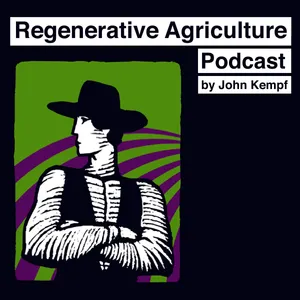
Free Daily Podcast Summary
Regenerative Agriculture Podcast: Daily Summaries Delivered
by John Kempf
This is a show for professional growers and agronomists who want to learn about the dynamics of regenerative agriculture systems to increase quality, yield, and profitability.
Latest Episodes
The most recent episodes — sign up to get AI-powered summaries of each one.
- 4 days ago1h 24m
Episode 190: What the 1980s Farm Crisis Should Have Taught Us with Wendy Johnson
Wendy Mariko Johnson farms in Floyd County, Iowa, near Charles City. She grew up on an Iowa farm, left at 18 in the 1990s for an 18-year career in the Los Angeles fashion industry, and returned in 2010 with her husband Johnny Rafkin. Having watched farms close across Iowa in the 1980s, she came back determined to follow the three things that carried her parents through that era: diversification, low cost of production, and little to no debt. Today Wendy runs two businesses from the same land. Jóia Food & Fiber Farm carries 160 ewes, 25 cows and their calves, plus hogs, chickens, and ducks across roughly 130 certified organic acres, alongside 15 acres of Kernza and more than 6,000 trees planted over the past decade. Jóia Sleep turns the farm's wool into comforters, mattress toppers, and pillows. She also co-manages Center View Farms, her family's thousand-acre commodity operation, and serves as vice president of the Perennial Promise Growers Cooperative, co-founder of 99 Counties, and chair of Iowa's USDA Farm Service Agency state committee. Her current question is how to take what she has proven on 130 acres and extend it across a thousand. In this episode, John and Wendy discuss: What carried her parents through the 1980s farm crisis, and why it still applies How direct marketing made her a price maker instead of a price taker Why the thousand-acre corn and soybean farm is becoming obsolete How Kernza thrived through a 10-inch drought year and a 12-inch rain month Why she hires custom operators instead of owning machinery What it would take to treat agrarian labor like the skilled trades Whether the next generation wants land ownership or just land access Why she would rather be paid on practice and nutrition than on yield Four years of silvopasture planted over field tile Additional ResourcesTo listen to the podcast episode featuring Austin Unruh on integrating trees into working pastures, please visit: https://advancingecoag.com/podcast/episode-97-integrating-trees-into-working-pastures-with-austin-unruh/ To learn more about Jóia Food & Fiber Farm, please visit: https://www.joiafoodfarm.com/ To learn more about Jóia Sleep, please visit: https://www.joiasleep.com/ To learn more about 99 Counties, please visit: https://99counties.com/ To learn more about the Perennial Promise Growers' Cooperative, please visit: https://perennialpromise.com/ Learn more about AEA's regenerative programs and products: https://www.advancingecoag.com About John KempfJohn Kempf is the founder of Advancing Eco Agriculture (AEA). A top expert in biological and regenerative farming, John founded AEA in 2006 to help fellow farmers by providing the education, tools, and strategies that will have a global effect on the food supply and those who grow it. Through intense study and the knowledge gleaned from many industry leaders, John is building a comprehensive systems-based approach to plant nutrition – a system solidly based on the sciences of plant physiology, mineral nutrition, and soil microbiology. Support For This Show & Helping You GrowSince 2006, AEA has been on a mission to help growers become more resilient, efficient, and profitable with regenerative agriculture. AEA works directly with growers to apply its unique line of liquid mineral crop nutrition products and biological inoculants. Informed by cutting-edge plant and soil data-gathering techniques, AEA's science-based programs empower farm operations to meet the crop quality markers that matter the most. AEA has created real and lasting change on millions of acres with its products and data-driven services by working hand-in-hand with growers to produce healthier soil, stronger crops, and higher profits. Beyond working on the ground with growers, AEA leads in regenerative agriculture media and education, producing and distributing the popular and highly-regarded Regenerative Agriculture Podcast, inspiring webinars, and other educational content that serve as go-to resources for growers worldwide. Learn more about AEA's regenerative programs and products: https://www.advancingecoag.com
- 1 weeks ago1h 29m
Podcast Extra: Why Corn Is Dying Early with John Kempf & Brody Benton
In this Podcast Extra, Brody Benton of Six B and John Kempf, founder of Advancing Eco Agriculture, dig into why plants are shutting down weeks before black layer, what top dieback is actually telling you, and how nitrogen form, leaf temperature, and trace minerals decide whether a crop finishes strong or hollows out from the inside. John explains why the fungi behind stalk rot and crown rot — fusarium, rhizoctonia, pythium — are saprophytes that navigate by electrical charge, and why they only attack cells the plant has already given up on. Brody brings the 2026 weather data: 43 nights above 68°F in Polk County, Iowa (vs. a 28–29 night average), 35+ in York County, Nebraska, and record dew points that opened the door for tar spot. Put those together and you get a plant burning protein for energy, converting rubisco and PEP carboxylase back to ammonium, robbing amino skeletons out of the leaves, and dismantling its own photosynthetic engine during grain fill. From there the conversation goes well past stalk rot: front-loaded nitrogen and electrolyte overload, chloride and sodium from manure histories, herbicide and fungicide effects on fungal-to-bacterial ratios, the depletion of microbially active carbon under corn-on-corn and corn-soybean rotations, molybdenum and nitrate assimilation in soybeans, EDTA chelates that pull one nutrient out while adding another, plant sap pH targets, and how humic substances turned a manure pit into liquid gold. Additional ResourcesIf you farm in the midwest and would like to get in touch with Brody, please reach out to him via email, brody.benton@gmail.com To listen to the Podcast conversation with Mike Omeg, please visit: https://advancingecoag.com/podcast/episode-188-eliminating-ground-applied-urea-with-mike-omeg/ About John KempfJohn Kempf is the founder of Advancing Eco Agriculture (AEA). A top expert in biological and regenerative farming, John founded AEA in 2006 to help fellow farmers by providing the education, tools, and strategies that will have a global effect on the food supply and those who grow it. Through intense study and the knowledge gleaned from many industry leaders, John is building a comprehensive systems-based approach to plant nutrition – a system solidly based on the sciences of plant physiology, mineral nutrition, and soil microbiology. Support For This Show & Helping You Grow Since 2006, AEA has been on a mission to help growers become more resilient, efficient, and profitable with regenerative agriculture. AEA works directly with growers to apply its unique line of liquid mineral crop nutrition products and biological inoculants. Informed by cutting-edge plant and soil data-gathering techniques, AEA's science-based programs empower farm operations to meet the crop quality markers that matter the most. AEA has created real and lasting change on millions of acres with its products and data-driven services by working hand-in-hand with growers to produce healthier soil, stronger crops, and higher profits. Beyond working on the ground with growers, AEA leads in regenerative agriculture media and education, producing and distributing the popular and highly-regarded Regenerative Agriculture Podcast, inspiring webinars, and other educational content that serve as go-to resources for growers worldwide. Learn more about AEA's regenerative programs and products: https://www.advancingecoag.com
- 2 weeks ago1h 43m
Episode 189: Why Your Nitrogen Program Is Costing You 50 Bushels with Ed Baumgartner
Ed Baumgartner is a corn breeder and co-founder of Bass Hybrids in Olivia, Minnesota. His family has been in the seed corn business since the late 1930s, when his great uncles began producing hybrid seed as Troy Farms. Ed studied agronomy and plant genetics and spent 21 years and five mergers inside the commercial seed industry, much of it running winter nurseries in Puerto Rico and doing trait integration work for major companies. At Bass Hybrids, Ed breeds non-GMO corn using a shuttle breeding model borrowed from Norman Borlaug, cycling material between Puerto Rico and Minnesota for three generations a year under deliberate heat, drought, and disease stress. Working in 18 identified genetic families rather than the industry's two, he has selected for native insect tolerance and broad stress resilience and found those selections also produced plants with unusually strong microbial association and markedly lower nitrogen requirements. His current work includes nitrogen rate trials across genetics, interseeded cover crop studies in three states, and a 148-acre discovery farm dedicated entirely to regenerative research. In this episode, John and Ed discuss: Why corn inbreds developed before heavy nitrogen fertilization still carry the genetics for nutrient efficiency How some Bass hybrids produce 200 bushel corn on 50 pounds of applied nitrogen, and drop to 150 bushels when nitrogen is pushed above 200 Why Y-drop nitrogen placed too close to the stalk causes a yield hit on biologically responsive genetics The plant characteristics that signal high biological receptivity, including pubescence, leathery leaves, multiple ears, and heavy pollen loads Results from interseeding nine species of cover crops at V3, where the highest yielding treatment came with nitrogen cut by 25 percent Why Bass asked its seed producers to apply AEA's Pinion this season in place of conventional fungicide How AEA's fertility guidance gives growers an off-ramp from high nitrogen and an on-ramp for soil biology What germinator trials revealed about fungicide-treated seed versus seed grown without fungicides Additional Resources To listen to John's first conversation with the BASS Hybrids team, please visit: https://advancingecoag.com/podcast/podcast-extra-john-kempf-bass-hybrids-on-the-future-of-corn/ To read the University of Wisconsin research on nitrogen-fixing corn in Mexico, please visit: https://journals.plos.org/plosbiology/article?id=10.1371/journal.pbio.2006352 To learn more about AEA's Pinion, please visit: https://advancingecoag.com/product/pinion/ To find Charles Walters' book Eco-Farm, please visit: https://bookstore.acresusa.com/products/eco-farm?srsltid=AU7gw4XfkT_GNsryakPAWEYC5avS6GxN3ikUv9nbqaG0cJXfyZIq3Y8_ To learn more about BASS Hybrids, please visit: https://www.basshybrids.com/ About John Kempf John Kempf is the founder of Advancing Eco Agriculture (AEA). A top expert in biological and regenerative farming, John founded AEA in 2006 to help fellow farmers by providing the education, tools, and strategies that will have a global effect on the food supply and those who grow it. Through intense study and the knowledge gleaned from many industry leaders, John is building a comprehensive systems-based approach to plant nutrition – a system solidly based on the sciences of plant physiology, mineral nutrition, and soil microbiology. Support For This Show & Helping You Grow Since 2006, AEA has been on a mission to help growers become more resilient, efficient, and profitable with regenerative agriculture. AEA works directly with growers to apply its unique line of liquid mineral crop nutrition products and biological inoculants. Informed by cutting-edge plant and soil data-gathering techniques, AEA's science-based programs empower farm operations to meet the crop quality markers that matter the most. AEA has created real and lasting change on millions of acres with its products and data-driven services by working hand-in-hand with growers to produce healthier soil, stronger crops, and higher profits. Beyond working on the ground with growers, AEA leads in regenerative agriculture media and e
- 3 weeks ago1h 19m
Episode 188: Eliminating Ground-Applied Urea with Mike Omeg
Mike Omeg is a fifth-generation farmer who grew up on a diverse family farm in Oregon, initially producing cherries, hay, cattle, apricots, apples, and wheat. Over time, he honed in on fresh cherry production. He is currently the Director of Orchard Operations at Orchard View Cherries. Drawing on decades of tree-fruit experience and driven by a vision to keep his operation thriving for the next 100 years, Mike has spent the last 13 years collaborating closely with Advancing Eco Agriculture to challenge the conventional . Currently, Mike is implementing management practices to maintain high cherry yields while drastically reducing input costs . He has completely eliminated dry nitrogen ground applications, shifting toward targeted fertigation and carbon-based energy sources to optimize tree metabolism . By focusing on biological precision and custom blends, he is growing firmer, higher-quality fruit while successfully testing new methods to control severe powdery mildew pressure without relying on conventional fungicides . In this episode, John and Mike discuss: How eliminating dry nitrogen ground applications improved overall tree health and nutrition <!
- Sep 4, 20261h 17m
Podcast Extra: Building High-Efficiency Fertility Systems for Row Crops
Join us for a discussion led by Heather Poutre of Agronomy Diversified LLC, Jeff True of True Potential Ag Consulting, LLC, and John Kempf, founder of Advancing Eco Ag. With nitrogen management remaining a central topic amidst heightened focus on water quality, Heather, Jeff, and John will dive into practical agronomic strategies designed to balance environmental stewardship with farm profitability. Topics in this webinar that are discussed include: Navigating evolving water quality focuses and proactive nitrogen management. Building a practical fertility program designed to maximize nutrient efficiency and profitability. Implementing management practices that address root causes rather than relying on bulk fertilizer top-ups. Actionable strategies for cutting conventional commercial fertilizer dependence while maintaining yield. Utilizing biology, humic and fulvic acids, and amino acids to improve nutrient uptake. Maximizing Return on Investment (ROI) by lowering unit costs per bushel through smarter nutrient delivery. Additional ResourcesClick here to watch "How Excess Nitrogen Creates Yield Drag" For Iowa/Midwest growers who want to reach out to Heather or Jeff, contact info is below: Jeff True, True Potential Ag Consulting, LLC. 641-431-0436 Jeff serves the NW and SE corners of Iowa Heather Poutre, Agronomy Diversified LLC About John Kempf John Kempf is the founder of Advancing Eco Agriculture (AEA). A top expert in biological and regenerative farming, John founded AEA in 2006 to help fellow farmers by providing the education, tools, and strategies that will have a global effect on the food supply and those who grow it. Through intense study and the knowledge gleaned from many industry leaders, John is building a comprehensive systems-based approach to plant nutrition – a system solidly based on the sciences of plant physiology, mineral nutrition, and soil microbiology. Support For This Show & Helping You Grow Since 2006, AEA has been on a mission to help growers become more resilient, efficient, and profitable with regenerative agriculture. AEA works directly with growers to apply its unique line of liquid mineral crop nutrition products and biological inoculants. Informed by cutting-edge plant and soil data-gathering techniques, AEA's science-based programs empower farm operations to meet the crop quality markers that matter the most. AEA has created real and lasting change on millions of acres with its products and data-driven services by working hand-in-hand with growers to produce healthier soil, stronger crops, and higher profits. Beyond working on the ground with growers, AEA leads in regenerative agriculture media and education, producing and distributing the popular and highly-regarded Regenerative Agriculture Podcast, inspiring webinars, and other educational content that serve as go-to resources for growers worldwide. Learn more about AEA's regenerative programs and products: https://www.advancingecoag.com
- Aug 27, 20261h 14m
Episode 187: Clearing Nitrogen "Constipation" in High-Yield Corn with Brody Benton
Brody Benton is an agronomist and no-till farmer in Guthrie County, Iowa, specializing in continuous corn rotations and hoop-barn hog manure management . Brody works with growers in Iowa and the midwest as an independent consultant through his company, Six B, using sap analysis and field trials to help growers reduce synthetic chemical dependency. To forward regenerative agriculture, Brody focuses on restoring soil fungal communities, accelerating humification, and keeping living roots in the ground year-round through cover cropping . He advocates replacing synthetic fungicides with targeted trace mineral nutrition to resolve plant nutrient backlogs, boost photosynthesis, and rebuild natural crop immunity . In this episode, John and Brody discuss: The historical shift over the last 50 years from naturally maturing green corn to crops dependent on continuous synthetic inputs . How late-season cover crops feed soil biology with exudates to increase organic matter and boost cash crop yields <!--
- Aug 13, 202652 min
Episode 186: The Power of Precision Management and Multi-Species Covers with Mike Thompson
Mike Thompson is a fifth-generation farmer in West Texas who grew up in conventional "cotton-on-cotton" country. After leaving the farm for 16 years, he returned to face the region's harsh climate, hot winds, and declining water reserves. His perspective shifted during his first year back when his plow hit a patch of decomposing hay on pasture land, effortlessly slicing through moist mud instead of pulling up massive dirt clods. Today, Mike manages a resilient operation by rotating corn, wheat with summer cover crop mixes, and cotton, while dividing his pivot irrigation fields into thirds to optimize water efficiency. By incorporating livestock grazing and multi-species covers like sunn hemp, he has built rich soil structure, eliminated synthetic plant growth regulators, and produced his highest-yielding cotton crops even during severe dry spells. In this episode, John and Mike discuss: Navigating landlord relationships by splitting fields into thirds for consistent annual cotton income and incorporating vegetable species in cover crop mixes. The crucial role of deep pre-watering before planting to build subsoil moisture reserves for late-summer heat. Haney soil test results showing 57 pounds of available nitrogen remaining after harvesting a heavy three-bale cotton crop. Plant physiological changes under regenerative management, including dark green, dinner-plate-sized leaves that act as massive solar panels. Using AEA sap analysis to track how a targeted spring boron application activated a massive mid-season surge in boron, calcium, and magnesium uptake. Testing handheld Croptix sensors for instant field data and utilizing FieldLark AI to analyze root zone nutrient mobility. Mike's advice on the intense scouting, preparation, and attention to detail needed to succeed in regenerative agriculture. Resources To learn more about Croptix, please visit: https://advancingecoag.com/news/how-the-croptix-platform-is-changing-plant-nutrition-and-disease-monitoring/ To learn more about FieldLark AI, please visit: https://advancingecoag.com/land/fieldlark/ To learn more about plant sap analysis: https://advancingecoag.com/plant-sap-analysis/ To learn more about Green Cover, please visit: https://greencover.com/ About John Kempf John Kempf is the founder of Advancing Eco Agriculture (AEA). A top expert in biological and regenerative farming, John founded AEA in 2006 to help fellow farmers by providing the education, tools, and strategies that will have a global effect on the food supply and those who grow it. Through intense study and the knowledge gleaned from many industry leaders, John is building a comprehensive systems-based approach to plant nutrition – a system solidly based on the sciences of plant physiology, mineral nutrition, and soil microbiology. Support For This Show & Helping You Grow Since 2006, AEA has been on a mission to help growers become more resilient, efficient, and profitable with regenerative agriculture. AEA works directly with growers to apply its unique line of liquid mineral crop nutrition products and biological inoculants. Informed by cutting-edge plant and soil data-gathering techniques, AEA's science-based programs empower farm operations to meet the crop quality markers that matter the most. AEA has created real and lasting change on millions of acres with its products and data-driven services by working hand-in-hand with growers to produce healthier soil, stronger crops, and higher profits. Beyond working on the ground with growers, AEA leads in regenerative agriculture media and education, producing and distributing the popular and highly-regarded Regenerative Agriculture Podcast, inspiring webinars, and other educational content that serve as go-to resources for growers worldwide. Learn more about AEA's regenerative programs and products: https://www.advancingecoag.com
- Aug 7, 202620 min
Podcast Short: Fast Five with John Kempf on the Permaculture Orchard Podcast
In this Podcast Short, John Kempf returns to the Permaculture Orchard Podcast with Stefan Sobkowiak and his son Zach to share actionable agronomic tips and key mindset shifts for regenerative growers. He explains that adding sugar to foliar sprays boosts plant metabolism and can halve fertilizer application rates, while establishing at least eight plant families triggers quorum sensing for ecosystem collaboration. John warns that most fruit quality issues stem from self-inflicted excesses of nitrogen and potassium, advocating for an internal shift from "what to kill" to "how to nurture." Finally, he urges growers to pinpoint their crop's specific "value drivers"—such as peak flavor, nutrient density, or shelf life—to guide their soil and management practices. Hosted by Stefan Sobkowiak, The Permaculture Orchard Podcast serves as a practical guide for growers seeking cutting-edge insights into ecological agriculture and sustainable land management. Through hands-on testing, resources like the Permaculture Orchard Blueprint ebook, and real-world experiments in non-chemical weed management and multi-family ground covers, Stefan demonstrates how working with nature builds long-term soil health, improves fruit quality, and enhances overall farm profitability. Resources To listen to more episodes of the Permaculture Orchard Podcast and learn more about Stefan's work, please visit the links below: YouTube Channel : www.youtube.com/c/stefansobkowiak POP Podcast: https://www.youtube.com/@PermacultureOrchardPodcast Permaculture Orchard Masterclass: https://permaculture.study/ Talks: Stefan Sobkowiak Les Fermes Miracle Farms & Courses: miracle.farm Social Media: Facebook: <a title= "Original URL: https://www.facebook.com/lesfermes.farms. Click or tap if y
Get Regenerative Agriculture Podcast summaries in your inbox
Free AI-powered daily recaps. Key takeaways, quotes, and mentions — in a 5-minute read.
Get Free Summaries →Free forever for up to 3 podcasts. No credit card required.
You Might Also Like
Listeners also like.

Regenerative Agriculture: Buzzwords & Bullsh*t
A no-nonsense look at the realities and myths behind regenerative agriculture practices and the claims they generate.

The Acres U.S.A. Podcast
Explores organic and regenerative farming practices through interviews and insights aimed at building a sustainable, profitable food system.
Working Cows - Regenerative Ranching to Maximize Profitability and Soil Health
Discusses regenerative ranching practices focusing on soil health, grazing, herd management, and profitability with industry leaders.
Growing For Market Podcast
Practical advice for small-scale farmers and market gardeners on growing and selling produce, flowers, and plants profitably.
Farm Small Farm Smart Daily
A daily podcast covering practical farming and gardening topics, from soil prep to marketing, for small-scale growers.
Cannabis Cultivation and Science Podcast
Experts discuss science-based organic cannabis cultivation techniques and advancements in growing technology.
Sustainable World Radio- Ecology and Permaculture Podcast
Experts discuss ecology, permaculture, organic gardening, and sustainable living through interviews and commentary.
Permaculture P.I.M.P.cast
Discusses permaculture practices and sustainable living through casual conversations between two hosts.

Grassfed Life
Covers small-scale farming, grass-fed livestock, and farm-based entrepreneurship with seasonal insights and practical guidance.

Podcast | ice age farmer
Ice Age Farmer, iceagefarmer.com

Peak Performance Life Podcast
Covers health, energy, and mental performance optimization through biohacking, nutrition, and lifestyle strategies.

The joe gardener Show - Organic Gardening - Vegetable Gardening - Expert Garden Advice From Joe Lamp'l
Joe Lamp'l shares practical, organic gardening advice focused on growing food and sustainable practices for gardeners of all skill levels.
About Regenerative Agriculture Podcast
This is a show for professional growers and agronomists who want to learn about the dynamics of regenerative agriculture systems to increase quality, yield, and profitability.
Customized Recaps
AI-powered recaps with compact key takeaways, quotes, and insights.
Straight to Your Inbox
Get key takeaways from Regenerative Agriculture Podcast in a 5-minute read.
Save Hours Every Week
Stay current on your favorite podcasts without falling behind.
Frequently Asked Questions
What is Podzilla's Regenerative Agriculture Podcast daily summary?
It's a free AI-powered email that summarizes new episodes of Regenerative Agriculture Podcast as soon as they're published. You get the key takeaways, notable quotes, and links & mentions — all in a quick read.
How does the Regenerative Agriculture Podcast podcast summary work?
When a new episode drops, our AI transcribes and analyzes it, then generates a personalized summary tailored to your interests and profession. It's delivered to your inbox every morning.
Is this an official Regenerative Agriculture Podcast product?
No. Podzilla is an independent service that summarizes publicly available podcast content. We're not affiliated with or endorsed by John Kempf.
Can I get summaries of other podcasts too?
Absolutely! The free plan covers up to 3 podcasts. Upgrade to Pro for 15, or Premium for 50. Browse our full catalog at /podcasts.
How often does Regenerative Agriculture Podcast release new episodes?
Regenerative Agriculture Podcast publishes weekly. Our AI generates a summary within hours of each new episode.
What topics does Regenerative Agriculture Podcast cover?
Regenerative Agriculture Podcast covers topics including Science, Natural Sciences, Earth Sciences. Our AI identifies the specific themes in each episode and highlights what matters most to you.
Start getting Regenerative Agriculture Podcast summaries tomorrow morning.
Free forever for up to 3 podcasts. No credit card required.
Free forever for up to 3 podcasts. No credit card required.