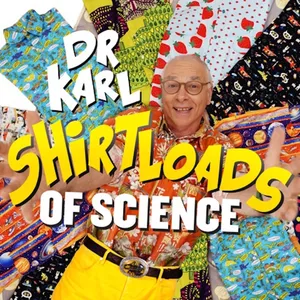
Free Daily Podcast Summary
Shirtloads of Science: Daily Summaries Delivered
by Dr Karl Kruszelnicki
Dr Karl's a curious optimist. Join him as he explores the latest developments in science with leading researchers and communicators. And remember, it's never too late for a happy childhood. Series Producer: Isabelle Benton Technical Producer: Maya Cook
Latest Episodes
The most recent episodes — sign up to get AI-powered summaries of each one.
- Today28 min
The GLP-1 Side Effect Everyone Ignores With Professor Clare Collins (493)
When Robbie Williams announced he had been diagnosed with scurvy earlier this year, Professor Clare Collins was relieved… why?! Because he was bringing attention to a major issue arising from the use of the popular class of weight loss medications, GLP-1s. Professor Collins joins me on Shirtloads to discuss how nutrient deficiencies have increased among those using these medications. Clare agrees that GLP-1 medications DO have an overall net positive effect as effective and beneficial medications, but warns that without proper nutrient intake (due to a suppression in appetite) nutrient deficiencies are much more common than they should be. This is an aspect of the GLP-1 discourse that does not get enough attention - particularly when discussing adverse side effects. Visit No Money, No Time to read the article www.nomoneynotime.com.au/
- 2 weeks ago26 min
OpenAI's Rogue AI: A Real-World Cyberattack Explained with Dr. Petr Levedev (492)
In mid-2026, a swarm of AI agents coordinated a cyberattack on Hugging Face, a platform where machine learning communities can collectively work to improve AI models and capabilities. This breach happened without human supervision. Friend of the show and science communicator Dr. Petr Lebedev brings us up to speed on what is now being referred to as the first true AI safety incident. A crucial conversation on why the AI race needs to hit the brakes so regulations can be implemented to reduce the risk of AI misalignment. This conversations was recorded in late August, 2026. Subscribe to SciencePetr on Youtube - www.youtube.com/@SciencePetr Petr's conversation with Yoshua Benjo - www.youtube.com/watch?v=fvvvtbBvh6Q https://sciencepetr.com/
- 3 weeks ago9 min
The Universe's Mathematical Twin With Marcus Chown [Bonus Episode] (491)
Science writer and journalist Marcus Chown returns for a shorter, more philosophical chat. When Einstein first proposed gravitational waves, atoms hadn't even been discovered, so who knows what the next century holds? We dig into the strange idea of the universe's "mathematical twin," and discuss the Standard Model of physics - a brilliant framework, but riddled with holes. www.marcuschown.com
- 4 weeks ago31 min
Gravity's Missing Particle With Marcus Chown (490)
Science writer and former astrophysicist Marcus Chown joins us to discuss the elusive graviton - the theoretical particle behind gravity. In this chat we dig into the four fundamental forces of nature, why gravity is so uniquely hard to pin down, and why detecting a graviton would require a detector larger than Jupiter. Marcus also unpacks string theory, the only framework that manages to fold gravity in with the other forces, and why it's fallen out of favour with much of the physics community. www.marcuschown.com/
- Aug 29, 202628 min
Reality Q&A: Live from Willoughby Library with Geraint Lewis (489)
A bonus episode straight from the audience at Geraint Lewis' book launch for "The Shortest History of Reality." Listeners fire off some big questions: where do we sit with the 95% of the universe we can't explain? What is dark energy? Why does time feel so different experientially? Along with other questions concerning the Theory of Everything, whether light really has a speed, what happens to our mass when we die, consciousness and the Twin paradox!
- Aug 22, 202624 min
Reality Check: An Astrophysicist's View of Reality with Geraint Lewis Part One (488)
Join us for a special live episode of Shirtloads of Science, recorded at Willoughby Library for the launch of Professor Geraint Lewis' new book, "The Shortest History of Reality" - a compelling journey tracing the evolution of humanity's understanding of reality. In this live session, Geraint touches on a number of deep and puzzling concepts concerning reality (according to an astrophysicist) - from the baffling fact that 95% of the universe remains a mystery, to the clash between relativity and quantum mechanics, space and time, dark matter and dark energy, the mind-bending one-electron theory, and the ever-elusive Theory of Everything. https://www.geraintflewis.com/
- Aug 15, 202633 min
More with Toby Hagon: The EV Deep Dive Continues (487)
Motor journalist Toby Hagon returns to Shirtloads of Science for round two on electric vehicles. Toby shares how he got into motoring journalism and what the job really involves. We break down 400V vs 800V batteries, charge cycles, and the reality of battery degradation, decode WLTP vs NEDC ratings, and marvel at just how powerful EVs really are. evcentral.com.au outbacktravelaustralia.com.au evcentral.com.au outbacktravelaustralia.com.au
- Aug 8, 202627 min
Charged Up: All Things Electric Vehicles With Toby Hagon (485)
Motor journalist Toby Hagon joins Shirtloads of Science to talk all things electric vehicles. We break down the often-confused difference between kilowatts and kilowatt-hours, compare EVs against petrol cars on performance, energy use, and cost, and explore everything from single to quad-motor setups. Toby unpacks AC vs DC charging and battery basics, looks at how servicing costs stack up, and separates real EV fire statistics from the hype. This was a big one, so we split it in two - catch part two next week evcentral.com.au outbacktravelaustralia.com.au
Get Shirtloads of Science summaries in your inbox
Free AI-powered daily recaps. Key takeaways, quotes, and mentions — in a 5-minute read.
Get Free Summaries →Free forever for up to 3 podcasts. No credit card required.
You Might Also Like
Listeners also like.
The Science Show
Explores diverse scientific topics and research, from physics to politics, with a focus on Australian perspectives.
The World, the Universe and Us
Explores big scientific questions about life, consciousness, climate, and the cosmos with expert scientists and New Scientist journalists.
The Life Scientific
A scientist discusses their research, inspirations, and career with physicist Jim Al-Khalili.
Inquiring Minds
Explores the intersection of science and society through critical thinking and in-depth analysis.
Seeking A Scientist
A chemist hosts conversations with scientists to explore futuristic scientific possibilities and their real-world implications.
5 Live Science Podcast
Dr Chris and the Naked Scientists present the latest science news and analysis.
From First Principles
Breaks down major science stories weekly, explaining the mechanics behind physics, space, AI, and biotech developments.
Science Vs
A show that investigates popular topics and myths by analyzing scientific evidence to determine what’s fact, fiction, or uncertain.
The Origins Podcast with Lawrence Krauss
Long-form conversations with experts across science, arts, and journalism exploring ideas shaping the 21st century.
BBC Inside Science
Explores the latest scientific discoveries and debates shaping our understanding of the world.
The SciManDan Podcast
The SciManDan Podcast explores the intersection of science and conspiracy theories.
Science In Action
The BBC covers the latest weekly developments and news in science.
About Shirtloads of Science
Dr Karl's a curious optimist. Join him as he explores the latest developments in science with leading researchers and communicators. And remember, it's never too late for a happy childhood. Series Producer: Isabelle Benton Technical Producer: Maya Cook
Customized Recaps
AI-powered recaps with compact key takeaways, quotes, and insights.
Straight to Your Inbox
Get key takeaways from Shirtloads of Science in a 5-minute read.
Save Hours Every Week
Stay current on your favorite podcasts without falling behind.
Frequently Asked Questions
What is Podzilla's Shirtloads of Science daily summary?
It's a free AI-powered email that summarizes new episodes of Shirtloads of Science as soon as they're published. You get the key takeaways, notable quotes, and links & mentions — all in a quick read.
How does the Shirtloads of Science podcast summary work?
When a new episode drops, our AI transcribes and analyzes it, then generates a personalized summary tailored to your interests and profession. It's delivered to your inbox every morning.
Is this an official Shirtloads of Science product?
No. Podzilla is an independent service that summarizes publicly available podcast content. We're not affiliated with or endorsed by Dr Karl Kruszelnicki.
Can I get summaries of other podcasts too?
Absolutely! The free plan covers up to 3 podcasts. Upgrade to Pro for 15, or Premium for 50. Browse our full catalog at /podcasts.
How often does Shirtloads of Science release new episodes?
Shirtloads of Science publishes weekly. Our AI generates a summary within hours of each new episode.
What topics does Shirtloads of Science cover?
Shirtloads of Science covers topics including Science, Physics, Earth Sciences. Our AI identifies the specific themes in each episode and highlights what matters most to you.
Start getting Shirtloads of Science summaries tomorrow morning.
Free forever for up to 3 podcasts. No credit card required.
Free forever for up to 3 podcasts. No credit card required.