Free Daily Podcast Summary
Signal & Noise: Daily Summaries Delivered
by Signal and Noise
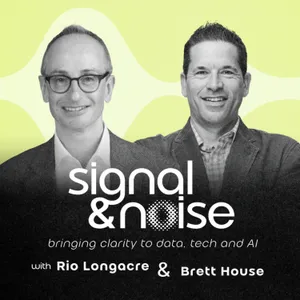
Join advertising industry veterans Brett House and Rio Longacre as they share regular updates and analysis on the changing world of data, tech, and AI. You’ll hear real talk from thought leaders across industries about the latest trends having the biggest impact on our jobs… and lives. Signal & Noise means no BS - only straight talk and first-hand insights from leading operators, creators, and founders.
Latest Episodes
The most recent episodes — sign up to get AI-powered summaries of each one.
- 3 days ago1h 51m
The Meme Is The Message: Gregory Kennedy on Vibes. Attention, and Building a Business After Silicon Valley
AI makes it easier to create content. Getting people to care is still the hard part.On this episode of Signal & Noise, host Rio Longacre and guest host Krish Raja sit down with Gregory Kennedy, founder of Vibe Your SaaS, for a candid conversation about memes, founder-led marketing, creative talent, and building an independent business in the AI era.Gregory traces his path from New York’s design scene and an award-winning website he built in 1997 to two decades in Silicon Valley and a move to Seattle. He explains how a founder-coaching idea grew into Vibe Your SaaS—a business combining content and go-to-market consulting, a newsletter, and startup pitch competitions—and why his Bay Area network remains central to his work.Along the way, the conversation tackles what it takes to build an audience, develop a recognizable voice, and turn attention into an opportunity to do business.In this episode:• The anatomy of a meme: How recognizable moments, humor, and an unexpected twist make an idea travel—and why Gregory thinks the Drake meme needs to retire.• Building an audience from zero: The posting, replies, persistence, and personal commitment behind Gregory’s presence on X, plus why your platform should fit your strengths and personality.• Founder-led marketing with a point of view: How Gregory uses his voice to attract the right clients, why controversy carries real risks, and how he advises founders to stay in a lane they understand and can defend.• Taste, brand, and AI-generated content: Why Gregory believes taste has always mattered, how consistent quality builds recognition, and why cheaper content doesn’t make attention easier to earn.• “Become inevitable”: The connection between founder conviction, a real customer need, a clear market story, and building an audience before you launch.• Silicon Valley, Seattle, and startup culture: Gregory’s case for the Bay Area’s concentration of talent and ambition, and his perspective on how Seattle’s business policies have affected his own plans.• AI and the human side of sales: Why automating outreach doesn’t automatically win customers—and the value of a founder’s ability to make decisions on the spot.• Talent, careers, and smaller teams: A debate about leaning into your strengths, valuing individual contributors, and using AI to build more with fewer resources.Plus, Gregory makes his pick between taste and distribution, questions the return on in-person B2B events, and shares why he’s optimistic about the opportunities opening up for solo founders and small teams.For founders, marketers, and creators trying to earn attention in a crowded feed, this is a conversation about finding what you’re good at, showing up consistently, and giving people a reason to remember you.Connect with Gregory:Vibe Your SaaSXLinkedInSubscribe to Signal & Noise on YouTube or follow on Spotify for more conversations on marketing, technology, and the people building what comes next.#SignalAndNoise #GregoryKennedy #VibeYourSaaS #B2BMarketing #FounderLedMarketing #Memes #AI #Startups #GoToMarket
- 6 days ago1h 23m
Can the Open Web Survive the Al Age? Kurt Donnell on Publisher Economics, Radical Transparency, and pubOS
The open web has survived search, social media, programmatic advertising, privacy regulation, and the rise of the walled gardens. But does generative AI represent a fundamentally different threat?In this episode of Signal & Noise, Rio Longacre sits down one-on-one with Kurt Donnell, President & CEO of Freestar, while Brett House is away.Kurt brings an unusual perspective. He began his career as an M&A attorney, moved into media and operations, helped take YogaWorks public, and eventually joined Freestar as its first CEO. Under his leadership, Freestar says it has grown sevenfold, expanded to 185 employees across 15 countries, and returned more than $1 billion to publishers.Rio and Kurt tackle an increasingly urgent question for digital media: Is the publisher crisis still primarily a monetization problem, or has AI created a structural break in the economics of the open web?Kurt explains how the historical bargain between publishers and platforms is changing. Search engines consumed publisher content but also sent traffic back. AI answer engines can deliver the answer without the click. Larger publishers with strong brands, direct audiences, and genuine utility have generally held up better, while SEO-dependent long-tail publishers have faced greater pressure.The conversation goes well beyond AI.Rio and Kurt discuss why original journalism remains essential even in a world of podcasts, Substacks, creators, and AI summaries. Someone still has to produce the reporting—the raw material everyone else analyzes, summarizes, and synthesizes. Without a sustainable model for creating that information, the ecosystem suffers.They also unpack the economics of programmatic: supply-path duplication, unnecessary intermediaries, declining trust, and why the open web remains harder for advertisers to understand than closed platforms. Kurt argues one of the walled gardens’ greatest advantages is simplicity and transparency—the ability to show advertisers what happens when they put money into the system.Kurt also explains Freestar’s pubOS, a unified operating layer to help publishers manage header bidding, yield optimization, analytics, identity, integrations, demand partners, and managed services with less complexity.Rio and Kurt explore:Why publishers need to become better marketersWhether subscriptions, commerce, events, and licensing can supplement adsWhy email and newsletters may be among the most valuable assets pubs controlHow first-party data and authenticated audiences can improve economicsWhy trust and verification remain barriers to monetizing pub signalsWhether cleaner supply paths can rebuild advertiser confidenceWhy CPM and fill rate can be misleadingThe role of curation and first-party audience signalsWhether agentic trading can remove unnecessary layers from programmaticWhat publishers must own directly as discovery shifts from searchOn agentic advertising, Kurt is cautiously optimistic. Direct communication between scaled buyer and seller systems could improve targeting, packaging, reporting, and transparency, but the market remains early and infrastructure still needs to be recreated.This is a conversation about much more than publisher yield. It is about whether independent digital media can build a new economic model around direct relationships, trusted content, cleaner advertising infrastructure, better data, and dramatically less friction before AI permanently reshapes how audiences discover information.Featuring: Kurt Donnell, President & CEO, FreestarHosted by: Rio Longacre, Signal & Noise#SignalAndNoise #KurtDonnell #Freestar #AdTech #Publishing #OpenWeb #ProgrammaticAdvertising #DigitalMedia #GenerativeAI #AgenticAI #PublisherMonetization #FirstPartyData #HeaderBidding #SupplyPathOptimization #Journalism #MediaEconomics #pubOS
- 1 weeks ago1h 36m
Companies Don’t Transform, People Do: Rishad Tobaccowala on Work, Agencies, and Reinvention
Few people have had a better vantage point on the transformation of advertising, technology, and work than Rishad Tobaccowala.Over a 37-year career at Publicis Groupe, Rishad helped pioneer its digital businesses, chaired Digitas and Razorfish, and ultimately served as Global Chief Strategist and Growth Officer. Today, he is an author, teacher, adviser, senior adviser to Publicis Groupe, co-founder of the Athena Project on Modern Leadership, and one of the industry’s most original thinkers on how people and organizations navigate change. In this wide-ranging, smart, funny, and deeply thought-provoking conversation, Rishad joins Brett House and Rio Longacre to challenge one of the biggest assumptions surrounding technological transformation: companies don’t transform simply because they buy new technology, reorganize, or deploy AI. Companies transform when their people do.Rishad argues that AI represents something fundamentally different from previous technology waves—not simply another tool, but what he calls an emerging form of “alien intelligence.” The question, then, isn’t whether organizations have an AI strategy. It’s whether they are willing to rethink how work gets done, how people are rewarded, where power sits, and what human beings uniquely contribute. The conversation explores why transformation is ultimately about power, politics, people, and partnering; why technology moves faster than organizations; and why simply making the old model more efficient is like putting a faster engine into a car when what you really need is to design an airplane. Rishad also explains his idea of “de-bossification”—the decline of management built around control and the rise of leadership built around influence. He compares the organization of the future to jazz rather than classical music: more improvisational, collaborative, fluid, and less dependent on rigid hierarchy. Along the way, they dig into:Why AI may change nearly every white-collar job without necessarily eliminating workThe rise of portfolio careers, fractional talent, freelance work, and agentic employeesThe six skills Rishad believes matter most: creativity, curiosity, cognition, collaboration, convincing, and communicationWhy knowledge may become abundant while judgment, imagination, and wisdom become more valuableHow individuals can “rearchitect” their careers instead of waiting for an employer to provide purposeWhy leaders should “untie, not cut” when leaving organizationsWhat Publicis got right in its decade-long transformation—and why changing incentives and behavior mattered as much as acquisitions and technologyWhy agencies, consultancies, and other services businesses will struggle to keep selling hours and FTEs in an AI-enabled economyRishad also shares a deceptively simple definition of success: the freedom to spend your time in ways that give you joy.This is a conversation about AI, but even more, it is about work, leadership, careers, agencies, reinvention, and human agency. And it’s a reminder from one of advertising’s great strategic thinkers that the hardest part of transformation has never been the technology.#SignalAndNoise #RishadTobaccowala #FutureOfWork #Leadership #Reinvention #Advertising #Marketing #Agencies #PublicisGroupe #DigitalTransformation #OrganizationalTransformation #GenerativeAI #AgenticAI #Careers #FutureOfAgencies #Workplace #BusinessStrategy #HumanIntelligence #Debossification #RethinkingWork
- 2 weeks ago55 min
From Cash Back to Outcomes: Bryan Leach on Building Ibotta, Going Public, and Betting on Denver
What does it take to walk away from a prestigious legal career, build a technology company from scratch, take it public—and then reinvent the business along the way?In this episode of Signal & Noise, Brett House and Rio Longacre sit down with Bryan Leach, Founder, CEO, President & Chairman of Ibotta, for a wide-ranging conversation about entrepreneurship, commerce media, measurement, AI, and why he chose Denver as the place to build. Bryan’s path to technology was anything but conventional. After Harvard, Oxford as a Marshall Scholar, Yale Law School, a Supreme Court clerkship, and a successful career at Bartlit Beck, he realized he wanted to build something of his own. The idea that became Ibotta began on an airplane, when Bryan watched another traveler photograph receipts and started thinking about how smartphones could capture purchase data—and eventually make rebates dramatically easier for consumers. What started as a cash-back app has evolved into something much larger: the Ibotta Performance Network (IPN), which distributes digital promotions through major platforms and retailers. Today, much of Ibotta operates behind the scenes, powering offers inside experiences like Walmart and other publisher partners rather than requiring consumers to use the Ibotta app itself. The conversation goes deep on one of advertising’s hardest problems: proving outcomes. Bryan explains why a redemption isn’t enough, why incrementality matters, and how Ibotta is trying to shift CPG promotions away from impressions, clicks, and blanket discounts toward measurable incremental sales and a true cost-per-outcome model. He also explains how persistent retailer IDs and item-level purchase data make it possible to compare exposed and unexposed consumers and measure actual lift. They also dig into:Why Bryan left law even after reaching a career most people would never walk away from—and how one mentor’s decision to invest became a pivotal moment in Ibotta’s creation.How Ibotta grew from roughly 2 million to 20.9 million redeemers, with much of that growth coming through third-party publishers. Why Bryan believes promotions should increasingly be treated as an always-on performance channel, with spending governed by incremental economics rather than fixed annual budgets. How AI is already changing Ibotta’s product, software development, measurement capabilities, and internal workflows.The transition from private company to public company—and the lessons of building one of Colorado’s landmark technology companies.Why Bryan sees Denver’s culture, talent base, quality of life, and civic accessibility as competitive advantages for founders. It’s a conversation about much more than coupons or cash back. It’s about transforming promotions from a century-old marketing tactic into a measurable growth engine—and what Bryan learned from taking Ibotta from an idea to a public technology company along the way.#SignalAndNoise #Ibotta #BryanLeach #CommerceMedia #RetailMedia #CPG #PerformanceMarketing #AdTech #MarTech #Incrementality #MarketingMeasurement #DigitalPromotions #RetailTech #CustomerData #AI #ArtificialIntelligence #Entrepreneurship #Founders #Startups #DenverTech #ColoradoTech #IPO #BusinessLeadership #Innovation #Marketing #Advertising #ConsumerBehavior #FutureOfCommerce
- 2 weeks ago51 min
When Content Becomes Infinite: Alex Collmer on Creative Intelligence in the AI Advertising Era
Generative AI has made it radically easier—and cheaper—to create advertising. But if every brand can suddenly produce infinite variations using the same models, what creates competitive advantage?In this episode of Signal & Noise, Rio Longacre and Brett House sit down with Alex Collmer, Founder & Executive Chairman of Vidmob, to explore why the next battleground in advertising may not be content generation. It may be the intelligence that determines what to create, why it works, and what brands learn from every ad they put into market. Alex traces Vidmob’s evolution from a marketplace connecting marketers with video creators into what it now calls a creative data company. The turning point came when Vidmob connected its production systems directly to advertising platforms and suddenly gained access to performance data. That exposed a major disconnect: marketers spent years optimizing audiences, bids, identity, attribution, geography, and media—but creative remains one of advertising’s most important and least-instrumented variables. Alex explains what creative data means: a structured understanding of the thousands of decisions contained within an ad—from messaging and narrative arc to logo placement, pacing, framing, imagery, and brand cues—and how those decisions correlate with business and campaign outcomes.The conversation turns to generative AI. Alex argues foundation models themselves are rapidly becoming commodities. If every competitor has access to the same technology, simply having better AI won’t create a durable advantage. The differentiator is proprietary intelligence brands bring into those systems: what they know about their creative, customers, performance, and how their brand communicates effectively.That raises an even bigger strategic question: Should brands allow platforms to own that intelligence—or build and control it themselves?Alex discusses Vidmob360 and the shift from static dashboards to APIs, MCP services, assistants, and agents that make creative intelligence actionable inside existing marketing workflows. Instead of receiving a PowerPoint weeks after a campaign launches, marketers can interrogate live creative performance, identify fatigue, understand why assets are succeeding or failing, generate better briefs, and connect insights directly to production and media decisioning. Rio, Brett, and Alex also tackle the danger of creative sameness. Generative AI can produce thousands of variations, but volume isn't originality. Continuous optimization can easily become a feedback loop in which every brand learns from yesterday's winners and gradually begins looking and sounding the same.They also explore what all of this means for designers and creative professionals. Alex sees AI less as a replacement for great creatives than another powerful tool—and argues the best technically literate creators may enter an entirely new playing field. Real-time performance feedback can also finally give creative teams something they've historically lacked: a direct learning loop between what they make and how audiences respond.Plus: why Alex once raced humans against horses, why click-through rate is the creative metric he'd eliminate tomorrow, and the human capability he believes becomes even more valuable as AI improves: storytelling. Topics include: Creative intelligence • Creative data • Generative AI • Vidmob360 • MCP and AI agents • Creative optimization • Brand sovereignty • Walled gardens • Creative measurement • Content abundance • Advertising automation • Creative fatigue • Human creativity • The changing role of designers#SignalAndNoise #AlexCollmer #Vidmob #CreativeIntelligence #CreativeData #GenerativeAI #Advertising #AdTech #Marketing #MarketingTechnology #CreativeTechnology #AIAdvertising #AgenticAI #AIAgents #MCP #BrandStrategy #DigitalAdvertising #CreativeOptimization #MarketingAI #Media #PerformanceMarketing #CreativeStrategy #FutureOfAdvertising #ContentCreation #BrandMarketing
- 3 weeks ago1h 22m
The Operating System for Commerce Media: Jeffrey Cohen on Amazon Ads’ Rise, Retail Media’s Measurement Reckoning, and the Shift from Dashboards to Agents
Retail media was built on a powerful promise: connect advertising directly to transactions and finally show marketers what their media dollars produced. But as the category matures, a harder question is replacing simple attribution: Did the advertising actually cause the sale?In this episode of Signal & Noise, Rio Longacre and Brett House sit down with Jeffrey Cohen, Chief Business Development Officer at Skai and former Principal Evangelist at Amazon Ads, for a wide-ranging conversation about the evolution of commerce media—and what happens as intelligent agents begin taking over work once performed through dashboards, spreadsheets, rules engines, and manual campaign management.Jeff had a front-row seat during Amazon Ads’ extraordinary rise. He explains what Amazon got right, from the simplicity of “search, find, buy” to its ability to connect media exposure with actual commerce. But from outside Amazon, he now sees the larger challenge: consumers don’t live inside walled gardens. TikTok can drive an Amazon purchase. Prime Video can influence a Walmart sale. In-store activity affects digital behavior, and digital media influences what happens on the shelf. That creates a measurement reckoning. ROAS and last-touch attribution can tell marketers what received credit for a transaction, but not necessarily what caused it. The conversation digs into incrementality, cross-channel effects, independent measurement, and why historically siloed media, shopper marketing, trade promotion, and commerce teams increasingly need to operate together.Then the discussion moves from dashboards to agents.Jeff explains how Skai is approaching this transition through Celeste, Skai Studio, MCP connectivity, and agentic workflows. Instead of asking an AI assistant for an insight, marketers can build systems capable of analyzing signals, finding audiences, recommending budgets, creating campaigns, monitoring performance, and escalating decisions to humans for approval.The goal, Jeff argues, shouldn't be another marketing black box, but a glass box: automation where marketers can understand the logic behind decisions, establish guardrails, audit actions, and retain control over critical choices—especially where budgets are concerned.One particularly striking finding: Jeff says 45% of the questions asked through Celeste could not have been answered manually within the traditional Skai platform. Agents aren't simply making analytics faster; they're combining data and performing analysis that previously required people to jump between systems, download reports, manipulate data, and assemble the answer themselves. The implications extend far beyond media buying. Jeff describes Skai's own company-wide agentic transformation and the emergence of a new kind of marketer: the builder—someone who may not be a traditional software engineer but understands systems, processes, data, business rules, and how to turn them into intelligent workflows.In this episode:How Amazon Ads became an advertising giantWhy “search, find, buy” proved so powerfulAttribution vs. incrementalityWhy platforms end up “grading their own homework”The convergence of retail media, CTV, social, and in-storeCeleste, Skai Studio, MCP, and agentic workflowsWhy agents need guardrails, auditability, and human oversightWhy major budget decisions still require human approvalWhy AI transformation is really operating-model transformationThe marketer as a builderWhy companies need to rethink workflows instead of automating themThe big question is no longer whether AI can optimize another campaign or generate dashboards. It’s what decisions we delegate, what governance those systems require, and where human judgment remains essential.Hosted by Rio Longacre and Brett House on Signal & Noise.#RetailMedia #CommerceMedia #AmazonAds #AdTech #MarketingTechnology #AgenticAI #MarketingAI #RetailMediaNetworks #Incrementality #Advertising #MediaBuying #Skai #DigitalAdvertising #SignalAndNoise
- 3 weeks ago1h 58m
The Permission Layer: Who Told the Al It Could Do That? Richy Glassberg on Data Privacy, Consent, and Al Innovation
AI agents can retrieve, combine, analyze, infer from, and act on enormous amounts of data—often at a speed no human compliance team can match. But access to data does not automatically confer the right to use it. So who sets the rules, and who remains accountable when an AI system crosses the line?In this episode of Signal & Noise, Brett House and Rio Longacre sit down with Richy Glassberg, Co-Founder and CEO of SafeGuard Privacy, for a candid and wide-ranging conversation about privacy, consent, AI governance, and the digital advertising industry’s long history of creating problems it later asks technology to solve.Richy brings a rare perspective to the discussion. He helped build CNN.com’s commercial business, co-founded the IAB, worked across publishing, agencies, ad tech, and media, and now leads a company focused on making privacy compliance and vendor diligence standardized, operational, and auditable.The conversation begins with a provocative argument: AI may not require an entirely new category of privacy law because AI is ultimately software—and existing rules governing data use, discrimination, consent, and accountability still apply. The real challenge is enforcing those rules as AI dramatically increases the speed, scale, and complexity of data use.Richy explains why companies are now responsible for privacy compliance throughout their vendor chains, including the DSPs, publishers, data brokers, identity providers, models, APIs, and other partners involved in a transaction. When one black box passes data to another black box—and AI begins making decisions across the entire chain—policies and promises are no longer enough. Organizations need standardized diligence, enforceable controls, ongoing monitoring, and proof.The group also examines why today’s consent system is fundamentally broken. Cookie banners have created consent fatigue without giving consumers meaningful understanding or control. Privacy policies are rarely read, permissions do not travel cleanly across platforms, and people can opt out in one place only to reappear in the same identity graph somewhere else.Other topics include:• Why an AI agent should never have more authority than the person or organization it represents• The tension between giving AI more context and protecting individual privacy• Why human oversight remains essential in agentic systems• How marketers should assess and monitor every company handling their data• Why privacy diligence must become machine-readable for real-time agent decisions• The failure of one-to-one targeting and the industry’s obsession with questionable audience data• How poor frequency management is damaging the connected TV experience• Why better privacy practices could become a mark of data quality and competitive differentiation• The threat AI-generated content poses to trusted information and the open internet• Whether consumer-controlled data and permission agents could produce a healthier advertising ecosystemIt’s a funny, blunt, and occasionally uncomfortable conversation about what responsible data use should look like when machines can move faster than the institutions meant to govern them.Learn more about SafeGuard Privacy: https://safeguardprivacy.com/#ArtificialIntelligence #DataPrivacy #AIPrivacy #AIGovernance #Consent #DigitalAdvertising #AdTech #AgenticAI #PrivacyTech #MarketingTechnology #DataGovernance #ProgrammaticAdvertising #SignalAndNoisePodcast
- 4 weeks ago56 min
AI That People Actually Use: Zoher Karu on Personalization, Trust, and Building AI at Scale
Everyone is talking about AI. Far fewer people have spent decades actually building AI and data systems inside some of the world’s largest organizations.In this episode of Signal & Noise, Brett House and Rio Longacre sit down with Zoher Karu, Head of AI at Taelor, to separate AI hype from what it actually takes to create measurable business value.Zohar brings an unusually broad perspective. His career has taken him through McKinsey, Sears, Citi, eBay, Blue Shield of California, and now Taelor—an AI-powered men’s clothing rental service attempting to combine machine intelligence with human styling expertise. Across those very different businesses, Zohar argues that the same lesson keeps resurfacing: the technology is rarely the hardest part. The conversation starts with one of enterprise AI’s least glamorous truths: bad data doesn’t disappear because you put an LLM on top of it. As Zoher puts it, AI can simply give you “bad answers faster.” Data governance, business processes, organizational knowledge, and change management remain foundational.From there, the discussion gets practical. Zoher explains how Taelor is attempting to teach machines something surprisingly difficult: taste. Matching clothes to a person requires understanding not just size and style, but weather, occasion, context, individual preferences, previous feedback—and even whether two individually appropriate pieces of clothing actually work together. That becomes a window into a much bigger conversation about the future of personalization. Generative AI dramatically expands the amount of customer context businesses can process, how quickly they can respond to new signals, and the number of individualized experiences they can create. Instead of choosing among three versions of an email, brands could theoretically generate an almost infinite number of variations for individual customers.The discussion also tackles the uncomfortable economics of enterprise AI. Companies are spending enormous amounts on models, infrastructure and tokens—but are they actually redesigning the business processes required to capture the ROI? Zoher argues that automating pieces of an existing workflow may deliver incremental efficiency, while the much larger opportunity comes from asking whether that workflow should exist at all. Finally, the conversation explores what may become one of the most important issues in enterprise AI: context. Agents can access data, but data alone doesn't contain all the rules, judgment and institutional knowledge humans use to make decisions. Capturing that tacit business knowledge—and making it available to AI systems—could become a critical source of competitive advantage and intellectual property.In this episode:* Why dirty data can derail even sophisticated AI* Why AI transformation is really organizational transformation* The gap between AI spending and measurable ROI* Why simply automating existing processes isn't enough* How AI is changing personalization and recommendation systems* How Taelor combines human stylists with machine intelligence* Why context and business knowledge matter as much as models* Whether AI is actually eliminating jobs or simply changing them* Why change management may be the biggest barrier to enterprise AI* The continuing importance of human judgment in increasingly autonomous systemsThe companies that win the AI race may not be the ones with the most sophisticated models. They may simply be the ones that figure out how to build AI that people actually use. #ArtificialIntelligence #AI #EnterpriseAI #GenerativeAI #AgenticAI #Personalization #CustomerExperience #DataStrategy #DataGovernance #MachineLearning #DigitalTransformation #AITransformation #ChangeManagement #MarTech #RecommendationEngines #FutureOfWork #SignalAndNoise #Podcast
Get Signal & Noise summaries in your inbox
Free AI-powered daily recaps. Key takeaways, quotes, and mentions — in a 5-minute read.
Get Free Summaries →Free forever for up to 3 podcasts. No credit card required.
You Might Also Like
Listeners also like.

The Best One Yet
A daily 20-minute podcast breaking down the three key business stories with sharp, accessible takes.
Signals and Threads
Discussions with engineers tackling technical challenges in systems programming, infrastructure, and hardware at Jane Street.

The Cast Nexa Show
Explores how AI, creativity, and digital storytelling are reshaping business, communication, and content in the modern era.

Right About Now - Legendary Business Advice
Raw business insights from founders and industry leaders, revealing real wins, failures, and actionable strategies without the fluff.

Latent Space: The AI Engineer Podcast
Explores AI engineering breakthroughs in foundation models, code generation, and AI agents through interviews with researchers and developers.

More or Less
Tech insiders discuss the future of Silicon Valley and the industry's biggest trends.

The Best SEO Podcast
A practical guide to SEO in the age of AI, focusing on real-world strategies that work and insights from experienced marketers.

All-In with Chamath, Jason, Sacks & Friedberg
Four tech investors discuss technology, markets, politics, and poker with candid, in-depth analysis.

Sources with Alex Heath
A podcast offering insider interviews with influential tech leaders and rising entrepreneurs shaping Silicon Valley's future.

Primary Technology
Tech news covering consumer gadgets, AI, and major industry stories explained for a general audience.

The a16z Show
Explores technology and cultural shifts shaping the future through conversations with industry leaders and innovators.

The AI XR Podcast.
Industry insiders interview top founders and executives on AI, spatial computing, VR/AR, and synthetic media.
About Signal & Noise
Join advertising industry veterans Brett House and Rio Longacre as they share regular updates and analysis on the changing world of data, tech, and AI. You’ll hear real talk from thought leaders across industries about the latest trends having the biggest impact on our jobs… and lives. Signal & Noise means no BS - only straight talk and first-hand insights from leading operators, creators, and founders.
Customized Recaps
AI-powered recaps with compact key takeaways, quotes, and insights.
Straight to Your Inbox
Get key takeaways from Signal & Noise in a 5-minute read.
Save Hours Every Week
Stay current on your favorite podcasts without falling behind.
Frequently Asked Questions
What is Podzilla's Signal & Noise daily summary?
It's a free AI-powered email that summarizes new episodes of Signal & Noise as soon as they're published. You get the key takeaways, notable quotes, and links & mentions — all in a quick read.
How does the Signal & Noise podcast summary work?
When a new episode drops, our AI transcribes and analyzes it, then generates a personalized summary tailored to your interests and profession. It's delivered to your inbox every morning.
Is this an official Signal & Noise product?
No. Podzilla is an independent service that summarizes publicly available podcast content. We're not affiliated with or endorsed by Signal and Noise.
Can I get summaries of other podcasts too?
Absolutely! The free plan covers up to 3 podcasts. Upgrade to Pro for 15, or Premium for 50. Browse our full catalog at /podcasts.
How often does Signal & Noise release new episodes?
Signal & Noise publishes every few days. Our AI generates a summary within hours of each new episode.
What topics does Signal & Noise cover?
Signal & Noise covers topics including News. Our AI identifies the specific themes in each episode and highlights what matters most to you.
Start getting Signal & Noise summaries tomorrow morning.
Free forever for up to 3 podcasts. No credit card required.
Free forever for up to 3 podcasts. No credit card required.