Free Daily Podcast Summary
Strange Health: Daily Summaries Delivered
by The Conversation
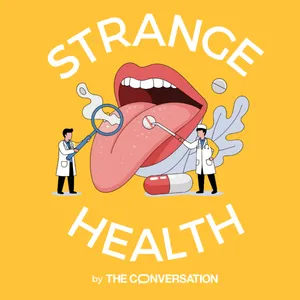
Strange Health dives into the science behind the most bizarre, viral, and sometimes questionable health trends dominating social media from period scooping and menstrual masking to stroboscopic light therapy, demodex mites, vagus nerve hacks and liver detox myths. Expect honest, engaging, and sometimes stomach-turning discussions. Hosted by Katie Edwards from The Conversation and Dan Baumgardt, a GP and lecturer at the University of Bristol.
Latest Episodes
The most recent episodes — sign up to get AI-powered summaries of each one.
- Mar 10, 202638 min
What is period scooping? And other menstrual hacks you should think twice about
Period scooping sounds like something you would only hear in a biology lab, not while doom-scrolling TikTok. Yet earlier this year, videos claiming you can “scoop out” your period to avoid the mess and shorten the whole thing racked up millions of views. In this episode, we hear from Sally King, a visiting fellow at King’s College London, about why you can't shorten your period, and why you need to be careful about upsetting the pH balance of your body. She also gives us her perspective as a menstrual physiologist on other period hacks, including menstrual blood face masks, and drinks that some influencers say can shorten your period. Strange Health is a podcast from The Conversation, an independent, not-for-profit news organisation. If you've got a question about a viral trend or video you've seen and you'd like us to delve into the science behind it in a future episode, please email us at strangehealth@theconversation.com. Full credits for this episode available here. If you like the show, please consider donating to support our work. You can sign up here for a free daily newsletter from The Conversation here. If you've got a questeion Hosts: Katie Edwards from The Conversation and Dan Baumgardt, University of Bristol Executive Producer: Gemma Ware Editing and mixing: Anouk Millet Artwork: Alice Mason Menstrual health literacy is alarmingly low – what you don’t know can harm you Would you put period blood on your face? What science says about ‘menstrual masking’ Your vagina cleans itself: why vagina cleaning fads are unnecessary and harmful
- Mar 3, 202639 min
Does light therapy work? The science of stroboscopic stimulation
Light therapy sounds wholesome. Sit in front of a lamp. Feel better. But nowadays, it can also mean strapping on a flashing mask and watching your own brain generate kaleidoscopic hallucinations behind closed eyelids. In this episode, host Katie Edwards tries on a stroboscopic light mask being promoted by celebrities including Jennifer Aniston and Rosamund Pike to find out what happens. And David Schwartzman, a research fellow at the Sussex Centre for Consciousness Science at the University of Sussex, explains how stroboscopic light produces hallucinations in the brain, and how it's currently being trialled to treat conditions like depression. Strange Health is a podcast from The Conversation, an independent, not-for-profit news organisation. Full credits for this episode available here. If you like the show, please consider donating to support our work. You can sign up here for a free daily newsletter from The Conversation here. Hosts: Katie Edwards from The Conversation and Dan Baumgardt, University of Bristol Executive Producer: Gemma Ware Editing and mixing: Anouk Millet Artwork: Alice Mason Can a psychedelic-induced mystical experience really improve your mental health? SAD lamps: do they work? Experts explain how they help the winter blues
- Feb 24, 202641 min
What your body odour says about you
Body odour has a reputation problem. It is often treated as a hygiene failure or a social offence. In reality, it is biology at work, plus a big helping of culture. And yet people online are trying chlorophyll shots to make their BO smell better. Hosts Katie Edwards and Dan Baumgardt discuss what evidence there is behind this, plus some of the health conditions that can affect body odour. And we talk to Mats Olsson, a professor of experimental psychology at the Karolinska Institutet in Stockholm, who studies how humans perceive body odour. Strange Health is a podcast from The Conversation is an independent, not-for-profit news organisation. Full credits for this episode available here. If you like the show, please consider donating to support our work. You can sign up here for a free daily newsletter from The Conversation here. Hosts: Katie Edwards from The Conversation and Dan Baumgardt, University of Bristol Executive Producer: Gemma Ware Editing and mixing: Anouk Millet Artwork: Alice Mason
- Feb 17, 202635 min
Meet the mites that live on you: from demodex to dust mites and scabies
You are not alone in your own skin. Millions of microscopic creatures live there too. Our skin is home to entire ecosystems of microscopic life. Bacteria and fungi get most of the attention, but mites are there too. Among the most common are demodex mites, tiny eight-legged relatives of spiders that live inside hair follicles and pores, especially on the face. Almost all adults carry them. In this episode we explore what these microscopic housemates are actually doing on our bodies and why the idea of them can feel so unsettling. While demodex may be harmless, there are plenty of other mites that can cause problems, from dust mites, to scabies. Hosts Katie Edwards and Dan Baumgardt turn this week to Alejandra Perotti, professor of invertebrate biology at the University of Reading, who studies the relationship between mites and humans. Strange Health is a podcast from The Conversation is an independent, not-for-profit news organisation. Full credits for this episode available here. If you like the show, please consider donating to support our work. You can sign up here for a free daily newsletter from The Conversation here. Hosts: Katie Edwards from The Conversation and Dan Baumgardt, University of Bristol Executive Producer: Gemma Ware Editing and mixing: Sikander Khan Artwork: Alice Mason Invisible skin mites called Demodex almost certainly live on your face – but what about your mascara? How often should you really be washing your bedding? A microbiologist explains Scabies outbreak in UK and Europe – what you need to know
- Feb 10, 202636 min
What is the vagus nerve and can you really reset it?
The vagus nerve has become the internet’s favourite body part. On social media, it is everywhere. People hum into their phones, gargle with theatrical enthusiasm, dunk their faces into bowls of ice water and poke at their ears in the hope of “activating” it. So in this episode we focus our attention on the body’s longest cranial nerve and ask a simple question: what does the vagus nerve actually do, and can we really hack it? Hosts Katie Edwards and Dan Baumgardt turn this week to Arshad Majid, a professor of cerebrovascular neurology at the University of Sheffield and an expert in vagus nerve stimulation. Strange Health is a podcast from The Conversation is an independent, not-for-profit news organisation. Full credits for this episode available here. If you like the show, please consider donating to support our work. You can sign up here for a free daily newsletter from The Conversation here. Hosts: Katie Edwards from The Conversation and Dan Baumgardt, University of Bristol Executive Producer: Gemma Ware Editing and mixing: Anouk MIllet Artwork: Alice Mason From decapitation to positive psychology: how one nerve connects body, brain and mind Stimulating the pathway connecting body and brain may change chronic condition patients’ lives
- Feb 3, 202634 min
Is cracking my neck and knuckles bad?
Joint cracking is one of those habits most of us acquire without thinking about it. In our third episode, we turn our attention to one of the body’s most common and least understood noises. Knuckles, backs, knees and necks all feature, along with the enduring warning many of us grew up with: “Stop cracking your joints, you’ll get arthritis.” Is there any truth in it? And why can cracking feel so strangely satisfying? Hosts Katie Edwards and Dan Baumgardt turn this week to Clodagh Toomey, a specialist in musculoskeletal injury and chronic lifestyle-related diseases such as osteoarthritis, to give you the science behind the myths. Strange Health is a podcast from The Conversation is an independent, not-for-profit news organisation. If you like the show, please consider donating to support our work. You can sign up here for a free daily newsletter from The Conversation here. Hosts: Katie Edwards from The Conversation and Dan Baumgardt, University of Bristol Executive Producer: Gemma Ware Editing and mixing: Anouk MIllet Artwork: Alice Mason Can popping your neck cause a stroke? What makes joints pop and crack and is it a sign of disease? Joint pain or osteoarthritis? Why exercise should be your first line of treatment
- Jan 27, 202626 min
Tonsils, kidneys and gall: why your body makes stones
The human body, it turns out, is surprisingly good at making stone. Give it enough time and the right conditions and it will go about crystallising minerals, hardening secretions and, in rare cases, turning tragedy into rock. Gallstones. Kidney stones. Tonsil stones. Salivary stones. And, in one of the strangest and saddest corners of medical history, stone babies. In our second episode, hosts Katie Edwards, a health editor at The Conversation, and Dan Baumgardt, a practising GP and lecturer in health and life sciences at the University of Bristol, take a tour through the stony side of human anatomy and ask why this keeps happening, where these stones form and which ones you actually need to worry about. They talk to Adam Taylor, a professor of anatomy at Lancaster University, who has spent years studying stones in both everyday and extraordinary contexts, including a rare genetic condition called alkaptonuria Strange Health is a podcast from The Conversation is an independent, not-for-profit news organisation. If you like the show, please consider donating to support our work. You can sign up here for a free daily newsletter from The Conversation here. Hosts: Katie Edwards and Dan Baumgardt Executive Producer: Gemma Ware Editing and mixing: Sikander Khan Artwork: Alice Mason Stone baby: the rare condition that produces a calcified foetus Our bodies don’t just make gall and kidney stones – from saliva to tonsils, these are other ones to look out for Bubble tea’s dark side: from lead contamination to kidney stones
- Jan 20, 202633 min
Is detoxing your liver worth the hype?
Social media is full of green juices, charcoal supplements, foot patches and seven-day “liver resets”, all promising to purge the body of mysterious toxins and return it to a purer state. But do you really need to detox your liver? In the first episode of Strange Health, hosts Katie Edwards, a health editor at The Conversation, and Dan Baumgardt, a practising GP and lecturer in health and life sciences at the University of Bristol wince and occasionally laugh their way through some of the internet’s most popular detox trends. They also speak to Trish Lalor, a liver expert from the University of Birmingham, whose message is refreshingly blunt: “your body is really set up to do it by itself.” Strange Health is a podcast from The Conversation is an independent, not-for-profit news organisation. If you like the show, please consider donating to support our work. You can sign up here for a free daily newsletter from The Conversation here. Hosts: Katie Edwards and Dan Baumgardt Executive Producer: Gemma Ware Editing and mixing: Sikander Khan Artwork: Alice Mason
Get Strange Health summaries in your inbox
Free AI-powered daily recaps. Key takeaways, quotes, and mentions — in a 5-minute read.
Get Free Summaries →Free forever for up to 3 podcasts. No credit card required.
You Might Also Like
Listeners also like.

Health vs Hype with the American Medical Association
A medical expert debunks viral health trends and misinformation with science-backed insights from physicians.

Health Discovered
Doctors explore surprising stories to uncover insights about health and well-being.

Red Pill Your Healthcast
Two healthcare providers discuss overlooked health issues and empower listeners to make informed decisions for their families.
Paul Saladino MD podcast
A physician explores the root causes of chronic disease and optimal health through science and personal experimentation.

Science Weekly
The Guardian provides weekly updates on the latest science and environment news.

What's Up Docs?
Doctors Chris and Xand van Tulleken examine health science and medical advice to help listeners navigate conflicting wellness claims.

hol+ with Dr. Taz MD | The Future of Medicine is Holistic
A physician explores holistic health through the interconnected physical, mental, emotional, energetic, and social dimensions of wellness.

Own Your Health
Katie Brindle discusses health, ageing, and wellness topics with expert insights and personal anecdotes to help listeners improve their well-being.

hol+ with Dr. Taz MD | The Future of Medicine is Holistic
Explores holistic health by connecting physical, mental, and emotional factors like hormones, inflammation, and stress with expert discussions.
Naked Neuroscience, from the Naked Scientists
A monthly deep dive into how the nervous system works, exploring brain science in an engaging and interactive format.

ZOE Science & Nutrition
Experts break down cutting-edge health and nutrition science to help you make better choices for your body and gut.
The Art of Being Well
Explores holistic wellness through functional medicine, focusing on body, mind, spirit, and relationships as acts of self-respect.
About Strange Health
Strange Health dives into the science behind the most bizarre, viral, and sometimes questionable health trends dominating social media from period scooping and menstrual masking to stroboscopic light therapy, demodex mites, vagus nerve hacks and liver detox myths. Expect honest, engaging, and sometimes stomach-turning discussions. Hosted by Katie Edwards from The Conversation and Dan Baumgardt, a GP and lecturer at the University of Bristol.
Customized Recaps
AI-powered recaps with compact key takeaways, quotes, and insights.
Straight to Your Inbox
Get key takeaways from Strange Health in a 5-minute read.
Save Hours Every Week
Stay current on your favorite podcasts without falling behind.
Frequently Asked Questions
What is Podzilla's Strange Health daily summary?
It's a free AI-powered email that summarizes new episodes of Strange Health as soon as they're published. You get the key takeaways, notable quotes, and links & mentions — all in a quick read.
How does the Strange Health podcast summary work?
When a new episode drops, our AI transcribes and analyzes it, then generates a personalized summary tailored to your interests and profession. It's delivered to your inbox every morning.
Is this an official Strange Health product?
No. Podzilla is an independent service that summarizes publicly available podcast content. We're not affiliated with or endorsed by The Conversation.
Can I get summaries of other podcasts too?
Absolutely! The free plan covers up to 3 podcasts. Upgrade to Pro for 15, or Premium for 50. Browse our full catalog at /podcasts.
How often does Strange Health release new episodes?
Strange Health publishes weekly. Our AI generates a summary within hours of each new episode.
What topics does Strange Health cover?
Strange Health covers topics including Medicine, Nutrition, Fitness, Health & Fitness. Our AI identifies the specific themes in each episode and highlights what matters most to you.
Start getting Strange Health summaries tomorrow morning.
Free forever for up to 3 podcasts. No credit card required.
Free forever for up to 3 podcasts. No credit card required.