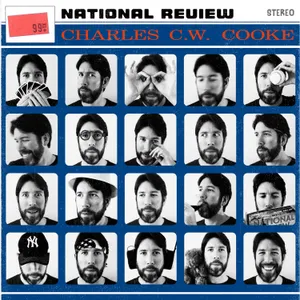
Free Daily Podcast Summary
The Charles C. W. Cooke Podcast: Daily Summaries Delivered
by National Review
A show about politics, music, technology, rollercoasters, golf carts, and the United States of America.
Latest Episodes
The most recent episodes — sign up to get AI-powered summaries of each one.
- May 1, 20261h 10m
Episode 103: The Declaration of Independence — with Michael Auslin
Charles talks to Michael Auslin about his new book, National Treasure: How the Declaration of Independence Made America. What is the Declaration of Independence? Who wrote it? How close we were to losing the original copy? Why did it appeal to early nineteenth-century socialists? Why did the committee remove the lines condemning the slave trade? When did women start using it to demand the vote? How did it help assimilate immigrants? What happened to it in WWII? Will it survive the next century? The dial-up tone in the introduction was recorded by lintphishx and is used under a CC 3.0 License. Hosted by Simplecast, an AdsWizz company. See pcm.adswizz.com for information about our collection and use of personal data for advertising.
- Apr 22, 202636 min
Episode 102: All About Gerrymandering — with Sean Trende
After the success of the Virginia gerrymander, Charles asks Sean Trende about the history of gerrymandering. What is it? Why is it called that? When did it start? What is a dummymander? When did our modern gerrymandering fights begin? Is mid-decade redistricting a historical anomaly? Who is playing defense here: the Democrats or the Republicans? Why have Republicans opposed federal laws banning gerrymandering? Are independent commissions actually independent? Can we outsource redistricting to a computer? What happens if the Supreme Court reworks its Voting Rights Act jurisprudence? Should we just go back to having representatives-at-large, who run statewide? Did the 2020 Census unfairly undercount gains in Republican states? How will the 2030 Census change our politics? Also: Is Donald Trump unpopular because he's Donald Trump, or because we just hate everyone now? And where are all the moderates? The dial-up tone in the introduction was recorded by lintphishx and is used under a CC 3.0 License. Hosted by Simplecast, an AdsWizz company. See pcm.adswizz.com for information about our collection and use of personal data for advertising.
- Apr 14, 202653 min
Episode 101: Last Branch Standing — with Sarah Isgur
On episode 101, Charles talks to Sarah Isgur about her new book, Last Branch Standing: A Potentially Surprising, Occasionally Witty Journey Inside Today's Supreme Court. What is the role of the Court? Do Americans understand it? Why has it survived? Do the justices get along? Why does everyone hate Citizens United? Is it a paradox that to get the Court to change the law, one often has to break the law? The dial-up tone in the introduction was recorded by lintphishx and is used under a CC 3.0 License. Hosted by Simplecast, an AdsWizz company. See pcm.adswizz.com for information about our collection and use of personal data for advertising.
- Mar 11, 202653 min
Episode 100: Turn of the Century — with Sean Beienburg
On episode 100, Charles celebrates having made it into triple figures, and then talks to Sean Beienburg, first about the interesting history of progressive federalism, and then about whether Prohibition worked. The dial-up tone in the introduction was recorded by lintphishx and is used under a CC 3.0 License. Hosted by Simplecast, an AdsWizz company. See pcm.adswizz.com for information about our collection and use of personal data for advertising.
- Jan 29, 202637 min
Episode 99: Access and Influence — with Tim Chapman
On episode 99, Charles talks to Tim Chapman of Advancing American Freedom about the role of a think tank in contemporary politics. Are we still in an era where ideas matter? How much will be up for grabs when Trump leaves the scene? How do advocacy organizations avoid being captured by political parties? Are young people really lost to the bad actors of the world? What's the biggest challenge facing America? Is Tim optimistic or pessimistic about the future?The dial-up tone in the introduction was recorded by lintphishx and is used under a CC 3.0 License. Hosted by Simplecast, an AdsWizz company. See pcm.adswizz.com for information about our collection and use of personal data for advertising.
- Dec 17, 202547 min
Episode 98: Is Everything Awful? — with Scott Winship
On episode 98, Charles offers a brief apology to Ohio, and then talks to Scott Winship about whether everything is awful. Has the middle class disappeared? Is it impossible for young people to buy a home? Why do people say that one can have a '1950s living standard if one wants one' when regulations make that tough? Is society worse than it was in the 1950s or 1970s? Is the new poverty line really $140,000? If not, where is it? Is the poverty line a useful measure? Is it likely that there will be a political war between the generations? Is there a 'two income trap'?The dial-up tone in the introduction was recorded by lintphishx and is used under a CC 3.0 License. Hosted by Simplecast, an AdsWizz company. See pcm.adswizz.com for information about our collection and use of personal data for advertising.
- Dec 8, 20251h 7m
Episode 97: Cardboard Juice — with Luther Ray Abel
On episode 97, Charles talks to Luther Ray Abel about the Best and Worst of many things: American cars, American holidays, American fast food chains, American restaurant chains, Beatles albums, American states, Christmas songs, rollercoasters, alcoholic drinks, non-alcoholic drinks, movies, American roads, and desserts.The dial-up tone in the introduction was recorded by lintphishx and is used under a CC 3.0 License. Hosted by Simplecast, an AdsWizz company. See pcm.adswizz.com for information about our collection and use of personal data for advertising.
- Oct 28, 202541 min
Episode 96: Atomic Swizzles and Cold War Spies — with Shawnna Morris
On episode 96, Charles briefly praises a tiki bar in Grand Rapids, MI, and then talks to Shawnna Morris about her fascinating new book, The Cambridge Spy Ring: The Treachery of the Five Who Got Away. Among the topics they discussed were: Who were the Cambridge Spies? Why were they susceptible to recruitment? How did they get away with it? Why were none of them prosecuted or executed? Why does Shawnna find the Cold War so interesting?The dial-up tone in the introduction was recorded by lintphishx and is used under a CC 3.0 License. Hosted by Simplecast, an AdsWizz company. See pcm.adswizz.com for information about our collection and use of personal data for advertising.
Get The Charles C. W. Cooke Podcast summaries in your inbox
Free AI-powered daily recaps. Key takeaways, quotes, and mentions — in a 5-minute read.
Get Free Summaries →Free forever for up to 3 podcasts. No credit card required.
You Might Also Like
Listeners also like.

The Editors
Political analysis and commentary from National Review editors on current events, policy, and American conservatism.

Cato Podcast
Scholars and policymakers explore liberty, limited government, free markets, and peace through a libertarian lens.
Townhall Review | Conservative Commentary On Today's News
Conservative commentary and analysis on current events from prominent talk show hosts.

The New Yorker Radio Hour
Profiles, storytelling, and insightful conversations are explored in episodes hosted by David Remnick.
Impolitic with John Heilemann
Candid interviews with figures in politics, media, tech, and culture exploring power, influence, and societal change.

Capital Record
David Bahnsen discusses free markets and capitalism with business leaders and economists.

Townhall Review | Full Interviews & Monologues
A conservative talk-radio show offering weekly political commentary and analysis from leading voices in U.S. and global news.
The Book Review
Top authors and critics discuss the week's most notable books and literary news with The New York Times Book Review.

Breaking News from Pod Save America
Former Obama staffers and guests analyze breaking political news, underreported stories, and major political speeches.
Steve Deace Show
Daily commentary on principled conservatism with a snarky tone.
Spolitics
Explores how sports intersect with race, gender, sexuality, and culture through narrative storytelling and in-depth conversations.

The Press Box
A roundtable discussion of major media stories with a focus on sports, politics, and cultural news.
Customized Recaps
AI-powered recaps with compact key takeaways, quotes, and insights.
Straight to Your Inbox
Get key takeaways from The Charles C. W. Cooke Podcast in a 5-minute read.
Save Hours Every Week
Stay current on your favorite podcasts without falling behind.
Frequently Asked Questions
What is Podzilla's The Charles C. W. Cooke Podcast daily summary?
It's a free AI-powered email that summarizes new episodes of The Charles C. W. Cooke Podcast as soon as they're published. You get the key takeaways, notable quotes, and links & mentions — all in a quick read.
How does the The Charles C. W. Cooke Podcast podcast summary work?
When a new episode drops, our AI transcribes and analyzes it, then generates a personalized summary tailored to your interests and profession. It's delivered to your inbox every morning.
Is this an official The Charles C. W. Cooke Podcast product?
No. Podzilla is an independent service that summarizes publicly available podcast content. We're not affiliated with or endorsed by National Review.
Can I get summaries of other podcasts too?
Absolutely! The free plan covers up to 3 podcasts. Upgrade to Pro for 15, or Premium for 50. Browse our full catalog at /podcasts.
How often does The Charles C. W. Cooke Podcast release new episodes?
The Charles C. W. Cooke Podcast publishes biweekly. Our AI generates a summary within hours of each new episode.
What topics does The Charles C. W. Cooke Podcast cover?
The Charles C. W. Cooke Podcast covers topics including News, History, Music, Arts, Books, Politics. Our AI identifies the specific themes in each episode and highlights what matters most to you.
Start getting The Charles C. W. Cooke Podcast summaries tomorrow morning.
Free forever for up to 3 podcasts. No credit card required.
Free forever for up to 3 podcasts. No credit card required.