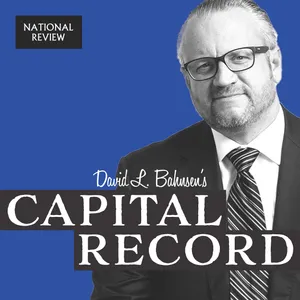
Free Daily Podcast Summary
Capital Record: Daily Summaries Delivered
by National Review
American prosperity was built on a foundation of free markets and free people. But, with inflation on the rise and a struggling market, many in America’s political class are attempting to recycle failed socialist ideas and calling for government intervention in nearly every aspect of American life. In this National Review Capital Matters podcast, financier David Bahnsen hosts interviews with the nation’s top business leaders, entrepreneurs, and financial commentators. Guests such as Larry Kudlow, Steve Forbes, and Art Laffer present a practical and moral vindication of America’s capitalist way of life.
Latest Episodes
The most recent episodes — sign up to get AI-powered summaries of each one.
- 2 days ago20 min
Episode 326: The American Dream, Human Flourishing, and The Bahnsen Group
Those who hate the financial sector and demonize the activity of capital markets will never understand that beneath it all is the story of the human spirit. Dealing with the aspirations embedded in financial markets has to be avoided, because it gets in the way of their narrative of grievance and victimhood. On today’s Capital Record, David has a highly personal story to tell that gets to the essence of all of this. Hosted by Simplecast, an AdsWizz company. See pcm.adswizz.com for information about our collection and use of personal data for advertising.
- 4 days ago12 min
Episode 325: Being Trained to Be an Entrepreneur... by the Government??
The United States federal government currently has an aggressive agenda, and it has now added to its portfolio… training workers in technology, energy, and defense. Several universities are creating the materials, and the government is organizing the national training program known as the Foundry School. Is this the retraining and investment in work-and-business dynamism we have been waiting for, or is it another government overreach where inexperienced bureaucrats are way out of their lane, feeling good about saying the right things? A balanced and nuanced discussion in today’s Capital Record. Hosted by Simplecast, an AdsWizz company. See pcm.adswizz.com for information about our collection and use of personal data for advertising.
- 1 weeks ago17 min
Episode 324: A Choice, Not a Socialist Echo
We are living in a period when the greatest political opportunity I have ever seen for either party is being squandered. For the Democrats, it is understandable. For the Republicans, it is unforgivable. In today’s Capital Record, David looks at this current moment, where true conservatives have a chance to present an actual contrast – a choice – to the left-wing socialist nonsense of our day. Hosted by Simplecast, an AdsWizz company. See pcm.adswizz.com for information about our collection and use of personal data for advertising.
- 1 weeks ago13 min
Episode 323: No One is a Libertarian Now
One of the craziest things that has worked its way into the folklore of our age is that the new-found appreciation for a heavy role of government in our personal and economic lives is replacing what was previously this broad moment of “libertarianism,” wherein society ran off of a very limited role of government in matters of economic regulation. Not only did I miss the memo on when that period was to have taken place, but today, some of yesterday’s loudest proponents of a small government are actually screaming for the government to tell you what you can eat. My, how the tea party has fallen. Come tread on me, in today’s Capital Record. Hosted by Simplecast, an AdsWizz company. See pcm.adswizz.com for information about our collection and use of personal data for advertising.
- 2 weeks ago14 min
Episode 322: AI Is Slowing Down to Find Itself
The internet and social media were aghast over the weekend as Anthropic founder and CEO Dario Amodei penned a “Jerry Maguire” screed about the AI labs “slowing down” due to the risks of “losing control” and giving way to “bioterrorism” and “serious economic disruption” … Other AI lab heads from Sam Altman to Elon Musk chimed in with agreement. You may read his letter as a call for prudent, selfless moderation, or you may read his call as rent-seeking, cronyist, "pull the ladder up" corporatism at its worst. Today, we will unpack it all.Show Notes:Dario Amodei's LetterDavid Sacks' Response Hosted by Simplecast, an AdsWizz company. See pcm.adswizz.com for information about our collection and use of personal data for advertising.
- 3 weeks ago25 min
Episode 321: Subsidies for Child Care?
Vice President JD Vance and a few other folks on the right beat the drum this weekend for a new bill to pay married families with one stay-at-home spouse based on the number of kids they have. Some people on the right defend the bill as “pro-family.” Others on the right lambaste it for being “pro-welfare state.” Some claim it merely redirects funds already in circulation. Others claim it represents a new entitlement altogether and that the bill is a classic case of “right-wing dressing” on top of a “left-wing salad.” In today’s Capital Record, David calls a spade a spade – which is to say, he takes this awful anti-family, pro-welfare, statist idea to the woodshed. Hosted by Simplecast, an AdsWizz company. See pcm.adswizz.com for information about our collection and use of personal data for advertising.
- 3 weeks ago11 min
Episode 320: Gratitude for Higher Football Costs
A “consultant” was on TV last week in a panic over the cost of watching NFL games now, not to mention the utter horror of finding out which streaming network your game might be on. The greed and debauchery of “big football” are on full display as far as many are concerned, but one group stands out as not being concerned at all: those who actually watch the NFL. And there is something else being missed when people complain about the cost of watching the NFL, something even more obvious than the fact that NFL fans love it. Listen to today’s Capital Record for a test case in basic economics that even a punter could understand.Show Notes: Fox Business Video Clip Hosted by Simplecast, an AdsWizz company. See pcm.adswizz.com for information about our collection and use of personal data for advertising.
- Sep 1, 202616 min
Episode 319: Uncle Sam, The Oil Tycoon
It was announced over the weekend that the United States is taking a 35 percent stake in a private energy company connected to Venezuelan oil rights. Is this “U.S. government in private business” thing getting out of control, or is the United States government a natural business partner in the Venezuelan oil production market? In today’s Capital Record, David will unpack the good, bad, and ugly of this deal, and ask us if our first principles endorse these public-private partnerships, or if they should cause us concern. Hosted by Simplecast, an AdsWizz company. See pcm.adswizz.com for information about our collection and use of personal data for advertising.
Get Capital Record summaries in your inbox
Free AI-powered daily recaps. Key takeaways, quotes, and mentions — in a 5-minute read.
Get Free Summaries →Free forever for up to 3 podcasts. No credit card required.
You Might Also Like
Listeners also like.
Capitalisn't
Examines the flaws in modern capitalism and explores solutions to make it work better for society.

Rebel Capitalist News
Teaches wealth-building through investing, real estate, and economics amid government and central bank overreach.

Optimist Economy
Economists discuss U.S. economic challenges and practical solutions to improve outcomes for workers, retirees, and aspiring Americans.

Peak Prosperity
Explores economic, energy, environmental, and geopolitical systems to offer clarity beyond mainstream narratives.

The Editors
Political analysis and commentary from National Review editors on current events, policy, and American conservatism.
Charles Payne's Unstoppable Prosperity Podcast
A Wall Street expert shares decades of financial wisdom to help listeners start investing and build long-term prosperity.

American Potential
Stories of ordinary Americans driving change in their communities through grassroots action and policy advocacy.

Afford Anything | Get Smarter With Money
A weekly discussion on financial freedom covering psychology, income, investing, real estate, and entrepreneurship with experts.

The Ezra Klein Show
Conversations on pressing political, social, and cultural issues with experts and thinkers.
Money And Wealth With John Hope Bryant
Offers financial education and wealth-building strategies with a focus on economic empowerment in the Black community.

Know Your Risk Podcast
A financial podcast exploring investment risk, portfolio strategies, and market insights beyond traditional Wall Street approaches.

The Paul Morris Podcast
Entrepreneurs and investors share strategies for building wealth, scaling businesses, and leading high-performance teams.
About Capital Record
American prosperity was built on a foundation of free markets and free people. But, with inflation on the rise and a struggling market, many in America’s political class are attempting to recycle failed socialist ideas and calling for government intervention in nearly every aspect of American life. In this National Review Capital Matters podcast, financier David Bahnsen hosts interviews with the nation’s top business leaders, entrepreneurs, and financial commentators. Guests such as Larry Kudlow, Steve Forbes, and Art Laffer present a practical and moral vindication of America’s capitalist way of life.
Customized Recaps
AI-powered recaps with compact key takeaways, quotes, and insights.
Straight to Your Inbox
Get key takeaways from Capital Record in a 5-minute read.
Save Hours Every Week
Stay current on your favorite podcasts without falling behind.
Frequently Asked Questions
What is Podzilla's Capital Record daily summary?
It's a free AI-powered email that summarizes new episodes of Capital Record as soon as they're published. You get the key takeaways, notable quotes, and links & mentions — all in a quick read.
How does the Capital Record podcast summary work?
When a new episode drops, our AI transcribes and analyzes it, then generates a personalized summary tailored to your interests and profession. It's delivered to your inbox every morning.
Is this an official Capital Record product?
No. Podzilla is an independent service that summarizes publicly available podcast content. We're not affiliated with or endorsed by National Review.
Can I get summaries of other podcasts too?
Absolutely! The free plan covers up to 3 podcasts. Upgrade to Pro for 15, or Premium for 50. Browse our full catalog at /podcasts.
How often does Capital Record release new episodes?
Capital Record publishes weekly. Our AI generates a summary within hours of each new episode.
What topics does Capital Record cover?
Capital Record covers topics including News, Business, Politics. Our AI identifies the specific themes in each episode and highlights what matters most to you.
Start getting Capital Record summaries tomorrow morning.
Free forever for up to 3 podcasts. No credit card required.
Free forever for up to 3 podcasts. No credit card required.