Free Daily Podcast Summary
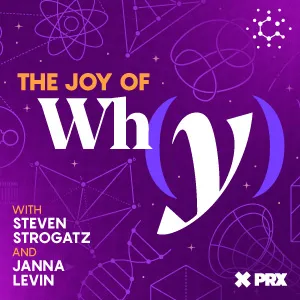
The Joy of Why: Daily Summaries Delivered
by Steven Strogatz, Janna Levin and Quanta Magazine
The mathematician and author Steven Strogatz and the astrophysicist and author Janna Levin interview leading researchers about the great scientific and mathematical questions of our time.
Latest Episodes
The most recent episodes — sign up to get AI-powered summaries of each one.
- 1 weeks ago53 min
What Does the Fourth Dimension Actually Look Like?
We know all about how things exist in the three dimensions of length, width, and height. Physicists often talk about time as a fourth dimension, but what if there were a fourth spatial dimension — another direction entirely? How on earth would we picture that? Mathematicians use topology to visualize abstract spaces in higher dimensions. Maggie Miller at the University of Texas at Austin explores what happens when knots encounter an extra dimension. Familiar tangled loops behave in unexpectedly complex and counterintuitive ways in 4D: Knots can always come undone, while ordinary surfaces like spheres can — surprisingly — become knotted in ways that can’t be undone. In this episode, Miller explains to co-host Janna Levin why 4D is the lowest dimension that mathematicians still don’t fully understand, how she and her collaborators resolved a question about knotted surfaces first posed by mathematician Charles Livingston in 1982, and how her interest in art has helped her develop the visual techniques she uses to picture 4D spaces.
- 3 weeks ago47 min
Where Does the Quantum World End and Ours Begin?
Quantum mechanics may be one of the most precisely tested paradigms in science, but there’s still no universally accepted interpretation of what it tells us about reality. How do we get from the wave-like behavior of quantum systems to the solid, macroscopic world of objects and the universe at large? Jonathan Halliwell, a professor of theoretical physics at Imperial College London, has spent his career probing the foundations of quantum theory. In this episode, he tells Steven Strogatz why decoherence — the process by which fragile quantum behavior becomes dispersed through interactions with the surrounding environment — is key to the transition from quantum to classical behavior, and he describes the “histories” approach that he uses to understand this. Along the way, Halliwell tackles some of the field’s deepest paradoxes. He explains why the quantum-to-classical transition doesn’t require a conscious observer, and he explores Einstein’s famous question of whether the moon is really there when no one looks. The conversation ends with Halliwell explaining how yoga and meditation help him sit with the mystery of competing perspectives in science.
- Sep 3, 202653 min
Live from ICM 2026: What Is Math For in the Age of AI?
Mathematicians are witnessing a profound shift in their field. AI systems are now producing proofs, spotting connections between distant fields, and, in a few cases, solving problems that had stumped mathematicians for decades. The pace of progress over the past several months has raised challenging questions: What can AI systems actually do? And what happens to the more human, creative aspects of the field once machines can match – or exceed – people at problem-solving? In this special live episode of The Joy of Why, recorded at the International Congress of Mathematicians in Philadelphia on July 26, 2026, hosts Janna Levin and Steven Strogatz are joined by three mathematicians responding to the rise of AI in math: Akshay Venkatesh at the Institute for Advanced Study; Ravi Vakil at Stanford University and president of the American Mathematical Society; and Alex Kontorovich at Rutgers University. Together they discuss what recent AI-generated proofs really demonstrate, what will be gained and lost as mathematics becomes more machine-assisted at the frontier, and what this means for the next generation of mathematicians. The conversation turns to a deeper question: What do mathematicians value about doing mathematics in the first place? The answer involves grappling with what proof and understanding really mean, and with the surprising importance of storytelling.
- Aug 20, 202652 min
Are We Thinking Correctly about AI Intelligence?
When an LLM answers a question, is it reasoning like humans, or just producing text that looks like reasoning? The distinction isn’t just philosophical, this determines what we can trust AI to do, how closely we need to supervise it, and ultimately what its real-world impact will turn out to be. Melanie Mitchell at the Santa Fe Institute argues that we lack adequate methods for measuring machine cognition, and that AI is a form of “alien intelligence” that operates through non-human cognitive mechanisms. In this episode of The Joy of Why, Mitchell tells Steven Strogatz how methods that psychologists use to study cognition in other kinds of “alien intelligence” — babies and animals — can be adapted to probe AI, and she lays out six principles for better assessing machine cognition. Their conversation ranges from the challenge of interpreting what’s happening inside these systems, to recent AI-assisted breakthroughs in mathematics, to why a math-performing horse from the early 1900s offers a cautionary tale for how we assess intelligence.
- Aug 6, 202655 min
How does touch lead to pain or pleasure?
Pain and pleasure seem like simple facts of life, but they are far from it. Neuroscientists still cannot say why physical pain differs from psychological pain, for instance, nor why a loved one’s touch soothes while a stranger’s touch repels. To explore the science behind these sensations, Janna Levin talked to Ishmail Abdus-Saboor, a neuroscientist at Columbia University’s Zuckerman Institute. Their conversation covers how pain serves an evolutionary purpose, how researchers measure pain and pleasure in the lab despite the absence of any objective biomarker, and how touch functions as a social and emotional signal, not just a sensory one. Abdus-Saboor also describes his work with naked mole rats — a species that barely feels pain, shows no signs of aging, and lives in colonies built almost entirely on touch — and the ethical trade-offs when studying sensations in animals that cannot describe what they feel.
- Jul 23, 20261h 4m
How Fast Is the Universe Really Expanding?
One of the biggest mysteries in cosmology seems to keep getting bigger. Astronomers have known since the 1930s that the universe is expanding, but in the 1990s, the discovery that this expansion is accelerating rather than slowing down came as a huge shock to the field. Something had to be driving that acceleration, and dark energy was proposed as the cause. What began as a seismic shock in cosmology eventually led to a Nobel prize. But this story has a sequel, and it comes with another major plot twist. The two main methods for estimating the universe’s present-day expansion rate are producing significantly different answers. As a result, how fast the universe is really expanding has become a matter of considerable debate — with no small amount of angst — and the discrepancy has become known as the Hubble tension. Perhaps most surprising of all is that one of the loudest voices raising concern is Adam Riess, the astrophysicist whose Nobel Prize-winning work helped ignite the acceleration debate in the first place. Riess joined co-host Steven Strogatz on The Joy of Why to explain how we got to this point, what the Hubble tension might be telling us, and what may happen next.
- Jul 9, 202653 min
Will We Ever Find Alien Civilizations?
Does intelligent life exist elsewhere in the universe? The question has captivated us for centuries, but despite decades of searching it remains frustratingly unanswered. Every so often a curious signal appears — fossilized structures in a meteorite, say, or an unusual gas in an exoplanet’s atmosphere — and for a moment it seems possible that we are not alone before the excitement gives way to a more mundane explanation. So what would it actually take to find life in the cosmos — and how would we know when we saw it? David Kipping, an astronomer at Columbia University, has spent his career finding better ways to answer these questions. His approach is statistical: rather than chasing individual detections, he develops mathematical frameworks for reasoning about where habitable worlds are likely to exist and how confidently we can interpret the signals they produce. In this episode of The Joy of Why, Kipping joins co-host Janna Levin to discuss efforts to frame one of humanity’s oldest existential questions as a tractable scientific problem, why biosignatures have proved so difficult to interpret, and why he believes exomoons may be an overlooked place to search for life.
- Jun 25, 202651 min
What Is the Positive Grassmannian and Why Does It Show Up Everywhere?
What links certain mathematical models of traffic flow, shallow-water waves, and quantum particle scattering? The surprising answer lies in a corner of the algebraic combinatorics world that goes by the name of positive Grassmannian. In simple terms, the positive Grassmannian is a shape that classifies other shapes. Remarkably, pieces of the positive Grassmannian can be reassembled in forms that reveal shared structures in these and many other seemingly unrelated mathematical systems. That we know the positive Grassmannian crops up in many real-world settings is largely down to the theoretical work of Lauren Williams at Harvard University. In this latest episode of The Joy of Why, Williams talks to co-host Steven Strogatz about her work, how she realized the surprising pervasiveness of the positive Grassmannian, and how she has made a career of finding connections among fields that don’t at first sight seem connected. The conversation then switches to another project Williams is working on, called First Proof, which is trying to measure objectively how good AI systems are at coming up with proofs of research-level mathematical statements, and which leads to an exploration of whether AI may or may not take over mathematics. Note: Since this conversation was recorded, results from the First Proof, Second Batch project were released on June 10 2026.
Get The Joy of Why summaries in your inbox
Free AI-powered daily recaps. Key takeaways, quotes, and mentions — in a 5-minute read.
Get Free Summaries →Free forever for up to 3 podcasts. No credit card required.
You Might Also Like
Listeners also like.

The Joy of x
A mathematician explores the lives and ideas of leading scientists through in-depth conversations.

The Quanta Podcast
A weekly discussion on groundbreaking science and math stories with Quanta's editorial team.

The Rest Is Science
Hannah Fry and Michael Stevens explore the strange and overlooked questions at the boundary of scientific understanding.

Inquiring Minds
Explores the intersection of science and society through critical thinking and in-depth analysis.
Math & Physics Podcast
Two University of Toronto students discuss topics in math and physics.

COMPLEXITY
Santa Fe Institute

Sean Carroll's Mindscape: Science, Society, Philosophy, Culture, Arts, and Ideas
Conversations with leading thinkers exploring fundamental ideas in science, philosophy, culture, and the arts.

My Favorite Theorem
A mathematician discusses their favorite theorem and what they enjoy pairing with it.

Relatively Prime: Stories from the Mathematical Domain
A podcast featuring stories from the world of mathematics.
Inner Cosmos with David Eagleman
Neuroscientist David Eagleman examines how the brain interprets reality through science, stories, and interviews.

The World, the Universe and Us
Explores big scientific questions about life, consciousness, climate, and the cosmos with expert scientists and New Scientist journalists.

From First Principles
Breaks down major science stories weekly, explaining the mechanics behind physics, space, AI, and biotech developments.
About The Joy of Why
The mathematician and author Steven Strogatz and the astrophysicist and author Janna Levin interview leading researchers about the great scientific and mathematical questions of our time.
Customized Recaps
AI-powered recaps with compact key takeaways, quotes, and insights.
Straight to Your Inbox
Get key takeaways from The Joy of Why in a 5-minute read.
Save Hours Every Week
Stay current on your favorite podcasts without falling behind.
Frequently Asked Questions
What is Podzilla's The Joy of Why daily summary?
It's a free AI-powered email that summarizes new episodes of The Joy of Why as soon as they're published. You get the key takeaways, notable quotes, and links & mentions — all in a quick read.
How does the The Joy of Why podcast summary work?
When a new episode drops, our AI transcribes and analyzes it, then generates a personalized summary tailored to your interests and profession. It's delivered to your inbox every morning.
Is this an official The Joy of Why product?
No. Podzilla is an independent service that summarizes publicly available podcast content. We're not affiliated with or endorsed by Steven Strogatz, Janna Levin and Quanta Magazine.
Can I get summaries of other podcasts too?
Absolutely! The free plan covers up to 3 podcasts. Upgrade to Pro for 15, or Premium for 50. Browse our full catalog at /podcasts.
How often does The Joy of Why release new episodes?
The Joy of Why publishes biweekly. Our AI generates a summary within hours of each new episode.
What topics does The Joy of Why cover?
The Joy of Why covers topics including Science, Life Sciences. Our AI identifies the specific themes in each episode and highlights what matters most to you.
Start getting The Joy of Why summaries tomorrow morning.
Free forever for up to 3 podcasts. No credit card required.
Free forever for up to 3 podcasts. No credit card required.