Free Daily Podcast Summary
The New Thinkery: Daily Summaries Delivered
by The New Thinkery
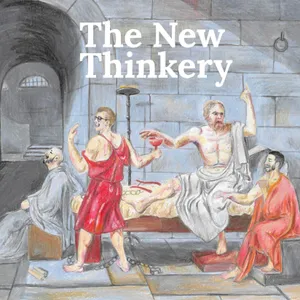
The New Thinkery is a podcast devoted to political philosophy and its history, along with its many guises in literature, film, and human experience generally. Named after Socrates' infamous "Thinkery" in Aristophanes' Clouds, The New Thinkery strikes a balance between the seriousness of academia and the playfulness of casual conversation among friends.
Latest Episodes
The most recent episodes — sign up to get AI-powered summaries of each one.
- Mar 31, 20261h 11m
Panel: David Bolotin's On Plato's Republic: The 1988 Lecture Notes
In this episode, Alex takes the mic on the road, hosting a special panel on the late David Bolotin and the recently released volume On Plato's Republic: The 1988 Lecture Notes, which preserves Bolotin's notes and was coedited by Alex and Paul Diduch. Joined by Louis Slawsky, Nasser Behnegar, Peter J. Hansen, Paul Ulrich, Joshua Parens, Paul Diduch, and Travis Mulroy, the group reflect above all on Bolotin himself: his presence in the classroom, his precision as a reader, and the lasting impression he made as a teacher. The book gives the panel its occasion, but Bolotin remains its real subject.
- Feb 10, 20261h 39m
Eric Buzzetti & Devin Stauffer on Christopher Bruell: Essays of Five Decades on Philosophy and Philosophers
The guys have emerged from an eight-month slumber to sit down with Eric Buzzetti and Devin Stauffer to talk about their teacher Christopher Bruell and the newly edited collection Christopher Bruell: Essays of Five Decades on Philosophy and Philosophers. They recount what it was like to study with Bruell at Boston College, why his writing is equal parts illuminating and elusive, and how his work presses readers back toward tough questions of philosophy. Along the way, they discuss Bruell's relationship to Strauss, his long engagement with Plato, Xenophon, Aristotle, and the moderns, as well as why he resisted easy slogans about nature, happiness, and the philosophical life. If serious reading and soul-forming education are your thing, buckle up for this 99-minute marathon.
- Jun 25, 20259 min
Summer Break at The New Thinkery
Since launching in July 2020, The New Thinkery hasn't taken an extended break—but after nearly five years of weekly episodes, the guys are finally taking a much needed summer pause. The show will return with fresh conversations on political philosophy, literature, film, and more on September 3, 2025, with high-caliber guests on the horizon. In the meantime, revisit your favorite episodes, catch up on ones you may have missed, and spread the word. See you in September, and thank you all for listening in for the past few years!
- Jun 18, 20251h 17m
Joshua Parens on Maimonides' Guide of the Perplexed
Josh Parens joins Alex and Greg to discuss his recently released book, Maimonides's Guide on Obstacles to Knowledge, Being, and Action. Parens elaborates on a bold interpretation of Maimonides's Guide of the Perplexed that highlights how the philosopher uses "obstacles" to structure his defense of law, prophecy, and providence. This episode delves into Parens' middle-ground reading, reframing skeptical and dogmatic extremes as intentionally vague limits that safeguard both revelation and philosophical reason.
- Jun 11, 20251h 6m
Richard Polt on Heidegger' Origin of the Work of Art
This week, a full complement of the guys are back, and are joined by Professor Richard Polt for a deep dive into Heidegger's The Origin of the Work of Art. Together, they unpack Heidegger's claims about truth, being, and the unique role art plays in revealing the world. The episode offers an accessible entry point into one of Heidegger's most challenging—and strangely beautiful—essays. Plus: the virtues of... typewriters?
- Jun 4, 202558 min
Robert Wyllie on Alasdair MacIntyre
Greg welcomes Prof. Rob Wyllie back to the show for a thoughtful conversation on the philosophical legacy of Alasdair MacIntyre. Ranging across MacIntyre's major works—from After Virtue to his reflections on tradition, ethics, and rationality—they consider his influence on contemporary moral philosophy and make an attempt at placing his thoughts intellectually. Recommended reading: Alasdair MacIntyre, R.I.P. Ethics in the Conflicts of Modernity: An Essay on Desire, Practical Reasoning, and Narrative
- May 28, 20251h 3m
Joseph Conrad's Heart of Darkness
Joseph Conrad's Heart of Darkness offers more than a critique of empire—it's a meditation on the slipperiness of truth, the fragmentation of self, and the unsettling possibility that meaning is just another European export gone missing. This episode peers into the novella's narrative hall of mirrors, examining its existential fog, moral vertigo, and the peculiar power of a story that both reveals and withholds in the same breath.
- May 21, 202546 min
Ray Bradbury's The Veldt
Imagine a Jetsons-esque home that attempts to meet all of your needs while also featuring a room that makes your imagination into reality. Add some behaviorally troubled children imagining bloodthirsty lions into the mix, and you have the setup for Ray Bradbury's The Veldt. In a dystopian tale that would make an excellent episode of Black Mirror, Bradbury explores the pitfalls of tech that robs humanity of purpose. The guys discuss and analyze the story's plot, characters, and more in this week's rerelease.
Get The New Thinkery summaries in your inbox
Free AI-powered daily recaps. Key takeaways, quotes, and mentions — in a 5-minute read.
Get Free Summaries →Free forever for up to 3 podcasts. No credit card required.
You Might Also Like
Listeners also like.
Philosophize This!
Explores the history of philosophy by breaking down key thinkers and ideas in chronological order for a general audience.
In Our Time: Philosophy
Discusses philosophers, theories, and key themes in philosophy, from altruism to Wittgenstein.

The UnMute Podcast
Philosophers discuss current social and political issues with insight, humor, and a drive for change.
Political Theory 101
A podcast that explores foundational ideas and thinkers in political theory.

Hi-Phi Nation
Philosophy is explored through real-life stories and expert insights on topics like justice, morality, and existence.

Theories of Everything with Curt Jaimungal
A deep, rigorous exploration of theories uniting physics, consciousness, AI, and metaphysics through analytical and unconventional thinking.

TheThinkingAtheist
A former Christian examines atheism and skepticism through calm, reasoned discussions on religion and belief.

The Grimerica Show
Casual conversations with fringe thinkers on spirituality, alternative history, and UFOs.

Forum Borealis
In-depth interviews with authors and thinkers on unconventional topics in history, science, philosophy, and politics.

To The Best Of Our Knowledge
Explores big ideas through conversations with thinkers and creators across science, arts, and humanities.
Free Thinking
Philosophers, historians, and critics explore current events through the lens of history, culture, and ideas.
Conversations with Tyler
Discussions with intellectuals and experts on ideas, culture, and global issues.
About The New Thinkery
The New Thinkery is a podcast devoted to political philosophy and its history, along with its many guises in literature, film, and human experience generally. Named after Socrates' infamous "Thinkery" in Aristophanes' Clouds, The New Thinkery strikes a balance between the seriousness of academia and the playfulness of casual conversation among friends.
Customized Recaps
AI-powered recaps with compact key takeaways, quotes, and insights.
Straight to Your Inbox
Get key takeaways from The New Thinkery in a 5-minute read.
Save Hours Every Week
Stay current on your favorite podcasts without falling behind.
Frequently Asked Questions
What is Podzilla's The New Thinkery daily summary?
It's a free AI-powered email that summarizes new episodes of The New Thinkery as soon as they're published. You get the key takeaways, notable quotes, and links & mentions — all in a quick read.
How does the The New Thinkery podcast summary work?
When a new episode drops, our AI transcribes and analyzes it, then generates a personalized summary tailored to your interests and profession. It's delivered to your inbox every morning.
Is this an official The New Thinkery product?
No. Podzilla is an independent service that summarizes publicly available podcast content. We're not affiliated with or endorsed by The New Thinkery.
Can I get summaries of other podcasts too?
Absolutely! The free plan covers up to 3 podcasts. Upgrade to Pro for 15, or Premium for 50. Browse our full catalog at /podcasts.
How often does The New Thinkery release new episodes?
The New Thinkery publishes weekly. Our AI generates a summary within hours of each new episode.
What topics does The New Thinkery cover?
The New Thinkery covers topics including Philosophy, Culture, Society & Culture. Our AI identifies the specific themes in each episode and highlights what matters most to you.
Start getting The New Thinkery summaries tomorrow morning.
Free forever for up to 3 podcasts. No credit card required.
Free forever for up to 3 podcasts. No credit card required.